Spices · Profile
Anardana: Dried Pomegranate Seeds as a Souring Spice
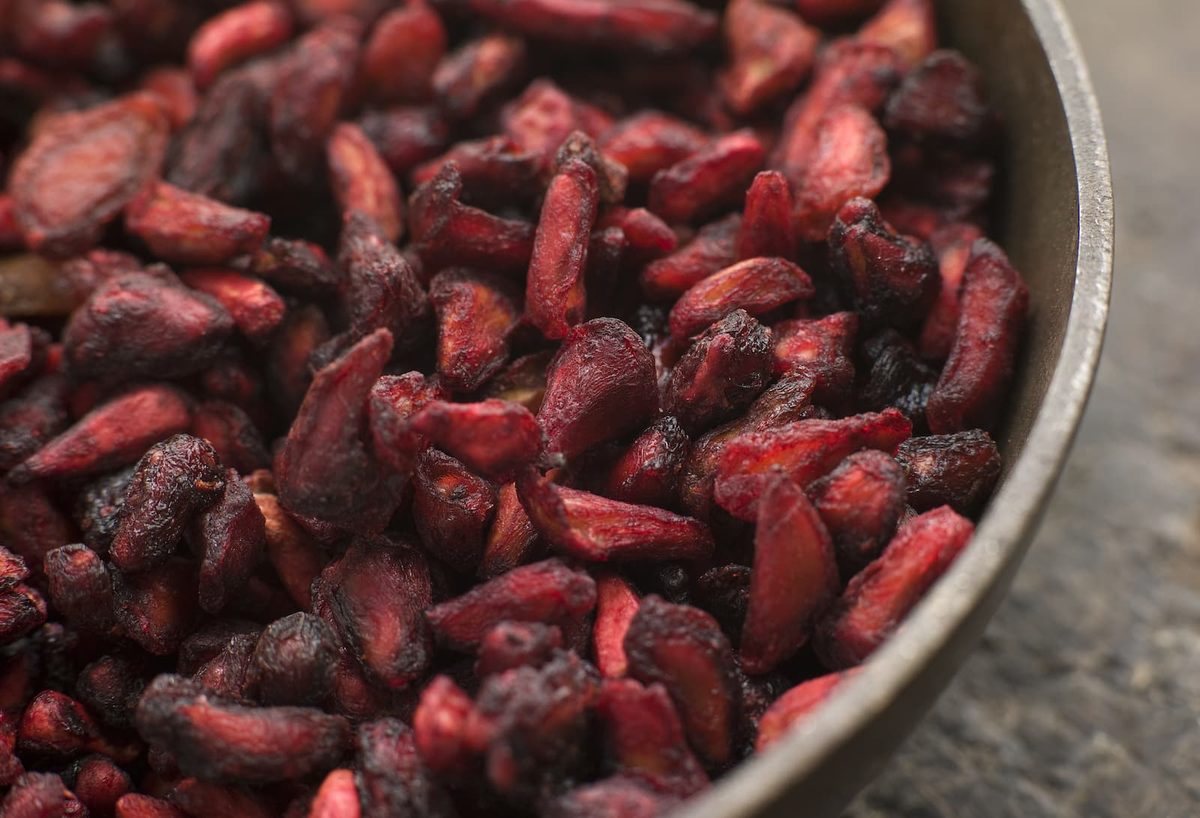
Anardana is a souring ingredient made by drying pomegranate seeds with their juicy pulp still on them. In Indian cooking it does the job that lemon, amchur or tamarind might do in another dish: it brings acidity, with a dark, fruity edge. This page covers what it is made from, what researchers have measured, how it is used, and how it is dried, bought and stored.
At a glance
| Source plant | Punica granatum L., the pomegranate1 |
| Plant family | Lythraceae12 |
| Part used | The seeds with their pulp (arils), sun-dried or machine-dried34 |
| Traditional raw material | Wild pomegranate, called daru, from Himalayan hill slopes35 |
| Native range of the species | Northeastern Türkiye to western and northern Pakistan (Kew); Iran and neighboring countries (Britannica)12 |
| Titratable acidity of the wild fruit | 3.20–6.80%, depending on the study (see below)35 |
| Forms sold | Whole dried seeds and ground powder |
| Production figures | No published figure found |
Measured values
5 figures, sourced| Measure | Value | Scope | Source |
|---|---|---|---|
| Titratable acidity | 5.26–6.80 % | daru (wild pomegranate) collections from Doda district, Jammu (Bakshi et al., 2014); fruitSources differ; different samples and years, not merged | journal.iahs.org.in |
| Titratable acidity | 5.53 % | wild pomegranate fruit (Parmar and Kaushal, 1982, as tabulated in a 2018 review)Sources differ | phytojournal.com |
| Titratable acidity | 6.68 % | wild pomegranate fruit (Singh and Kingsley, 2008, as tabulated in a 2018 review)Sources differ | phytojournal.com |
| Titratable acidity | 3.20–3.65 % | wild pomegranate fruit (Thakur et al., 2011, as tabulated in a 2018 review)Sources differ | phytojournal.com |
| Titratable acidity | 1.59 % | anardana at the start of storage in aluminum laminated pouches (Dak et al., 2014, as cited by Kaute et al.) | phytojournal.com |
Each figure is quoted as its source states it, with the samples or standard it applies to. Where sources differ, both are shown; nothing is averaged. All measured values
What anardana is
Anardana is made from the seeds of the pomegranate, which Kew and Britannica both place in the family Lythraceae.12 Each seed sits inside a translucent sac of reddish, juicy pulp, the aril.2 To make anardana, the seeds are dried with that pulp attached. A study of wild pomegranate in Jammu describes it plainly: the sun-dried seeds with pulp make up the condiment anardana.3
The traditional raw material is not the large, sweet pomegranate sold in supermarkets but the small, sour wild fruit of the Himalayan foothills. Indian horticulture researchers describe wild pomegranate, known locally as daru, growing scattered on the hill slopes of Jammu and Kashmir and widely on the hilly slopes of Himachal Pradesh.36 A 2018 review places it on dry, marginal land in the outer Himalaya at about 900 to 1,800 m above sea level.5 The Himachal Pradesh study credits the wild fruit with a higher acid content, along with other quality traits that suit it to anardana.6 Anardana can also be made from cultivated lines: one 2018 study screened promising pomegranate selections for the purpose.4
Where the pomegranate comes from
Sources describe the native range differently. Kew’s Plants of the World Online gives it as northeastern Türkiye to western and northern Pakistan, and does not list India among the native areas.1 Britannica says the pomegranate is considered indigenous to Iran and neighboring countries, and that its cultivation long ago spread around the Mediterranean.2 The Indian literature cited above treats Himalayan daru as wild.35 Whether those stands are native or very old escapes from cultivation is not something the sources we read settle.
Kew records the species as introduced in Spain, Italy, France, central Mexico and California, among many other places.1 The English word comes through Old French from Medieval Latin pomum granatum, “apple with many seeds”.7 The Spanish city of Granada is said to take its name from Latin granatum, though the etymology is not certain.7
Flavor and acidity
Anardana tastes sharply sour and fruity, with some astringency and a faint sweetness; the dried seeds also add crunch if left whole. That description is ours.
The sourness has been measured. A 2018 study notes that the arils of wild pomegranate are a rich source of organic acids.4 Titratable acidity, the usual lab measure of sourness, has been reported as follows. These come from different samples and years and should not be merged into one figure.
| Scope | Titratable acidity | Source |
|---|---|---|
| Daru collections from Doda district, Jammu (Bakshi et al., 2014) | 5.26–6.80% | 3 |
| Wild pomegranate fruit (Parmar and Kaushal, 1982, as tabulated in a 2018 review) | 5.53% | 5 |
| Wild pomegranate fruit (Singh and Kingsley, 2008, as tabulated in the same review) | 6.68% | 5 |
| Wild pomegranate fruit (Thakur et al., 2011, as tabulated in the same review) | 3.20–3.65% | 5 |
| Anardana at the start of storage in aluminum laminated pouches (Dak et al., 2014, as cited by Kaute et al.) | 1.59% | 4 |
The last three rows come from secondary tabulations; the original papers were not opened for this page.
How anardana is used
The 2018 review describes anardana as an acidulant in many Asian cuisines and in curries.5 By common practice, it is used in North Indian chickpea dishes, stuffed breads and fritters, and in chutneys, usually ground and added to the dish for sourness. Whole seeds can be toasted lightly and ground just before use. These uses and techniques are kitchen practice rather than findings from the sources above.
For other souring spices, see mango powder (amchur) and sumac.
How it is made, and what good anardana looks like
The traditional method is sun-drying. In Jammu, drying usually takes 10 to 15 days, until the seeds turn reddish brown.3 Researchers have tested faster methods: one study dried arils in a cabinet dryer at 60 °C for 8 hours,4 and a Himachal Pradesh thesis found that anardana from a mechanical cabinet dryer and from a solar tunnel dryer was of comparable quality.6
Timing matters too. The same thesis found the best anardana came from fruit harvested about 134 to 140 days after full bloom, depending on location,6 and a 2023 follow-up study found good anardana could still be made from wild fruit stored for up to 20 days before processing.8
No grading standard for anardana from a regulator or standards body was found. As a shopper’s guide (our judgment, not a standard): look for seeds that are deep red to dark maroon, slightly sticky, and clearly sour when tasted, and avoid dull brown, dusty-looking packs.
Storage
The Himachal Pradesh thesis found anardana kept its quality better under refrigeration in vacuum-sealed aluminum laminated pouches, and that solar-dried anardana changed faster in storage than cabinet-dried.6 We found no published shelf-life figure for anardana stored at home. A cool, dark, airtight container is the sensible default, and a seed that has lost its sourness has faded.
Health and safety
NCCIH has no page on anardana itself. Its page on pomegranate, which covers mainly juice and extracts rather than dried seeds, says studies show pomegranate may lower blood glucose to a small extent, that juice or extract may help reduce blood pressure though more research is needed, and that no clear effects on cholesterol have been shown.9 It describes pomegranate juice as believed to be safe and notes that allergic reactions to pomegranate have been reported.9 Its caution about large amounts applies to the root, stem and peel, not the seeds.9 This page makes no claim that anardana treats or prevents any condition.
Substitutes and related pages
Amchur and sumac are the closest pantry stand-ins for sourness, and pomegranate molasses works where a liquid is acceptable. No source we found gives a tested swap ratio. See anardana substitutes for the full list.
Footnotes
-
Punica granatum L., Plants of the World Online, Royal Botanic Gardens, Kew. powo.science.kew.org · Reference work ↩ ↩2 ↩3 ↩4 ↩5 ↩6
-
“Pomegranate”, Encyclopaedia Britannica. britannica.com · Reference work ↩ ↩2 ↩3 ↩4 ↩5
-
Bakshi et al., “Studies on variability in physico-chemical traits and multiplication of Daru (wild pomegranate) collections”, Indian Journal of Horticulture, 2014. journal.iahs.org.in · Peer-reviewed ↩ ↩2 ↩3 ↩4 ↩5 ↩6 ↩7 ↩8
-
Kaute et al., “Evaluation of promising lines of pomegranate for preparation of anardana”, Journal of Pharmacognosy and Phytochemistry, 2018. phytojournal.com · Peer-reviewed ↩ ↩2 ↩3 ↩4 ↩5
-
Sharma and Thakur, “Wild pomegranate (Punica granatum L.): A review on physical and chemical attributes of himalayan wild pomegranate fruit”, Journal of Pharmacognosy and Phytochemistry, 2018. phytojournal.com · Peer-reviewed ↩ ↩2 ↩3 ↩4 ↩5 ↩6 ↩7 ↩8
-
“Evaluation of Wild Pomegranate for the Development of Anardana in Himachal Pradesh”, doctoral thesis, Dr YS Parmar University of Horticulture and Forestry, 2018. krishikosh.egranth.ac.in · Peer-reviewed ↩ ↩2 ↩3 ↩4 ↩5
-
“pomegranate (n.)”, Online Etymology Dictionary. etymonline.com · Reference work ↩ ↩2
-
Thakur et al., “The Quality Characteristics of Dried Arils (Anardana) Prepared From Wild Pomegranate”, Bangladesh Journal of Botany, 2023. banglajol.info · Peer-reviewed ↩
-
“Pomegranate”, National Center for Complementary and Integrative Health, 2025. nccih.nih.gov · Regulator ↩ ↩2 ↩3