Seasonings · Profile
Garam Masala: What’s in It, How It Varies by Region, and How to Use It
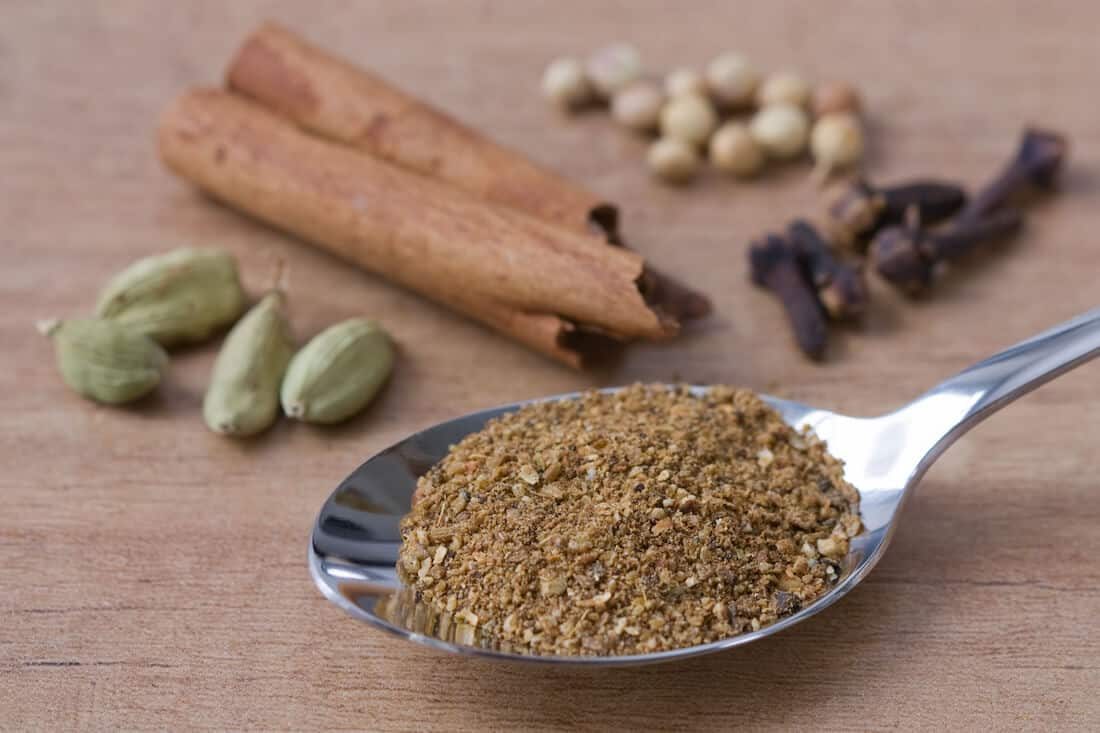
Garam masala is a ground blend of warm spices used across the Indian subcontinent, built most often on cardamom, cinnamon and cloves. There is no single recipe: the spices change from region to region and from cook to cook, and so does the way the blend is made. This page covers what typically goes into it, how regional versions differ, the compounds behind its aroma, how cooks use it, and how to buy and store it.
At a glance
| What it is | A blend of ground spices; no single fixed recipe12 |
| Name | “Hot spices”; the heat refers to the spices’ warming reputation, not to chile12 |
| Typical components | Cloves, bay leaf, fennel, cinnamon, cardamom, cumin, coriander seed, mace, black and white pepper (Great British Chefs)1; cardamom, cinnamon and cloves at its most basic (Bong Eats, Bengali style)3 |
| Origin | Used across the Indian subcontinent1 |
| Forms sold | Ground blend; also made at home from whole spices |
| Toasted? | Sometimes: Great British Chefs toasts the spices; Madhur Jaffrey’s recipe in Saveur does not12 |
| Official standard | None found; the USDA spice-blend specification covers curry powder but not garam masala4 |
| Keeps | Up to 3 months (Saveur); within a few months, up to four (Great British Chefs)12 |
What is in it
Great British Chefs lists cloves, bay leaf, fennel, cinnamon, cardamom, cumin, coriander seeds, mace and black and white peppercorns as the spices commonly used, and notes that some cooks add chile, though the blend is not generally hot.1 Saveur puts the point about variety plainly: there are as many versions as there are home cooks in India.2
Three published recipes show how far apart they can be:
| Recipe | Spices | Toasted? | Source |
|---|---|---|---|
| Madhur Jaffrey, via Saveur | 1/4 cup cardamom seeds; 1 1/2 tsp each black cumin seeds, black peppercorns and cloves; 4 cinnamon sticks; 1 whole nutmeg | No | 2 |
| Bengali, via Bong Eats | 7 g cardamom, 2 g cloves, 2 g cinnamon | Yes, about 5 minutes dry-roasting | 3 |
| Great British Chefs | Common spices listed above, by taste | Yes, until fragrant | 1 |
Cardamom dominates the Jaffrey recipe by volume.2 The Bengali blend is the stripped-down form; Bong Eats says the versions used in most of northern and western India may also include coriander, cumin and mustard seeds.3
Regional versions
Gulf News food writer Karishma Nandkeolyar collected regional lists that show the range:5
| Region | Spices listed |
|---|---|
| Bengal | Cinnamon, green cardamom, cloves |
| Kashmir | Cumin, cardamom, cloves, cinnamon, coriander, black pepper, fennel, bay leaves |
| Tamil Nadu | Coriander, pepper, cumin, cloves, fennel, mace, star anise, cardamom, cinnamon, bay leaves |
| Kerala | Fennel, green cardamom, cloves, cinnamon, star anise, nutmeg, mace, bay leaves, black pepper |
She also notes that star anise is not part of the garam masala used in Hyderabad, where black cumin, cardamom, cloves and cinnamon carry the biryani.5 These are one writer’s lists, not a survey, but they agree with the other sources that the blend shifts with every state and every household.15 A widely repeated claim that some blends contain 32 or more spices could not be traced to any source.
Flavor and aroma
Garam masala smells sweet, warm and resinous, with cardamom and clove usually out front and pepper giving a mild bite at the back. That description is ours. The compounds behind it belong to the individual spices, measured in their essential oils:
| Spice | Key compound | What has been measured | Source |
|---|---|---|---|
| Cardamom | 1,8-cineole | Up to about 31% of the oil (0.24–30.62% across samples in one 2025 study) | 6 |
| Clove | Eugenol | About 85–92% of clove oil (review) | 7 |
| Cinnamon (Ceylon) | Cinnamaldehyde | About 49.9–62.8% of bark oil (systematic review) | 8 |
| Coriander seed | Linalool | 60–80% of the oil (review) | 9 |
| Cumin | Cuminaldehyde | 20–72% of the oil (range in the literature) | 10 |
| Black pepper | Piperine | The primary pungent alkaloid | 11 |
No published analysis of a garam masala blend’s aroma as a whole was found, so how these compounds interact in the mix is not measured. Because recipes differ so much, a blend heavy in cardamom and a blend heavy in cumin and coriander will taste quite different.
Name and history
“Garam” means hot. Saveur explains that the name refers to the combination of spices, which Ayurvedic medicine considers warming to the body.2 Great British Chefs gives the translation as “hot spices.”1 Neither is a claim about chile heat.
Claims that garam masala originated in northern India, or was first used to warm people through cold winters, could not be traced to any source. Nor could the claim that it is meant to balance all six tastes of Ayurveda.
How garam masala is used
Great British Chefs describes two moments for it: early, in marinades, sauces, rubs and the flavor base of a dish, and at the end, as a finish for a soup, dal or dip.1 Bong Eats uses the Bengali blend to flavor egg, chicken, mutton and beef curries, and sprinkles it with ghee over vegetarian dishes such as ghonto, dalna and khichuri; a pinch with a little ghee also revives day-old vegetables when reheating.3 Saveur’s headnote mentions stews, curries and fried snacks such as samosas.2
Technique
When ground spices go into a dish early, America’s Test Kitchen recommends blooming them in fat, since powdered spices added straight to the pot can taste bland and musty; blooming takes from 30 seconds to several minutes, and ground spices burn fairly quickly.12 When garam masala is added at the end, it is not cooked further, which keeps its aroma bright. That last point is common practice rather than a measured finding.
If a dish has gone over, see too much garam masala. For more ideas, see garam masala uses and cooking with garam masala.
Buying and quality
There is no Codex or USDA standard for garam masala; the USDA’s specification for spices and spice blends sets requirements for curry powder but does not include garam masala at all.4 So the label is the only guide: check the ingredient list, since a blend led by coriander and cumin will taste very different from one led by cardamom and cloves. Grinding whole spices at home gives control over the mix. Great British Chefs recommends grinding small quantities because spices lose pungency over time.1
Storage
Saveur says to store its blend in an airtight container for up to 3 months.2 Great British Chefs says to use it within a few months, and up to four.1 Bong Eats says its Bengali blend keeps for months.3 These are recipe guidance from each publisher, not measured shelf lives. The practical test is smell: if the blend has little aroma when rubbed between your fingers, it has faded.
Safety
Garam masala carries no specific safety warning from a regulator that we found. One finding applies to ground spices in general: a New York City health department review of 1,496 spice samples from 41 countries, collected from 2008 to 2017, found detectable lead in more than half and more than 2 parts per million in more than 30%; spices bought abroad had higher average levels than those bought in the US.13 The abstract does not break the results out by blend, so it does not tell us about garam masala specifically.
Health claims
Garam masala has a place in Ayurvedic thinking about warming foods,2 but no regulator or systematic review we found supports health claims for the blend, and this page makes none. Lists crediting it with lowering blood sugar, preventing disease or aiding weight loss could not be traced to any credible source.
Substitutes and comparisons
The best stand-in is a homemade blend from whatever warm whole spices are on hand. For ranked options, see garam masala substitutes. Comparisons:
- Garam masala vs. curry powder (see also curry powder)
- Garam masala vs. allspice
- Chaat masala vs. garam masala
- Tandoori masala vs. garam masala
- Tikka masala vs. garam masala
- Ras el hanout vs. garam masala
The individual spices: cardamom, black cardamom, cinnamon, cloves, cumin, coriander, black pepper, nutmeg, mace, bay leaves, star anise and fennel seed.
Footnotes
-
GBC Kitchen, “How to make garam masala”, Great British Chefs, 2025. greatbritishchefs.com · Publication ↩ ↩2 ↩3 ↩4 ↩5 ↩6 ↩7 ↩8 ↩9 ↩10 ↩11 ↩12 ↩13
-
“Garam Masala” (Madhur Jaffrey recipe), Saveur, 2014. saveur.com · Publication ↩ ↩2 ↩3 ↩4 ↩5 ↩6 ↩7 ↩8 ↩9 ↩10 ↩11
-
“Bengali Garam Masala”, Bong Eats, 2016. bongeats.com · Publication ↩ ↩2 ↩3 ↩4 ↩5
-
Commercial Item Description A-A-20001C, Spices and Spice Blends, USDA Agricultural Marketing Service, 2023. ams.usda.gov · Regulator ↩ ↩2
-
Karishma H. Nandkeolyar, “How Hyderabadi biryani taught me not all of India’s garam masalas are the same”, Gulf News, 2021. gulfnews.com · Publication ↩ ↩2 ↩3
-
Blažeković et al., “Content and Chemical Composition of Essential Oil from Cardamom”, Croatica Chemica Acta, 2025. hrcak.srce.hr · Peer-reviewed ↩
-
Batiha et al., “Syzygium aromaticum L. (Myrtaceae)”, Biomolecules, 2020. mdpi.com · Peer-reviewed ↩
-
Ranasinghe et al., “Medicinal properties of ‘true’ cinnamon: a systematic review”, BMC Complementary and Alternative Medicine, 2013. link.springer.com · Peer-reviewed ↩
-
Al-Khayri et al., “Essential Oil from Coriandrum sativum: A Review”, Molecules, 2023. mdpi.com · Peer-reviewed ↩
-
P.C.M. Jansen, Cuminum cyminum, Plant Resources of South-East Asia (PROSEA). uses.plantnet-project.org · Reference work ↩
-
McNamara, Randall and Gunthorpe, “Effects of piperine at the human vanilloid receptor (TRPV1)”, British Journal of Pharmacology, 2005. pmc.ncbi.nlm.nih.gov · Peer-reviewed ↩
-
“How to Bloom Spices”, America’s Test Kitchen, 2023. americastestkitchen.com · Publication ↩
-
Hore et al., “A Spoonful of Lead: A 10-Year Look at Spices as a Potential Source of Lead Exposure”, Journal of Public Health Management and Practice, 2019. scholars.mssm.edu · Peer-reviewed ↩