Cooking · Uses
Celery Leaves Uses: Salads, Soups, Pesto, Garnish and Homemade Celery Salt
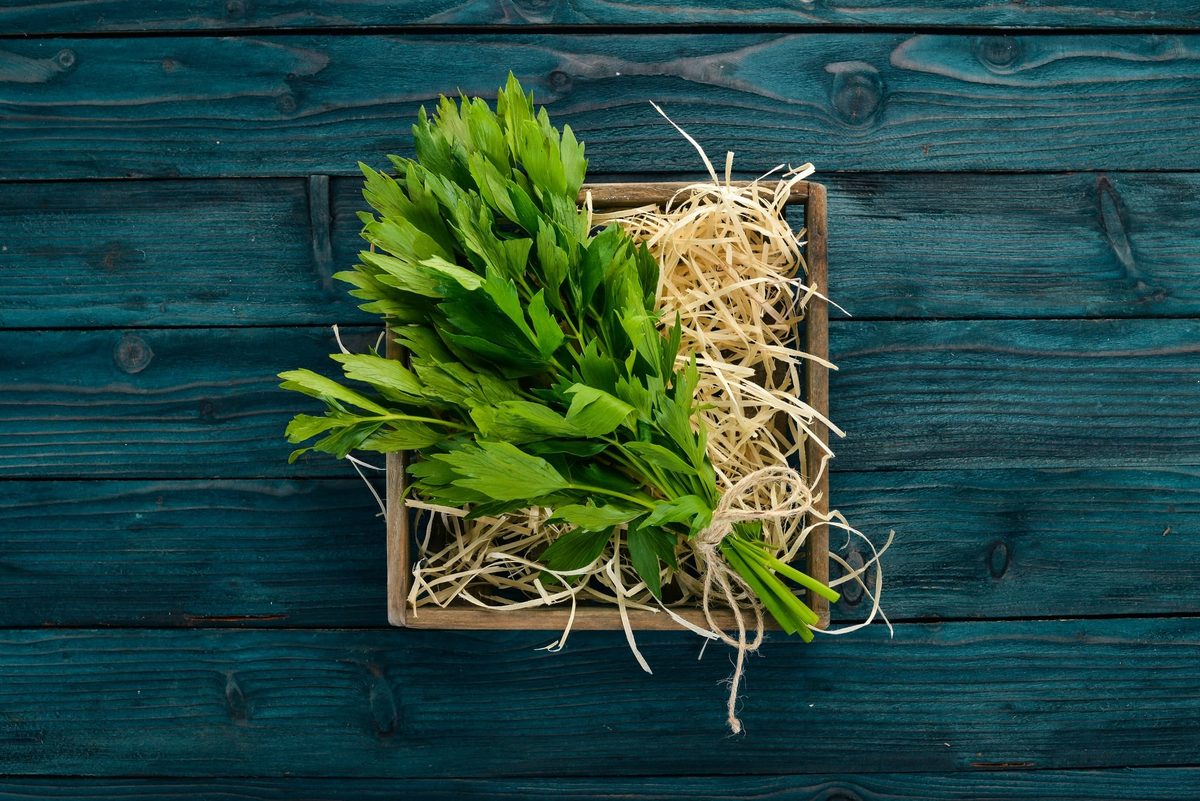
Celery leaves are the leafy tops most people cut off and throw away. They are worth keeping. Gernot Katzer’s Spice Pages notes that celery leaves are used both as a garnish and, more often, cooked into soups and sauces,1 and the University of Delaware’s extension service ranks celery leaves as a medium-strength herb, alongside basil and dill.2 In other words, treat them as an herb, not as a vegetable scrap. This page lists the uses with a source behind them first, then the ones that are kitchen judgment. For what the leaves are and how they compare with the stalk, see the celery leaves profile.
Celery leaves uses at a glance
| Use | What the source says | Source |
|---|---|---|
| Soups, stocks and sauces | More often cooked in soups or sauces than used as garnish | Katzer1 |
| Garnish | Sometimes chopped as a garnish | Katzer1 |
| Salads | Coarsely chopped leaves with the sliced stalks | Ellie Krieger3 |
| Pesto | Leaves blended with garlic, pecorino, pine nuts, lemon zest and oil | Tasting Table4 |
| In place of celery seed | 2 tablespoons minced tops per ½ teaspoon seed | The Spice House5 |
| Raw and steamed (leaf celery) | Eaten raw as well as steamed in Southeast Asia | PROSEA6 |
| Homemade celery salt | Dried leaves mixed with salt; commercial versions use seed | McCormick label7 |
Soups and stocks
This is the most common use. Katzer says the leaves are more often cooked in soups or sauces than used as a garnish,1 and they bring celery flavor to a pot without the stalk’s crunch. For long-simmered dishes, the University of Delaware’s general advice for herbs is to add them during the last 45 minutes.2 Chicken soup, white bean soup, lentil soup and vegetable stock are all natural places for them; those dishes are common practice, not named recipes.
Instead of celery seed (Attributed). The Spice House gives 2 tablespoons of minced celery tops for every ½ teaspoon of celery seed.5 That makes the leaves a handy stand-in when a soup or stew calls for seed. Katzer notes that the seeds have a similar but much stronger aroma than the plant,1 which is why the leaf amount is so much larger. A common claim says celery leaves round out the umami of a stock; we found no source for it.
Salads
Celery, radish and herb salad (Attributed). Ellie Krieger’s salad starts with a large bunch of celery, about 2 pounds, leaves included: the stalks are sliced thin on the bias and the leaves only coarsely chopped, then both go into the bowl together.3 Celery leaves can also go into a green salad whole, like any tender herb, or replace some of the parsley in a tabbouleh-style grain salad. Those last two are kitchen judgment. If the leaves taste too strong, use the pale inner ones, which are milder (a common kitchen observation, not a measurement).
Pesto
Tasting Table’s Elizabeth Okosun makes celery leaf pesto the same way as basil pesto: rinsed leaves, garlic, pecorino, pine nuts and lemon zest blended to a paste, then olive oil pulsed in.4 She suggests cashews or almonds in place of pine nuts, and uses the pesto on pasta, chicken and salmon.4 The article gives no amounts. A pesto made from celery leaves will taste of celery rather than basil; it plays the same role, not the same flavor (our judgment).
Garnish and green sauces
Katzer notes that the leaves are sometimes chopped and used as a garnish.1 Anywhere a sprinkle of parsley would go, celery leaves work too, with a stronger, more savory flavor: over soups, creamy pasta, potato salad, grilled steak or roast fish. Chopped into a salsa verde or chimichurri in place of some of the parsley, they add a celery note. Those pairings are common practice rather than sourced dishes.
Sandwiches
Celery leaves can stand in for lettuce or other greens on a sandwich, or for some of the herbs in a bánh mì. That is a kitchen suggestion; we found no named recipe that does it.
Salsa, for cilantro-averse cooks
Some people find cilantro soapy. A 2012 study of 14,604 people of European ancestry linked reports of soapy-tasting cilantro to a genetic variant near olfactory receptor genes.8 Celery leaves are one possible swap in a tomato salsa or guacamole for those cooks. They do not taste like cilantro, so the result is a different salsa, not a copy. That swap is our suggestion. See celery leaves substitutes for going the other way.
Stir-fries and Chinese celery
Chinese celery is a different form from the supermarket stalk. The Woks of Life describes it as longer and thinner than Western celery, with a very strong celery flavor, and says Chinese cooks use it mostly for stir-fries.9 It also says that, as with Western celery, it is mainly the stalks that are eaten, because the leaves are usually too bitter.9 So a widely repeated tip, that celery leaves stand in well for Chinese celery in a stir-fry, has the parts the wrong way round: the stalk is the better match. Toss a handful of leaves into a stir-fry at the end if you like their bitterness; that is a matter of taste.
In Southeast Asia, PROSEA notes, leaf celery, a cultivar group grown for its leaves, is eaten raw as well as steamed and used as a flavoring fresh or dried and powdered.6
Homemade celery salt and dried leaves
Dried, crumbled celery leaves mixed with salt make a homemade celery salt. Commercial celery salt is made differently: McCormick’s label lists only salt and celery seed.7 Dry the leaves on a rack or in a low oven until crisp, then store them in a sealed jar; that method is common practice. See celery salt and celery flakes.
Allergy
Celery is one of the allergens EU law requires on food labels, listed as “celery and products thereof.”10 The leaves count. Anyone cooking for a guest with a celery allergy should leave them out.
Not yet sourced
- A named recipe with amounts for celery leaf pesto, salsa or salsa verde.
- Any test of celery leaves against parsley or cilantro in the same dish.
- A source for celery leaves deepening the savory flavor of stock.
Related
- Celery leaves profile
- Celery leaves substitutes
- Celery seeds and celery seed uses
- Celery salt, celery flakes and celery powder
- Lovage and parsley
Footnotes
-
Celery, Gernot Katzer’s Spice Pages. gernot-katzers-spice-pages.com · Reference work ↩ ↩2 ↩3 ↩4 ↩5 ↩6
-
“Using Herbs and Spices”, University of Delaware Cooperative Extension, 2025. udel.edu · Reference work ↩ ↩2
-
Ellie Krieger, “Celery, Radish, and Herb Salad”, 2016. elliekrieger.com · Publication ↩ ↩2
-
Elizabeth Okosun, “Turn Celery Leaves Into A Bright And Savory Pesto”, Tasting Table, 2024. tastingtable.com · Publication ↩ ↩2 ↩3
-
“Celery Seed Substitute”, The Spice House, 2018. thespicehouse.com · Merchant ↩ ↩2
-
S. Susiarti and J.S. Siemonsma, Apium graveolens, Plant Resources of South-East Asia (PROSEA). uses.plantnet-project.org · Reference work ↩ ↩2
-
McCormick Celery Salt product listing with label ingredients, Stop & Shop. stopandshop.com · Merchant ↩ ↩2
-
Eriksson et al., “A genetic variant near olfactory receptor genes influences cilantro preference”, 2012 (journal article). link.springer.com · Peer-reviewed ↩
-
“Chinese Vegetables: A Guide to Asian Leafy Greens”, The Woks of Life, 2024. thewoksoflife.com · Publication ↩ ↩2
-
Regulation (EU) No 1169/2011, Annex II. eur-lex.europa.eu · Regulator ↩