Herbs · Profile
Parsley: Curly vs. Flat-Leaf, Flavor Chemistry, Uses and Safety
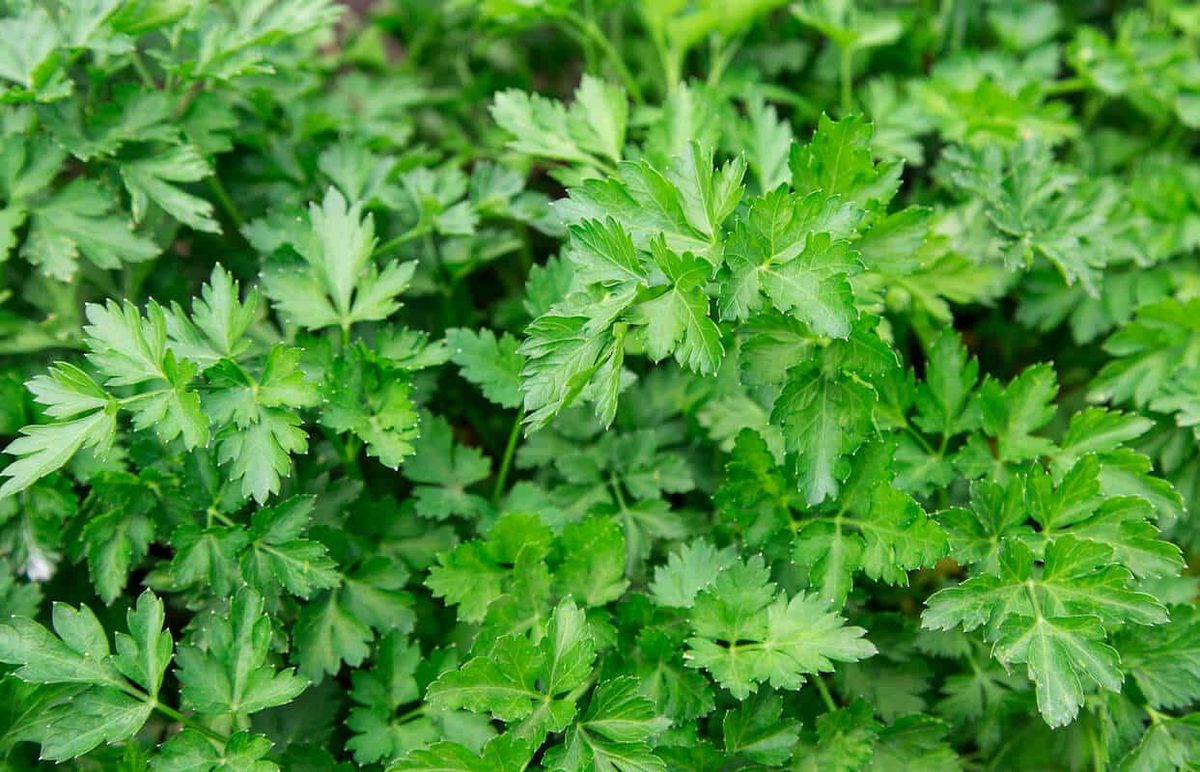
Parsley is the leaf of Petroselinum crispum, a biennial in the carrot family. It is often dismissed as garnish, but it has a real flavor, slightly bitter and green, and the curly and flat-leaf types differ in their chemistry as well as their looks. This page covers the types, the compounds behind the taste, history, uses, storage, and the two safety points worth knowing.
At a glance
| Botanical name | Petroselinum crispum1 |
| Plant family | Apiaceae (carrot family)12 |
| Part used | Leaves and stems; the root of Hamburg parsley2 |
| Native range | Northwest Africa and the Balkan Peninsula (Kew); “Mediterranean lands” (Britannica)12 |
| Main types | Curly-leaved, flat-leaved, turnip-rooted (Hamburg)3 |
| Essential oil in the fresh herb | 0.04–0.15%, depending on type3 |
| Forms sold | Fresh bunches, dried flakes |
Measured values
13 figures, sourced| Measure | Value | Scope | Source |
|---|---|---|---|
| Essential oil | less than 0.5 % | Parsley, Britannica (plant part not specified)Sources differ: PROSEA gives lower figures for the fresh herb; the two may not describe the same plant part. | britannica.com |
| Essential oil | 0.07–0.15 % of fresh herb | Curly types, PROSEA | uses.plantnet-project.org |
| Essential oil | 0.04 % of fresh herb | Flat-leaved type, PROSEA | uses.plantnet-project.org |
| Essential oil | 0.05 % of fresh herb | Turnip-rooted type, PROSEA | uses.plantnet-project.org |
| 1,3,8-p-Menthatriene | about 20 % of leaf oil | German-grown flat-leaved and curly samples, PROSEA | uses.plantnet-project.org |
| Myristicin | about 32 % of leaf oil | German-grown curly sample, PROSEA | uses.plantnet-project.org |
| Myristicin | 9.1 % of leaf oil | German-grown flat-leaved sample, PROSEA | uses.plantnet-project.org |
| Limonene | 18 % of leaf oil | German-grown flat-leaved sample, PROSEA | uses.plantnet-project.org |
| Limonene | 14 % of leaf oil | German-grown curly sample, PROSEA | uses.plantnet-project.org |
| Apiole | 33.3 % of seed (fruit) oil | French flat-leaved sample, PROSEA | uses.plantnet-project.org |
| Myristicin | 22.5 % of seed (fruit) oil | French flat-leaved sample, PROSEA | uses.plantnet-project.org |
| Myristicin | 56 % of seed (fruit) oil | French curly sample, PROSEA | uses.plantnet-project.org |
| Ascorbic acid (vitamin C) Nutrient | 122 mg per 100 g | Dried parsley, PROSEA composition table | uses.plantnet-project.org |
Each figure is quoted as its source states it, with the samples or standard it applies to. Where sources differ, both are shown; nothing is averaged. All measured values
What parsley is
Kew lists parsley as a biennial or perennial of the temperate biome.1 As a biennial, it grows leaves in its first season; the compound leaves are deep green and tender, either flat or deeply frilled.2 PROSEA describes three cultivated groups:3
- Curly-leaved parsley has compact branches with curled leaf blades. Its fresh leaves are mostly used for garnishing and seasoning.
- Flat-leaved parsley, often sold as Italian parsley, has more open branches with flat leaf blades.
- Turnip-rooted parsley, also called Hamburg parsley, is grown for a large white root that Britannica calls parsnip-like and popular in Europe.2 PROSEA says these thick-rooted forms are recent, probably developed around 1500 AD in northern Germany.3
For the differences in the kitchen, see Italian parsley vs. curly parsley and flat-leaf vs. Italian parsley.
Flavor and aroma
Parsley tastes green and fresh with a light bitterness, and that bitterness can sharpen other flavors the way a squeeze of lemon does; that description is ours. Britannica calls the leaves mildly aromatic.2 PROSEA describes the flavor of parsley herb oil as warm but slightly burning and bitter.3 Flat-leaved parsley is stronger flavored than curly, according to PROSEA.3
The compounds
Britannica puts parsley’s essential oil at less than 0.5% and names apiol as its principal component.2 PROSEA’s figures are lower for the fresh herb: about 0.07–0.15% oil in curly types, 0.04% in flat-leaved and 0.05% in turnip-rooted.3 The two references are not necessarily describing the same plant part, so both are given.
The leaf oil differs by type. In PROSEA’s figures for German-grown samples, flat-leaved and curly parsley both had about 20% 1,3,8-p-menthatriene, but the curly type’s oil carried about 32% myristicin against 9.1% in flat-leaved, and limonene ran 18% in flat-leaved against 14% in curly.3 The seed (fruit) oil is a different product: PROSEA reports apiole (33.3%) and myristicin (22.5%) in a French flat-leaved sample and myristicin at 56% in a French curly sample.3
Origin and history
Kew gives parsley’s native range as northwest Africa and the Balkan Peninsula, listing Algeria, Greece, Morocco and the northwest Balkans.1 Britannica says Mediterranean lands.2
The name comes through Medieval Latin and Latin petroselinum from Greek petroselinon, “rock-parsley”, from petros (rock, stone) and selinon (celery).4 That is the source of the “stone” in the name; we found no source that ties it to where the plant was first found growing.
Parsley is an old crop, well known in classical Greece and Rome, according to PROSEA.3 Britannica says the ancient Greeks and Romans used the leaves to flavor and garnish food.2 Several stories about parsley’s past circulate widely, including Greek legends of its springing from a hero’s blood, Roman use on corpses, Charlemagne’s gardens and medieval sayings about germination. We could not trace these to a source and have left them out.
Production and trade
We found no official production figure for parsley. PROSEA, in figures that carry no date, reported that parsley accounts for over half the area planted with culinary herbs in the United Kingdom, and that more than 10,000 tonnes are eaten each year in 23 major US cities.3
How parsley is used
Britannica lists fish, meats, soups, sauces and salads as the classic uses.2 PROSEA notes that flat-leaved parsley is used to flavor dishes in much the way coriander leaves are in Asian cooking.3
By common practice, parsley is the main ingredient in Levantine tabbouleh, Argentine chimichurri, Italian gremolata and salsa verde, and it is one of the four French fines herbes, with chervil, chives and tarragon. It also goes into meatballs, stuffings and herb butters.
Technique
LSU AgCenter groups parsley with the delicate herbs best added in the last minute or two of cooking, since prolonged heat costs flavor and aroma.5 Stems carry more flavor than they get credit for and suit stocks and sauces where they can be strained out; that is kitchen judgment. LSU’s rule of thumb for swapping fresh herbs with dried is 1 tablespoon fresh to 1 teaspoon dried.5 See fresh vs. dried parsley. If a dish has gone over, see too much parsley.
Buying and storage
Look for bright, crisp leaves with no yellowing; that is common practice. We found no sourced shelf-life figure for fresh parsley. See how to store parsley, can you freeze parsley and how to dry parsley.
For dried parsley, PROSEA’s composition table for dried parsley gives 122 mg of ascorbic acid per 100 g.3 We could not retrieve USDA figures for fresh parsley during this review.
Safety
Warfarin
MedlinePlus lists parsley among foods that can change how the blood thinner warfarin works, alongside endive, lettuce, spinach, watercress, garlic and scallions.6 Its advice is not to avoid these foods but to eat small amounts and keep the amount steady from day to day.6 Anyone on warfarin should follow their prescriber’s guidance.
Seed oil and concentrated preparations
Culinary amounts of the leaf are not the concern here. Britannica warns that ingesting parsley seed oil, or large amounts of other parsley preparations, can cause potentially lethal reactions including organ damage, hemorrhage and nerve damage.2 PROSEA notes that apiole, the main compound of the seed oil, is an abortifacient, that large doses may cause paralysis and death, and that the fruits taken in large quantities may induce abortion.3 PROSEA also reports that the aerial parts contain furanocoumarins, mainly bergapten, and that some people who handle parsley regularly develop dermatitis.3
Health claims
Parsley is often said to treat diabetes, osteoporosis and arthritis. This page makes no claim that parsley treats or prevents any condition.
Substitutes and comparisons
See parsley substitutes for ranked options, and these comparisons:
- Chervil vs. parsley
- Cilantro vs. parsley and coriander vs. parsley
- Basil vs. parsley
- Oregano vs. parsley
Related profiles: chervil, cilantro.
Footnotes
-
Petroselinum crispum, Plants of the World Online, Royal Botanic Gardens, Kew. powo.science.kew.org · Reference work ↩ ↩2 ↩3 ↩4 ↩5
-
“Parsley”, Encyclopaedia Britannica. britannica.com · Reference work ↩ ↩2 ↩3 ↩4 ↩5 ↩6 ↩7 ↩8 ↩9 ↩10 ↩11
-
I.B. Ipor and L.P.A. Oyen, Petroselinum crispum, Plant Resources of South-East Asia (PROSEA). uses.plantnet-project.org · Reference work ↩ ↩2 ↩3 ↩4 ↩5 ↩6 ↩7 ↩8 ↩9 ↩10 ↩11 ↩12 ↩13 ↩14 ↩15
-
“parsley”, Online Etymology Dictionary. etymonline.com · Reference work ↩
-
“Flavorful Herbs”, LSU AgCenter. lsuagcenter.com · Reference work ↩ ↩2
-
“Taking warfarin”, MedlinePlus, U.S. National Library of Medicine. medlineplus.gov · Regulator ↩ ↩2