Spice Substitutes · Substitutes
Celery Leaves Substitutes: Lovage, Celery Seed, Parsley and More
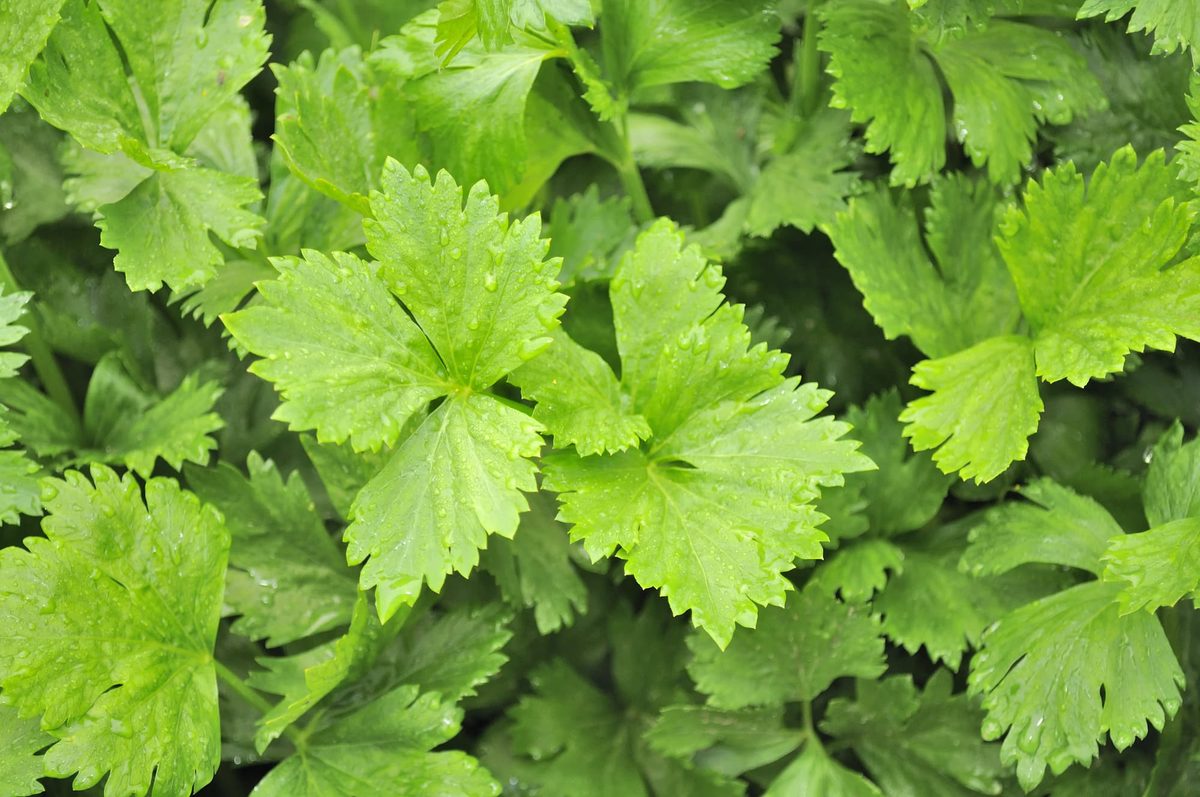
Celery leaves are the leafy tops of Apium graveolens, the same plant that gives celery stalks and celery seed. PROSEA notes that a separate leafy form, leaf celery, is grown and used as a flavoring, fresh or dried and powdered.1 The leaves taste of celery, sharper and greener than the stalk, from the same family of aroma compounds: a series of phthalides gives celery its characteristic smell.2 The University of Delaware’s extension service places celery leaves among the medium-strength herbs, with basil, dill and marjoram.3 The best substitute depends on whether the leaves are flavoring a cooked dish, acting as a fresh herb, or sitting on top as a garnish.
Quick answer
| What celery leaves are doing | Best substitute | Starting amount, per 2 tbsp chopped leaves | Treatment |
|---|---|---|---|
| Celery flavor in soups, stocks, stews | Celery seed | 1/2 tsp | Attributed |
| Fresh herb in salads and raw dishes | Lovage leaves | About 1 tbsp, then taste | Method |
| Garnish | Flat-leaf parsley | 2 tbsp | Method |
How the ratios on this page are labeled
- Computed: based on a measurable physical relationship, with the source named.
- Attributed: a named source publishes this ratio. We quote it as theirs.
- Disputed: named sources give different answers to the same swap. We show each one and do not average them.
- Method: we found no published ratio. We give a direction and a cautious starting point, and say so.
Only one published ratio turned up, and it does not say how it was arrived at. The rest are starting points.
If the leaves are flavoring a cooked dish
In soups, stocks, stews and braises, celery leaves are there for flavor; their texture disappears. Any form of celery will do the job, and the question is only how much.
1. Celery seed
Ratio (Attributed): The Spice House gives 2 tablespoons of minced celery tops as the replacement for 1/2 teaspoon of celery seed.4 Read the other way, 1/2 teaspoon of seed stands in for 2 tablespoons of chopped leaves. The Spice House offers the figure for replacing seed with leaves; reversing it is our arithmetic.
Seed is far more concentrated: Katzer describes its aroma as similar to the leaf’s but much stronger, and slightly bitter.5 McCormick says celery seed “goes a long way.”6 If you are cautious, start below 1/2 teaspoon and add more after tasting. Seed adds no green color or leafy bulk.
2. Celery stalk
Stalk celery and leaf celery are forms of the same species.1 The stalk is milder and sweeter than the leaves, and crunchy; that is a cook’s description, not a measurement.
Ratio (Method): No published ratio was found. Start with an equal volume of finely chopped stalk, taste near the end of cooking, and add more if the celery note is faint. Chop it small so it softens in the same time as the leaves would.
3. Dried celery leaves
Leaf celery is used dried as well as fresh.1
Ratio (Computed): LSU AgCenter’s general rule for herbs is that 1 tablespoon of finely cut fresh herbs equals 1 teaspoon of crumbled dried.7 By that rule, use 2 teaspoons of dried celery leaf for 2 tablespoons of fresh. It is a general rule for herbs, not a test on celery leaf. For long-simmered dishes, the University of Delaware’s general advice is to add herbs in the last 45 minutes.3
If the leaves are a fresh herb
Raw in salads, egg dishes, potato salad or slaws, celery leaves bring a green, celery-flavored freshness. Here you need a fresh leaf.
1. Lovage
Lovage, Levisticum officinale, is a separate plant of the parsley family. Britannica describes its flavor as sweet and similar to celery, and notes that its stalks and foliage are used as a vegetable and to flavor food.8 It is the closest fresh match, but in our judgment it is stronger than celery leaf.
Ratio (Method): No published ratio was found. Start with about half as much chopped lovage as celery leaves, taste, and add more.
2. Flat-leaf parsley, with a pinch of celery seed
Parsley is in the same plant family as celery.9 Britannica calls its flavor mildly aromatic,9 while PROSEA describes it as warm but slightly burning and bitter, and says the flat-leaved type is stronger flavored than the curly.10 Parsley gives you the green leaf and some of the bitter edge, but not the celery note. A small pinch of celery seed supplies that.
Ratio (Method): No published ratio was found. Use an equal volume of chopped flat-leaf parsley and add a pinch of celery seed, crushed, per 2 tablespoons. Taste and adjust.
Falls short: cilantro
Cilantro is the leaf of coriander, another member of the parsley family.11 Its key aroma compounds are aldehydes,12 not the phthalides behind celery’s smell,2 and some people find it soapy.12 It can fill a garnish or salad slot, but it will taste of cilantro, not celery.
If the leaves are a garnish
As a garnish, celery leaves are mostly about a fresh green leaf on top of the dish. Parsley has served that purpose since antiquity: Britannica notes the ancient Greeks and Romans used it as a flavoring and garnish.9 PROSEA notes that curly-leaved parsley is commonly used fresh for garnishing and seasoning.10
Ratio (Method): Use flat-leaf or curly parsley leaves in the same amount you would use celery leaves. For the look of celery, flat-leaf parsley’s leaves are closer in shape; that is a matter of appearance, not flavor.
What isn’t known
- The Spice House’s celery-tops figure is the only published ratio we found, and it gives no method.
- Most published composition data on celery leaves is for the leaf-celery cultivar group, not the tops of stalk celery,1 and no study compares the flavor strength of either with lovage, parsley or celery seed.
- The fresh-to-dried figure is a general herb rule, not measured on celery leaf.
Related
- Celery leaves and celery leaves uses
- Lovage and lovage substitutes
- Celery seeds, celery flakes and celery salt
- Parsley, flat-leaf vs. Italian parsley, Italian parsley vs. curly parsley and parsley substitutes
- Cilantro and cilantro vs. parsley
- Celery seed substitutes and celery flakes substitutes
Footnotes
-
Apium graveolens (PROSEA), Plant Resources of South-East Asia. uses.plantnet-project.org · Reference work ↩ ↩2 ↩3 ↩4
-
Salehi et al., Apium Plants: Beyond Simple Food and Phytopharmacological Applications, Applied Sciences, 2019. mdpi.com · Peer-reviewed ↩ ↩2
-
Using Herbs and Spices, University of Delaware Cooperative Extension, 2025. udel.edu · Reference work ↩ ↩2
-
Celery Seed Substitute, The Spice House. thespicehouse.com · Merchant ↩
-
Gernot Katzer, Celery (Apium graveolens), Gernot Katzer’s Spice Pages. gernot-katzers-spice-pages.com · Reference work ↩
-
McCormick Whole Celery Seed, product page, McCormick & Company. mccormick.com · Merchant ↩
-
Flavorful Herbs, LSU AgCenter. lsuagcenter.com · Reference work ↩
-
Lovage, Encyclopaedia Britannica. britannica.com · Reference work ↩
-
Parsley, Encyclopaedia Britannica. britannica.com · Reference work ↩ ↩2 ↩3
-
Petroselinum crispum (PROSEA), Plant Resources of South-East Asia. uses.plantnet-project.org · Reference work ↩ ↩2
-
Coriander, Encyclopaedia Britannica. britannica.com · Reference work ↩
-
Eriksson et al., A genetic variant near olfactory receptor genes influences cilantro preference, Flavour, 2012. link.springer.com · Peer-reviewed ↩ ↩2