Spices · Profile
Houttuynia Cordata (Fish Mint): Flavor, Chemotypes, Uses and Safety
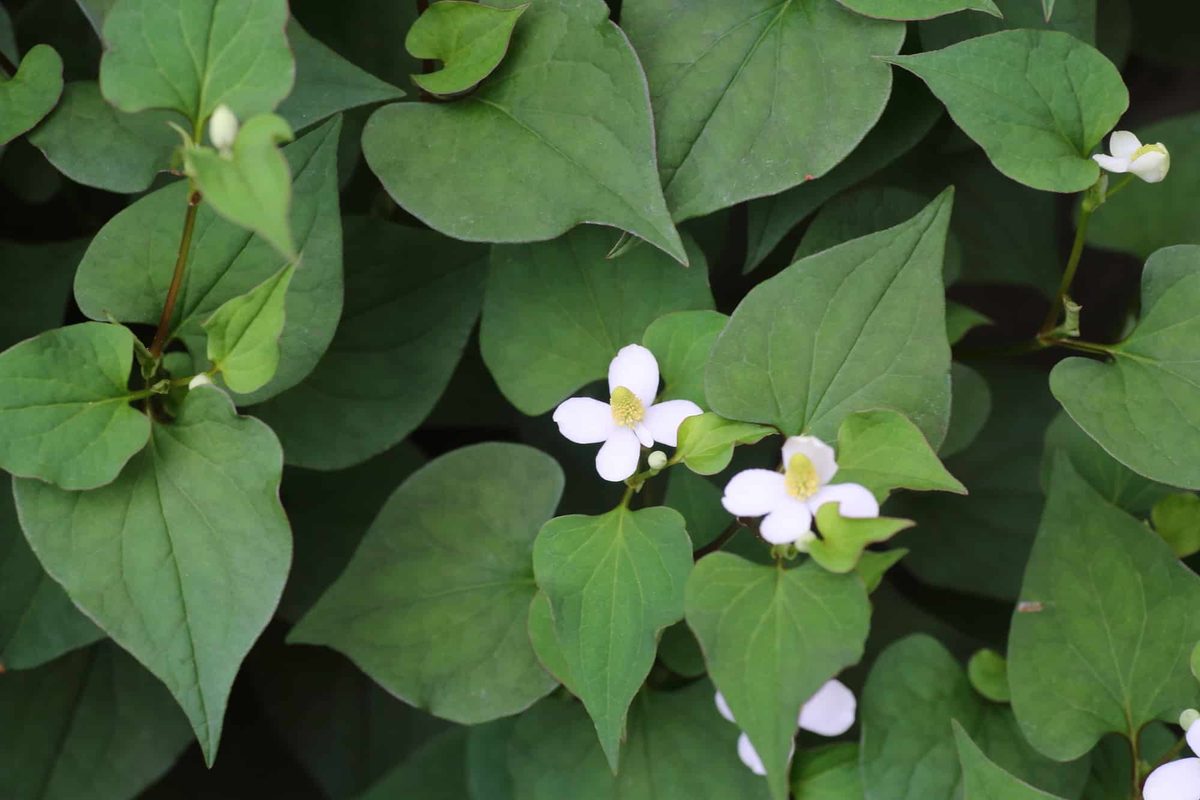
Houttuynia cordata is a low, creeping East Asian herb whose crushed leaves smell strongly of fish, which is where the English name fish mint comes from.12 It is not a mint at all: Kew places it in the family Saururaceae, not the mint family.3 Cooks across East and Southeast Asia and northeast India eat the leaves raw in salads and as a garnish, and in some places they eat the rhizome too.12
At a glance
| Botanical name | Houttuynia cordata Thunb.3 |
| Plant family | Saururaceae3 |
| Part used | Leaves, mostly raw; rhizome in parts of China and northeast India12 |
| Native range | Himalaya to temperate East Asia and Indo-China3 |
| Growth habit | Rhizomatous perennial (geophyte) of the temperate biome3 |
| Key aroma compound | Decanoyl acetaldehyde (houttuynin)14 |
| Other names | Fish mint, chameleon plant, heartleaf, fishwort; Vietnamese diếp cá; Chinese yuxing cao; Japanese dokudami1 |
| Forms sold | Fresh leaves in Asian markets; dried leaf for tea and medicine; ornamental plants in garden centers |
Measured values
1 figure, sourced| Measure | Value | Scope | Source |
|---|---|---|---|
| Essential oil: nonyl ketones | 2.10 to 40.36 % of the essential oil | across the samples cited in Wu et al. 2021 reviewRange too wide for any single typical figure | frontiersin.org |
Each figure is quoted as its source states it, with the samples or standard it applies to. Where sources differ, both are shown; nothing is averaged. All measured values
What it is
Kew describes Houttuynia cordata as a rhizomatous geophyte of the temperate biome and gives its native range as the Himalaya to temperate East Asia and Indo-China.3 PROSEA notes that it grows wild in semi-shaded marshy places and is occasionally cultivated, particularly in Thailand and Indo-China.2 It is also often grown as an ornamental in Europe and the United States.1
The genus is named for Maarten Houttuyn (1720 to 1798), a Dutch naturalist.1 Kew dates the species name, authored by Thunberg, to 1783.3
The names tell you about the smell. Katzer translates the Chinese yuxing cao as “fish-stinking herb” and reads the Vietnamese diếp cá as lettuce that smells like fish; he says the English names fishwort and heartleaf refer, with some exaggeration, to the odor and to the heart-shaped leaves.1
Flavor and aroma
Fishy is the word everyone reaches for, but it is not the whole story, and it depends on which plant you have. Katzer describes two chemotypes, chemically distinct forms of the same species:1
| Chemotype | Aroma (Katzer) | Main oil components reported |
|---|---|---|
| Chinese/Vietnamese | Resembles coriander leaf | Myrcene, 2-undecanone (methyl nonyl ketone), limonene, decanoyl acetaldehyde |
| Japanese | A “strange lemon or orange” odor | Mainly decanal, with dodecanal and 2-undecanone |
Katzer finds the taste aromatic and very close to Vietnamese coriander, with an astringent aftertaste, and says that although some compare the smell to raw fish or meat, he does not.1 PROSEA, by contrast, describes the crushed leaves plainly as having a fish-like, fetid odor.2 Both are honest descriptions; the fishiness is real but varies by plant and by palate.
The compound behind the fish
Katzer names decanoyl acetaldehyde as the compound mainly responsible for the characteristic flavor, and Wu and colleagues’ 2021 review says houttuynin, the same compound, has “a special fishy scent.”14 The review lists nonyl ketones among the main components of the essential oil, at 2.10% to 40.36% across the samples it cites, a range wide enough that no single figure is typical.4
How it is used
- Vietnam. The leaves are sometimes found in Vietnamese salads and garnishes.1
- Northeast India. In Manipur cooks use both the leaves and the fresh rhizome. Katzer describes the leaves in salads such as singju, in the fermented-fish dish iromba, where the herb cuts the intense fermented fish flavor, and dipped in chickpea-flour batter for bora, a fritter.1 Wu and colleagues note it is harvested as daily food and medicine in the Yarlung Zangbo valley of Assam.4
- Southwest China. Katzer describes a Guizhou dish of salt-cured bacon fried with the rhizome.1
- Nepal. Little used, though some people flavor pickles with the fresh leaves or rhizomes.1
- General. PROSEA says the leaves are eaten raw, in salads or as a garnish for several dishes.2
The review notes that its use has been described in China, Korea, Japan, India and other Asian regions.4
In our kitchen judgment, it works best raw and in small amounts, torn into herb plates, rice-paper rolls and salads where coriander or other strong herbs balance it. If you are new to it, try a few leaves alongside cilantro before building a dish around it.
Buying and storage
We found no grading standard or published shelf life. Buy bright, unwilted leaves, refrigerate them wrapped in a damp towel, and use within a few days; that is common practice for tender leaf herbs, not a sourced figure.
Health and safety
As food. Wu and colleagues found no reports of toxicity from long-term eating of the plant as a vegetable, and call it relatively safe for oral use in humans.4
Compounds. The same review lists rutin, hyperoside, quercetin and quercitrin among its flavonoids and calls flavonoids and volatile oils its main active components.4 Most of the research on what these compounds do comes from cell and animal studies; the review itself says some of its findings were “mainly investigated in vitro” and need confirming in living systems.4 None of this shows that eating the herb treats or prevents any disease.
Traditional medicine. In China, the aboveground parts are used in traditional medicine for pneumonia and lung abscess.4 That records a tradition; it is not evidence of effect.
Injections are a separate matter. In China the herb has also been made into an injectable drug. A 2010 systematic review collected 1,232 reported adverse reactions to Houttuynia injection from 645 articles. Anaphylactic shock made up about 59% of the most serious reactions, and the authors concluded that the reactions “were serious.”5 This concerns an injected drug, not the leaf eaten as food.
Open questions. In its safety discussion, the 2021 review also cites studies associating aristolochic acid and aristolactams with liver cancer, and a high-dose 28-day rat study in which some animals died and kidney cells showed focal necrosis.4 These are animal and literature findings, not evidence of harm from culinary amounts.
Substitutes and comparisons
No herb reproduces the fishy note. For the green, coriander-like side of the flavor, cilantro or culantro can stand in, with more of either than you would use of fish mint; that is Method, a starting direction with no tested ratio. Shiso is another strong leaf for herb plates. For herbs that really are in the mint family, see types of mint and Korean mint.
Footnotes
-
“Chameleon plant (Houttuynia cordata)”, Gernot Katzer’s Spice Pages. gernot-katzers-spice-pages.com · Reference work ↩ ↩2 ↩3 ↩4 ↩5 ↩6 ↩7 ↩8 ↩9 ↩10 ↩11 ↩12 ↩13 ↩14 ↩15
-
“Houttuynia cordata (PROSEA)”, Plant Resources of South-East Asia, via Pl@ntUse. uses.plantnet-project.org · Reference work ↩ ↩2 ↩3 ↩4 ↩5 ↩6
-
Houttuynia cordata Thunb., Plants of the World Online, Royal Botanic Gardens, Kew. powo.science.kew.org · Reference work ↩ ↩2 ↩3 ↩4 ↩5 ↩6 ↩7
-
Zhao Wu et al., “Houttuynia cordata Thunb: An Ethnopharmacological Review”, Frontiers in Pharmacology, 2021. frontiersin.org · Peer-reviewed ↩ ↩2 ↩3 ↩4 ↩5 ↩6 ↩7 ↩8 ↩9 ↩10
-
Li Wang et al., “Adverse events to Houttuynia injection: A systematic review”, Journal of Evidence-Based Medicine, 2010 (abstract). scholars.hkbu.edu.hk · Peer-reviewed ↩