Blog · Profile
Types of Mint: The Species, Hybrids and Garden Mints Cooks Actually Meet
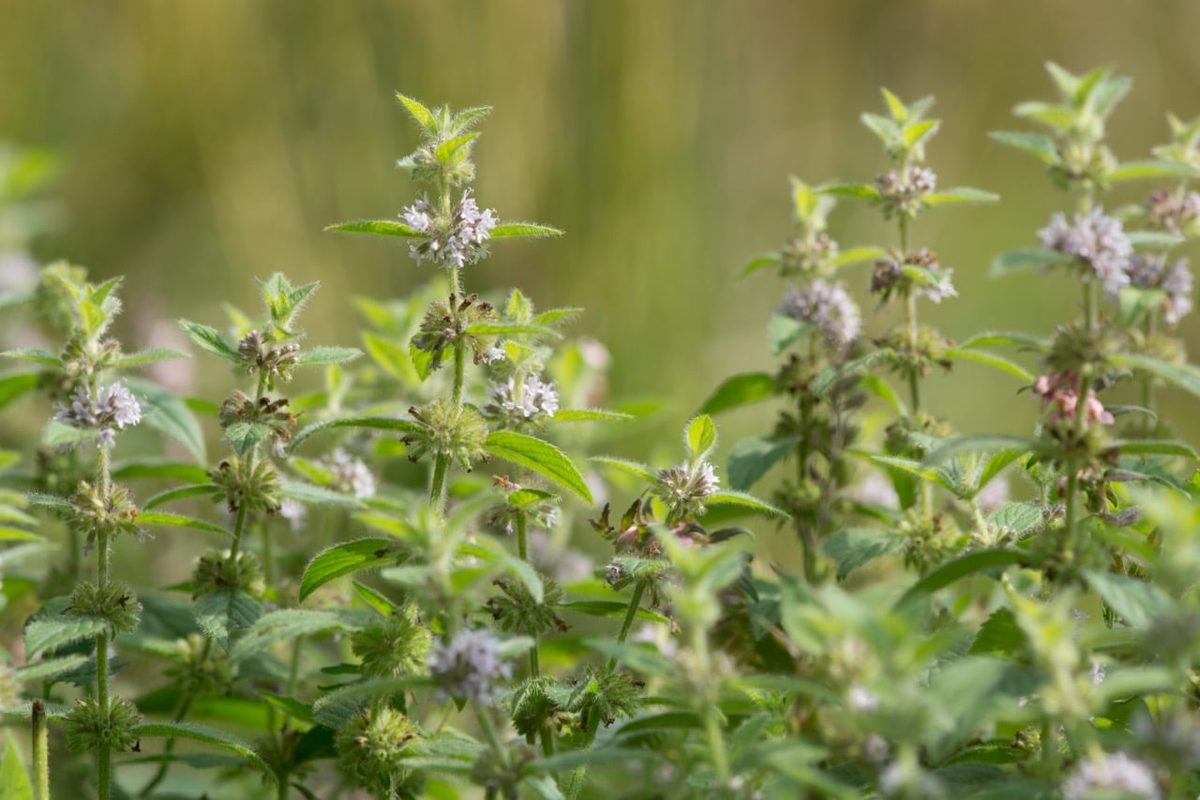
The mint genus, Mentha, is smaller than its reputation: Britannica counts about 25 species, and a 2018 review puts it at 25 to 30.12 Many more names appear on nursery labels because of hybrids and garden cultivars: peppermint itself is a natural hybrid,3 and the RHS lists “strawberry” and “grapefruit” mints as cultivars of existing species.45 In cooking, “mint” usually means spearmint or peppermint.1 The others differ mainly in which compound dominates their oil, and that is the most useful way to tell them apart.
A widely repeated claim says there are over 600 kinds of mint. No source we found gives that figure or shows how it was arrived at.
The mints at a glance
| Mint | Botanical name | What the sources say about its scent or oil | Page |
|---|---|---|---|
| Spearmint | Mentha spicata6 | Rich in carvone2 | Spearmint |
| Peppermint | Mentha × piperita, water mint × spearmint73 | Oil mostly menthol and menthone2 | Peppermint |
| Water mint | Mentha aquatica8 | Oil led by menthofuran in measured samples9 | Watermint |
| Orange (bergamot, eau de Cologne) mint | Kew: a synonym of M. aquatica; RHS: M. × piperita f. citrata1011 | Leaves scented like eau de Cologne11 | Orange mint |
| Chocolate mint | M. × piperita f. citrata ‘Chocolate’ (RHS)12 | Minty-chocolate scented leaves12 | Chocolate mint |
| Ginger mint | Mentha × gracilis, field mint × spearmint13 | “Neither minty nor ginger-like at all” (Katzer)14 | Ginger mint |
| Apple mint | Mentha suaveolens (RHS); Katzer uses M. rotundifolia1514 | Apple-scented (RHS); very mild, not apple-like (Katzer)1514 | Apple mint |
| Pineapple mint | M. suaveolens ‘Variegata’16 | Weakly pineapple-like (Katzer)14 | Apple mint |
| Moroccan mint | Mentha spicata, the green mint of North African mint tea14 | Carvone type, like other spearmint2 | Moroccan mint |
| Field mint | Mentha arvensis17 | Oil 50–70% menthol (Katzer)14 | No page |
| Corsican mint | Mentha requienii18 | Peppermint-scented leaves (RHS)19 | No page |
| Strawberry mint | Cultivar, filed differently by the RHS420 | Strawberry-like scent (RHS)20 | No page |
| Grapefruit mint | Cultivar, filed differently by the RHS521 | Citrus flavor (RHS)521 | No page |
| Egyptian mint (M. niliaca) | Kew: a synonym of Mentha × rotundifolia22 | No source found | No page |
Two plants called mint are not in the genus at all: lemon balm and Korean mint (below).
Measured values
3 figures, sourced| Measure | Value | Scope | Source |
|---|---|---|---|
| Menthofuran (water mint) | 38.4–55.9 % of essential oil | Two Italian samples of Mentha aquatica subsp. aquatica from North Tuscany | arpi.unipi.it |
| Menthol (field mint) | 50 to 70 % of essential oil | Mentha arvensis oil, per Katzer | gernot-katzers-spice-pages.com |
| Estragole (Korean mint) | 89.49 % of essential oil | One earlier sample of Agastache rugosa tabulated by Hong et al.Not a Mentha species. | mdpi.com |
Each figure is quoted as its source states it, with the samples or standard it applies to. Where sources differ, both are shown; nothing is averaged. All measured values
Spearmint and peppermint
Spearmint (Mentha spicata) is native from Europe to China.6 Its oil is rich in carvone,2 and to our taste it is sweeter and less cooling than peppermint. It is the mint of British mint sauce for lamb, according to Katzer.14 More: spearmint, spearmint vs. peppermint.
Peppermint (Mentha × piperita) is a natural cross between water mint and spearmint.37 Its oil is dominated by menthol and menthone.2 Katzer notes that true peppermint goes almost exclusively into confectionery and sweet liqueurs.14 More: peppermint, apple mint vs. peppermint, peppermint substitutes.
Water mint and its garden forms
Water mint (Mentha aquatica) is the wild, wet-ground parent of peppermint, native to Africa and from Europe to western Asia and central Siberia.8 Two Italian samples gave oils with 38.4–55.9% menthofuran, a different compound from peppermint’s menthol.9 See watermint.
Orange mint, also sold as bergamot or eau de Cologne mint, is classified differently by different authorities: Kew sinks Mentha citrata into water mint, while the RHS lists it as a form of peppermint.1011 Either way its leaves smell like eau de Cologne.11 Katzer compares its scent to the bergamot orange of Earl Grey tea.14 See orange mint and cooking with orange mint.
Chocolate mint is a garden selection the RHS places in the same group, as M. × piperita f. citrata ‘Chocolate’, with minty-chocolate scented leaves.12 See chocolate mint.
Apple, pineapple and the woolly mints
Apple mint is the RHS’s name for Mentha suaveolens, a mint with softly hairy leaves.15 Kew gives its native range as Macaronesia and Europe to the Mediterranean.23 Sources disagree on how it smells: the RHS calls the leaves apple-scented, while Katzer finds apple mint very mild, slightly minty and not reminiscent of apples.1514 Names tangle here too: Katzer treats apple mint as M. rotundifolia, a hybrid of horse mint (M. longifolia) and M. suaveolens,14 and Kew lists M. × rotundifolia var. suaveolens among the synonyms of M. suaveolens.23
Pineapple mint is the variegated form, M. suaveolens ‘Variegata’, with cream-edged leaves.16 Katzer calls it weakly pineapple-like and says these mints are used more for tea than for cooking.14 Both are covered on the apple mint page.
Egyptian mint. The old name Mentha niliaca is, in Kew’s treatment, a synonym of Mentha × rotundifolia,22 the hybrid Katzer equates with apple mint.14 We found no source describing its flavor; claims that it tastes halfway between peppermint and spearmint could not be traced.
Ginger mint and Moroccan mint
Ginger mint (Mentha × gracilis) is a hybrid of field mint and spearmint, native from western Europe to Italy.13 Despite the name, Katzer finds it “neither minty nor ginger-like at all.”14 See ginger mint.
Moroccan mint is spearmint: Katzer identifies Moroccan green mint as Mentha spicata and notes that green mint tea is the “national beverage” of Morocco and Tunisia.14 It is sometimes labeled M. spicata var. crispa, which Kew treats as a synonym of ordinary spearmint;24 Katzer describes curly mint as minty with a hint of caraway.14 No source ties the Moroccan tea mint to the curly form, or calls it lemon mint. See Moroccan mint.
Field mint and Corsican mint
Field mint (Mentha arvensis) is a perennial native from Europe to Kamchatka and Nepal.17 It matters more to industry than to cooks: Katzer calls it the world’s most important source of menthol, with an oil that is 50 to 70% menthol, and notes it is the only mint naturalized in tropical Asia.14 No source we opened describes a distinct culinary use.
Corsican mint (Mentha requienii) is native to Corsica, Sardinia and Italy.18 The RHS describes a mat-forming plant about 1 cm tall with peppermint-scented leaves up to 7 mm across.19 A widely repeated claim says it flavors crème de menthe; no source we found supports that.
Strawberry and grapefruit mints
These are cultivar names, and the RHS files plants under each name in two different places:
| Name | RHS entry | RHS description |
|---|---|---|
| Strawberry mint | Mentha × piperita ‘Strawberry’ | Strongly aromatic, bright green leaves; culinary herb4 |
| Strawberry mint | Mentha ‘Strawberry Mint’ | Leaves with a scent reminiscent of strawberries; suggested as a dessert garnish20 |
| Grapefruit mint | Mentha suaveolens ‘Grapefruit’ | Hairy, grey-green leaves with a citrus flavor5 |
| Grapefruit mint | Mentha × piperita f. citrata ‘Grapefruit’ | Wrinkled leaves with a citrus taste21 |
So a plant sold as grapefruit mint may be an apple mint or an eau de Cologne-type peppermint. No oil analysis of either cultivar was found.
Mints that are not Mentha
Lemon balm (Melissa officinalis) belongs to the mint family, Lamiaceae, but not to the mint genus; it is native from the Mediterranean to Central Asia.25 See lemon balm and lemon balm vs. mint.
Korean mint (Agastache rugosa) is another Lamiaceae plant outside Mentha.26 Estragole is the main compound of its oil in the most common chemotype among wild Korean plants tested, and made up 89.49% of one earlier sample that Hong et al. tabulate.27 To our taste it reads more as anise than as mint. See Korean mint.
Using any mint
As common practice rather than a sourced rule, the carvone mints (spearmint, Moroccan) go into savory food and the menthol mints into sweets and drinks. Technique, storage and fixes are covered here:
- Mint · Mint uses · Cooking with mint
- Mint substitutes · Too much mint?
- How to store mint · Can you freeze mint? · How to dry mint
- Basil vs. mint · Oregano vs. mint
Footnotes
-
Mint (plant), Encyclopaedia Britannica. britannica.com · Reference work ↩ ↩2
-
Singh and Pandey, Prospective of Essential Oils of the Genus Mentha as Biopesticides, Frontiers in Plant Science, 2018. frontiersin.org · Peer-reviewed ↩ ↩2 ↩3 ↩4 ↩5 ↩6
-
Peppermint Oil, NCCIH (NIH), May 2025. nccih.nih.gov · Regulator ↩ ↩2 ↩3
-
Mentha × piperita ‘Strawberry’, Royal Horticultural Society. rhs.org.uk · Reference work ↩ ↩2 ↩3
-
Mentha suaveolens ‘Grapefruit’, Royal Horticultural Society. rhs.org.uk · Reference work ↩ ↩2 ↩3 ↩4
-
Mentha spicata L., Plants of the World Online, Royal Botanic Gardens, Kew. powo.science.kew.org · Reference work ↩ ↩2
-
Mentha × piperita L., Plants of the World Online, Royal Botanic Gardens, Kew. powo.science.kew.org · Reference work ↩ ↩2
-
Mentha aquatica L., Plants of the World Online, Royal Botanic Gardens, Kew. powo.science.kew.org · Reference work ↩ ↩2
-
Spinelli et al., Variability of essential oil composition of Mentha aquatica subsp. aquatica from two habitats in North Tuscany, Journal of Essential Oil Research, 1997. arpi.unipi.it · Peer-reviewed ↩ ↩2
-
Mentha citrata Ehrh., Plants of the World Online, Royal Botanic Gardens, Kew. powo.science.kew.org · Reference work ↩ ↩2
-
Mentha × piperita f. citrata, Royal Horticultural Society. rhs.org.uk · Reference work ↩ ↩2 ↩3 ↩4
-
Mentha × piperita f. citrata ‘Chocolate’, Royal Horticultural Society. rhs.org.uk · Reference work ↩ ↩2 ↩3
-
Mentha × gracilis Sole, Plants of the World Online, Royal Botanic Gardens, Kew. powo.science.kew.org · Reference work ↩ ↩2
-
Mint (Mentha), Gernot Katzer’s Spice Pages. gernot-katzers-spice-pages.com · Reference work ↩ ↩2 ↩3 ↩4 ↩5 ↩6 ↩7 ↩8 ↩9 ↩10 ↩11 ↩12 ↩13 ↩14 ↩15 ↩16 ↩17
-
Mentha suaveolens (apple mint), Royal Horticultural Society. rhs.org.uk · Reference work ↩ ↩2 ↩3 ↩4
-
Mentha suaveolens ‘Variegata’ (pineapple mint), Royal Horticultural Society. rhs.org.uk · Reference work ↩ ↩2
-
Mentha arvensis L., Plants of the World Online, Royal Botanic Gardens, Kew. powo.science.kew.org · Reference work ↩ ↩2
-
Mentha requienii Benth., Plants of the World Online, Royal Botanic Gardens, Kew. powo.science.kew.org · Reference work ↩ ↩2
-
Mentha requienii (Corsican mint), Royal Horticultural Society. rhs.org.uk · Reference work ↩ ↩2
-
Mentha ‘Strawberry Mint’, Royal Horticultural Society. rhs.org.uk · Reference work ↩ ↩2 ↩3
-
Mentha × piperita f. citrata ‘Grapefruit’, Royal Horticultural Society. rhs.org.uk · Reference work ↩ ↩2 ↩3
-
Mentha niliaca Juss. ex Jacq., Plants of the World Online, Royal Botanic Gardens, Kew. powo.science.kew.org · Reference work ↩ ↩2
-
Mentha suaveolens Ehrh., Plants of the World Online, Royal Botanic Gardens, Kew. powo.science.kew.org · Reference work ↩ ↩2
-
Mentha spicata var. crispa, Plants of the World Online, Royal Botanic Gardens, Kew. powo.science.kew.org · Reference work ↩
-
Melissa officinalis L., Plants of the World Online, Royal Botanic Gardens, Kew. powo.science.kew.org · Reference work ↩
-
Agastache rugosa, Plants of the World Online, Royal Botanic Gardens, Kew. powo.science.kew.org · Reference work ↩
-
Hong et al., Chemical Diversity of Essential Oils from Korean Native Populations of Agastache rugosa, Molecules, 2022. mdpi.com · Peer-reviewed ↩