Spice Substitutes · Fix
Too Much Vinegar? How to Balance a Dish That’s Too Sour
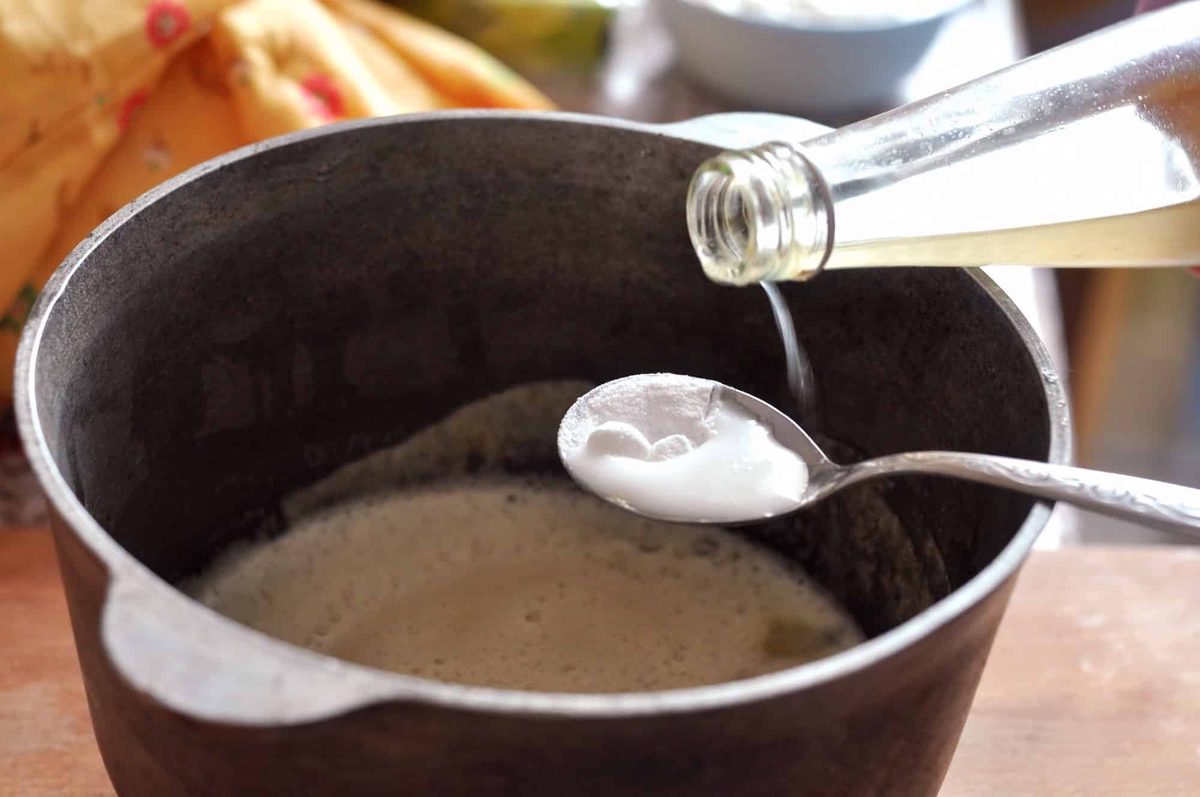
Too much vinegar makes a dish sharp and puckery, and the fix depends on what you’re making. In a sauce, dressing or stew, dilute it first, then soften what’s left with a little sweetness or salt, the two tastes with evidence that they reduce sourness. In home-canned pickles, don’t dilute at all: the vinegar is what makes them safe.
Quick answer
| What’s wrong | Fastest fix | If that’s not enough |
|---|---|---|
| Salad dressing or vinaigrette too sharp | Add more oil and other ingredients, leaving the vinegar out | A pinch of sugar or salt, or a little honey |
| Sauce, stew or braise too sour | Add more of the other ingredients or unsalted stock | A little sugar; a pinch of salt |
| Tomato sauce too tart | A small amount of sugar | Baking soda only in tiny amounts, and expect a flatter taste |
| Pickles for canning too sour | Add sugar; never dilute the vinegar | Find a tested recipe written for a milder pickle |
Dilute: the fix that lowers the acid
Add more of everything but the vinegar. In a dressing, that means more oil, mustard, herbs and whatever else is in it. In a sauce or stew, add more of the main ingredients or some unsalted stock. Two equal batches, one with no vinegar, combine into half the acidity per spoonful.
Pour some off first if you’ll have too much. With a dressing, you can pour off part of the overly sharp batch before diluting the rest, so you aren’t left with a quart of vinaigrette. You’ll lose some precision, but it saves ingredients.
Fat. Extra olive oil in a vinaigrette is really dilution: the vinegar becomes a smaller share of the whole. In other dishes, a little extra oil, butter or cream can round out a sharp sauce. We found no source showing that fat reduces how sour something tastes, so treat this as cooking judgment.
Balance: sweetness and salt
Sweetness. In a 2010 taste-mixture study, sucrose significantly reduced the intensity of each of the other basic tastes it was mixed with, sourness included, and was the strongest suppressor overall.1 The sour stimulus in that study was citric acid, not vinegar, and the authors caution that results from pure solutions may not hold in real foods.1 In practice, a pinch of sugar or a little honey can take the edge off a dressing or sauce that’s only slightly too sharp. Add too much and you’ll have a sweet-and-sour dish, which works in some recipes and not others. Liquid sweeteners also thin a dressing or sauce.
Salt. In a 1967 study of salt and citric acid, salt sharply reduced how sour the mixtures tasted, both in water and in a green bean purée.2 A pinch of salt in a too-sharp dressing is worth trying before reaching for more sugar, if the dish can take it. Again, the acid tested wasn’t vinegar.
Baking soda: it works, at a cost
Baking soda does chemically neutralize vinegar. When the two react, they form water, carbon dioxide (the fizz) and sodium acetate, which is a salt.3 So the reaction doesn’t turn vinegar into plain water: it leaves a salt behind, and any baking soda that doesn’t react stays in the food.3
Neutralizing also flattens flavor. America’s Test Kitchen tested baking soda against sugar for taming the acidity of tomato sauce. Even an eighth of a teaspoon in 3 cups of sauce raised the pH sharply and left the sauce tasting flatter, while a quarter teaspoon of sugar left it bright and balanced, and tasters preferred the sugar.4 If you try baking soda, use a tiny pinch, stir, wait for the fizzing to stop and taste. In most cases, sugar or dilution is the better choice.
Fixes that don’t hold up
Adding chili heat. Hot spices are sometimes suggested to distract from sourness. In a study of chili users, capsaicin suppressed sweetness, but sourness was unaffected by capsaicin.5 Heat won’t make a sour dish taste less sour; it adds a second strong sensation on top. If the dish wants heat anyway, add it for flavor, not as a fix.
A potato or other starchy vegetable to absorb the acid. We found no test of a potato against too much vinegar. The well-known test of the potato trick for salt, Robert L. Wolke’s experiment as reported by Sara Moulton, found the potato simply soaked up the salty liquid around it rather than pulling out the salt.6 If potato, corn or sweet potato suits the dish, leave it in to eat; then it’s more food in the pot, which is dilution.
Pickles: don’t dilute the vinegar
Home-canned pickles are the one place where too much vinegar is a safety matter, not just a taste problem. Ohio State University Extension calls for white distilled or cider vinegar of 5% to 6% acidity, and warns that diluting the vinegar lowers the acid concentration and its preservative effect.7 It also says not to change the proportions of vinegar, salt or water in a tested recipe.7
If a pickle recipe tastes too sour, Ohio State’s advice is to add more sugar rather than diluting the vinegar.7 It also warns against using a sugar substitute unless the recipe was developed for it.7 For refrigerator pickles and quick salads that won’t be canned, the dilution and balancing fixes above apply.
Preventing it next time
Add vinegar in stages and taste. It’s far easier to add another splash than to correct a sour sauce. That’s common practice.
Taste dressings on what they’ll dress. Dip a leaf of the salad in before adding more vinegar or correcting it. That’s kitchen practice, not a measured rule.
Mind vinegar’s strength when swapping. Vinegar strength is given as percent acidity; canning recipes, for example, call for 5% to 6%.7 Check the label when you swap one vinegar for another.
Related
- Too much sugar
- Too much salt
- Too much tamarind
- Too much cream of tartar
- Vinegar powder
- Pickling salt
Footnotes
-
Green BG et al., Taste Mixture Interactions: Suppression, Additivity, and the Predominance of Sweetness, Physiology & Behavior, 2010. pmc.ncbi.nlm.nih.gov · Peer-reviewed ↩ ↩2
-
Pangborn RM, Trabue IM, Detection and apparent taste intensity of salt–acid mixtures in two media, Perception & Psychophysics, 1967 (abstract). doi.org · Peer-reviewed ↩
-
Vinegar and baking soda: a cleaning hack or just a bunch of fizz?, Nathan Kilah, The Conversation (republished by InDaily SA), 2024. indailysa.com.au · Publication ↩ ↩2
-
How to Make Tomato Sauce Less Acidic, America’s Test Kitchen. americastestkitchen.com · Publication ↩
-
Prescott J, Stevenson RJ, Effects of oral chemical irritation on tastes and flavors in frequent and infrequent users of chili, Physiology & Behavior, 1995 (abstract). researchers.mq.edu.au · Peer-reviewed ↩
-
Sara’s Kitchen Revelations: Oversalted it? There is one solution, Sara Moulton, saramoulton.com, 2012 (updated 2016), reporting Robert L. Wolke’s experiment. saramoulton.com · Publication ↩
-
Food Preservation: Quick-Process Pickles (HYG-5345), Megan Taylor, Ohio State University Extension, 2025. ohioline.osu.edu · Reference work ↩ ↩2 ↩3 ↩4 ↩5