Spice Substitutes · Substitutes
Barberry Substitutes for Zereshk Polow, Stuffings and Salads
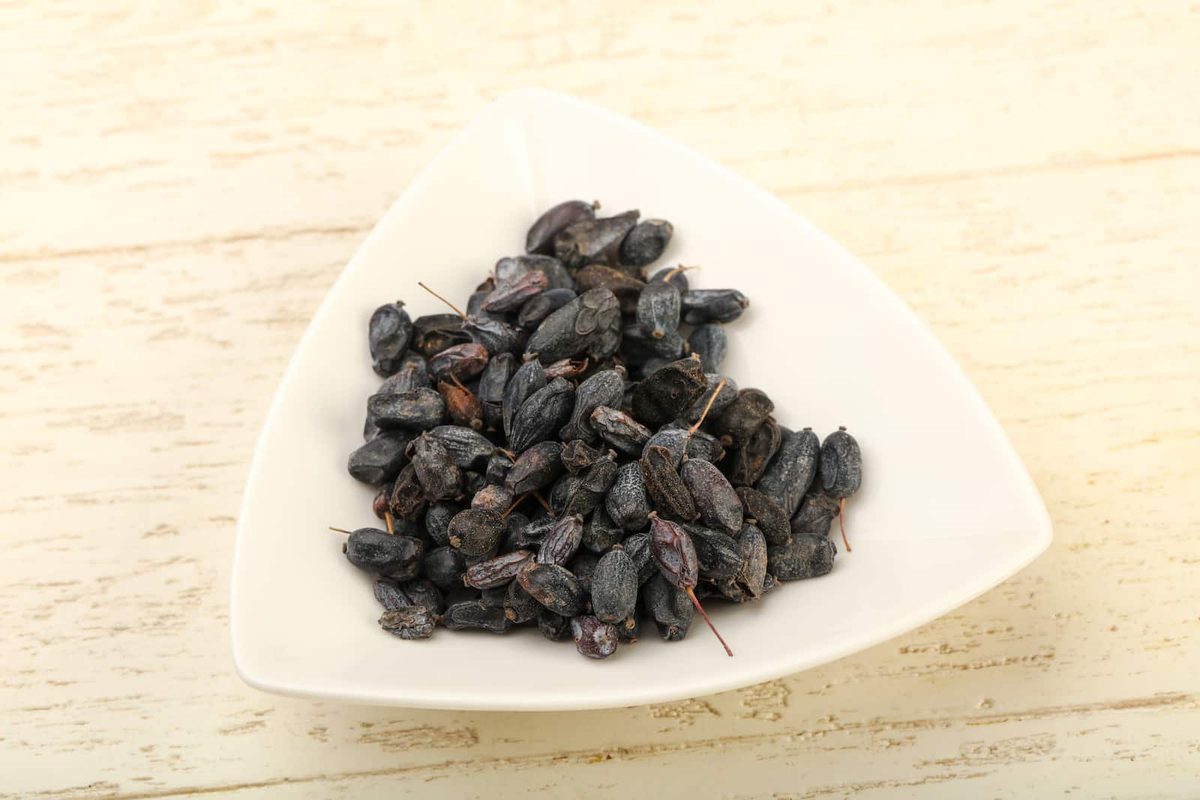
Barberries are the small, tart berries of Berberis shrubs; the common barberry, Berberis vulgaris, is native from Europe to western and northern Iran.1 Dried, they are sold under the Persian name zereshk, and their best-known use is zereshk polow, in which washed barberries are scattered over boiled rice.2 Iranian cooks also use them in soups, other rice dishes and chicken stuffing.2 What a substitute has to deliver is sharp sourness in a small, chewy, red piece of fruit. The acid in ripe barberries is mostly malic acid, according to a 2025 study.3
Quick answer
| What barberries are doing | Best substitute | Starting amount, per 1 part barberries | Treatment |
|---|---|---|---|
| Tart red “jewels” in rice or grain dishes | Unsweetened dried cranberries, chopped | 1 part by volume, then taste | Method |
| Tart fruit in a stuffing, braise or pilaf | Dried sour cherries, chopped | 1 part by volume, then taste | Method |
| Small fruit scattered through a salad | Currants soaked in lemon juice | 1 part currants, lemon to taste | Attributed (method), Method (amount) |
| Sourness without whole fruit | Sumac | A sprinkle, to taste | Method |
How the ratios on this page are labeled
Every ratio carries one of four labels.
- Computed: based on a measurable physical relationship, with the source named.
- Attributed: a named source publishes this ratio. We quote it as theirs.
- Disputed: named sources give different answers to the same swap. We show each one and do not average them.
- Method: we found no published ratio. We give a direction and a cautious starting point, and say so.
None of the sources we found gives an amount for any barberry substitute. The fruit swaps below are volume-for-volume starting points, which is the obvious place to begin with one small dried fruit in place of another, but they are not measured equivalents.
If barberries are tart jewels in rice or grains
Unsweetened dried cranberries
This is the closest match. America’s Test Kitchen says barberries’ flavor is similar to that of unsweetened dried cranberries, and that barberries are smaller, closer to currants in size, so they spread through a dish more easily.4 Food writer Beth Lee also suggests cranberries, chopped into smaller pieces if size matters.5
Where they fall short: most dried cranberries are sweetened, which works against the whole point of barberries. Look for unsweetened ones. If you can only get sweetened, our suggestion is to cut back any sugar the recipe adds. Many zereshk polow recipes already sweeten the berries: Nadia Sajadi’s sautés a cup of dried barberries in butter, then adds 2 tablespoons of sugar with saffron water.6 With sweetened cranberries, that sugar can go.
Ratio (Method): We found no published ratio. Use the same volume of chopped, unsweetened dried cranberries as barberries, and taste.
How to use them. Treat them as you would barberries. ATK suggests plumping barberries in hot water before adding them to rice, grain dishes or stuffing,4 and Sajadi’s recipe rinses them and sautés them briefly in butter.6 Both steps suit cranberries too, in our judgment, though sweetened ones can scorch faster.
If barberries are tart fruit in a stuffing, braise or pilaf
Dried sour cherries
Lee suggests chopped dried sour cherries as a substitute.5 In our judgment they are fleshier, darker and more fruity than barberries, which suits braises and stuffings for chicken, where barberries are also traditional,2 better than a delicate rice garnish. We did not find a source on their acid content, so we can’t say how close their sourness is.
Ratio (Method): No published ratio was found. Use the same volume, chopped to roughly barberry size, and taste. Check the label for added sugar.
If barberries are small fruit scattered through a salad
Currants soaked in lemon juice
Currants are a good size match; ATK compares barberries to currants in size.4 They are sweet rather than sour, so they need acid. Lee reports Yotam Ottolenghi’s suggestion: soak the currants in some lemon juice.5 We have this tip from Lee’s account and did not find Ottolenghi’s own text.
Ratio (Attributed method, Method amount): Neither Lee nor the Ottolenghi tip gives amounts.5 Start with the same volume of currants as barberries, add just enough lemon juice to moisten them, leave them for about 15 minutes, then drain and taste. The soaking time is our suggestion, not a tested one.
If you need sourness without whole fruit
Sumac
If the fruit itself isn’t essential, as in a soup or a finishing sprinkle, sumac gives a similar sharp sourness, with a shared acid. Its sour taste is attributed to malic acid,7 the same acid that dominates ripe barberries.3 Katzer describes sumac as tart and sour with slightly astringent overtones.8 Where it falls short: it is a powder, so you lose the chewy pieces and the jewel-like look, and Katzer notes that ground sumac is often mixed with salt.8
Ratio (Method): No published ratio exists for this swap, and it isn’t a like-for-like replacement. Sprinkle a little over the finished dish, or stir a pinch into a soup near the end, and taste.
What isn’t known
- No credible source we found publishes an amount for any barberry substitute.
- No measurement compares the sourness of barberries with cranberries, sour cherries or lemon-soaked currants. We found acid data only for barberries (malic acid dominant)3 and sumac (sourness attributed to malic acid).7
- We found Ottolenghi’s currant tip only as reported by another writer.
- Goji berries and rose hips are sometimes suggested as substitutes. We found no credible source comparing either with barberries, so they are not ranked here.
Related
- Barberry
- Sumac, cooking with sumac and sumac substitutes
- Saffron and advieh, two other ingredients of Persian cooking
- Anardana substitutes, for another tart dried fruit
- Cranberry sauce spices
Footnotes
-
Berberis vulgaris L., Plants of the World Online, Royal Botanic Gardens, Kew. powo.science.kew.org · Reference work ↩
-
Prods Oktor Skjærvø and Wolfgang Frey, “Barberry”, Encyclopaedia Iranica. iranicaonline.org · Reference work ↩ ↩2 ↩3
-
Ghasemi et al., “Investigating Some Physicochemical Characteristics of Seedless Barberry (Berberis vulgaris) Fruits in Three Geographical Regions of Iran”, Agrotechniques in Industrial Crops, 2025. atic.razi.ac.ir · Peer-reviewed ↩ ↩2 ↩3
-
“What Are Dried Barberries?”, America’s Test Kitchen. americastestkitchen.com · Publication ↩ ↩2 ↩3
-
Beth Lee, “Barberries: Edible Persian Jewels also known as Zereshk”, OMG! Yummy. omgyummy.com · Publication ↩ ↩2 ↩3 ↩4
-
Nadia Sajadi, “Barberry rice (zereshk polow)”, SBS Food. sbs.com.au · Publication ↩ ↩2
-
Alsamri et al., “Pharmacological and Antioxidant Activities of Rhus coriaria L. (Sumac)”, Antioxidants, 2021. mdpi.com · Peer-reviewed ↩ ↩2
-
Gernot Katzer, “Sumac (Rhus coriaria L.)”, Gernot Katzer’s Spice Pages. gernot-katzers-spice-pages.com · Reference work ↩ ↩2