Spice Substitutes · Substitutes
Sumac Substitutes, Ranked by the Job Sumac Is Doing
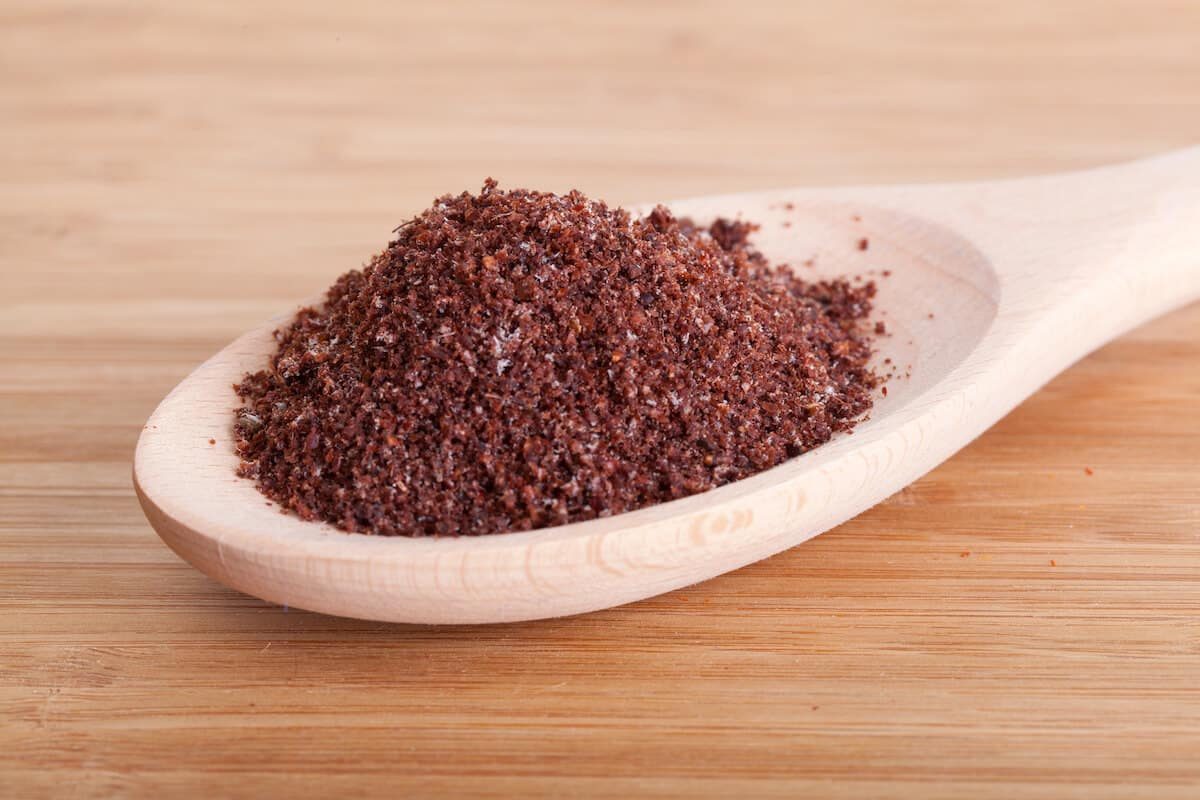
Sumac is the dried fruit of Rhus coriaria, ground to a dark red powder.1 Gernot Katzer describes its taste as tart and sour with slightly astringent overtones,2 and one review credits the sourness mainly to malic acid.1 Katzer calls it a very popular condiment in Turkey and Iran, where it is often mixed with salt and sprinkled liberally over rice.2 No substitute copies it exactly, because none brings the same acid, the same astringency and the same red color together. The right swap depends on which of those your dish needs.
Quick answer
| What sumac is doing | Best substitute | Starting amount, per 1 part sumac | Treatment |
|---|---|---|---|
| Dry, sour finish (salads, kebabs, rice, eggs) | Finely grated lemon zest | 1 part, then taste | Attributed |
| Sourness inside a wet dish (dressings, marinades, stews) | Lemon juice or wine vinegar | 1/2 part, then add to taste | Attributed |
| Sour and herbal (flatbread, roast vegetables) | Za’atar that lists sumac | 1 part, after tasting the blend | Attributed |
| Sour seasoning on meat or fish, salt welcome | Lemon pepper | 1/2 part, cut other salt | Attributed |
How the ratios on this page are labeled
- Computed: based on a measurable physical relationship, with the source named.
- Attributed: a named source publishes this ratio. We quote it as theirs.
- Disputed: named sources give different answers to the same swap. We show each and do not average them.
- Method: we found no published ratio. We give a direction and a cautious starting point, and say so.
The only sumac ratios we could trace come from one merchant, The Spice House, and it does not say how they were arrived at. Its general advice is to start with less than the recipe amount.3 No published study compares the sourness of sumac with any of these substitutes.
If sumac is a dry, sour finish
This is sumac as a sprinkle: over a salad, on grilled meat, stirred into sliced onions. You want tartness without adding liquid.
1. Lemon zest
In our kitchen judgment, zest gives the lemony impression sumac gives without wetting the dish. It will not add sumac’s astringency or its color.
Ratio (Attributed): The Spice House says you can start 1:1 with lemon zest.3
Dried lemon peel (Computed): If you have dried peel instead of fresh zest, NDSU Extension gives 1 teaspoon dried lemon peel as equal to 1 to 2 teaspoons grated fresh peel.4 So start with half as much dried peel as you would fresh zest.
2. Amchur (dried mango powder)
Amchur is a dry, sour powder, which makes it a natural stand-in for a dry, sour powder. Katzer attributes its sourness to citric acid and related compounds and says it is used when only a hint of tartness is wanted.5 He also calls its taste subtle and resin-like.5
Ratio (Method): We found no published ratio. Start with about half the sumac amount, taste, and add more. It is milder in color and will not turn the dish red.
3. Ground anardana (dried pomegranate seeds)
Anardana is another dry souring agent. Susan Jung describes it as astringent and used quite sparingly.6 Astringency is the part of sumac’s taste that lemon zest lacks.
Ratio (Method): No published ratio was found. Grind it fine and start with about half the sumac amount.
4. Powdered loomi (dried lime)
Katzer notes that powdered loomi is used to flavor rice as an alternative to sumac.7 Expect a musky, bitter edge that sumac does not have; that description is ours.
Ratio (Method): No published ratio was found. Start with a quarter to half the sumac amount, because loomi’s bitterness builds quickly.
If sumac is souring a wet dish
In a dressing, a marinade or a pot of stew, the sumac dissolves into the liquid and you mostly taste its acid. Here a liquid acid does the job well.
1. Lemon juice
Katzer gives lime juice about 8 percent citric acid and says lemon juice is similar in acidity.7 Lemon juice therefore swaps sumac’s malic-acid sourness for citric-acid sourness. Both are sour, but they are different acids, and the dish loses the astringency.
Ratio (Attributed): The Spice House says to use about half the volume of lemon juice and add more to taste.3
2. Wine or apple cider vinegar
Ratio (Attributed): The Spice House gives the same advice as for lemon juice: about half the volume, then add more to taste.3 Vinegar brings its own sharp aroma, so it suits marinades better than a delicate salad. That is a kitchen judgment.
3. Tamarind
Tamarind pulp is rich in tartaric acid and contains other organic acids, and one study describes ripe tamarind’s appeal as its acidic sweetness.8 It is darker and sweeter than sumac, so it suits stews and sauces better than pale dishes.
Ratio (Attributed): The Spice House says to use about half and adjust.3 Its page does not say whether it means paste, concentrate or pulp, and these differ in strength.
If sumac is part of an herbal blend
Za’atar
Many za’atar blends contain sumac, so using one puts sumac back in the dish. How much sumac they contain varies widely. America’s Test Kitchen uses 1 1/2 tablespoons of sumac with 2 tablespoons of thyme, 1 tablespoon of oregano and 1 tablespoon of sesame seeds.9 The Spice House’s small-batch version uses 1/4 teaspoon of sumac to 1 teaspoon of thyme plus oregano, marjoram and sesame.10 The first is much more sour than the second.
Ratio (Attributed): The Spice House says you can start 1:1 with za’atar, but to taste first, because it adds thyme, sesame and sometimes extra salt.3 Check the label for sumac; a blend without it will add no sourness.
If sumac is seasoning meat or fish
Lemon pepper
Commercial lemon pepper is mostly salt and pepper with a lemon note. The McCormick label lists salt first, then black pepper and citric acid, with lemon oil near the end.11 The Spice House’s version lists pepper, salt, monosodium glutamate, citric acid, garlic, lemon peel and onion.12 The label of McCormick’s Signature Seasonings Lemon Pepper gives 170 mg of sodium per 1/4 teaspoon.13 Lemon pepper therefore changes the salt level of the dish, not only its sourness.
Ratio (Attributed): The Spice House says to use about half as much lemon pepper and adjust.3 Reduce any other salt in the recipe.
What none of these replaces
Sumac’s deep red is part of its job on a white plate of hummus or yogurt. None of the substitutes above reproduces it. A pinch of sweet paprika gives color without sourness; that is a kitchen judgment, not a sourced pairing.
What isn’t known
- No published measurement compares the sourness of sumac with lemon zest, lemon juice, vinegar, amchur, anardana, loomi or tamarind. Every ratio above is a rule of thumb.
- No published ratio was found for amchur, anardana or loomi in place of sumac.
- It is often said that sumac was used for sourness in the region before lemons arrived. No source reviewed here supports that account.
- Za’atar blends range from sumac-forward to barely sour, and no source measures the sumac share of a typical store-bought blend.
Related
- Sumac, sumac uses and cooking with sumac
- Za’atar and za’atar substitutes
- Lemon pepper and lemon pepper substitutes
- Mango powder (amchur), anardana, loomi and barberry
- Too much tamarind? and too much vinegar?
Footnotes
-
Alsamri et al., Pharmacological and Antioxidant Activities of Rhus coriaria L. (Sumac), Antioxidants, 2021. mdpi.com · Peer-reviewed ↩ ↩2
-
Sumac, Gernot Katzer’s Spice Pages. gernot-katzers-spice-pages.com · Reference work ↩ ↩2
-
Sumac Substitute, The Spice House, 2018. thespicehouse.com · Merchant ↩ ↩2 ↩3 ↩4 ↩5 ↩6 ↩7
-
Garden-Robinson, Ingredient Substitutions (FN198), NDSU Extension. ksre.ksu.edu · Reference work ↩
-
Mango, Gernot Katzer’s Spice Pages. gernot-katzers-spice-pages.com · Reference work ↩ ↩2
-
Jung, How to use dried pomegranate seeds, or anardana, South China Morning Post, 2025. scmp.com · Publication ↩
-
Lime, Gernot Katzer’s Spice Pages. gernot-katzers-spice-pages.com · Reference work ↩ ↩2
-
Ayala-Silva et al., Characterization of Tamarindus indica grown in Florida, Journal of Agriculture of the University of Puerto Rico, 2016. revistas.upr.edu · Peer-reviewed ↩
-
Roof, Za’atar, America’s Test Kitchen, 2017. americastestkitchen.com · Publication ↩
-
Za’atar Substitute, The Spice House, 2020. thespicehouse.com · Merchant ↩
-
McCormick Lemon & Pepper Seasoning, McCormick. mccormick.com · Merchant ↩
-
Lemon Pepper Seasoning, The Spice House. thespicehouse.com · Merchant ↩
-
McCormick Signature Seasonings Lemon Pepper, label via Stop & Shop. stopandshop.com · Merchant ↩