Cooking · Dish guide
The Best Spices for Cranberry Sauce, and What Three Tested Recipes Actually Use
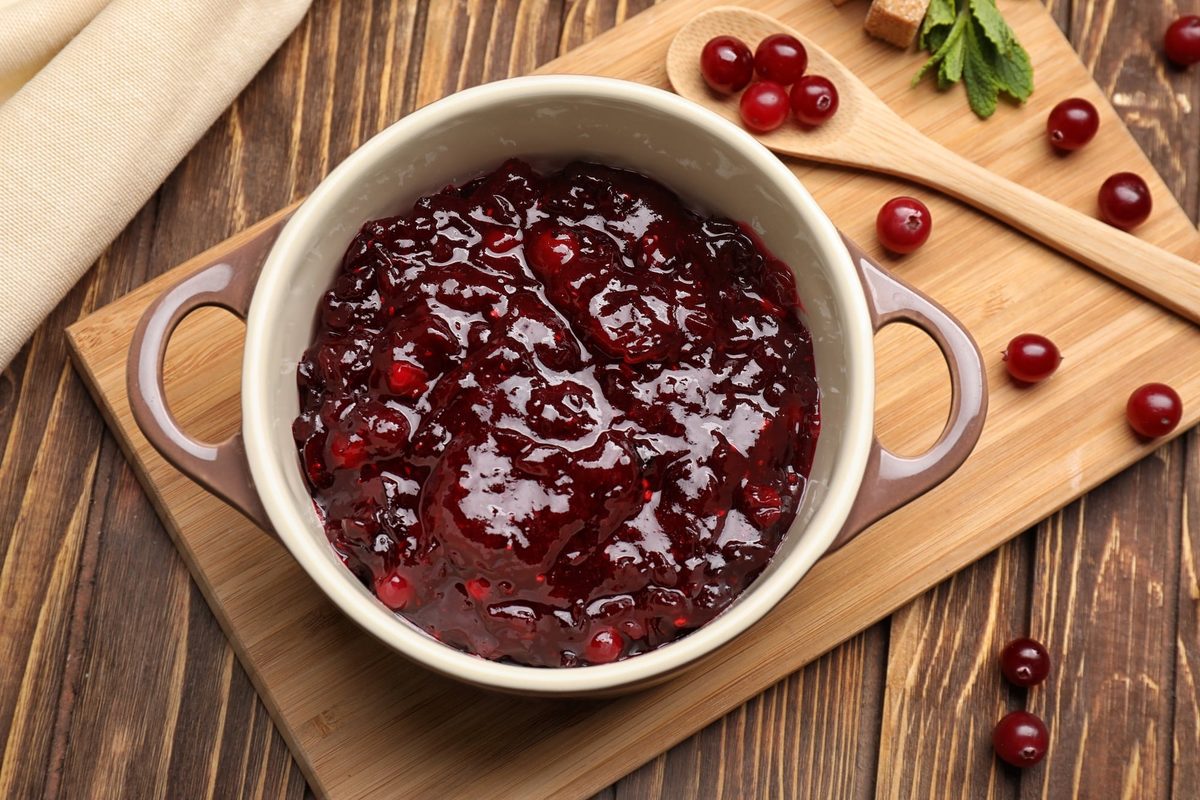
Cranberry sauce needs two things from its seasonings: sweetness to tame a very sour berry, and something aromatic to round it out. Britannica describes cranberries as tart fruits with an acid taste, traditionally served as sauce or relish at U.S. and Canadian Thanksgiving and Christmas meals.1 The one flavoring nearly every recipe agrees on is orange. Beyond that, cinnamon is the most common spice, with ginger and cloves as the usual additions. This page shows what three named recipes use, what each spice contributes, and when to add it. Quantities appear only where a named recipe gives them.
At a glance
| Seasoning | Job in the sauce | In the recipes below |
|---|---|---|
| Sugar, brown sugar or honey | Balances the acid | All three234 |
| Orange (zest, juice or whole fruit) | Fruity, bright background | All three234 |
| Cinnamon | Warm, sweet spice | Two of three34 |
| Ginger | Pungent bite | One (fresh, grated)4 |
| Cloves | Strong, pungent depth; use sparingly | One (1/8 tsp ground)4 |
| Salt | Seasoning | One4 |
| Allspice, nutmeg | Optional warm notes | None of the three |
The fruit
The American cranberry is Vaccinium macrocarpon, a low subshrub in the heath family, Ericaceae, native from eastern Canada to the north-central and eastern United States.51 Britannica lists Massachusetts, New Jersey and Wisconsin among the main growing areas, along with Washington and Oregon.1 Its sourness is the problem every cranberry sauce recipe is solving.
Three recipes side by side
| Utah State Extension2 | Texas A&M AgriLife Extension3 | Stephanie Hua, KQED4 | |
|---|---|---|---|
| Cranberries | 3 cups (12 oz) | 12 oz | 12 oz |
| Sweetener | 1 cup sugar | 1/4 cup honey, plus 2 pears | 1 cup brown sugar |
| Orange | 1 whole orange, peeled | 1/4 cup orange juice, 1/2 tsp zest | 1/2 cup orange juice, zest of 1 orange |
| Spices | None | 1/2 tsp ground cinnamon | 1/2 tsp ground cinnamon, 1 tbsp grated fresh ginger, 1/8 tsp ground cloves |
| Other | 1/2 cup water | 1/2 tsp salt | |
| When spices go in | n/a | Stirred in off the heat, after cooking3 | Everything into the pan together4 |
These are the publishers’ own recipes, not a house standard. The plainest version, Utah State’s, is just cranberries, sugar and an orange, blended and heated.2 Spice is an addition, not a requirement.
The spices and what each one does
Orange: the constant
All three recipes use orange in some form: a whole peeled orange blended in,2 juice and zest,3 or juice with the zest of a whole orange.4 Lemon zest is a reasonable variation, but none of these recipes uses it.
Cinnamon: the most common spice
Two of the three recipes use 1/2 teaspoon of ground cinnamon.34 Neither uses a stick. A stick works if you simmer the sauce and remove it before serving; that is a cooking option, not something these recipes call for.
Ceylon cinnamon (Cinnamomum verum) is native to Sri Lanka,6 but most cinnamon sold in North America is cassia, according to NCCIH.7 Cassia contains coumarin, which matters for heavy daily use: Germany’s BfR says a 60 kg adult reaches the tolerable daily intake at about 2 g of average cassia a day.8 The recipes above use 1/2 teaspoon for a whole batch.34 See Ceylon vs. cassia cinnamon and cinnamon sticks vs. ground cinnamon.
Ginger: pungency against the acid
Ginger’s bite comes from its gingerols, non-volatile phenolic compounds.9 Kew gives its native range as the eastern Himalaya to south-central China.10 The KQED recipe uses a full tablespoon of grated fresh ginger, the largest spice quantity in any of the three.4 See fresh vs. ground ginger and too much ginger.
Cloves: a small amount goes far
Cloves are the dried flower buds of Syzygium aromaticum, native to Maluku.11 Britannica describes them as strong in aroma and hot and pungent in taste,12 and most of that aroma is eugenol, 70 to 90% of the bud oil.13 The KQED recipe uses only 1/8 teaspoon of ground cloves against a full 12 ounces of berries.4 Whole cloves in a sachet are easier to control. See ground vs. whole cloves and too much clove.
Allspice and nutmeg: optional
None of the three recipes uses allspice or nutmeg, so treat them as variations. Allspice is the dried berry of Pimenta dioica, native to southern Mexico, Central America and the Caribbean,14 and Britannica says it is named for a flavor resembling cinnamon, nutmeg and cloves.15
Nutmeg is native to the Banda Islands in Maluku.16 PROSEA estimates that about 60% of the nutmeg and mace on the world market comes from Indonesia.17 Britannica describes its taste as warm and slightly sweet.18 A widely repeated claim says West Indian nutmeg is more flavorful than other origins; no source here supports a ranking. See allspice vs. nutmeg and allspice vs. cloves.
When to add the spices
The two spiced recipes differ:
| Approach | Source |
|---|---|
| Cook the berries first, then stir in cinnamon, orange juice and zest off the heat | Texas A&M AgriLife Extension3 |
| Put everything, spices included, in the pan together | KQED, Stephanie Hua4 |
Both work. A practical starting point (Method, not a measured rule): simmer whole spices with the berries and remove them, or add ground spices near the end and taste, since ground cloves in particular are hard to take back out. The Texas A&M recipe notes that the sauce keeps thickening as it cools.3
Related
- Christmas spices
- Spices for turkey and turkey gravy spices
- Thanksgiving herbs and spices
- Good stuffing spices
- Apple pie spice and pumpkin pie spice
- The master list of herbs and spices
Footnotes
-
“Cranberry”, Encyclopaedia Britannica, updated 2026. britannica.com · Reference work ↩ ↩2 ↩3
-
“Homemade Cranberry Sauce”, Utah State University Cooperative Extension, via MyPlate (USDA). myplate.gov · Regulator ↩ ↩2 ↩3 ↩4 ↩5
-
“Simple Cranberry Sauce”, Texas A&M AgriLife Extension, EFNEP. efnep.tamu.edu · Reference work ↩ ↩2 ↩3 ↩4 ↩5 ↩6 ↩7 ↩8 ↩9 ↩10
-
Stephanie Hua, “Orange and Ginger Spiced Cranberry Sauce”, KQED Bay Area Bites, 2011. kqed.org · Publication ↩ ↩2 ↩3 ↩4 ↩5 ↩6 ↩7 ↩8 ↩9 ↩10 ↩11 ↩12 ↩13 ↩14
-
“Vaccinium macrocarpon Aiton”, Plants of the World Online, Royal Botanic Gardens, Kew. powo.science.kew.org · Reference work ↩
-
“Cinnamomum verum J.Presl”, Plants of the World Online, Royal Botanic Gardens, Kew. powo.science.kew.org · Reference work ↩
-
“Cinnamon: Usefulness and Safety”, NCCIH, 2024. nccih.nih.gov · Regulator ↩
-
“Cassia cinnamon with high coumarin contents to be consumed in moderation”, BfR. bfr.bund.de · Regulator ↩
-
Sutarno, Hadad and Brink, “Zingiber officinale”, PROSEA. uses.plantnet-project.org · Reference work ↩
-
“Zingiber officinale Roscoe”, Plants of the World Online, Royal Botanic Gardens, Kew. powo.science.kew.org · Reference work ↩
-
“Syzygium aromaticum (L.) Merr. & L.M.Perry”, Plants of the World Online, Royal Botanic Gardens, Kew. powo.science.kew.org · Reference work ↩
-
“Clove”, Encyclopaedia Britannica. britannica.com · Reference work ↩
-
Verheij and Snijders, “Syzygium aromaticum”, PROSEA. uses.plantnet-project.org · Reference work ↩
-
“Pimenta dioica (L.) Merr.”, Plants of the World Online, Royal Botanic Gardens, Kew. powo.science.kew.org · Reference work ↩
-
“Allspice”, Encyclopaedia Britannica. britannica.com · Reference work ↩
-
“Myristica fragrans Houtt.”, Plants of the World Online, Royal Botanic Gardens, Kew. powo.science.kew.org · Reference work ↩
-
Flach and Tjeenk Willink, “Myristica fragrans”, PROSEA. uses.plantnet-project.org · Reference work ↩
-
“Nutmeg”, Encyclopaedia Britannica. britannica.com · Reference work ↩