Spices · Profile
Black Cardamom: The Smoky Himalayan Cardamom and How to Use It
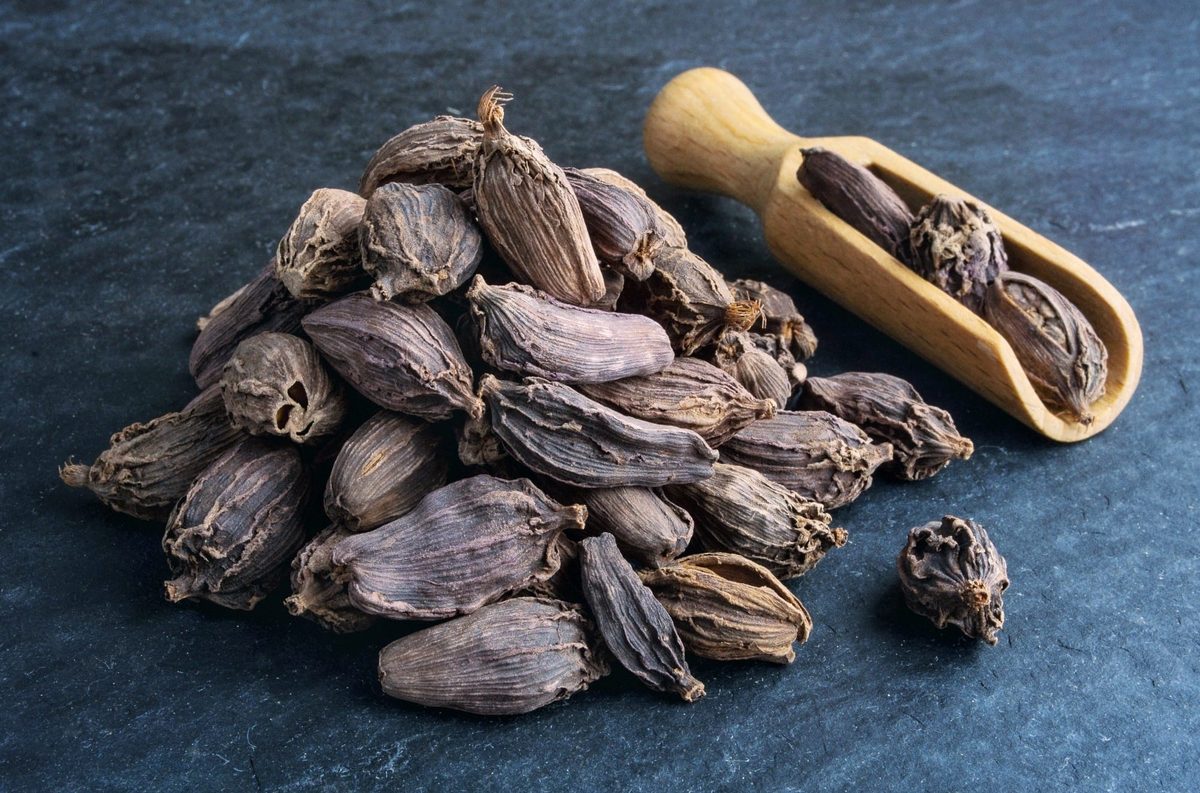
Black cardamom is the dried fruit of Amomum subulatum, a ginger-family plant of the eastern Himalaya, sold in India as large cardamom.12 It is a different plant from the green cardamom of baking and chai, and it tastes different too: smoky and camphor-like, because the pods are traditionally dried over a wood fire.23 This page covers what it is, where the smoke comes from, where it grows, and how cooks use it.
At a glance
| Botanical name | Amomum subulatum Roxb.12 |
| Plant family | Zingiberaceae (ginger family)1 |
| Other name | Large cardamom (the name used by India’s spice agencies)24 |
| Part used | The dried fruit (capsule) and its seeds |
| Native range | Nepal to central China, including the eastern Himalaya, Assam, Tibet and Myanmar1 |
| Main Indian growing areas | Sikkim, Darjeeling and Arunachal Pradesh2 |
| India, 2024-25 (final) | 9,552 tonnes from 46,017 hectares4 |
| Main oil component | 1,8-Cineole2 |
| Why it tastes smoky | Traditional drying over wood fires in a “bhatti”23 |
What black cardamom is
Amomum subulatum is a perennial herb of the ginger family, growing about 1.5–2.5 m tall, found at 800–2,000 m elevation, and cultivated mainly in the northeastern Himalayan region of India.2 Kew gives its native range as Nepal to central China and lists no areas where it has been introduced.1
It is not a dark form of green cardamom. Green cardamom is Elettaria cardamomum, a separate genus native to southwest India.5 PROSEA notes that substitutes for true cardamom, the so-called false cardamoms, sometimes appear in trade.6 See black vs. green cardamom for a side-by-side comparison, and Thai cardamom for another Amomum spice.
Names such as “Nepal cardamom” and “brown cardamom” circulate widely; we did not find them in the sources reviewed for this page, which use “large cardamom.”
Why it tastes smoky
The smoke is added after harvest, not grown into the pod. ICAR’s Indian Institute of Spices Research describes the traditional curing process as using flame heat over pits, which gives the pods their dark brown color.2 A patent from India’s Central Food Technological Research Institute (CFTRI) explains the system in more detail: freshly harvested wet pods are spread 20–25 cm deep on a platform, firewood is burned below, and air carrying smoke passes up through the bed of capsules for two to three days, with occasional stirring.3 Cardamom dried this way, it says, is dark brown with a strong smoky odor from direct contact with the smoke, and the heat may change both the original aroma and the chemical composition.3 The smoke odor carries into oil distilled from the pods, which is why CFTRI patented a way to remove it.3 According to the same source, most large cardamom is still dried by the traditional bhatti system.3
Flavor and the compounds behind it
ICAR-IISR describes the flavor as strong, smoky and slightly camphoraceous, and names 1,8-cineole as the main component of its essential oil.2 1,8-Cineole has a camphor-like odor,7 which fits that description. To us it tastes resinous and cooling under the smoke, with a dry, slightly astringent finish; that part is editorial. We found no figure for the oil content of the pods or for the share of 1,8-cineole in the oil from a source we could open.
Where it is grown
Kew’s distribution covers Assam, Bangladesh, south-central and southeastern China, the eastern Himalaya, India, Myanmar, Nepal and Tibet.1 In India, ICAR-IISR names Sikkim, Darjeeling and Arunachal Pradesh as the main producers.2
The Spices Board of India gives large cardamom at 9,552 tonnes from 46,017 hectares in 2024-25 (final), and an advance estimate of 9,831 tonnes from 46,472 hectares for 2025-26.4 The three seasons before were 8,812 t (2021-22), 9,075 t (2022-23) and 9,288 t (2023-24).4 Cardamom figures in that table are the Board’s own estimates and are subject to revision.4 We found no official production figures for Nepal or Bhutan to compare.
Claims that black cardamom is grown commercially in Somalia, Cameroon or on the China–Vietnam border could not be traced to a source.
How black cardamom is used
ICAR-IISR says large cardamom is widely used in rice dishes, curries, meat preparations and spice blends, with whole pods going into biryani and rice preparations and the ground spice into masala blends and garam masala.2 Its smoky character makes it a savory spice; we found no source describing traditional sweet uses. For garam masala itself, see garam masala.
These are cooking judgments, not measured facts. Whole pods are usually cracked and added early to a braise, dal or pot of rice and removed before serving; one or two pods flavor a large pot. Toasting the pods briefly in a dry pan before grinding sharpens their aroma. The seeds can be scraped out and ground on their own for a less woody result.
Black cardamom is sometimes said to appear in versions of Chinese five-spice powder. Britannica’s list of the five spices (fennel seeds, cassia, cloves, star anise and Sichuan pepper) does not include it,8 and we found no source for a Chinese use of Amomum subulatum specifically.
Buying and storage
Good pods are large, intact, dark brown and strongly smoky when cracked; that is kitchen judgment. ICAR-IISR notes that the dark brown color itself is a product of the flame curing.2 We found no grading standard or shelf-life figure from a regulator or standards body. Store pods whole, sealed and away from heat, and grind as needed, as with other whole spices.
Health claims
Black cardamom is widely credited online with anti-inflammatory, anticancer, anti-obesity and anti-diabetic effects, and with being a rich source of potassium and fiber. We found no systematic review or regulator assessment of Amomum subulatum in people, and no nutrient data from USDA FoodData Central, so this page makes no health claims for it. Claims of use in traditional Chinese medicine, Ayurveda and Unani, and of use by ancient Arabs, Greeks and Romans, could not be traced either.
Substitutes and comparisons
Green cardamom gives the camphor and floral notes without the smoke; a little smoked paprika or a pinch of a smoky spice can stand in for the smoke. That is cooking judgment, and no source we found gives a tested ratio. See black cardamom substitutes for the ranked list, black vs. green cardamom for how they differ, and cardamom for the green spice.
Footnotes
-
Amomum subulatum Roxb., Plants of the World Online, Royal Botanic Gardens, Kew. powo.science.kew.org · Reference work ↩ ↩2 ↩3 ↩4 ↩5 ↩6
-
“Large cardamom”, ICAR-Indian Institute of Spices Research. spices.res.in · Regulator ↩ ↩2 ↩3 ↩4 ↩5 ↩6 ↩7 ↩8 ↩9 ↩10 ↩11 ↩12 ↩13
-
Patent IN245040, smoky odour free large cardamom volatile oil, CSIR-CFTRI, via India Science, Technology & Innovation portal. indiascienceandtechnology.gov.in · Regulator ↩ ↩2 ↩3 ↩4 ↩5 ↩6
-
Spice wise area and production in India, 2021-22 to 2025-26, Spices Board India. indianspices.com · Regulator ↩ ↩2 ↩3 ↩4 ↩5
-
Elettaria cardamomum (L.) Maton, Plants of the World Online, Royal Botanic Gardens, Kew. powo.science.kew.org · Reference work ↩
-
T.H. Wardini and A. Thomas, Elettaria cardamomum, Plant Resources of South-East Asia (PROSEA). uses.plantnet-project.org · Reference work ↩
-
1,8-Cineole (CID 2758), PubChem, U.S. National Library of Medicine. pubchem.ncbi.nlm.nih.gov · Reference work ↩
-
Tony Hill, “Five-spice powder”, Encyclopaedia Britannica. britannica.com · Reference work ↩