Spice Comparisons · Comparison
Black vs. Green Cardamom: Two Plants, Smoke vs. Perfume
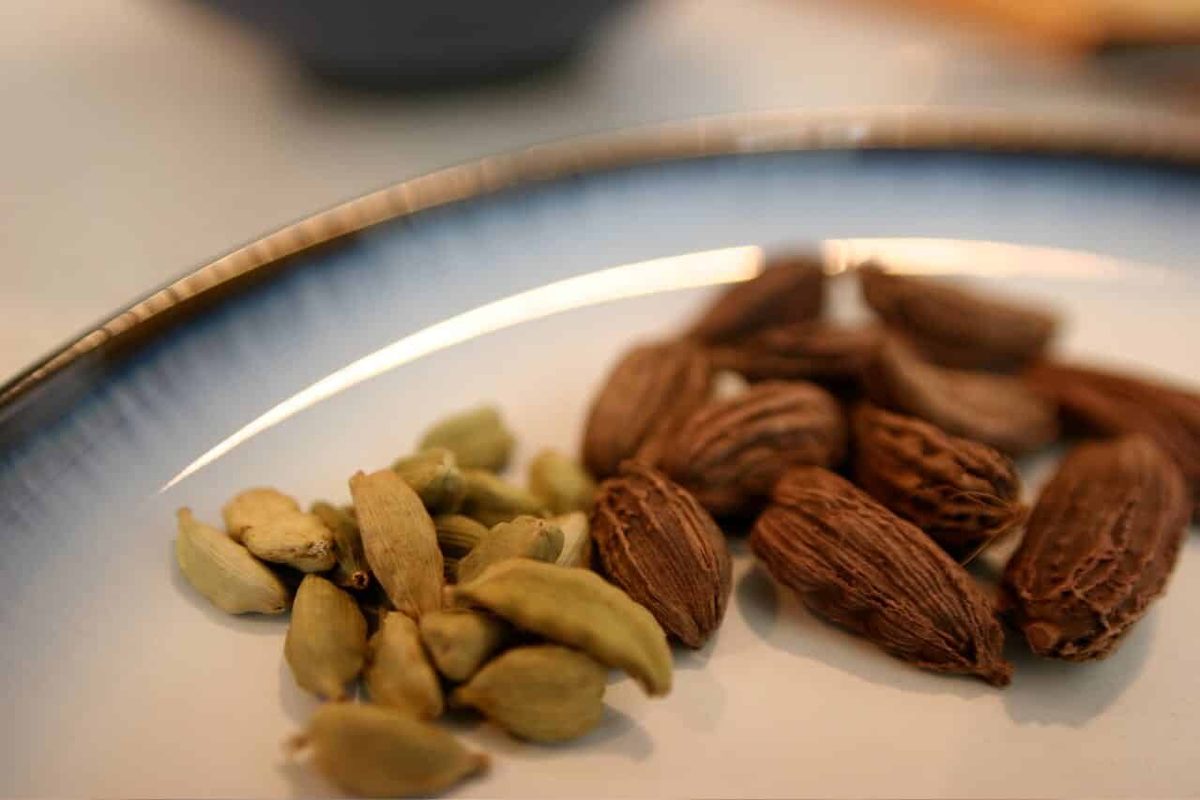
Black cardamom is not a darker green cardamom. It is the dried fruit of a different plant, Amomum subulatum, sold in India as large cardamom, while green cardamom is Elettaria cardamomum.123 Both are in the ginger family, and both carry 1,8-cineole, a compound with a camphor-like smell.345 The difference a cook notices is smoke: black cardamom is traditionally dried over fire, which gives it a strong, smoky, slightly camphoraceous flavor that suits savory dishes, while green cardamom goes into curries and rice dishes but also into pastries, coffee and tea.356
Side by side
| Black cardamom | Green cardamom | |
|---|---|---|
| Species | Amomum subulatum (large cardamom)13 | Elettaria cardamomum (small cardamom)27 |
| Family | Zingiberaceae (ginger family)1 | Zingiberaceae (ginger family)2 |
| Native range | Nepal to central China1 | Southwest India2 |
| Where it is grown | Mainly the northeastern Himalayan region of India, especially Sikkim, Darjeeling and Arunachal Pradesh3 | Major suppliers: Guatemala, India, Sri Lanka and Tanzania5 |
| Indian production, 2024-25 (final) | 46,017 ha; 9,552 t7 | 70,410 ha; 20,696 t7 |
| Part used | Dried capsules (pods) and their seeds3 | Dried fruits (pods) and their seeds5 |
| Drying | Traditionally flame-cured over pits; smoke passes through the bed of pods38 | Picked green; flue-cured in curing rooms, or sun-dried and sometimes bleached in sulfur fumes5 |
| Key compounds | 1,8-Cineole is the main oil component; pyrazines from curing give the smoky aroma3 | Oil mainly 1,8-cineole and α-terpinyl acetate (see below)59 |
| Flavor | Strong, smoky and slightly camphoraceous (ICAR-IISR)3 | Fragrant and lemony (The Spice House)10 |
| Typical uses | Rice dishes, biryani, curries, meat preparations, Mughlai cooking, masala blends and garam masala3 | Curries, spiced rice, meat and vegetable dishes; coffee and tea; Scandinavian baked goods and pastries511 |
| Price | No dated, sourced retail comparison found | No dated, sourced retail comparison found |
Both production figures come from the same Spices Board table, so they compare like with like, but only for India.7 ICAR-IISR calls India the world’s largest producer and exporter of large cardamom;3 we found no figures for Nepal or Bhutan to check that against. For green cardamom, whether Guatemala or India is the bigger producer depends on the source and year, a disagreement laid out on our cardamom profile.
Where the smoke comes from
Black cardamom’s signature is a processing effect, not just a property of the plant. ICAR-IISR says its flavor comes from the traditional curing process, flame heat over pits, which also turns the pods dark brown.3 A government-listed patent from India’s Central Food Technological Research Institute describes the same traditional “bhatti” method: wet pods are spread about 20 to 25 cm deep over a platform, firewood burns below, and air and smoke pass through the bed; the result is dark brown with a strong smoky odor, and the patent notes that the bulk of large cardamom is still dried this way.8 It adds that the heat may change the original aroma and even the chemical composition.8 ICAR-IISR attributes the smoky aroma to pyrazines formed during curing.3
Green cardamom is handled to keep its color. PROSEA says the fruits are picked when fully developed but still green and are usually flue-cured in special curing rooms; sun-dried cardamom is sometimes bleached in sulfur fumes, and the trade sorts cardamom by appearance rather than origin.5 The pale “white cardamom” sometimes sold is that bleached product, not a third plant.
The chemistry they share, and where it differs
| Sample (scope) | 1,8-Cineole | α-Terpinyl acetate | Source |
|---|---|---|---|
| Green cardamom oil, general reference range | 20 to 60% | 20 to 53% | PROSEA5 |
| Green cardamom oil, eight commercial samples (2025 study) | 0.24 to 30.62% | 35.99 to 62.28% (the most abundant compound in every sample) | Blažeković et al. 20259 |
| Black cardamom oil | Named as the main component; no percentage found | not reported | ICAR-IISR3 |
1,8-Cineole has a camphor-like odor,4 and it is the compound both pods have in common. That is the chemical reason green cardamom is the usual first substitute for black. The two green-cardamom rows disagree widely on cineole; they are different samples measured at different times, so neither should be read as “the” figure. For black cardamom, we found no source that gives oil composition as percentages, so a like-for-like comparison is not possible.
Differences that change the dish
Sweet or savory. Green cardamom works in both: Britannica notes it in South Asian dishes and Scandinavian pastries, and PROSEA lists curries, spiced rice and meat dishes alongside coffee and tea.511 The Spice House says black cardamom, being smoke-dried, is better suited to braised meats and savory recipes.6 In our judgment its smoke would dominate a cake or custard.
Whole or ground. ICAR-IISR describes both uses for black cardamom: whole pods in biryani and rice dishes, and the ground spice in masala blends and garam masala.3 Whole pods are usually fished out or pushed aside at the table; that is common practice. For green cardamom, The Spice House says grinding the pods fresh gives the best aroma and flavor,10 and the 2025 study reported that whole fruit is of superior quality to the powdered form.9 See cardamom pods vs. seeds.
Which is stronger. Sources disagree, and nobody has measured it:
| Source | Which is stronger |
|---|---|
| The Spice House (merchant) | Black: a similar flavor to green, but stronger and slightly acrid6 |
| Tasting Table (Natasha Bailey) | Green: much more intense than black12 |
They may be describing different things, overall punch versus green cardamom’s bright, perfumed notes. That reading is ours.
Can one stand in for the other?
Partly, and in one direction more than the other. No named, credible source publishes a ratio for either swap, so both starting points below are Method.
- Green for black. Tasting Table says you can replace black cardamom with green, but the dish will taste different and will lack the smokiness.12 Our starting point, from black cardamom substitutes, is 2 green pods for each black pod, cracked, tasting before adding a third. If smoke matters, a small pinch of a smoked spice you already have can help; that is kitchen judgment.
- Black for green. Only in savory dishes, given the smoke.6 Our starting point, from cardamom substitutes, is one black pod in place of two or three green pods, cracked, then taste. Do not use it in baking, coffee or sweets.
- In spice blends. Great British Chefs lists cardamom among the spices commonly used in garam masala,13 and ICAR-IISR says ground black cardamom goes into masala blends and garam masala.3 Recipes differ on which cardamom they mean, so follow the recipe.
What isn’t known
- No source opened gives black cardamom’s essential oil composition as percentages.
- No production figures were found for Nepal or Bhutan, which are often described as major growers; ICAR-IISR’s claim that India leads is unchecked against them.
- Which pod is “stronger” is disputed and unmeasured.
- No published ratio exists for swapping one for the other.
- Whether smoke-drying leaves contaminants in black cardamom was not researched for this page.
Related
- Black cardamom and cardamom profiles
- Black cardamom substitutes and cardamom substitutes
- Cardamom pods vs. seeds and cardamom vs. cloves
- Thai cardamom
- Cooking with cardamom and too much cardamom
Footnotes
-
Amomum subulatum Roxb., Plants of the World Online, Royal Botanic Gardens, Kew. powo.science.kew.org · Reference work ↩ ↩2 ↩3 ↩4
-
Elettaria cardamomum (L.) Maton, Plants of the World Online, Royal Botanic Gardens, Kew. powo.science.kew.org · Reference work ↩ ↩2 ↩3 ↩4
-
“Large cardamom”, ICAR-Indian Institute of Spices Research. spices.res.in · Regulator ↩ ↩2 ↩3 ↩4 ↩5 ↩6 ↩7 ↩8 ↩9 ↩10 ↩11 ↩12 ↩13 ↩14 ↩15 ↩16
-
1,8-Cineole (CID 2758), Odor, PubChem. pubchem.ncbi.nlm.nih.gov · Reference work ↩ ↩2
-
T.H. Wardini and A. Thomas, Elettaria cardamomum, Plant Resources of South-East Asia (PROSEA). uses.plantnet-project.org · Reference work ↩ ↩2 ↩3 ↩4 ↩5 ↩6 ↩7 ↩8 ↩9 ↩10
-
Black Cardamom Pods, product page, The Spice House. thespicehouse.com · Merchant ↩ ↩2 ↩3 ↩4
-
Spice wise area and production in India, 2021-22 to 2025-26, Spices Board India. indianspices.com · Regulator ↩ ↩2 ↩3 ↩4
-
Patent IN245040, smokey odour free large cardamom volatile oil, CSIR-CFTRI, via India Science, Technology & Innovation portal. indiascienceandtechnology.gov.in · Regulator ↩ ↩2 ↩3
-
Blažeković et al., “Content and Chemical Composition of Essential Oil from Cardamom”, Croatica Chemica Acta, 2025. hrcak.srce.hr · Peer-reviewed ↩ ↩2 ↩3
-
“Cardamom Substitute”, The Spice House, 2017. thespicehouse.com · Merchant ↩ ↩2
-
Gregory Lewis McNamee, “Cardamom”, Encyclopaedia Britannica, 2026. britannica.com · Reference work ↩ ↩2
-
Natasha Bailey, “How Are Green And Black Cardamom Different?”, Tasting Table, 2022. tastingtable.com · Publication ↩ ↩2
-
“How to make garam masala”, Great British Chefs, 2025. greatbritishchefs.com · Publication ↩