Spices · Profile
Thai Cardamom (Krawan): The Round, Cineole-Rich Cardamom of Thailand and Cambodia
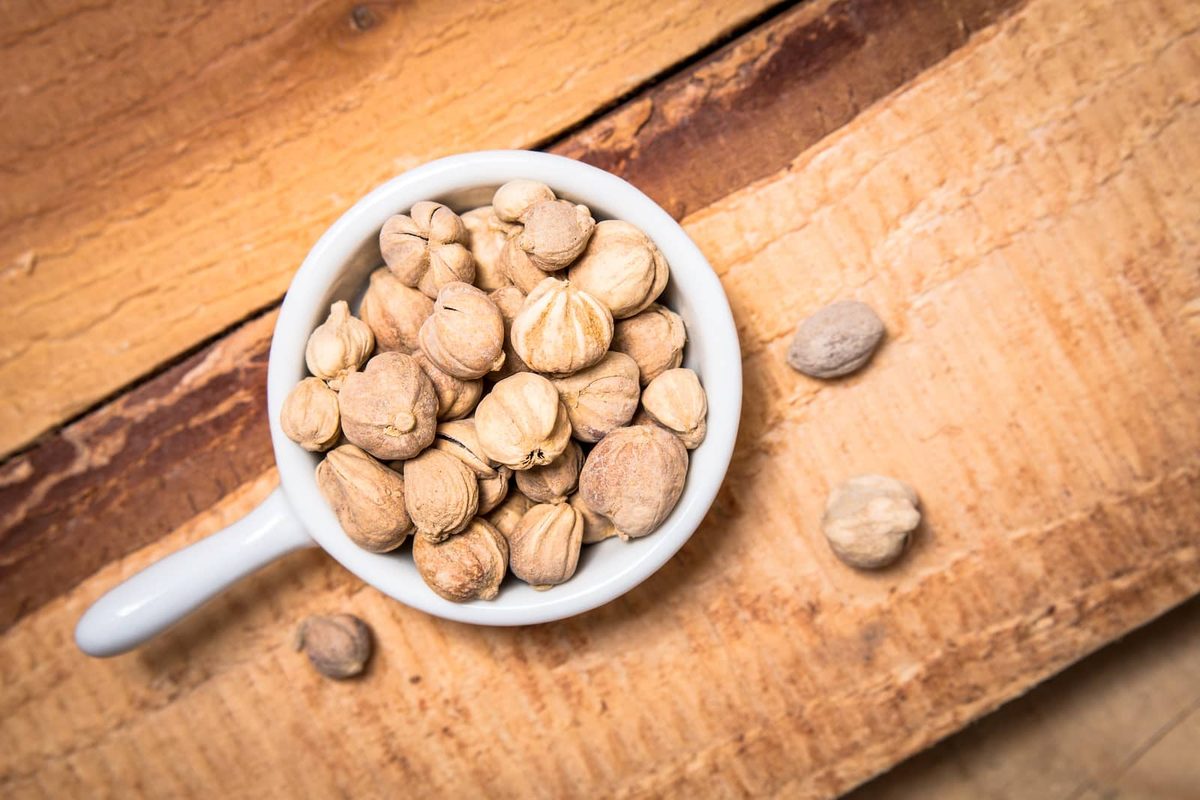
Thai cardamom is the small, nearly round pod of a Southeast Asian relative of green cardamom, known in Thai as krawan and in English also as Siam cardamom.1 It imitates true cardamom’s aroma well enough to stand in for it,1 but its oil is dominated even more heavily by 1,8-cineole, the compound with a camphor-like smell.23 In Thailand it is grown commercially in the eastern provinces around Chanthaburi.4
At a glance
| Accepted botanical name | Wurfbainia vera (Kew); long sold as Amomum krervanh, now a synonym56 |
| Other names | Siam cardamom; Thai krawan, luk krawan, krawan khaao; Khmer kravan1 |
| Plant family | Zingiberaceae (ginger family)5 |
| Native range | Indo-China and Sumatra (Kew)5 |
| Part used | Dried fruits (pods) and seeds; young shoots locally14 |
| Main Thai growing area | Chanthaburi and Trat provinces and Klaeng district, eastern Thailand4 |
| Main oil compound | 1,8-cineole, 60–80% of the fruit oil (PROSEA)2 |
| Forms sold | Whole dried pods; ground |
Measured values
4 figures, sourced| Measure | Value | Scope | Source |
|---|---|---|---|
| 1,8-Cineole | 60–80 % of fruit oil | Thai cardamom fruit, PROSEA | uses.plantnet-project.org |
| Essential oil | about 3–4 % of fruits | Fruits, general figure (PROSEA)Sources differ in scope: the eastern Thailand survey measured seeds. | uses.plantnet-project.org |
| Essential oil | 7.9–8.4 % of seeds | Seeds, eastern Thailand survey (Thai Department of Agriculture, 2010–2011) | info.doa.go.th |
| 1,8-Cineole | 84.38 % of shoot oil | Oil distilled from Amomum verum shoots, 2020 Thai study (a different plant part) | doaj.org |
Each figure is quoted as its source states it, with the samples or standard it applies to. Where sources differ, both are shown; nothing is averaged. All measured values
The name
Thai cardamom has been published under several names. Kew now accepts Wurfbainia vera and lists both Amomum krervanh (a superfluous name) and Amomum verum as synonyms.56 Katzer notes the common misspelling Amomum krevanh.1 It is a different plant from green cardamom (Elettaria cardamomum), which is native to southwest India.7
Flavor and the compounds behind it
Katzer says the small, almost spherical pods “imitate cardamom’s aroma pretty well.”1 To our taste Thai cardamom is a little sharper and more eucalyptus-like than green cardamom, with less of its sweet, floral roundness; that description is ours. Published oil compositions:
| Spice | Main oil components | Source |
|---|---|---|
| Thai cardamom fruit | 1,8-cineole 60–80% (with camphene, p-cymene, humulene, limonene, pinene, terpinene, terpineol) | PROSEA2 |
| Green cardamom | 1,8-cineole 20–60%, α-terpinyl acetate 20–53% | PROSEA8 |
1,8-cineole has a camphor-like odor.3 Green cardamom’s second major compound, α-terpinyl acetate, is not among the components PROSEA lists for Thai cardamom.28
How much oil the spice holds depends on what was measured:
| Material | Essential oil | Source |
|---|---|---|
| Fruits (general figure) | About 3–4% | PROSEA2 |
| Seeds, eastern Thailand survey | 7.9–8.4% | Thai Department of Agriculture4 |
One more data point, for a different part of the plant: oil distilled from Amomum verum shoots in a 2020 Thai study was 84.38% 1,8-cineole.9
A widely repeated description calls Thai cardamom less camphoraceous than green cardamom. No source we found compares the two by smell, so the claim is untested; the composition figures above are the only published evidence.
Where it grows
Kew gives the native range as Indo-China and Sumatra;5 Katzer describes it as native to peninsular Southeast Asia and used in the cuisines of Thailand and Cambodia.1 PROSEA says that in Cambodia the fruits are mainly collected from natural forest, while in Thailand the plants are mainly cultivated.2
A Thai Department of Agriculture survey (2010–2011) found Thai cardamom gardens mostly in Chanthaburi and Trat provinces and in Klaeng district of Rayong, with commercial production concentrated in Pong Nam Ron and Soi Dao districts of Chanthaburi, at 600 to 900 meters above sea level; it cites a 2009 figure of more than 2,000 rai (about 320 hectares) planted in Chanthaburi.4 Chanthaburi is in eastern, not southern, Thailand. Claims that Chanthaburi produces the finest Thai cardamom could not be traced to a source.
Harvest and drying. PROSEA says fruits are usually hand-picked as they start to darken and must be dried immediately after harvest.2 The Thai survey describes the pods being dried over fire for about two days.4
History
No source we found documents Thai cardamom’s early trade. Claims that Chinese merchants bought it and passed it to Middle Eastern traders, that it was once valued above green and black cardamom, or that the Romans knew it could not be traced. Katzer discusses the Roman amomum and cardamomum and suggests amomum may have been similar to black cardamom; he does not connect either to Thai cardamom.1
How it is used
Massaman curry. Thai cardamom is one of the aromatics of massaman curry paste, alongside cumin, cloves, nutmeg, mace and cassia, according to Rebecca Seal in National Geographic; her recipe calls for white cardamom pods.10 Thai cookbook author Pailin Chongchitnant’s massaman paste calls instead for half a teaspoon of ground “green or white cardamom,” and she clarifies in a comment that she means green.11 Katzer lists krawan khaao (“white krawan”) among the Thai names of Thai cardamom.1 So recipes disagree on which cardamom goes in; in our judgment either gives a good curry.
Other uses. Katzer says only that the pods are used in Thai and Cambodian cooking, without naming dishes.1 Claims that it is essential to other Thai curries, beef noodle soup, Vietnamese pho or chai could not be traced to a source. The Thai survey lists the seeds as a spice and records local use of the young shoots as food.4
Technique. As with green cardamom, whole pods are usually bruised and fried or simmered in the curry, and the seeds ground for pastes; that is common practice rather than a sourced rule. See cooking with cardamom and cardamom pods vs. seeds.
Buying and storage
Thai cardamom is mostly sold as whole pods. No grading standard, adulteration report or storage study for it was found. For general cardamom storage advice, see cardamom.
Health claims
PROSEA lists Thai cardamom among the well-known medicinal herbs of China, Indo-China and Thailand, used mainly for gastric and digestive complaints.2 The Thai survey records traditional use against bloating and indigestion.4 A diterpene peroxide isolated from the fruits was active against the malaria parasite Plasmodium falciparum in laboratory tests.2 We found no human trials, and no evidence that it prevents heart disease or arthritis or treats food poisoning; this page makes no such claims.
Substitutes and comparisons
Katzer says that where recipes from these regions call for cardamom, the local kinds are meant, and substitution with true cardamom is perfectly possible.1 No source gives a ratio. As a Method starting point, swap green cardamom pod for pod and adjust to taste. Related pages:
- Cardamom · Cardamom substitutes · Too much cardamom?
- Black cardamom · Black cardamom vs. green · Black cardamom substitutes
- Cardamom vs. cloves · Galangal · Ginger
Footnotes
-
Cardamom (Elettaria cardamomum), Gernot Katzer’s Spice Pages. gernot-katzers-spice-pages.com · Reference work ↩ ↩2 ↩3 ↩4 ↩5 ↩6 ↩7 ↩8 ↩9 ↩10 ↩11
-
Nguyen Quoc Binh, Amomum (PROSEA), Pl@ntUse. uses.plantnet-project.org · Reference work ↩ ↩2 ↩3 ↩4 ↩5 ↩6 ↩7 ↩8 ↩9
-
1,8-Cineole, Odor, PubChem. pubchem.ncbi.nlm.nih.gov · Reference work ↩ ↩2
-
Survey of cardamom and bastard cardamom production in the eastern region, Department of Agriculture, Thailand, 2010–2011. info.doa.go.th · Regulator ↩ ↩2 ↩3 ↩4 ↩5 ↩6 ↩7 ↩8
-
Wurfbainia vera, Plants of the World Online, Royal Botanic Gardens, Kew. powo.science.kew.org · Reference work ↩ ↩2 ↩3 ↩4 ↩5
-
Amomum krervanh, Plants of the World Online, Royal Botanic Gardens, Kew. powo.science.kew.org · Reference work ↩ ↩2
-
Elettaria cardamomum (L.) Maton, Plants of the World Online, Royal Botanic Gardens, Kew. powo.science.kew.org · Reference work ↩
-
Wardini and Thomas, Elettaria cardamomum (PROSEA), Pl@ntUse. uses.plantnet-project.org · Reference work ↩ ↩2
-
Tangjitjaroenkun et al., Chemical compositions of essential oils of Amomum verum and Cinnamomum parthenoxylon, Journal of HerbMed Pharmacology, 2020. doaj.org · Peer-reviewed ↩
-
Rebecca Seal, Deconstructing massaman curry, National Geographic, 2023. nationalgeographic.com · Publication ↩
-
Pailin Chongchitnant, Massaman Curry Paste Recipe, Hot Thai Kitchen. hot-thai-kitchen.com · Publication ↩