Spice Comparisons · Comparison
Cedar Berries vs. Juniper Berries: Two Junipers, Different Oils
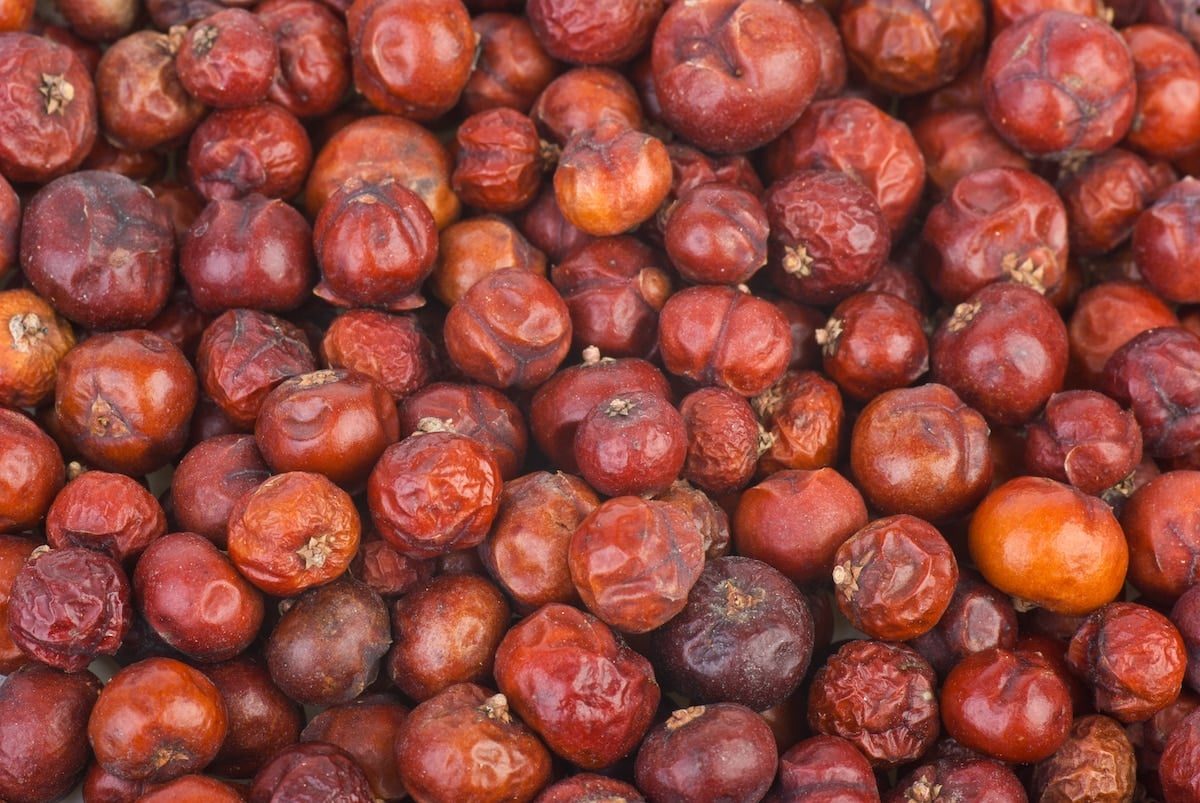
Cedar berries and juniper berries both come from junipers. “Cedar berries” are the cones of eastern redcedar, Juniperus virginiana, a North American tree; the juniper berries that flavor gin come from common juniper, Juniperus communis.12 The difference that matters in the kitchen is the oil: the one published analysis of eastern redcedar berry oil found it mostly limonene, while the pharmacopoeial standard for common juniper puts α-pinene, a piney compound, at 20 to 50 percent of the oil.34 Common juniper is also the only one of the two that US food rules name.5
Both are in the cypress family, Cupressaceae, and neither is a true berry: both bear fleshy, berry-like cones.1678
Side by side
| Cedar berries | Juniper berries | |
|---|---|---|
| Species | Juniperus virginiana L., eastern redcedar1 | Juniperus communis L., common juniper6 |
| Family | Cupressaceae1 | Cupressaceae6 |
| Native range | Southeastern Canada to the central and eastern US, and Coahuila, Mexico1 | Subarctic and temperate Northern Hemisphere6 |
| The plant | A medium-sized tree, 10 to 20 m (33 to 66 ft) tall9 | A subshrub or tree; Britannica calls it a small tree or sprawling shrub68 |
| Part used | Berry-like female cones, 0.4 to 0.7 cm, dark blue or bluish purple and waxy97 | Fleshy, berry-like cones (galbuli), globular and up to 10 mm across, typically bluish and waxy48 |
| Main oil compounds | One study, berries from several trees in Huntsville, Alabama: limonene 63.1%, elemol 18.4%, α-pinene 0.2%3 | European Pharmacopoeia ranges: α-pinene 20–50%, β-myrcene 1–35%, limonene 2–12%4 |
| Flavor (editorial) | No published sensory description found | Piney, with touches of fruitiness and pepperiness (Bramen); aromatic with a sweet accent (Katzer)1011 |
| US food status | Not named on the FDA’s list of GRAS essential oils and extracts5 | Listed there as “Juniper (berries),” J. communis5 |
| Best-known use | No culinary standard use documented | The principal flavoring of gin; game, sauces, sauerkraut2811 |
| Price | No dated, sourced price found | No dated, sourced price found |
The two oil figures are not like for like. The cedar column is one sample set from one study; the juniper column is a pharmacopoeial requirement, which the EMA notes is not the full range found in nature.34 Even so, the gap in α-pinene is large: 0.2 percent in the cedar sample against a required minimum of 20 percent for juniper.
What a cedar berry is
Juniper is a large genus. Britannica puts it at about 60 to 70 species of aromatic evergreen trees and shrubs, and notes that their cones, known as berries, flavor gin and other beverages.12 Eastern redcedar is one of them, a juniper despite its common name.1 The Forest Service describes its cones as small, fleshy and berry-like.7 For more on the species, including a Southwestern juniper also sold under the cedar name, see cedar berries.
The differences that change the dish
Aroma. In the 2014 study, eastern redcedar berry oil was dominated by limonene (63.1%) and elemol (18.4%), with α-pinene at 0.2% and myrcene at 1.5%.3 Limonene is a minor constituent of juniper oil under the pharmacopoeial standard, and α-pinene is its lead.4 Because Katzer traces juniper’s kitchen use to its essential oil,11 a cone with a different oil should not be expected to taste like a weaker juniper. That is our reading of the chemistry; no one has published a side-by-side tasting. The study’s berries were picked on 6 May 2014 from several mature trees on one university campus, so treat the figures as one sample set, not a market average.3
Strength. A widely repeated claim says cedar berries are simply milder than juniper berries. No source found measures the flavor strength of either, so that claim cannot be shown. The study did record an oil yield of 0.382 percent for the cedar berries;3 the European Pharmacopoeia requires juniper berries to contain at least 10 mL of oil per kg.4 Those are different measures and are not compared here.
Safety and regulation. The FDA’s list of essential oils and natural extracts generally recognized as safe includes juniper berries only as J. communis.5 We found no regulator or review that assesses eastern redcedar berries as food. The same 2014 study found safrole at 2.0 percent of the cedar berry oil.3 US rules treat food with added safrole as adulterated, and note that sassafras oil is about 80 percent safrole.13 That rule concerns added safrole, and no regulator has said how it applies to the safrole a cedar berry naturally contains. For common juniper, the European Medicines Agency does not recommend medicinal use during pregnancy and breastfeeding, for lack of data.14 Its guidance covers medicinal products from J. communis, not cedar berries. A widely repeated claim that cedar berries are the more toxic of the two, or unsafe in pregnancy, could not be traced to any source that studied them.
Can one stand in for the other?
No source gives a swap ratio in either direction, and the chemistry above says the swap changes the flavor, not just the amount.
- Juniper in place of cedar berries. Use common juniper, the species with a documented food history and US food listing.5 Bramen advises using juniper sparingly.10 Method: start with about half the number of cedar berries the recipe calls for, crushed, and taste after the dish has simmered. No published ratio exists.
- Cedar berries in place of juniper. We don’t recommend it, for the reasons in the safety paragraph. Our juniper berry substitutes page ranks gin, rosemary, caraway and bay leaf by the job juniper is doing, with each ratio labeled.
Where juniper earns its place
Juniper is gin’s principal flavoring.2 In the kitchen, Britannica notes its use with game meats, in sauces and for pickling;8 Katzer calls it indispensable for venison and names sauerkraut as a Central European classic, seasoned with juniper.11 Katzer also pairs it with black pepper and marjoram, and says the cones should be crushed just before use.11 No equivalent body of cooking use was found for cedar berries.
What isn’t known
- No published sensory description of eastern redcedar berries, and no tasting that compares them with common juniper.
- Only one analysis of eastern redcedar berry oil was found, from berries collected in one place on one day. How much the oil varies by tree, region or season is not known.
- No regulator or review has assessed cedar berries as food, and no source says how much safrole a serving would contain.
- Which species a given retail pack of “cedar berries” contains is not always stated; buy from a seller who names it.
Related
- Cedar berries and juniper berries
- Juniper berry substitutes
- Allspice berries vs. juniper berries
- Do spices go bad?
Footnotes
-
Juniperus virginiana L., Plants of the World Online, Royal Botanic Gardens, Kew. powo.science.kew.org · Reference work ↩ ↩2 ↩3 ↩4 ↩5 ↩6
-
“Gin,” Encyclopaedia Britannica. britannica.com · Reference work ↩ ↩2 ↩3
-
Stewart, Jones and Setzer, “Essential oil compositions of Juniperus virginiana and Pinus virginiana,” American Journal of Essential Oils and Natural Products, 2014. aromaticplant.org · Peer-reviewed ↩ ↩2 ↩3 ↩4 ↩5 ↩6 ↩7
-
Assessment report on Juniperus communis L., pseudo-fructus, Revision 1, European Medicines Agency, 2023. ema.europa.eu · Regulator ↩ ↩2 ↩3 ↩4 ↩5 ↩6
-
21 CFR 182.20, Essential oils, oleoresins (solvent-free), and natural extractives, U.S. Food and Drug Administration. ecfr.gov · Regulator ↩ ↩2 ↩3 ↩4 ↩5
-
Juniperus communis L., Plants of the World Online, Royal Botanic Gardens, Kew. powo.science.kew.org · Reference work ↩ ↩2 ↩3 ↩4 ↩5
-
Anderson, “Juniperus virginiana,” Fire Effects Information System, USDA Forest Service, 2003. fs.usda.gov · Regulator ↩ ↩2 ↩3
-
“Common juniper,” Encyclopaedia Britannica. britannica.com · Reference work ↩ ↩2 ↩3 ↩4 ↩5
-
Stevens, Kaiser and Dozier, “Eastern Red Cedar, Juniperus virginiana,” Plant Guide, USDA Natural Resources Conservation Service, 2000. plants.sc.egov.usda.gov · Regulator ↩ ↩2
-
Lisa Bramen, “What the Heck Do I Do With Juniper Berries?,” Smithsonian Magazine, 2011. smithsonianmag.com · Publication ↩ ↩2
-
Gernot Katzer, “Juniper (Juniperus communis L.),” Gernot Katzer’s Spice Pages. gernot-katzers-spice-pages.com · Reference work ↩ ↩2 ↩3 ↩4 ↩5
-
“Juniper,” Encyclopaedia Britannica. britannica.com · Reference work ↩
-
21 CFR 189.180, Safrole, U.S. Food and Drug Administration. ecfr.gov · Regulator ↩
-
European Union herbal monograph on Juniperus communis L., pseudo-fructus, Revision 1, European Medicines Agency, 2023. ema.europa.eu · Regulator ↩