Spice Comparisons · Comparison
Allspice Berries vs. Juniper Berries: A Clove-Scented Fruit and a Piney Cone
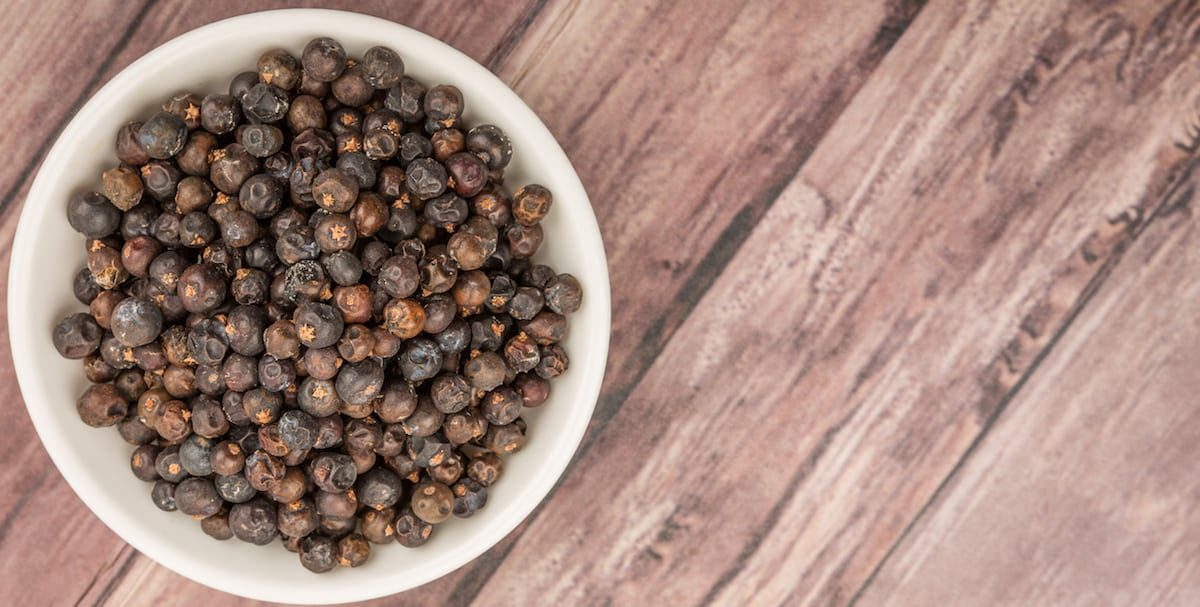
Allspice and juniper are both small, dark “berries” that go into pots of meat and cabbage, but they come from unrelated plants and smell of different compounds. Allspice is the dried fruit of a tropical myrtle-family tree, and its oil is led by eugenol, the compound that also dominates cloves.123 Juniper is the fleshy cone of a northern conifer, and its oil is led by α-pinene, which gives it the pine note people know from gin.456 Neither is a close substitute for the other.
Side by side
| Allspice | Juniper | |
|---|---|---|
| Species | Pimenta dioica1 | Juniperus communis (common juniper)4 |
| Family | Myrtaceae (myrtle family, like cloves)1 | Cupressaceae (cypress family)4 |
| Native range | Southern Mexico to Central America and the Caribbean1 | Subarctic and temperate Northern Hemisphere4 |
| Part used | The fruit, picked before it is fully ripe and dried7 | A fleshy, berry-like cone, typically bluish, up to 10 mm across85 |
| Key compounds | Oil led by eugenol (50–80% in PROSEA’s figure), with methyl eugenol and myrcene29 | Oil led by α-pinene (20–50%), with β-myrcene (1–35%) and limonene (2–12%), per the European Pharmacopoeia ranges quoted by the EMA5 |
| Essential oil content | About 4.5% for Jamaican allspice (Britannica)7 | At least 10 mL per kg of berries (Ph. Eur. minimum)5 |
| Flavor (editorial) | Warm and clove-forward; Britannica says it resembles a mix of cloves, cinnamon and nutmeg7 | Resinous and piney; Lisa Bramen adds touches of fruitiness and pepperiness10 |
| Forms | Whole berries, ground2 | Whole berries; also the main flavoring of gin6 |
| Typical uses | Jerk, broths and pickling liquids, baked goods and pies211 | Game, especially venison; sauerkraut; gin12106 |
| US status | Listed among spices generally recognized as safe13 | Juniper berries listed among GRAS essential oils and natural extractives14 |
| Safety | No regulator sets a concern level for allspice in food (see allspice) | As a herbal medicine, the EMA advises against use in pregnancy and in severe kidney disease15 |
| Price | No dated, sourced retail comparison found | No dated, sourced retail comparison found |
The two compound rows come from different sources and methods: PROSEA’s typical range for allspice berry oil and pharmacopoeial quality ranges for juniper oil. The oil-content row uses different units. Read them as a guide to which compound leads in each, not as a measured comparison.
Different plants, different “berries”
Allspice berries are true fruits. PROSEA says they are picked fully mature but still green, and that in Jamaica the harvest runs from July to September.2 As they dry, Britannica says, they turn from green to a dull reddish brown.7 In the wild, PROSEA notes that the seeds are dispersed by birds; growers propagate the tree from sown seed or by grafting.2 A widely repeated claim says allspice seeds must pass through a bird or bat before they can germinate. PROSEA describes seed that is simply sown and mulched, with germination beginning 9 to 10 days after sowing, and nothing in its account supports the claim.2
Juniper “berries” are not berries at all. Britannica calls them fleshy, berry-like cones,8 and the EMA uses the botanical term galbulus for the globular cone.5 They are not pine cones either: common juniper belongs to the cypress family, not the pine family.4 According to Gernot Katzer, the cones take two years to mature.12
Where the flavors come from
Allspice. Its oil’s three main constituents are eugenol, methyl eugenol and myrcene,9 and PROSEA puts eugenol at 50 to 80 percent of the berry oil.2 Eugenol is also about 85 to 92 percent of clove oil,3 which is why allspice reads as clove-like. Britannica says the spice got its English name because the dried berry tastes like a combination of cloves, cinnamon and nutmeg.7 A common version of the story swaps nutmeg for black pepper. The pepper link is real but different: PROSEA says Spanish explorers took the berries for black pepper and called them pimienta, which English later turned into “pimento.”2
Juniper. Its oil is made up mainly of monoterpenes,12 and the pharmacopoeial ranges put α-pinene in the lead.5 Juniper is the principal flavoring of gin, so anyone who has tasted gin knows the note.6
The two oils do share one compound, myrcene, which is a main constituent of allspice oil and can be a large part of juniper oil.95 That overlap is not enough to make them taste alike: the lead compounds, eugenol and α-pinene, are different.
Using them in the kitchen
Allspice. In Jamaica, pimento (allspice) is essential to jerk. Smithsonian Magazine’s history of the dish says the Maroons, people who escaped slavery into Jamaica’s mountains, traditionally hunted wild boar and seasoned the meat with pimento, salt and bird peppers.11 PROSEA says whole allspice goes into meat broths, gravies and pickling liquids, while ground allspice is preferred in desserts, fruit cakes and pies.2
Juniper. Katzer says juniper is much used in the traditional cuisine of Central Europe and is felt to be indispensable for venison,12 and Bramen counts game among its most common uses.10 Katzer also says traditional sauerkraut is seasoned with juniper and caraway, sometimes with a few bay leaves.12 Bramen’s advice is to use juniper sparingly.10 Using it in desserts is uncommon, in our judgment.
Together. The two can share a pot. Saveur’s Alsatian choucroute garnie ties juniper berries, cloves, garlic and a bay leaf in cheesecloth to cook with the sauerkraut.16 Adding a couple of allspice berries to that kind of bundle is a reasonable cook’s variation; no source tests it.
Can one stand in for the other?
Not closely. No source we found gives a ratio in either direction, so both swaps below are Method: a direction and a starting point, not a published number.
Allspice in place of juniper. In a braise of game or pork, allspice gives warmth but no pine. Start with about half as many whole allspice berries as the juniper berries called for, since allspice’s clove note takes over quickly (our judgment), and taste before adding more. If the pine note matters, the better choices are on our juniper berries substitutes page: gin, which carries juniper itself, and rosemary, whose oil shares α-pinene.
Juniper in place of allspice. Juniper’s pine note will not read as allspice. Where allspice is the main flavor, as in jerk or a spice cake, use a blend instead: The Spice House gives 2 parts cinnamon, 1 part nutmeg and 1 part ground cloves, used 1:1 for ground allspice, plus a pinch of black pepper for savory dishes (an Attributed ratio; more on our allspice substitutes page).17 Where allspice is one of several whole spices in a long-cooked pot, such as sauerkraut or a game braise, one or two crushed juniper berries can fill the space (Method), with a different result.
What isn’t known
- No study compares the flavor strength of allspice and juniper, and no source gives a swap ratio.
- The compound figures above come from different references and samples; we found no single study analyzing both oils the same way.
- No dated price comparison.
Related
- Allspice, allspice substitutes, too much allspice
- Juniper berries, juniper berries substitutes
- Cedar berries vs. juniper berries
- Allspice vs. cloves, allspice vs. black pepper, garam masala vs. allspice
- Jerk seasoning, caraway seeds, bay leaves
Footnotes
-
Pimenta dioica (L.) Merr., Plants of the World Online, Royal Botanic Gardens, Kew. powo.science.kew.org · Reference work ↩ ↩2 ↩3 ↩4
-
D. Sulistiarini, Pimenta dioica, Plant Resources of South-East Asia (PROSEA). uses.plantnet-project.org · Reference work ↩ ↩2 ↩3 ↩4 ↩5 ↩6 ↩7 ↩8 ↩9 ↩10
-
Batiha et al., “Syzygium aromaticum L. (Myrtaceae)”, Biomolecules, 2020. mdpi.com · Peer-reviewed ↩ ↩2
-
Juniperus communis L., Plants of the World Online, Royal Botanic Gardens, Kew. powo.science.kew.org · Reference work ↩ ↩2 ↩3 ↩4 ↩5
-
Assessment report on Juniperus communis, pseudo-fructus, European Medicines Agency, 2021. ema.europa.eu · Regulator ↩ ↩2 ↩3 ↩4 ↩5 ↩6 ↩7
-
“Gin”, Encyclopaedia Britannica. britannica.com · Reference work ↩ ↩2 ↩3 ↩4
-
“Allspice”, Encyclopaedia Britannica. britannica.com · Reference work ↩ ↩2 ↩3 ↩4 ↩5
-
“Common juniper”, Encyclopaedia Britannica. britannica.com · Reference work ↩ ↩2
-
Andrade Avila, Cruz-Olivares and Pérez-Alonso, “Antioxidant Effect and Medicinal Properties of Allspice Essential Oil”, IntechOpen, 2022. intechopen.com · Peer-reviewed ↩ ↩2 ↩3
-
Lisa Bramen, “What the Heck Do I Do With Juniper Berries?”, Smithsonian Magazine, 2011. smithsonianmag.com · Publication ↩ ↩2 ↩3 ↩4
-
Vaughn Stafford Gray, “A Brief History of Jamaican Jerk”, Smithsonian Magazine, 2020. smithsonianmag.com · Publication ↩ ↩2
-
Juniper, Gernot Katzer’s Spice Pages. gernot-katzers-spice-pages.com · Reference work ↩ ↩2 ↩3 ↩4 ↩5
-
21 CFR 182.10, Spices and other natural seasonings and flavorings, FDA. ecfr.gov · Regulator ↩
-
21 CFR 182.20, Essential oils, oleoresins and natural extractives, eCFR. ecfr.gov · Regulator ↩
-
European Union herbal monograph on Juniperus communis, pseudo-fructus, European Medicines Agency. ema.europa.eu · Regulator ↩
-
“Sauerkraut With Pork and Sausages (Choucroute Garnie)”, Saveur. saveur.com · Publication ↩
-
Allspice Substitute, The Spice House. thespicehouse.com · Merchant ↩