Spice Substitutes · Substitutes
Juniper Berry Substitutes, Ranked by the Job Juniper Is Doing
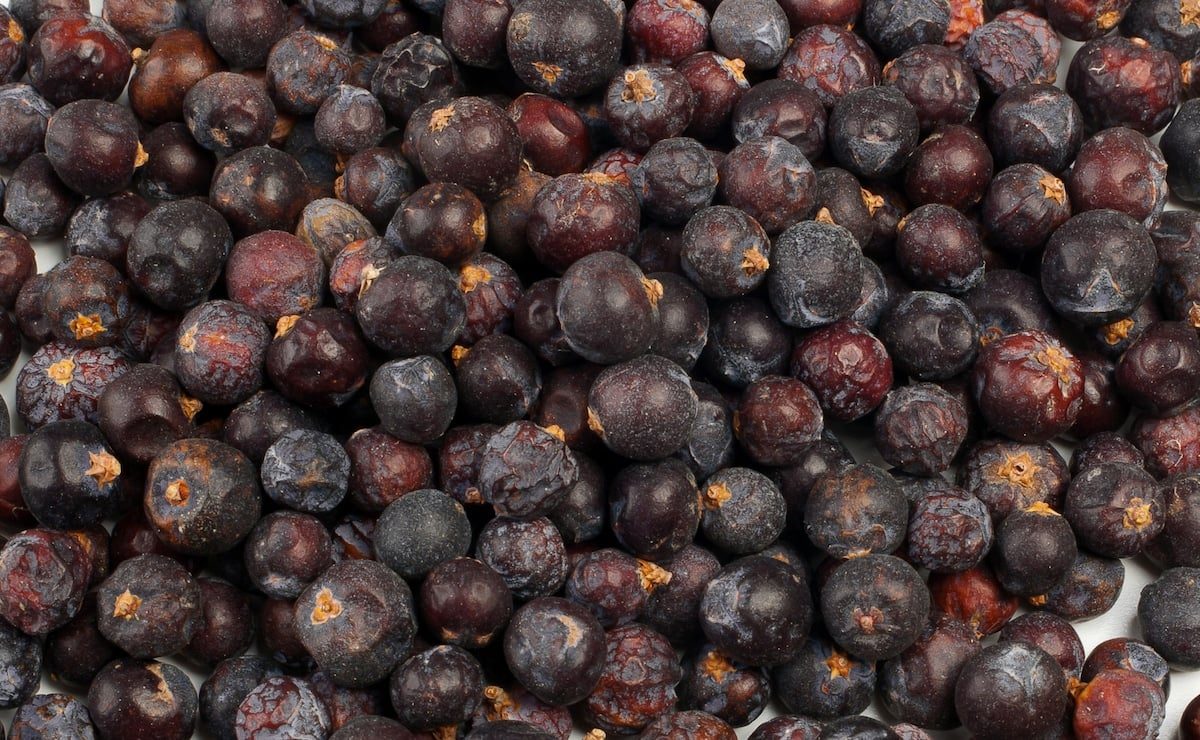
Juniper berries are the small fleshy cones of the common juniper, Juniperus communis, and their aroma comes from an essential oil led by α-pinene. The European Pharmacopoeia, as quoted by the European Medicines Agency, sets α-pinene at 20 to 50 percent of juniper oil, with β-myrcene at 1 to 35 percent and limonene at 2 to 12 percent; sabinene is also listed among the constituents.1 Smithsonian’s Lisa Bramen describes the taste as slightly piney with touches of fruitiness and pepperiness.2 Nothing else carries that whole profile, so the best stand-in depends on what juniper is doing in your recipe.
Quick answer
| What juniper is doing | Best substitute | Starting amount, per 6 juniper berries | Treatment |
|---|---|---|---|
| Piney note in a braise, marinade or sauce that can take a little liquid | Gin | 1 tablespoon | Attributed |
| Piney note in a dry rub, or a dish that can’t take liquid | Dried rosemary | A pinch (about 1/4 teaspoon), then taste | Disputed |
| Seasoning sauerkraut or braised cabbage | Caraway seed | About 1/4 teaspoon, then taste | Disputed |
| One of several aromatics in a long braise | Bay leaf | 1 leaf | Method |
The rest of the page explains each choice.
How the ratios on this page are labeled
Every ratio carries one of four labels.
- Computed: based on a measurable physical relationship, with the source named.
- Attributed: a named source publishes this ratio. We quote it as theirs.
- Disputed: named sources give different answers to the same swap. We show each one and do not average them.
- Method: we found no published ratio. We give a direction and a cautious starting point, and say so.
The only published juniper-substitute ratios we found come from two bylined food blogs, Pantry & Larder and Greedy Gourmet. Neither says how its figures were reached, and they measure juniper differently: Pantry & Larder counts berries, while Greedy Gourmet measures tablespoons of berries. No published study compares the strength of juniper with any substitute.
If juniper is the piney note in a braise, marinade or sauce
This is juniper’s classic job in game and rich meat dishes. Bramen counts game among its most common uses, and Gernot Katzer says it is felt to be indispensable for venison.23
1. Gin
Juniper is gin’s principal flavoring ingredient, according to Britannica.4 That makes gin the most direct way to put juniper’s own aroma into a dish.
Gin is not pure juniper, though. Britannica says each producer uses a secret formula that adds other botanicals to the juniper, such as orris, angelica and licorice roots, lemon and orange peel, cassia bark, caraway, coriander, cardamom, anise and fennel, and that dry gins carry more added flavorings than Dutch types.4 Expect some citrus or spice along with the pine, and a brand name is no guarantee of a juniper-only flavor.
Don’t count on the alcohol cooking off completely. In USDA’s measurements, a dish simmered or baked for 15 minutes after alcohol was stirred in kept about 40 percent of it, and one simmered for 2½ hours kept about 5 percent.5 A long braise suits gin better than a quick pan sauce.
Ratio (Attributed): Pantry & Larder says to replace 6 juniper berries with 1 tablespoon of gin,6 which works out to 1 teaspoon per 2 berries. Greedy Gourmet gives no amount for gin.7 Count the gin as part of the recipe’s liquid.
2. Dried rosemary
Rosemary is a mint-family herb (Lamiaceae), now placed by botanists in the sage genus as Salvia rosmarinus.8 Its link to juniper is chemical. In a 2017 study of rosemary oils from plants collected in six countries, α-pinene made up 13.5 to 37.7 percent of the oil,9 which overlaps the pharmacopoeial range for juniper.1 PROSEA attributes rosemary’s warm, piny scent to α-pinene.10
Where it falls short: the same rosemary oils also held 16.1 to 29.3 percent 1,8-cineole,9 and PROSEA ties rosemary’s pungent, camphor-like smell and burning taste to borneol.10 Neither is a lead compound in the pharmacopoeial description of juniper oil.1 Rosemary also lacks juniper’s fruitiness. Use it where the pine note matters more than the sweetness.
Ratio (Disputed):
| Source | Rosemary in place of juniper |
|---|---|
| Pantry & Larder | 1 tablespoon dried rosemary plus a spritz of lemon juice, per 6 berries6 |
| Greedy Gourmet | 1 teaspoon dried rosemary per 1 tablespoon crushed juniper berries7 |
These point in opposite directions. The EMA describes a juniper cone as up to 10 mm across;1 by our arithmetic, six spheres of that size come to about 3 mL, a fifth of a 15 mL tablespoon. So Pantry & Larder calls for several times more rosemary than juniper by volume, while Greedy Gourmet calls for about a third as much. Neither explains its figure. Our Method starting point: a pinch, about 1/4 teaspoon of dried rosemary per 6 berries, added early, then taste once the dish has simmered and add more if needed. Rosemary’s camphor note is easier to add than to take out.
If juniper is seasoning sauerkraut or cabbage
Caraway seed
Caraway is already juniper’s partner here. Katzer says traditional sauerkraut is seasoned with juniper, caraway and sometimes a few bay leaves.3 When the juniper is missing, leaning on the caraway keeps the dish in the same tradition. The flavor is different, though. Britannica describes caraway’s aroma as reminiscent of anise, with a warm, slightly sharp taste,11 and PROSEA gives its oil as 45 to 60 percent carvone and 35 to 55 percent limonene.12 Limonene is a minor constituent of juniper oil,1 but carvone, the compound PROSEA credits with caraway’s character, is not on juniper’s list. Expect a seedier, anise-tinged dish rather than a piney one.
Like juniper, caraway flavors spirits: Britannica names aquavit and kümmel.11
Ratio (Disputed):
| Source | Caraway in place of juniper |
|---|---|
| Pantry & Larder | 1 tablespoon caraway seeds per 6 berries6 |
| Greedy Gourmet | 1/2 to 1 teaspoon caraway seeds per 1 tablespoon juniper berries7 |
As with rosemary, the first is several times more caraway than juniper by volume and the second a small fraction. Our Method starting point: about 1/4 teaspoon of caraway per 6 berries, on top of any caraway the recipe already calls for, then taste.
If juniper is one of several aromatics in a long braise
Bay leaf
Bay laurel’s leaf oil is led by 1,8-cineole. In one Italian sample analyzed in a 2017 review it was 31.9 percent of the oil, with sabinene at 12.2 percent and α-pinene at 5.8 percent.13 It shares minor compounds with juniper rather than its main one, so a bay leaf adds a herbal background, not pine. Katzer’s sauerkraut seasoning puts the two side by side.3
Ratio (Method): Greedy Gourmet says to use 2 dried bay leaves per 1 tablespoon of juniper berries.7 Pantry & Larder says to replace 6 berries with an “equal amount” of bay leaves but does not say whether it means by count or by volume.6 Taking Greedy Gourmet’s figure at our size estimate above gives well under one leaf for 6 berries, so we suggest one leaf as a practical starting point.
Other options, and what to skip
- Cardamom. Its oil is mainly 1,8-cineole (20 to 60 percent) and α-terpinyl acetate (20 to 53 percent), according to PROSEA,14 so it brings a camphor-and-citrus warmth rather than pine. Pantry & Larder lists it but gives two different amounts in the same article (1/2 tablespoon ground per 6 berries in its text, 1:1 in its summary table),6 so we use neither. Method: if you try it, start with a small pinch of ground cardamom and taste.
- Cedar berries. These are the cones of other juniper species, such as eastern redcedar. The FDA’s list of essential oils and extracts generally recognized as safe names juniper berries only as Juniperus communis.15 We found no source assessing cedar berries as a food, so we don’t suggest them. See cedar berries.
What isn’t known
- No published measurement compares the flavor strength of juniper with gin, rosemary, caraway, bay or cardamom. The Attributed and Disputed figures above are rules of thumb from two food blogs.
- No source we found converts a count of juniper berries to a volume. The comparison above uses the EMA’s maximum cone size, so real berries may be smaller.
- How much juniper a given gin contains is not published; producers keep their formulas secret.4
- We found no credible source for a “traditional” substitute for juniper in any dish.
Related
- Juniper berries
- Allspice berries vs. juniper berries, cedar berries vs. juniper berries
- Rosemary, rosemary substitutes, too much rosemary
- Caraway seeds, cooking with caraway seeds
- Bay leaves, bay leaf substitutes
- Cardamom
Footnotes
-
Assessment report on Juniperus communis L., pseudo-fructus (galbulus), Revision 1, European Medicines Agency, 2023. ema.europa.eu · Regulator ↩ ↩2 ↩3 ↩4 ↩5
-
Lisa Bramen, “What the Heck Do I Do With Juniper Berries?”, Smithsonian Magazine, 2011. smithsonianmag.com · Publication ↩ ↩2
-
Gernot Katzer, “Juniper (Juniperus communis L.)”, Gernot Katzer’s Spice Pages. gernot-katzers-spice-pages.com · Reference work ↩ ↩2 ↩3
-
“Gin”, Encyclopaedia Britannica. britannica.com · Reference work ↩ ↩2 ↩3
-
USDA Table of Nutrient Retention Factors, Release 6, USDA Agricultural Research Service, 2007. ars.usda.gov · Regulator ↩
-
Veronica Fletcher, “Juniper Berries Substitutes”, Pantry & Larder, 2023. pantryandlarder.com · Publication ↩ ↩2 ↩3 ↩4 ↩5
-
Michelle Minnaar, “Juniper Berries Substitutes”, Greedy Gourmet, 2023. greedygourmet.com · Publication ↩ ↩2 ↩3 ↩4
-
Salvia rosmarinus Spenn., Plants of the World Online, Royal Botanic Gardens, Kew. powo.science.kew.org · Reference work ↩
-
Satyal et al., “Chemotypic Characterization and Biological Activity of Rosmarinus officinalis”, Foods, 2017. mdpi.com · Peer-reviewed ↩ ↩2
-
C.C. de Guzman, Rosmarinus officinalis, Plant Resources of South-East Asia (PROSEA). uses.plantnet-project.org · Reference work ↩ ↩2
-
“Caraway”, Encyclopaedia Britannica. britannica.com · Reference work ↩ ↩2
-
H. Toxopeus and J.H. Lubberts, Carum carvi, Plant Resources of South-East Asia (PROSEA). uses.plantnet-project.org · Reference work ↩
-
Caputo et al., “Laurus nobilis: Composition of Essential Oil and Its Biological Activities”, Molecules, 2017. mdpi.com · Peer-reviewed ↩
-
T.H. Wardini and A. Thomas, Elettaria cardamomum, Plant Resources of South-East Asia (PROSEA). uses.plantnet-project.org · Reference work ↩
-
21 CFR 182.20, Essential oils, oleoresins (solvent-free), and natural extractives, US Code of Federal Regulations. ecfr.gov · Regulator ↩