Spice Comparisons · Comparison
Celery Powder vs. Celery Salt: What Each One Is, and How to Swap Them
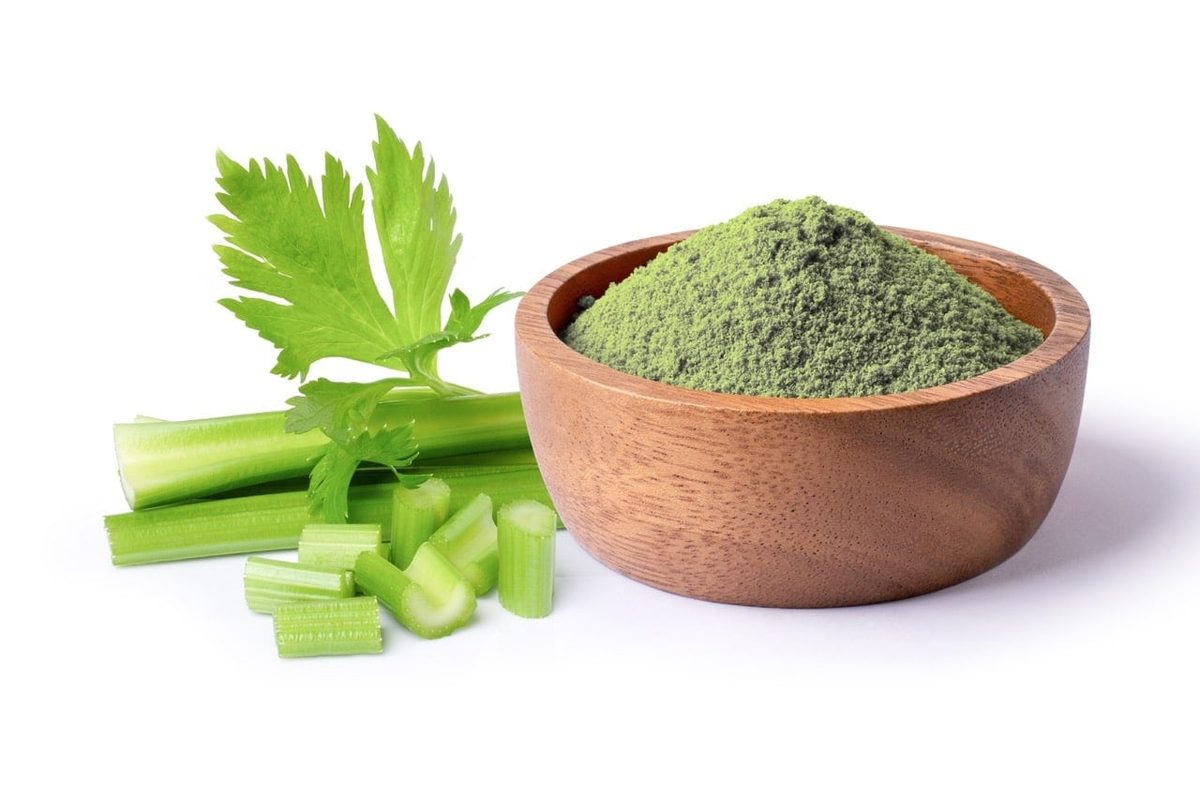
Celery salt is salt with ground celery seed in it, and salt is the bigger part of what it does: McCormick’s version lists only salt and celery seed and carries about 1,080 mg of sodium per teaspoon.1 Celery powder is celery with nothing added, made either from the dried vegetable or from ground seed, depending on the brand.23 So the real choice is whether you want salt along with the celery flavor. A third product shares the celery powder name: the cultured or pre-converted celery powders that cure “uncured” meats. These are made for their nitrate, and neither kitchen product can replace them.4
All three come from one plant, celery, Apium graveolens, a biennial of the parsley family (Apiaceae).5
Side by side
| Celery powder (seasoning) | Celery salt | |
|---|---|---|
| What it is | Ground dried celery, or ground celery seed; check the label. KOYAH’s is freeze-dried whole stalks; Spices, Inc. sells ground celery seed23 | Salt plus ground celery seed (McCormick: “Salt & Celery Seed”)1 |
| Plant | Apium graveolens, Apiaceae5 | Same5 |
| Part used | Stalk or seed23 | Seed1 |
| Key aroma compounds | Phthalides, including sedanenolide and 3-n-butylphthalide, give celery oil its smell6 | The same compound family, from the seed; essential oil is about 3% of the seed’s dry weight6 |
| Sodium | Seed-based: about 3 mg per teaspoon, computed from USDA’s 160 mg per 100 g and 2 g per teaspoon.7 Stalk-based: no published figure found | About 1,080 mg per teaspoon, from McCormick’s 270 mg per 1/4 teaspoon1 |
| Flavor (editorial) | Stalk powder: green, vegetal. Seed powder: concentrated, grassy, a little bitter | Salty first, then the seed’s celery note |
| Classic uses | Rubs, dressings, soups (common practice) | Bloody Mary, Chicago-style hot dog89 |
| Allergen labeling | EU: celery is a listed allergen10 | Same10 |
| Price | No dated, sourced comparison found | No dated, sourced comparison found |
The differences that change the dish
Salt. This is the big one. The FDA says 2,300 mg of sodium is about one teaspoon of table salt.11 By McCormick’s label, a teaspoon of its celery salt carries about 1,080 mg,1 a little under half the sodium of a teaspoon of table salt. Ground celery seed, by USDA’s figures, carries about 3 mg a teaspoon.7 With celery salt, every extra pinch of celery flavor brings salt along with it; with celery powder, you salt separately.
Strength. Which one tastes more of celery depends on the powder. Katzer describes celery seed’s aroma as similar to the leaf and root but much stronger.12 So a seed-based powder should be stronger than a stalk-based one. Where celery salt falls depends on how much seed it contains, and no source we found states that, or measures the strength of any of the three. A Couple Cooks says purchased blends run between 1:1 and 2:1 without saying which ingredient is the larger part.13
Moisture and texture. Both are dry, fine powders, so they suit rubs and dressings where fresh celery would add water. That is common practice.
The other celery powder: curing meat
Meats sold as “natural” or “uncured” often get their nitrite from celery. Bhusal and Muriana describe celery juice and its dried powders as high in nitrate, and celery powder as used extensively as a vegetable nitrite source in natural and organic meats.4 The nitrate is converted to nitrite either in the meat, by a bacterial culture such as Staphylococcus carnosus, or before sale, in “pre-converted” powders that give more consistent nitrite levels.4 A widely repeated description says curing celery powder is fermented to raise its nitrate; the culturing in these sources converts nitrate to nitrite instead.
Neither spice-aisle celery powder nor celery salt does this job. Control of Clostridium botulinum is the main reason nitrite goes into cured meat, according to the American Meat Science Association’s review.14 A kitchen powder or a jar of celery salt has no stated nitrate or nitrite content, so it cannot stand in for a measured cure. See curing salt and celery powder substitutes for what can.
On labels, US rules let meat made without added nitrate or nitrite be called “Uncured” if it also says “No Nitrate or Nitrite Added.”15 In December 2020, USDA’s Food Safety and Inspection Service said it intends to propose barring those statements on products processed with any source of nitrates or nitrites, celery powder included.16 More on that, and on the allergen rules, is on our celery powder page.
Can one stand in for the other?
Yes, for seasoning, as long as you handle the salt separately. Our substitute pages work out the numbers; the treatments below come from them.
- Celery powder plus salt, for celery salt. Salt (Computed): for each teaspoon of celery salt, use about 1/2 teaspoon of table salt, from McCormick’s sodium figure and the FDA’s teaspoon of salt.111 Celery (Method): no published figure gives the seed content of commercial celery salt, so there is nothing to compute. Start with 1/4 teaspoon of seed-based powder, or about 1/2 teaspoon of stalk-based powder, and taste. For a ready-mixed jar, A Couple Cooks’ homemade celery salt uses 1 1/2 parts celery seed to 1 part kosher salt, ground together (Attributed).13 See celery salt substitutes.
- Celery salt, for celery powder. Salt (Computed): cut about 1/2 teaspoon of table salt from the recipe for each teaspoon of celery salt you add.111 Celery (Method): start with the same amount of celery salt as the powder called for, after cutting the salt, and taste. How much celery flavor you can add is capped by how much salt the dish can take. Not for curing. See celery powder substitutes.
- For lower sodium. Ground celery seed carries almost no sodium by USDA’s figures,7 so it is the way to get celery salt’s flavor without most of the salt. McCormick’s label figure means 2 teaspoons of its celery salt carry about 2,160 mg of sodium, close to the FDA’s Daily Value of less than 2,300 mg.111
When to reach for each
- Celery salt for jobs that want salt and celery at once and a fine, even sprinkle: the International Bartenders Association’s Bloody Mary lists celery salt with Tabasco and pepper,8 and a Chicago-style hot dog is finished with it.9 Popcorn, fries and eggs are common uses.
- Celery powder when you want to control the salt yourself, or need a lot of celery flavor: rubs, dressings, soups, stocks and brines. Those uses are common practice. Pick seed-based powder for intensity and stalk-based for a milder, vegetal note.
What isn’t known
- No source we read publishes the salt-to-seed ratio of commercial celery salts.
- No published study compares the flavor strength of celery salt, seed-based powder and stalk-based powder.
- No sodium figure was found for stalk-based celery powder.
- Spice-aisle celery powders do not state a nitrate content, and none should be used to cure meat.
Related
- Celery powder and celery salt
- Celery powder substitutes and celery salt substitutes
- Celery seed vs. celery powder and celery seed vs. celery salt
- Celery seeds, celery flakes and celery flakes substitutes
- Curing salt
Footnotes
-
McCormick Celery Salt, label ingredients and Nutrition Facts as listed by Stop & Shop. stopandshop.com · Merchant ↩ ↩2 ↩3 ↩4 ↩5 ↩6 ↩7 ↩8
-
Organic Celery Powder, product page, KOYAH. koyah.com · Merchant ↩ ↩2 ↩3
-
Ground Celery Seed, product page, Spices, Inc. spicesinc.com · Merchant ↩ ↩2 ↩3
-
Bhusal and Muriana, “Isolation and Characterization of Nitrate Reducing Bacteria,” Applied Microbiology, 2021. mdpi.com · Peer-reviewed ↩ ↩2 ↩3
-
Apium graveolens L., Plants of the World Online, Royal Botanic Gardens, Kew. powo.science.kew.org · Reference work ↩ ↩2 ↩3
-
Salehi et al., “Apium Plants: Beyond Simple Food and Phytopharmacological Applications,” Applied Sciences, 2019. mdpi.com · Peer-reviewed ↩ ↩2
-
“Spices, celery seed,” FDC ID 170920, USDA FoodData Central. fdc.nal.usda.gov · Regulator ↩ ↩2 ↩3
-
Bloody Mary, International Bartenders Association. iba-world.com · Standard ↩ ↩2
-
Howard Yoon, “Chicago-Style Hot Dogs with ‘the Works’,” NPR. npr.org · Publication ↩ ↩2
-
Regulation (EU) No 1169/2011, Annex II, EUR-Lex. eur-lex.europa.eu · Regulator ↩ ↩2
-
Sodium in Your Diet, U.S. Food and Drug Administration. fda.gov · Regulator ↩ ↩2 ↩3 ↩4
-
Gernot Katzer, “Celery (Apium graveolens),” Gernot Katzer’s Spice Pages. gernot-katzers-spice-pages.com · Reference work ↩
-
Sonja Overhiser, “Celery Salt,” A Couple Cooks. acouplecooks.com · Publication ↩ ↩2
-
Sindelar and Milkowski, “Sodium Nitrite in Processed Meat and Poultry Meats,” American Meat Science Association White Paper No. 3, 2011. bluedynamo.msu.edu · Publication ↩
-
9 CFR 317.17, special labeling requirements concerning nitrate and nitrite, eCFR. ecfr.gov · Regulator ↩
-
FSIS final response to petition 19-03, USDA Food Safety and Inspection Service, 2020. fsis.usda.gov · Regulator ↩