Spice Substitutes · Substitutes
Celery Flakes Substitutes: Fresh Celery, Celery Seed and More, With Amounts
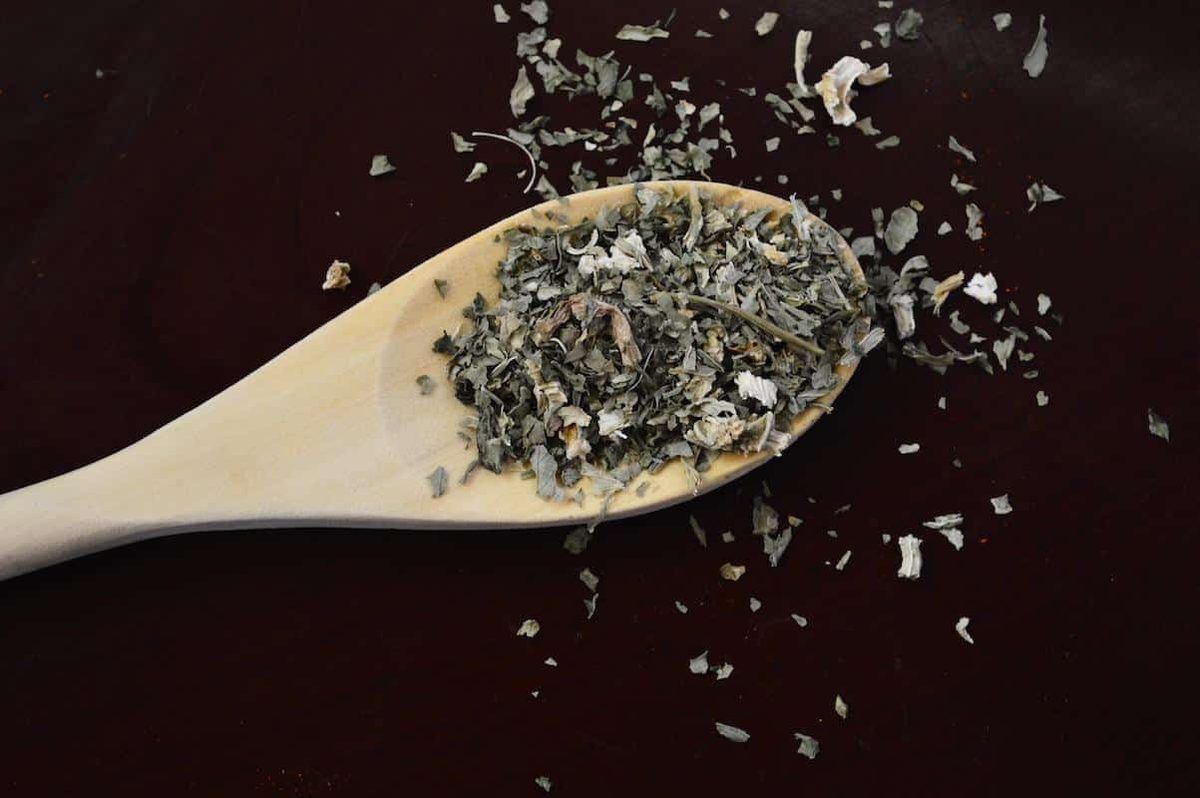
Celery flakes are dried, chopped celery stalk. McCormick makes its flakes from fresh, whole stalks and suggests them for soups, sauces, stuffings, casseroles and salad dressings.1 They add a mild celery flavor and small pieces of celery without any washing or chopping. Every other part of the plant, Apium graveolens,2 can stand in, but each brings a different strength and texture. Which substitute works depends on what the flakes are doing in your recipe.
Quick answer
| What celery flakes are doing | Best substitute | Starting amount, per 2 tbsp flakes | Treatment |
|---|---|---|---|
| Flavor and soft pieces in soups, stews, stuffing, casseroles | Chopped fresh celery | 1/4 cup | Attributed |
| Celery flavor in a dry rub, seasoning blend or dressing | Celery seed, ground | 1/4 tsp, then taste | Method |
| Celery flavor plus salt | Celery salt, with the recipe’s salt cut | 1/4 tsp, cutting about 1/8 tsp table salt | Method (flavor), Computed (salt) |
How the ratios on this page are labeled
- Computed: based on a measurable physical relationship, with the source named.
- Attributed: a named source publishes this ratio. We quote it as theirs.
- Disputed: named sources give different answers to the same swap. We show each one and do not average them.
- Method: we found no published ratio. We give a direction and a cautious starting point, and say so.
The one published figure here is a manufacturer’s conversion for its own product. Everything else is a starting point, because no published study compares the strength of celery flakes with any substitute.
If the flakes are flavoring a cooked dish
In soups, stews, braises, stuffing and casseroles, the flakes soften into small pieces of celery. Fresh celery does the same job and is the closest match.
1. Fresh celery
Ratio (Attributed): McCormick says to use 2 tablespoons of its celery flakes in place of 1/4 cup of chopped fresh celery.1 Going the other way, use 1/4 cup of chopped celery for every 2 tablespoons of flakes, or 2 parts fresh to 1 part flakes by volume. It is the maker’s figure for its own flakes; we found no independent test.
Chop the celery fine so it cooks in the same time as the rest of the dish. Fresh celery brings its own water, which matters little in a soup but can loosen a stuffing; reduce the liquid a little if needed. That is kitchen judgment.
One difference worth knowing: McCormick’s flakes list a sulfiting agent alongside the celery.3 Fresh celery doesn’t, which may matter to anyone avoiding sulfites.
2. Fresh celery leaves
The leafy tops of a head of celery carry the same flavor. PROSEA notes that leaf celery is used as a flavoring, fresh or dried and powdered.4
Ratio (Method): No published ratio was found. Use chopped leaves in the same volume as chopped stalk above, or mix leaves and stalk, and taste near the end of cooking.
If the flakes are flavoring a dry mix
In a rub, seasoning blend or dressing, flakes are usually ground or left to soften in the liquid. A dry, concentrated form of celery is easier to measure.
1. Celery seed
Celery seed comes from the same plant.5 It is far stronger than the fresh plant: Katzer describes its aroma as similar to the leaf and root but much stronger,5 and its essential oil, about 3% of its dry weight, carries the phthalides that give celery its smell.6 McCormick says its flavor “goes a long way” and suggests starting with a pinch.7
Ratio (Method): No published flakes-to-seed ratio was found. Start with 1/4 teaspoon of seed for every 2 tablespoons of flakes, ground if you want no visible seeds, then taste and add more. For comparison only, The Spice House swaps 2 tablespoons of minced celery tops for 1/2 teaspoon of seed;8 that figure is for fresh leaves, not dried flakes.
Celery seeds look different from flakes: small, dark seeds rather than pale green pieces. Whether that matters depends on the dish.
2. Celery powder
Celery powder is sold in more than one form. A seasoning powder may be ground dried celery or ground celery seed; read the label. Powders sold to meat processors for curing are a different product, made for their high nitrate content,9 and are not a seasoning substitute.
Ratio (Method): No published ratio was found. For a powder made from dried celery, start with about half the volume of flakes called for and taste. For a seed-based powder, start with the celery seed amount above.
If you also want salt
Celery salt
Celery salt is salt plus celery seed; McCormick’s lists just “Salt & Celery Seed.”10 It adds celery flavor and salt together, so you can’t raise one without raising the other.
Salt adjustment (Computed): McCormick’s label gives 270 mg of sodium per 1/4 teaspoon of celery salt.10 The FDA says 2,300 mg of sodium is about 1 teaspoon of table salt,11 so 1/4 teaspoon of this celery salt carries the sodium of just under 1/8 teaspoon of table salt. Cut that much salt from the recipe for each 1/4 teaspoon of celery salt you add.
Celery flavor (Method): No published ratio was found. Start with 1/4 teaspoon of celery salt per 2 tablespoons of flakes, and taste before adding more.
What isn’t known
- McCormick’s flakes-to-fresh conversion is the only published figure we found, and no independent test of it.
- No study measures how much of celery’s aroma survives commercial drying, so the strength of flakes against fresh celery or seed is not measured.
- No published figure gives the seed content of commercial celery salt.
Related
- Celery flakes, celery seeds, celery powder, celery salt and celery leaves
- Celery powder vs. celery salt and celery seed vs. celery powder
- Celery powder substitutes, celery seed substitutes, celery leaves substitutes
- Celery seed uses
Footnotes
-
McCormick Celery Flakes, product page, McCormick & Company. mccormick.com · Merchant ↩ ↩2
-
Apium graveolens L., Plants of the World Online, Royal Botanic Gardens, Kew. powo.science.kew.org · Reference work ↩
-
McCormick Celery Flakes, retailer listing with label ingredients, Stop & Shop. stopandshop.com · Merchant ↩
-
Apium graveolens (PROSEA), Plant Resources of South-East Asia. uses.plantnet-project.org · Reference work ↩
-
Gernot Katzer, Celery (Apium graveolens), Gernot Katzer’s Spice Pages. gernot-katzers-spice-pages.com · Reference work ↩ ↩2
-
Salehi et al., Apium Plants: Beyond Simple Food and Phytopharmacological Applications, Applied Sciences, 2019. mdpi.com · Peer-reviewed ↩
-
McCormick Whole Celery Seed, product page, McCormick & Company. mccormick.com · Merchant ↩
-
Celery Seed Substitute, The Spice House. thespicehouse.com · Merchant ↩
-
Bhusal and Muriana, Isolation and Characterization of Nitrate Reducing Bacteria, Applied Microbiology, 2021. mdpi.com · Peer-reviewed ↩
-
McCormick Celery Salt, label ingredients and Nutrition Facts as listed by Stop & Shop. stopandshop.com · Merchant ↩ ↩2
-
Sodium in Your Diet, U.S. Food and Drug Administration. fda.gov · Regulator ↩