Spice Comparisons · Comparison
Celery Seed vs. Celery Powder: Which Celery Powder You Have Decides the Swap
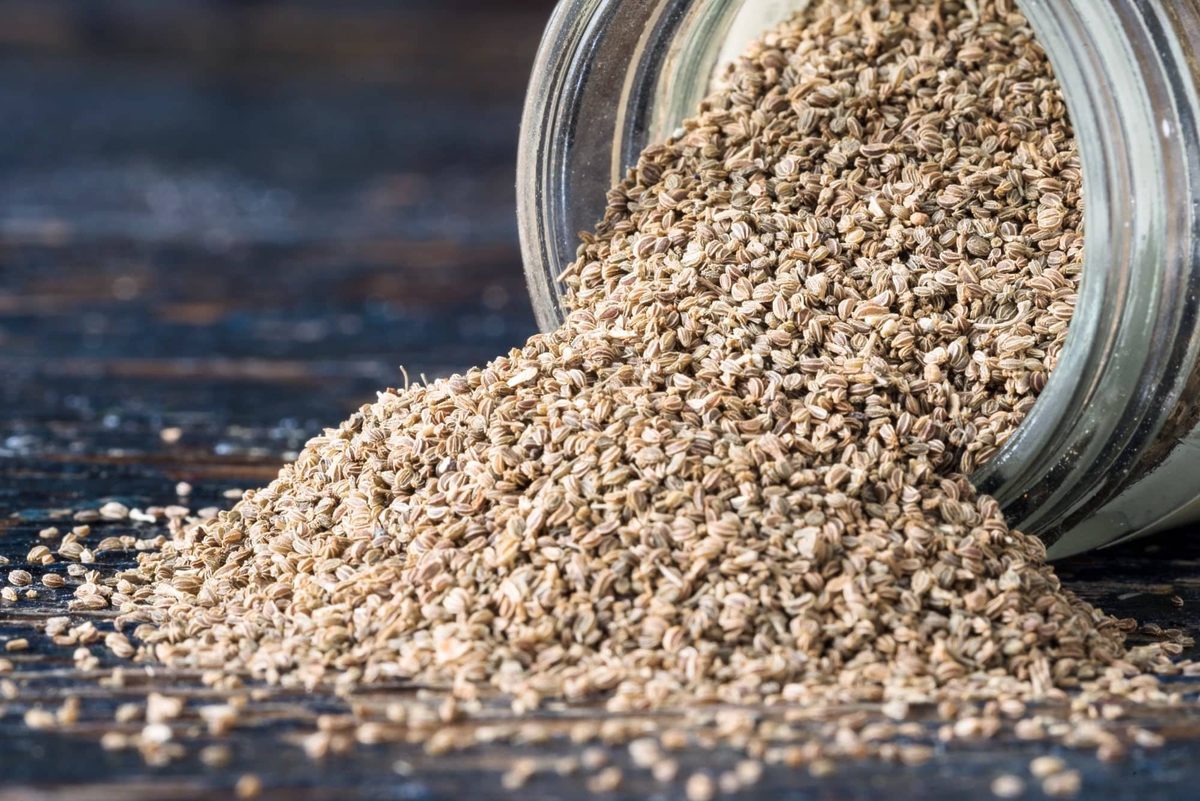
Celery seed is one product; celery powder is two. Some celery powder is simply ground celery seed, and some is dried celery stalk ground fine.12 Against seed-based powder, whole celery seed differs only in grind. Against stalk-based powder, it differs in strength: Katzer describes the seed’s aroma as similar to the leaf and root but much stronger.3 Neither kitchen product is the celery powder that cures “uncured” meats, which is a separate, nitrate-rich product made for that job.4
All of them come from celery, Apium graveolens, a biennial of the parsley family (Apiaceae).5
Side by side
| Celery seed | Celery powder | |
|---|---|---|
| What it is | The dried fruit of celery, sold as “seed”6 | Ground celery seed, or ground dried celery stalk; check the label12 |
| Plant | Apium graveolens, Apiaceae5 | Same5 |
| Essential oil | About 3% of the seed’s dry weight7 | Seed-based: the same seed, ground. Stalk-based: no published figure found |
| Key compounds | Phthalides give celery oil its smell; the seed oil also contains limonene, coumarins and the furanocoumarin bergapten7 | Seed-based: same. Stalk-based: no analysis of stalk powder found |
| Flavor | Similar to the leaf and root but much stronger, and slightly bitter (Katzer)3 | Seed-based: Spices, Inc. calls its ground seed hay-like, grassy and slightly bitter.1 Stalk-based (editorial): milder, more vegetal |
| Forms | Whole; ground | Fine powder |
| Typical uses | Spices, Inc. names deviled eggs and macaroni salad, and Bloody Marys, tomato juices and sauces, and sausages61 | Rubs, dressings, soups (common practice) |
| Price | No dated, sourced comparison found | No dated, sourced comparison found |
A widely repeated claim says celery seed comes from a separate “wild celery” plant. Katzer notes that modern celery cultivars carry far fewer bitter compounds than wild forms,3 but we found no source showing that commercial seed comes from a different plant from celery itself. Spices, Inc., which uses the “wild celery” phrase on one product page, calls celery seeds “the fruit of the celery plant” on another.16
The differences that change the dish
Strength. This is the main one, and it depends on the powder. If yours is ground seed, it is the same ingredient as celery seed. If it is stalk powder, the seed is the stronger of the two by Katzer’s description.3 McCormick says celery seed’s pungent, somewhat bitter flavor “goes a long way” and suggests starting with a pinch.8 No published study measures how much stronger.
Whole versus ground. Whole seed adds visible flecks and a little crunch; ground seed or powder disperses evenly. That is common practice. A widely repeated claim says ground seed releases its flavor faster and fades faster in the pot. No source we found measures that for celery seed, so treat it as unconfirmed.
Texture. Both are dry, which is the reason to use either over fresh celery. The Spice House describes celery seed as giving a strong celery flavor without the stalk’s stringy, fibrous texture.9
Celery powder as a curing agent
Celery is rich in nitrate, not nitrite: one 2021 paper’s table puts celery at 3,151 ppm nitrate.4 For curing, that nitrate has to be converted to nitrite, either in the meat by a bacterial culture or before sale, in pre-converted celery powders that give more consistent nitrite levels.4 Even with products made for curing, residual nitrite in celery-cured meats “can vary dramatically,” according to a University of Wisconsin dissertation’s review of the research.10 Spice-aisle celery powder states no nitrate or nitrite content at all. The American Meat Science Association’s review names control of Clostridium botulinum as the main reason nitrite goes into cured meat,11 so neither belongs in a cure in place of a measured curing agent. See curing salt and celery powder substitutes.
Can one stand in for the other?
For seasoning, yes. No published ratio exists for either direction, so every amount below is a Method starting point, the same treatment our substitute pages use.
- Celery seed for seed-based celery powder. It is the same ingredient. Grind it for an even texture. Method: start with a little less ground seed than the powder called for, and taste. We found no published whole-to-ground volume figure for celery seed.
- Celery seed for stalk-based celery powder. The seed is stronger.3 Method: start with about half as much, ground, and taste, as on our celery powder substitutes page.
- Seed-based powder for celery seed. Method: use a little less than the whole seed called for, and taste. You lose the crunch and flecks.
- Stalk-based powder for celery seed. Method: start with an equal amount and add more to taste; expect a milder, more vegetal result. The nearest published figure for dried stalk is McCormick’s for its celery flakes, 2 tablespoons in place of 1/4 cup of chopped fresh celery,12 which is a flakes-to-fresh figure, not a powder-to-seed one.
- Either, for curing. No. See above.
For more options, see celery seed substitutes.
What isn’t known
- No published study compares the flavor strength of celery seed with stalk-based celery powder.
- No whole-to-ground volume figure for celery seed was found.
- No analysis of the essential oil content of stalk-based celery powder was found.
- Spice-aisle celery powders do not state a nitrate content.
Related
- Celery seeds, celery seed uses and celery seed substitutes
- Celery powder and celery powder substitutes
- Celery seed vs. celery salt and celery powder vs. celery salt
- Celery leaves, celery leaves substitutes, celery flakes and celery salt
Footnotes
-
Ground Celery Seed, product page, Spices, Inc. spicesinc.com · Merchant ↩ ↩2 ↩3 ↩4 ↩5
-
Organic Celery Powder, product page, KOYAH. koyah.com · Merchant ↩ ↩2
-
Gernot Katzer, “Celery (Apium graveolens),” Gernot Katzer’s Spice Pages. gernot-katzers-spice-pages.com · Reference work ↩ ↩2 ↩3 ↩4 ↩5
-
Bhusal and Muriana, “Isolation and Characterization of Nitrate Reducing Bacteria,” Applied Microbiology, 2021. mdpi.com · Peer-reviewed ↩ ↩2 ↩3
-
Apium graveolens L., Plants of the World Online, Royal Botanic Gardens, Kew. powo.science.kew.org · Reference work ↩ ↩2 ↩3
-
Organic Ground Celery Seeds, product page, Spices, Inc. spicesinc.com · Merchant ↩ ↩2 ↩3
-
Salehi et al., “Apium Plants: Beyond Simple Food and Phytopharmacological Applications,” Applied Sciences, 2019. mdpi.com · Peer-reviewed ↩ ↩2
-
McCormick Whole Celery Seed, product page, McCormick & Company. mccormick.com · Merchant ↩
-
Celery Seed Substitute, The Spice House. thespicehouse.com · Merchant ↩
-
King, “Investigating the Antimicrobial Effect of Nitrite and Adjunct Ingredients,” PhD dissertation, University of Wisconsin-Madison, 2014. asset.library.wisc.edu · Peer-reviewed ↩
-
Sindelar and Milkowski, “Sodium Nitrite in Processed Meat and Poultry Meats,” American Meat Science Association White Paper No. 3, 2011. bluedynamo.msu.edu · Publication ↩
-
McCormick Celery Flakes, product page, McCormick & Company. mccormick.com · Merchant ↩