Spice Substitutes · Substitutes
Celery Powder Substitutes: Curing Salt for Cured Meat, Celery Seed and Flakes for Flavor
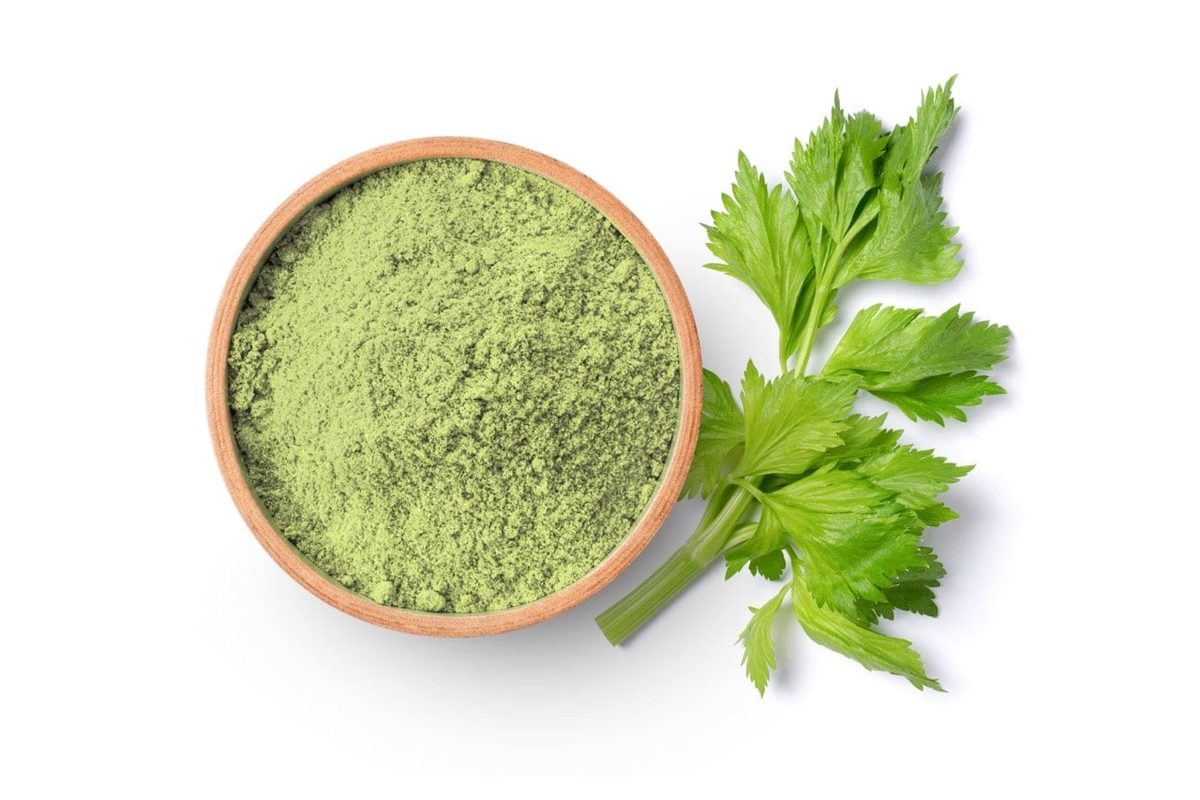
“Celery powder” names two different products, and the right substitute depends on which one your recipe means. In the meat trade it is a concentrated source of nitrate: celery juice and its dried powders are high in nitrate, and celery powder is used widely as a vegetable source of nitrite in natural and organic meats.1 In the spice aisle it is a seasoning, ground celery seed or ground dried celery. If your recipe uses celery powder to cure meat, a flavor swap will not do the job. Start with the curing section below.
Quick answer
| What celery powder is doing | Best substitute | Starting amount | Treatment |
|---|---|---|---|
| Curing meat that will be cooked (bacon, ham, hot dogs, smoked sausage) | Cure #1 (pink curing salt, 6.25% sodium nitrite) | 1 oz per 25 lb of ground meat, set by the meat’s weight, not by the celery powder amount | Computed |
| Curing a long dry-cured product eaten uncooked | Cure #2, in a recipe written for it | The amount in a tested Cure #2 recipe | Method |
| Concentrated celery flavor in rubs, dressings, soups | Ground celery seed | Start with about half as much, then taste | Method |
| Mild celery flavor in cooked dishes | Celery flakes, ground if the dish needs a fine texture | Start with an equal amount, then add to taste | Method |
| Celery flavor plus salt | Celery salt, with the recipe’s salt cut | About 1/2 tsp less table salt per 1 tsp celery salt | Computed (salt only) |
How the ratios on this page are labeled
- Computed: based on a measurable physical relationship, with the source named.
- Attributed: a named source publishes this ratio. We quote it as theirs.
- Disputed: named sources give different answers to the same swap. We show each one and do not average them.
- Method: we found no published ratio. We give a direction and a cautious starting point, and say so.
The curing figures are a different kind of number from the flavor figures. They come from US meat regulations and the nitrite percentage printed on a cure’s label. The flavor figures are starting points, because no published study compares the strength of celery powder with any substitute.
If celery powder is curing meat
Why this is not a flavor swap
What cures meat is nitrite. The American Meat Science Association’s review of curing names control of Clostridium botulinum, the bacterium behind botulism, as the main reason nitrite is added.2 Celery powder does that job only because its nitrate is converted to nitrite, either in the meat by a bacterial starter culture or before sale, in “pre-converted” celery powders.1 The same review says efforts to replace nitrite with other ingredients have been extensively studied and have not succeeded.2
So the substitute for curing celery powder is another measured source of nitrite. Plain salt, sea salt, celery salt, celery flakes and spice-aisle celery powder do not deliver a stated nitrite dose, and none of them belongs in a cure recipe in place of celery powder.
1. Cure #1 (pink curing salt), for meat that will be cooked
Cure #1 is salt with a small, fixed amount of sodium nitrite, dyed pink so it is not mistaken for table salt.3 It is the standard cure for products that are cooked, smoked or canned.3
Ratio (Computed): US rules cap ingoing sodium nitrite in ground (comminuted) products at 1/4 oz per 100 lb of meat.4 USDA’s training calculations use a cure containing 6.25% sodium nitrite.5 At that strength, 4 oz of cure per 100 lb of meat supplies the 1/4 oz of nitrite, which is 1 oz of cure per 25 lb, about 2.5 g per kilogram, or 156 ppm. The Sausage Maker describes 156 ppm as the maximum ingoing nitrite for ground meat.6 Spice Jungle labels its pink curing salt as 6% sodium nitrite,3 which at the same 1 oz per 25 lb gives 150 ppm. Use the percentage on your own package. Weigh the cure; do not measure it by volume.
Do not convert from the celery powder amount. Curing celery powders are used at higher weights than Cure #1, and the rate differs by product. Walton’s says to use its celery juice powder at 2 to 2.5 oz per 25 lb of product, aiming for 100 to 200 ppm ingoing nitrite.7 The Bearded Butchers sell a cultured celery powder in 2.5 oz packets, each meant for 25 lb of meat.8 Whatever the celery powder amount in your recipe, the Cure #1 amount is set by the weight of the meat.
What else changes. A celery powder recipe often includes a holding step before cooking. That step exists to give bacteria time to turn nitrate into nitrite; one study summarized in a 2014 University of Wisconsin dissertation found the holding time mattered more to cured color than the amount of celery powder.9 We found no source on how to adjust such a recipe’s process when switching to Cure #1. The safest course is a tested recipe written for Cure #1.
Labeling also changes. Under USDA rules, a product made without added nitrate or nitrite can be called “Uncured” and must say “No Nitrate or Nitrite Added.”10 Chemically derived sodium nitrite is not acceptable in products sold as natural.1 Meat cured with Cure #1 is conventionally cured.
2. Cure #2, for long dry cures eaten uncooked
Cure #2 contains sodium nitrate as well as nitrite; The Sausage Maker’s version lists 6.25% sodium nitrite and 1% sodium nitrate.6 Its maker names pepperoni, hard salami, Genoa salami, prosciutto, dried farmers sausage and capicola as the products it is for.6 US rules permit nitrate as a source of nitrite in cured products other than bacon.4
Ratio (Method): We found no conversion from a celery-powder dry-cure recipe to Cure #2, and these products are not cooked. Use a tested recipe written for Cure #2 and follow its amounts and process. Do not improvise this one.
3. Another curing celery powder, at its own rate
If you want to keep a “natural” cure, the substitute is another curing celery powder, used at the rate its maker gives. Pre-converted, standardized vegetable nitrite gives more consistent nitrite levels than relying on conversion in the meat.1
Ratio (Attributed): Use the maker’s rate, such as Walton’s 2 to 2.5 oz per 25 lb7 or The Bearded Butchers’ 2.5 oz per 25 lb.8 Neither product page states a measured nitrite content, so these are the makers’ directions, not a nitrite dose we could check.
What doesn’t work for curing
- Spice-aisle celery powder or celery flakes. These are seasonings with no stated nitrate or nitrite content. Curing products are made for their nitrate content, and even with them, residual nitrite in celery-cured products “can vary dramatically,” according to the Wisconsin dissertation’s review of the research.9
- Salt alone. The anti-botulinum job in a cure belongs to nitrite.2 We found no tested, nitrite-free home method for products that are normally cured, so we don’t offer one.
Is the celery-cured version safer or healthier?
Not by the evidence we found. The Wisconsin dissertation reports that alternatively cured products tend to carry less residual nitrite than conventionally cured ones, and that, in the studies it reviews, they allowed more growth of Listeria monocytogenes and Clostridium perfringens.9 On the health side, the Center for Science in the Public Interest has argued that nitrates from natural sources are chemically identical to synthetic ones.11 A 2022 review notes that the International Agency for Research on Cancer has classified processed meat as carcinogenic to humans; that classification is of processed meat, not of one curing ingredient.12 In 2020, USDA said it intends to propose barring “Uncured” and “No Nitrate or Nitrite Added” claims on products processed with any source of nitrate or nitrite, including celery powder.13
For home curing, FDA rules require curing preparations sold to consumers to carry directions that keep the finished meat at or below 200 ppm sodium nitrite.14 See curing salt for the full rules and the difference between Cure #1 and Cure #2.
If celery powder is concentrated celery flavor
Here celery powder is a seasoning in a rub, dressing, soup or stock. Check your label first: a powder made from seed tastes stronger than one made from the dried vegetable.
1. Ground celery seed
Celery seed is the most aromatic part of the plant, with essential oil at about 3% of its dry weight, and a group of compounds called phthalides gives celery oil its characteristic smell.15 If your celery powder is seed-based, ground celery seed is the same ingredient.
Ratio (Method): We found no published ratio. If the powder you are replacing is made from the vegetable, seed will be stronger: McCormick says celery seed’s pungent, somewhat bitter flavor “goes a long way” and suggests starting with a pinch.16 Start with about half the amount of powder called for, taste, and add more. Grind whole seed fine for a rub; whole seed adds crunch.
2. Celery flakes
McCormick’s celery flakes are made from fresh, whole celery stalks.17 They give the milder flavor of the vegetable, so they suit a recipe that uses vegetable-based powder better than one that uses seed.
Ratio (Method): No published flakes-for-powder ratio was found. Start with an equal amount, ground fine in a spice grinder if the dish needs a smooth texture, and add more to taste.
3. Fresh celery
Fresh celery brings water and fiber along with flavor, so it suits soups and braises better than dry rubs.
Ratio (Method): No published powder-to-fresh ratio was found. The nearest published figure is McCormick’s for its flakes: 2 tablespoons of flakes in place of 1/4 cup of chopped fresh celery.17 It is not a figure for powder. Start with a few tablespoons of finely chopped celery per teaspoon of powder and adjust after tasting.
If celery powder is celery flavor plus salt
Celery salt
McCormick’s celery salt lists just salt and celery seed.18 It is mostly salt, so cut the other salt in the recipe.
Salt adjustment (Computed): McCormick’s label gives 270 mg of sodium per 1/4 teaspoon,18 about 1,080 mg per teaspoon. The FDA says 2,300 mg of sodium is about 1 teaspoon of table salt.19 So each teaspoon of this celery salt carries a little under half the sodium of a teaspoon of table salt: cut about 1/2 teaspoon of table salt for each teaspoon of celery salt you add. Other brands may differ; check the sodium line on your label.
Celery flavor (Method): We found no figure for how much celery seed a commercial celery salt contains, so start with the same amount of celery salt as powder, after cutting the salt as above, and taste.
What isn’t known
- No published figure gives the nitrate or nitrite content of spice-aisle celery powder, or a dependable figure for curing celery powders. The two curing products checked here state usage rates but not measured nitrite content.
- We found no source on how to adapt a celery-powder recipe’s holding step or process when switching to Cure #1.
- No published study compares the flavor strength of celery powder with celery seed, flakes, fresh celery or celery salt. Every flavor amount above is a starting point.
- The salt-to-seed ratio of commercial celery salts is not published by the sources we read.
Related
- Celery powder, curing salt and curing salt substitutes
- Celery seeds, celery flakes, celery salt and celery leaves
- Celery seed vs. celery powder and celery powder vs. celery salt
- Celery seed substitutes, celery flakes substitutes and celery salt substitutes
Footnotes
-
Bhusal and Muriana, Isolation and Characterization of Nitrate Reducing Bacteria, Applied Microbiology, 2021. mdpi.com · Peer-reviewed ↩ ↩2 ↩3 ↩4
-
Sindelar and Milkowski, Sodium Nitrite in Processed Meat and Poultry Meats, American Meat Science Association White Paper No. 3, 2011. bluedynamo.msu.edu · Reference work ↩ ↩2 ↩3
-
Curing Salt, Pink, product page, Spice Jungle. spicejungle.com · Merchant ↩ ↩2 ↩3
-
9 CFR 424.21, Use of food ingredients and sources of radiation, eCFR. ecfr.gov · Regulator ↩ ↩2
-
Extra Practice Processing Calculations (FPLIC-8), USDA Food Safety and Inspection Service. fsis.usda.gov · Regulator ↩
-
Insta Cure #2, product page, The Sausage Maker. sausagemaker.com · Merchant ↩ ↩2 ↩3
-
Celery Juice Powder, product page, Walton’s. waltons.com · Merchant ↩ ↩2
-
Cultured Celery Powder (Veg Stable 506), product page, The Bearded Butchers. beardedbutchers.com · Merchant ↩ ↩2
-
King, Investigating the Antimicrobial Effect of Nitrite and Adjunct Ingredients, PhD dissertation, University of Wisconsin-Madison, 2014. asset.library.wisc.edu · Reference work ↩ ↩2 ↩3
-
9 CFR 317.17, special labeling requirements concerning nitrate and nitrite, eCFR. ecfr.gov · Regulator ↩
-
Devenyns, USDA plans to crack down on nitrate and nitrite labeling claims in meat, Food Dive, 2020. fooddive.com · Publication ↩
-
Shakil et al., Nitrites in Cured Meats, Health Risk Issues, Alternatives to Nitrites: A Review, Foods, 2022. mdpi.com · Peer-reviewed ↩
-
FSIS final response to petition 19-03, USDA Food Safety and Inspection Service, 2020. fsis.usda.gov · Regulator ↩
-
21 CFR 172.175, Sodium nitrite, eCFR. ecfr.gov · Regulator ↩
-
Salehi et al., Apium Plants: Beyond Simple Food and Phytopharmacological Applications, Applied Sciences, 2019. mdpi.com · Peer-reviewed ↩
-
McCormick Whole Celery Seed, product page, McCormick & Company. mccormick.com · Merchant ↩
-
McCormick Celery Flakes, product page, McCormick & Company. mccormick.com · Merchant ↩ ↩2
-
McCormick Celery Salt, label ingredients and Nutrition Facts as listed by Stop & Shop. stopandshop.com · Merchant ↩ ↩2
-
Sodium in Your Diet, U.S. Food and Drug Administration. fda.gov · Regulator ↩