Herbs · Profile
Garlic Scapes: What They Are, When to Find Them and How to Cook Them
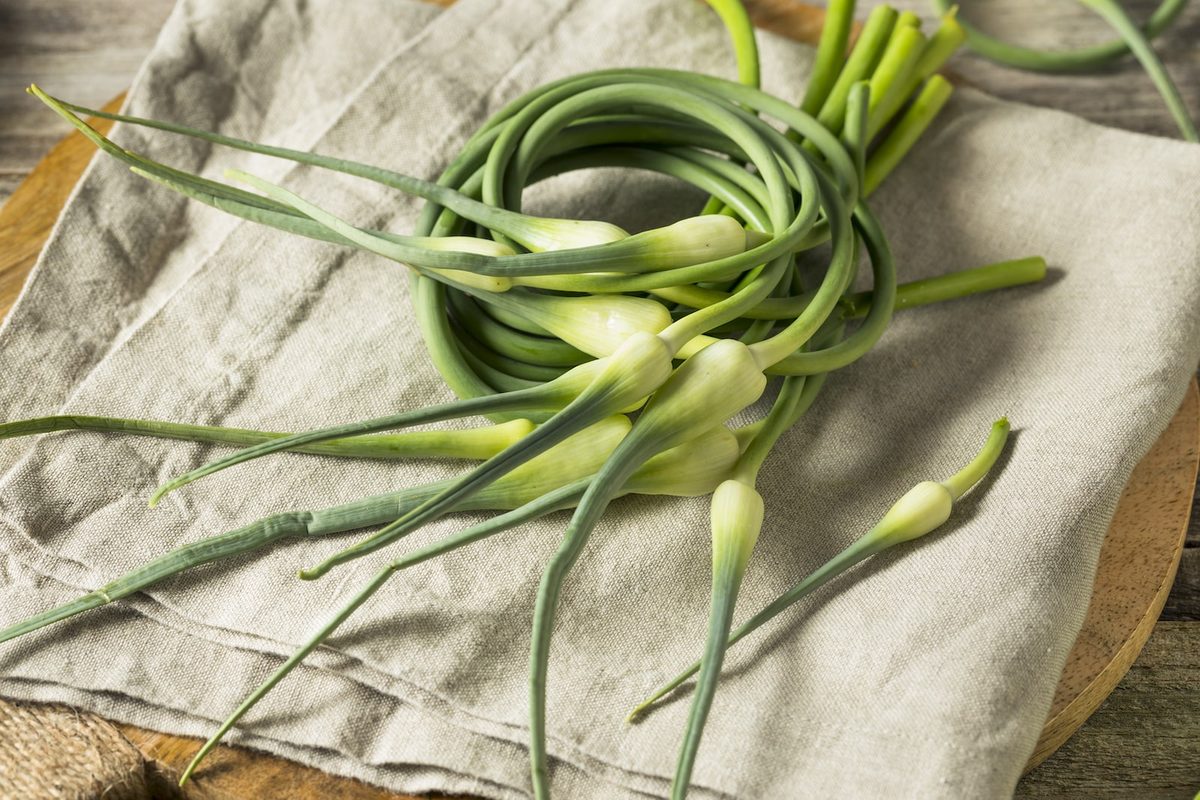
Garlic scapes are the curling green flower stalks that hardneck garlic sends up in late spring and early summer.12 Growers remove them to favor the bulb,13 and cooks get a short-season vegetable with a milder garlic flavor than the cloves. This page covers what scapes are, why only some garlic has them, when to find them, and how to cook and keep them.
At a glance
| What they are | The flower stalk of hardneck garlic1 |
| Plant | Garlic, Allium sativum4 |
| Plant family | Amaryllidaceae5 |
| Which garlic | Hardneck types only; softneck garlic does not produce a scape1 |
| How many | One scape per bulb2 |
| Season | May through July (Nebraska)2 |
| Flavor | Mild garlic, milder than the cloves12 |
| Keeps | Two to three weeks refrigerated in a plastic bag26 |
What a scape is
Garlic comes in two broad types. Hardneck garlic (also called stiffneck, ophio or topset garlic) bears a stiff stalk called a scape; softneck garlic does not.1 In Maine, the scape grows from the center whorl of leaves in June.1 In most hardneck varieties it ends in an umbel carrying small round clones called bulbils, not true seed.1 Each bulb produces a single scape.2
UC Agriculture and Natural Resources notes that most commercial garlic varieties are softneck.7 Nebraska Extension notes that scapes are more often found at farmers markets than in typical grocery stores.2
Why growers remove them
University of Maine research found that leaving the scape on the plant reduces the size of the harvested bulb, and that removing it does not harm the plant’s in-season growth or the storage life of the bulb.1 The bulletin advises removing scapes early, once the thickened bulbil body just behind the tip can be removed, rather than waiting for the stalk to lengthen and curl.1 A WSU Extension master gardener article gives the same advice, so that nutrients go to the bulb.3
Flavor
University of Maine Extension describes young chopped scapes as giving a mild garlic flavor,1 and Nebraska Extension calls them milder than garlic cloves.2 In the kitchen they are green and fresh, a cross between garlic and a young green vegetable like asparagus or green beans, and they get sweeter and softer the longer they cook. That description is ours.
No published analysis of the sulfur compounds in scapes was found for this page. For how garlic’s pungency forms in the cloves when they are cut, see garlic.
How garlic scapes are used
Extension guides suggest:
- In place of garlic. Cut into small pieces and use as you would garlic in a recipe.6
- In place of green onions or scallions.2
- Pesto. Both the Maine and Nebraska guides suggest it.12
- Grilled, sautéed or roasted.2
- Stir-fries, eggs, salads, hummus, pizza and baked potatoes.2
By common practice, scapes are also pickled, chopped into compound butter, and cut into lengths for soups. Young, tender scapes are better for eating raw; older, tougher ones are better cooked. The thin tip above the bulbil swelling is often trimmed off as fibrous. These are kitchen judgments, not sourced findings.
A note on scape pesto and oil
UC Agriculture and Natural Resources warns that garlic stored in oil must not be kept at room temperature, and that refrigerated garlic in oil should be used within 4 days; commercial garlic-in-oil products are made under strict guidelines.7 That guidance is written for garlic cloves, and no scape-specific guidance was found. Treating homemade scape pesto the same way (refrigerate, use within days, or freeze) is the cautious choice.
Buying and storage
Look for scapes that are firm, undamaged and evenly green,2 or, per a Wisconsin extension sheet, curled, with a yellow-green stalk and a white, tender bulb.6
Store them unwashed in a plastic bag in the refrigerator. Nebraska Extension gives up to three weeks,2 and the Wisconsin sheet two to three weeks.6 For longer storage, see how to store garlic scapes.
Garlic in history
Scapes have no separate written history that could be traced; the history belongs to garlic as a whole. A 2001 review in the Journal of Nutrition notes that garlic has been found in Egyptian pyramids and ancient Greek temples, that it was given to laborers to provide strength and increase work capacity, that it was given to the original Olympic athletes in Greece, and that ancient medical texts from Egypt, Greece, Rome, China and India describe its uses.8 Kew gives garlic’s native range as Central Asia to northeastern Iran.4 For more, see garlic.
Several popular stories about garlic, including garlic shortages causing strikes among pyramid builders, garlic in Tutankhamun’s tomb, and garlic rations for Greek soldiers, could not be traced to a source and are not repeated here as fact.
Nutrition and health
No USDA or other official nutrient profile for garlic scapes was found for this page. A Wisconsin extension fact sheet describes them as high in fiber and lists vitamins A and C, without figures.6 Claims that scapes are a meaningful source of calcium or iron could not be checked.
There is no research on scapes specifically. For garlic in general, the NIH’s National Center for Complementary and Integrative Health reports that eating garlic does not seem to reduce the risk of stomach cancer, and that it is uncertain whether garlic influences the risk of colorectal cancer.9 No claim is made here that garlic scapes prevent cancer, bone loss or any other disease.
Substitutes and comparisons
No source checked gives a tested swap ratio. Nebraska Extension suggests using scapes in place of green onions or scallions.2 Going the other way, a Method starting point is the green tops of scallions with a little minced garlic; taste and adjust.
- Garlic scapes substitutes
- How to store garlic scapes
- Garlic chives, a different plant with flat leaves and edible flower stalks
- Garlic and wild garlic
Footnotes
-
David Fuller and Steven B. Johnson, Growing Hardneck Garlic in Your Maine Garden, Bulletin #2063, University of Maine Cooperative Extension, 2013. projects.sare.org · Reference work ↩ ↩2 ↩3 ↩4 ↩5 ↩6 ↩7 ↩8 ↩9 ↩10 ↩11 ↩12
-
“Garlic Scapes”, Nebraska Extension, University of Nebraska-Lincoln. food.unl.edu · Reference work ↩ ↩2 ↩3 ↩4 ↩5 ↩6 ↩7 ↩8 ↩9 ↩10 ↩11 ↩12 ↩13 ↩14 ↩15
-
Ruth Sutton, “The Joys of Garlic”, WSU Extension, Skagit County, 2020. wpcdn.web.wsu.edu · Reference work ↩ ↩2
-
Allium sativum L., Plants of the World Online, Royal Botanic Gardens, Kew. powo.science.kew.org · Reference work ↩ ↩2
-
“Garlic”, Encyclopaedia Britannica, 2026. britannica.com · Reference work ↩
-
Garlic Scapes fact sheet, University of Wisconsin-Extension, St. Croix County. stcroix.extension.wisc.edu · Reference work ↩ ↩2 ↩3 ↩4 ↩5
-
Linda J. Harris, Garlic: Safe Methods to Store, Preserve, and Enjoy, UC Agriculture and Natural Resources, 2016. ccfruitandnuts.ucanr.edu · Reference work ↩ ↩2
-
Rivlin RS, “Historical perspective on the use of garlic”, Journal of Nutrition, 2001 (abstract). synapse.mskcc.org · Peer-reviewed ↩
-
Garlic: Usefulness and Safety, National Center for Complementary and Integrative Health, 2025. nccih.nih.gov · Regulator ↩