Herbs · Profile
Garlic Chives: The Flat-Leaved Allium of Chinese Cooking, and How to Use It
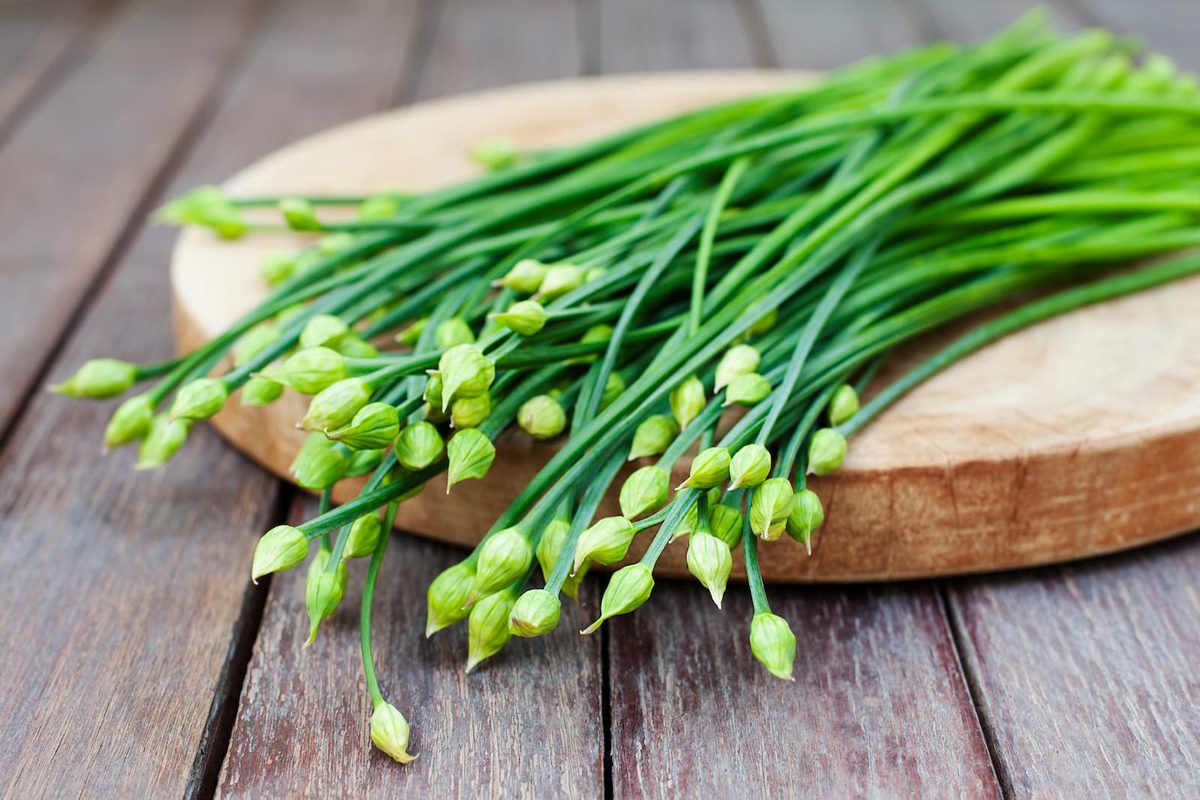
Garlic chives are the flat, strap-like leaves of Allium tuberosum, a clump-forming perennial in the onion’s genus. They taste and smell of garlic, but gently, and in Chinese cooking they are treated more as a vegetable than a garnish: chopped into dumpling fillings, stir-fried, and sold in three distinct forms. This page covers the plant, the forms you will find, what makes them smell the way they do, and how to cook, keep and replace them.
At a glance
| Botanical name | Allium tuberosum Rottler ex Spreng.1 |
| Plant family | Amaryllidaceae1 |
| Other names | Chinese chives2; jiǔ cài in Mandarin, “gow choy” in Cantonese3; kucai in Indonesia2 |
| Part used | Leaves and young flower stalks2 |
| Native range | Himalaya to China, per Kew1 |
| Flavor | Mild garlic taste and smell2 |
| Most abundant volatile (one study) | Dimethyl trisulfide4 |
| Forms sold | Green leaves, flowering stems with buds, and yellow (blanched) chives23 |
| Keeps | 2–3 days fresh at 0–2 °C; finely cut leaves freeze2 |
Measured values
6 figures, sourced| Measure | Value | Scope | Source |
|---|---|---|---|
| Dimethyl trisulfide (most abundant volatile) | 10,623.30 µg/kg | one 2022 study, Chinese chive samples, headspace SPME analysisOne study's samples and method; not a fixed value for the plant | doaj.org |
| Water Nutrient | 93 g per 100 g edible portion of leaves | PROSEA composition, leaves | uses.plantnet-project.org |
| Protein Nutrient | 2.1 g per 100 g edible portion of leaves | PROSEA composition, leaves | uses.plantnet-project.org |
| Fiber Nutrient | 0.9 g per 100 g edible portion of leaves | PROSEA composition, leaves | uses.plantnet-project.org |
| Carotene Nutrient | 4 mg per 100 g edible portion of leaves | PROSEA composition, leaves | uses.plantnet-project.org |
| Vitamin C Nutrient | 25 mg per 100 g edible portion of leaves | PROSEA composition, leaves | uses.plantnet-project.org |
Each figure is quoted as its source states it, with the samples or standard it applies to. Where sources differ, both are shown; nothing is averaged. All measured values
What garlic chives are
Allium tuberosum is a perennial herb 20–40 cm tall that grows in dense clumps. Its leaves are linear and flat, 13–45 cm long and 2–10 mm wide, and it carries white, star-shaped flowers in umbels 3–5 cm across, followed by small black seeds.2 Kew places it in the Amaryllidaceae and describes it as a bulbous geophyte of the temperate biome.1 (PROSEA, an older reference, files it under Liliaceae, the family the genus used to sit in.2)
The crop is grown as a ratoon: the leaves are cut, regrow, and are harvested again from the same plants, starting three to four months after planting.2
Garlic chives are a different species from common chives; see garlic chives vs. chives. They are also not garlic scapes, which are the flower stalks that hardneck garlic sends up in early summer.5
Where they come from
The two main references disagree on the wild range:
| Source | Native or wild range |
|---|---|
| Kew Plants of the World Online | Himalaya to China (southwest Shanxi): Assam, north-central China, Nepal and the western Himalaya1 |
| PROSEA | Believed to have originated in China; grows wild in central and northern Asia2 |
Kew lists Japan, Korea, Mongolia, the Philippines, Thailand and several US states among the places where the plant has been introduced rather than native.1 PROSEA records it under cultivation in China, India, Indonesia, Japan, Korea, Nepal, the Philippines, Taiwan, Thailand and the United States.2
History
PROSEA says garlic chives were certainly grown in China by the 10th century and probably as early as 200 BC.2 A cultivation history of 3,000 years or more is widely repeated; no source for it was found. PROSEA notes the crop is of considerable importance in China, Japan and Taiwan but only a minor vegetable in Southeast Asia, that no production statistics exist, and that international trade appears negligible.2
Flavor and the compounds behind it
PROSEA describes the leaves as having a mild garlic taste and smell.2 The Woks of Life describes them as having a strong garlicky fragrance and calls them more vegetal than herbal.3 Both are fair: the smell is pronounced when you cut a bunch, and the taste in a cooked dish is softer than garlic itself. That last observation is ours.
A 2022 study in Molecules identified 59 volatile compounds in Chinese chive using headspace sampling, and found dimethyl trisulfide to be the most abundant, at 10,623.30 µg/kg in the samples tested.4 Of the aroma categories the authors scored, a “garlic and onion” odor dominated all the others.4 Those figures come from one study’s samples and method and should not be read as a fixed value for the plant.
The three forms
Chinese markets sell garlic chives in three forms, and they are not interchangeable.
| Form | Names | What it is | How it differs |
|---|---|---|---|
| Green garlic chives | jiǔ cài, “gow choy”3 | The flat green leaves | Strong garlicky fragrance, meaty flat leaves3 |
| Flowering garlic chives | jiǔ cài tái3 | Stems with tender, unopened flower buds | Hollow and crunchier, suited to stir-frying; more seasonal, since the plant usually flowers once a season3 |
| Yellow chives | jiǔhuáng, “gow wang”3 | Leaves grown with little light, so they lack chlorophyll | Same basic flavor as the green leaves, but milder and more delicate; usually pricier3 |
PROSEA describes the yellow form’s production: in China, clumps are grown in darkness to produce etiolated leaves.2 It also notes that flower stalks are usually harvested for eating and are commonly sold in markets in Malaysia and Thailand.2 The buds and opened flowers are edible.3
How garlic chives are used
PROSEA records that both the leaves and young inflorescences are used to season food, eaten blanched or green.2 The Woks of Life treats the leaves more as a vegetable than an herb and recommends them for stir-fries and dumpling fillings, and notes that yellow chives often appear in Cantonese noodle and seafood dishes.3
Beyond that, the following is common kitchen practice rather than sourced fact:
- Dumplings and buns. Chopped finely and mixed with pork, shrimp or egg as a filling.
- Stir-fries. Cut into short lengths and tossed in a hot wok with egg, bean sprouts, pork or tofu, cooked only until just wilted. Flowering chives take a little longer.
- Eggs. Folded into scrambled eggs or an omelet.
- Raw. Thinly sliced as a garnish, used the way you would use chives but with a garlic note.
Because the leaves are thin, long cooking leaves them limp and olive-colored; most recipes add them near the end. That is a cooking judgment, not a measured finding.
For more, see garlic chives substitutes and garlic.
Buying and storage
Look for bunches with firm, flat, evenly colored leaves and no slimy or yellowing tips (yellow chives are pale by design). That is kitchen judgment.
Garlic chives do not keep long. PROSEA says the fresh leaves can be stored for only 2–3 days at 0–2 °C, and that finely cut leaves are suitable for freezing.2 It also notes that leaves are cut, bunched and marketed as fresh as possible.2 Freezing chopped leaves is the practical way to keep a surplus for cooked dishes.
Nutrition
Garlic chives are eaten in larger amounts than most herbs, but they are still mostly water. PROSEA gives this composition for the leaves, per 100 g edible portion:2
| Per 100 g leaves (PROSEA) | Amount | % Daily Value |
|---|---|---|
| Water | 93 g | |
| Protein | 2.1 g | |
| Fiber | 0.9 g | about 3% (DV 28 g)6 |
| Carotene | 4 mg | |
| Vitamin C | 25 mg | about 28% (DV 90 mg)6 |
That is a reasonable amount of vitamin C for a leafy vegetable and very little fiber. Popular lists that call garlic chives rich in fiber, calcium, iron or riboflavin could not be supported from the sources reviewed.
PROSEA records traditional medicinal uses in Asia, against tumors, intestinal disorders and lung infections, and as an aid to recovery from fatigue.2 These are folk uses, not evidence of effect, and no claim is made here that garlic chives treat or prevent any disease.
Substitutes and comparisons
No source checked gives a tested swap ratio for garlic chives. As a Method starting point: for raw use, common chives with a very small amount of finely grated garlic come closest; for cooked dishes, the green tops of scallions with a little garlic work. Taste and adjust.
- Garlic chives substitutes
- Garlic chives vs. chives
- Chives and chives substitutes
- Garlic scapes
- Garlic
Footnotes
-
Allium tuberosum Rottler ex Spreng., Plants of the World Online, Royal Botanic Gardens, Kew. powo.science.kew.org · Reference work ↩ ↩2 ↩3 ↩4 ↩5 ↩6
-
Q.P. van der Meer et al., Allium tuberosum, Plant Resources of South-East Asia (PROSEA). uses.plantnet-project.org · Reference work ↩ ↩2 ↩3 ↩4 ↩5 ↩6 ↩7 ↩8 ↩9 ↩10 ↩11 ↩12 ↩13 ↩14 ↩15 ↩16 ↩17 ↩18 ↩19 ↩20 ↩21
-
“Fresh Herbs & Aromatics Used in Chinese Cooking”, The Woks of Life, 2025. thewoksoflife.com · Publication ↩ ↩2 ↩3 ↩4 ↩5 ↩6 ↩7 ↩8 ↩9 ↩10 ↩11
-
Xie et al., “Identification of Major Volatile Aroma-Active Compounds in Chinese Chive (Allium tuberosum Rottler)”, Molecules, 2022 (abstract). doaj.org · Peer-reviewed ↩ ↩2 ↩3
-
David Fuller and Steven B. Johnson, Growing Hardneck Garlic in Your Maine Garden, Bulletin #2063, University of Maine Cooperative Extension, 2013. projects.sare.org · Reference work ↩
-
Daily Value on the Nutrition and Supplement Facts Labels, U.S. Food and Drug Administration. fda.gov · Regulator ↩ ↩2