Cooking · Storage
How to Store Garlic Scapes: Fridge, Freezer, Pesto, Pickles and Drying
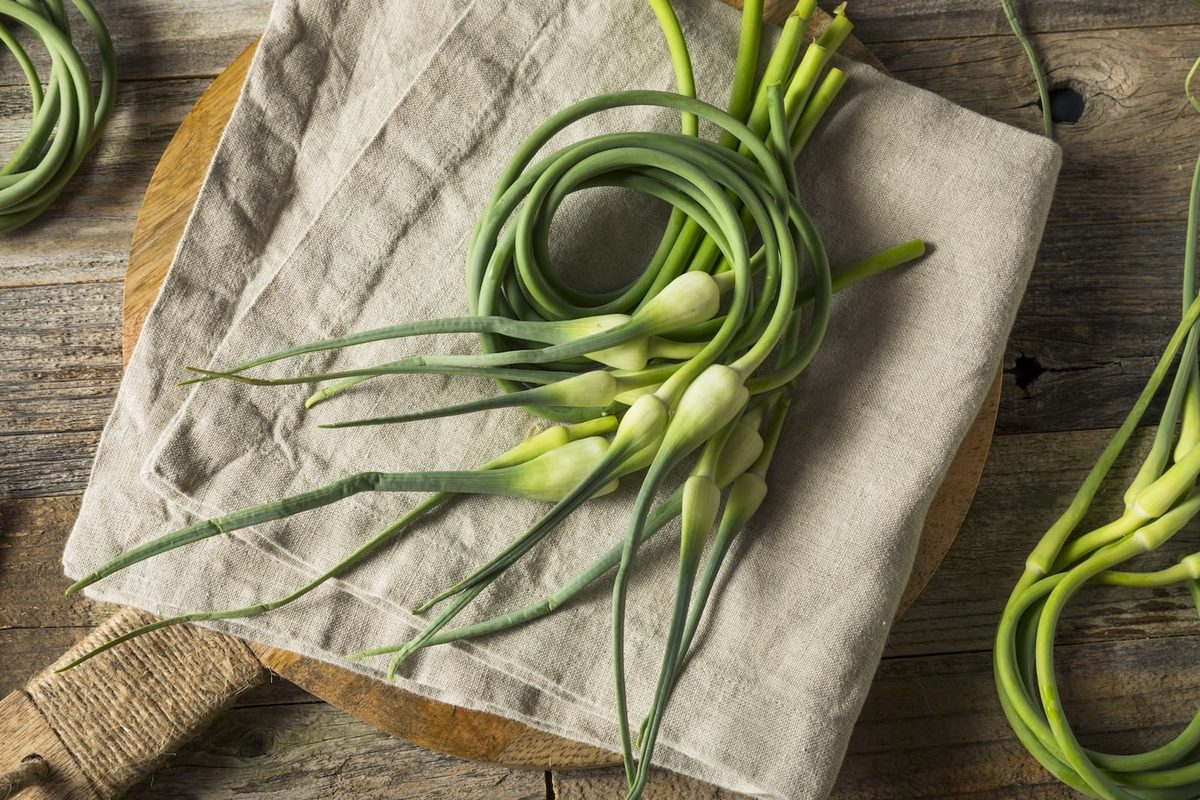
Garlic scapes are the stiff flower stalks of hardneck garlic, one per bulb, and removed so the plant puts its nutrients into the bulb.123 Nebraska Extension gives their season as May through July.1 They taste milder than garlic cloves,1 and they keep well in the fridge for a vegetable. For longer storage the freezer is the simple, safe choice. Pesto and pickles both work too, but each comes with a food-safety rule.
At a glance
| Method | How long | Source |
|---|---|---|
| Fridge, in a plastic bag | 2–3 weeks to about a month, depending on source | Wisconsin, Nebraska, Illinois Extension145 |
| Freezer, raw or blanched | No published limit found | Illinois Extension5 |
| Pesto (scapes in oil) | Freeze it; refrigerated guidance ranges from 3 days to 3 weeks | Nummer et al.; Penn State67 |
| Pickled | Refrigerate; no tested scape recipe found | NCHFP; UC ANR (for garlic cloves)89 |
| Dried | No scape-specific method or shelf life found |
Choosing scapes that will keep
Start with good ones. Nebraska Extension says to look for scapes that are firm, undamaged and evenly green;1 a Wisconsin extension sheet describes good scapes as curled, with a yellow-green stalk and a white, tender bulb.4
In the fridge
| Source | Method | How long |
|---|---|---|
| Nebraska Extension1 | Refrigerated | Up to 3 weeks |
| Wisconsin Extension, St. Croix County4 | In a plastic bag in the fridge | 2–3 weeks |
| Illinois Extension, citing the University of Kentucky5 | Refrigerated | Up to a month |
The figures differ by a week or so, and we have not averaged them. None is a measured test. Standing scapes upright in a glass of water like cut flowers is a popular alternative, but we found no extension source that recommends it or gives a time for it.
In the freezer
Illinois Extension says scapes can be frozen “either raw or blanched.”5 That matters, because a common claim is that blanching is required, and that it works by killing bacteria. Neither part holds up in the sources we found. Penn State Extension, writing about herbs, gives the purpose of blanching as stopping enzyme reactions, with a 15-second blanch for larger-leaved herbs such as basil.6 No source we found describes blanching as a safety step for scapes.
We found no tested blanching time for scapes, and no published limit on how long frozen scapes keep. The widely quoted “up to a year” has no source we could trace.
A practical way to freeze them (editorial): cut the scapes into short lengths, spread them on a tray so the pieces freeze separately, then pack them in a freezer bag. Penn State uses the same tray step for herb leaves.6
Garlic scape pesto: keep it frozen
Pesto is the most popular use for scapes,5 and it is also the one storage method with a real safety issue. Scapes in oil fall under the guidance for vegetables and herbs in oil. Nummer and colleagues, reviewing that guidance, note that vegetables and herbs stored in oil provide several conditions needed for botulinum toxin production, and that “the safest recommendation is to freeze” them.7 Penn State Extension says to add oil to herbs only if they will be frozen, and never to store herbs in oil at room temperature.6
How long pesto can sit in the fridge is a point where the guidance disagrees:
| Source | What it covers | Refrigerated limit |
|---|---|---|
| Recommendation reported by Nummer et al.7 | Pesto | Up to 3 days |
| Raab and Woodburn, 2009, as reported by Nummer et al.7 | Pesto | 3 weeks |
| Nummer et al.7 | Home-prepared vegetables and herbs in oil, generally | Refrigerate and use within 4 days, or discard |
| UC ANR Publication 85688 | Garlic cloves in oil | No more than 4 days; freezer for several months |
Given that spread, the cautious course is to freeze scape pesto in small portions and keep only what you will eat in a few days in the fridge. Never leave it at room temperature.6
Pickled scapes
The National Center for Home Food Preservation says to use only recipes with tested proportions of ingredients.9 We found no lab-tested recipe for pickled garlic scapes from NCHFP or an extension service. Recipes circulate that let pickled scapes sit in a cool place for weeks and claim a six-month life; we could not trace either figure to a tested source.
The nearest tested guidance is for garlic cloves. UC ANR says peeled cloves can be covered in undiluted wine or vinegar, which gives an acidic environment below pH 4.6, and kept in the refrigerator for about 4 months, but must not be stored at room temperature, where the mixture will rapidly grow mold.8 By analogy, and this is our judgment rather than tested guidance, keep home-pickled scapes in the refrigerator on the same terms, and discard any batch that shows mold or yeast on the surface.8
Dried scapes
We found no extension method for drying garlic scapes. The closest tested guidance is UC ANR’s for garlic cloves: dry prepared cloves in a dehydrator at 140°F for 2 hours, then at 130°F for another 4 to 6 hours until brittle or crisp, and store dried garlic in an airtight container at room temperature or in the freezer.8 That guidance was written for cloves, not scapes, so treat the times as a starting point only. We found no shelf life for dried scapes. For more on drying garlic, see how to dry garlic.
Not yet measured
- Fridge life of garlic scapes, measured rather than estimated, and whether a glass of water beats a bag.
- A blanching time for scapes, and how long frozen scapes keep.
- A tested recipe for pickled garlic scapes.
- A tested drying method and shelf life for dried scapes.
Related
- Garlic scapes
- Garlic scapes substitutes
- Garlic
- How to dry garlic
- Fresh garlic substitutes
- Garlic chives
Footnotes
-
Garlic Scapes, Nebraska Extension. food.unl.edu · Reference work ↩ ↩2 ↩3 ↩4 ↩5 ↩6
-
The Joys of Garlic, Washington State University Extension. wpcdn.web.wsu.edu · Reference work ↩
-
David Fuller and Steven B. Johnson, Growing Hardneck Garlic in Your Maine Garden, University of Maine Cooperative Extension, 2013. projects.sare.org · Reference work ↩
-
Garlic Scapes fact sheet, University of Wisconsin-Extension, St. Croix County. stcroix.extension.wisc.edu · Reference work ↩ ↩2 ↩3
-
Caitlin Mellendorf, “Game for Garlic Scapes?”, University of Illinois Extension, 2019. extension.illinois.edu · Reference work ↩ ↩2 ↩3 ↩4 ↩5
-
Freezing Herbs, Penn State Extension. extension.psu.edu · Reference work ↩ ↩2 ↩3 ↩4 ↩5
-
Nummer et al., Food Protection Trends, 2011. foodprotection.org · Peer-reviewed ↩ ↩2 ↩3 ↩4 ↩5
-
Garlic: Safe Methods to Store, Preserve, and Enjoy, UC Agriculture and Natural Resources. ccfruitandnuts.ucanr.edu · Reference work ↩ ↩2 ↩3 ↩4 ↩5
-
General Information on Pickling, National Center for Home Food Preservation. nchfp.uga.edu · Reference work ↩ ↩2