Spices · Profile
Garlic: Where It Comes From, Why It Bites, and How to Use and Store It
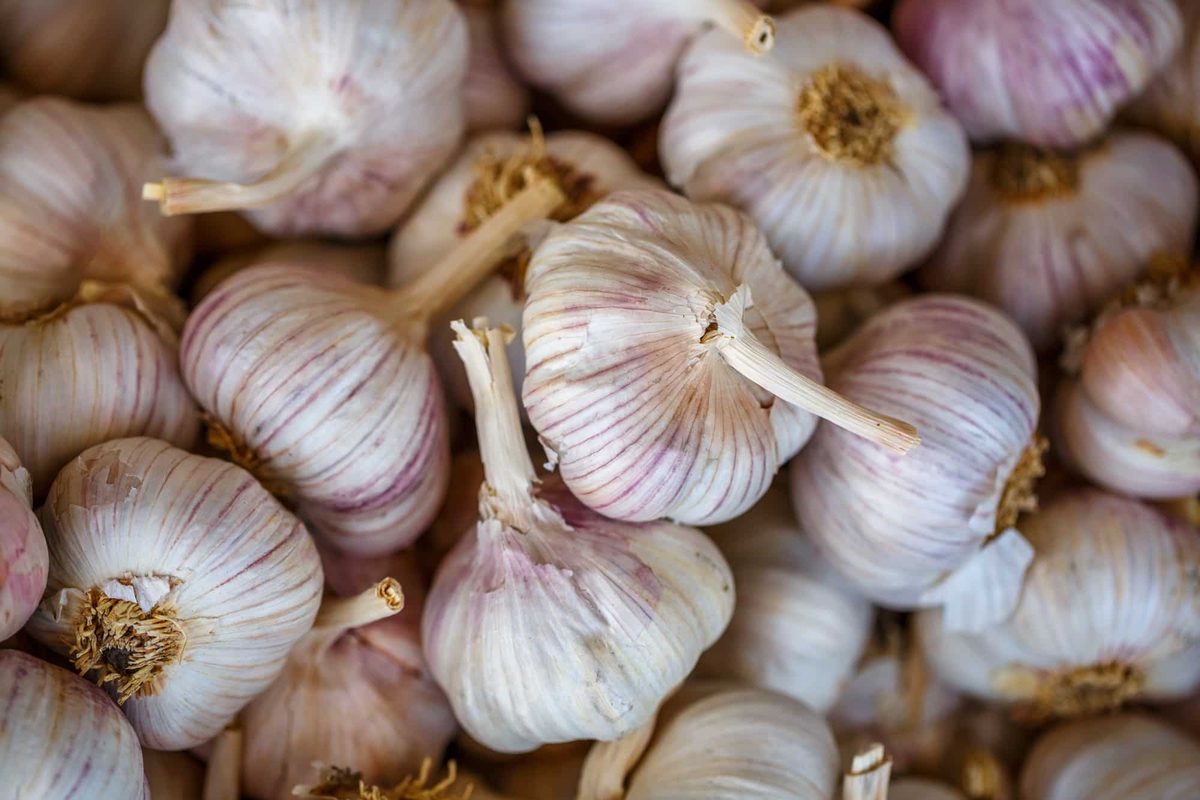
Garlic is the bulb of Allium sativum, a relative of onions and chives that is grown almost entirely from cloves rather than seed. Cut or crush a clove and an enzyme goes to work within seconds, producing the sharp, sulfurous compound that gives raw garlic its bite. Nearly everything cooks do with garlic, from slicing versus mincing to when it goes into the pan, comes back to that reaction. This page covers the plant and its origin, the chemistry of its flavor, how it is used, how to store it safely, how much is grown, and what the health evidence actually shows.
At a glance
| Botanical name | Allium sativum L.1 |
| Plant family | Amaryllidaceae (the amaryllis family)12 |
| Part used | The bulb, divided into cloves; up to 20 per bulb2 |
| Native range | Central Asia to northeastern Iran1 |
| Largest producer with official figures we could check | India, 3,565,321 tonnes in 2024-25 (final figure)3 |
| Key flavor compound | Allicin, formed when a cut clove’s enzyme alliinase meets alliin4 |
| Essential oil | About 0.1% of the bulb, mainly diallyl disulfide, diallyl trisulfide and allyl propyl disulfide2 |
| Forms sold | Fresh bulbs, peeled cloves, minced in jars, dried flakes, granulated, powder, salt, black garlic |
Measured values
4 figures, sourced| Measure | Value | Scope | Source |
|---|---|---|---|
| Essential oil | 0.1 % of the bulb (about) | scope not stated on source pageMainly diallyl disulfide, diallyl trisulfide and allyl propyl disulfide | britannica.com |
| Vitamin B6 Nutrient | 0.04 mg per 3 g clove (2% of the FDA Daily Value) | USDA FoodData Central, garlic, raw (SR Legacy), scaled to a 3 g cloveper-clove value computed by the page from USDA data; no per-100 g value given on the page | fdc.nal.usda.gov |
| Vitamin C Nutrient | under 1 mg per 3 g clove (1% of the FDA Daily Value) | USDA FoodData Central, garlic, raw (SR Legacy), scaled to a 3 g cloveper-clove value computed by the page from USDA data; no per-100 g value given on the page | fdc.nal.usda.gov |
| Manganese Nutrient | 0.05 mg per 3 g clove (2% of the FDA Daily Value) | USDA FoodData Central, garlic, raw (SR Legacy), scaled to a 3 g cloveper-clove value computed by the page from USDA data; no per-100 g value given on the page | fdc.nal.usda.gov |
Each figure is quoted as its source states it, with the samples or standard it applies to. Where sources differ, both are shown; nothing is averaged. All measured values
What garlic is
Garlic is a perennial in the amaryllis family, usually grown as an annual crop, with plants reaching about 60 cm.2 The bulb sits inside a papery skin and can hold up to 20 cloves.2 Kew classes it as a bulbous geophyte of the temperate biome.1 Growers propagate it from cloves or top bulbils, though seed can also be used.2 A 2023 review describes garlic as considered sterile and mostly propagated asexually.5
UC Agriculture and Natural Resources notes that most commercial varieties are softneck types.6 For the stalks some varieties send up, see garlic scapes. Several other plants carry the garlic name; see wild garlic and garlic chives.
Flavor and the chemistry behind it
Raw garlic is hot, sharp and sulfurous; cooked gently it turns sweet and mellow, and browned it takes on a nutty, toasty edge. Those descriptions are ours. Britannica sums up the raw bulb as having a powerful onionlike aroma and pungent taste.2
Why cutting matters
Cutting, crushing or chewing damages the clove’s cells and releases the enzyme alliinase, which turns alliin into allicin. The reaction is fast: in crushed garlic it is complete within 10 to 60 seconds.4 Allicin is unstable and breaks down into a range of other sulfur compounds,4 which is part of why garlic tastes different raw, sitting, and cooked.
The more you cut, the stronger the result. America’s Test Kitchen ranks whole cloves as the mildest, then sliced, then minced, with paste the sharpest, and notes that minced garlic left sitting keeps developing stronger flavor.7
What heat does
Heat inactivates alliinase.4 So a clove heated before it is cut never gets the chance to make much allicin. In ATK’s tests, raising whole cloves to 140°F or above took away much of the raw bite; blanching in water or milk and microwaving worked equally well, and toasting in a dry skillet was the least effective.8 That is the trick for a dressing or dip that needs garlic flavor without the burn.
The Linus Pauling Institute reports that some scientists recommend letting crushed or chopped garlic stand before cooking.4 The research behind that advice measured garlic’s effect on blood platelets, where crushed garlic kept more activity after heating than uncrushed garlic;4 it says nothing about flavor.
Origin and history
Where it comes from
Kew gives garlic’s native range as Central Asia to northeastern Iran, with Iran, Kazakhstan, Kyrgyzstan, Tajikistan, Turkmenistan and Uzbekistan as native, and a long list of introduced regions across Europe, Asia, Africa and the Americas.1 A 2023 review places the center of origin of garlic and its closest wild relative, Allium longicuspis, in Central Asia, and reports that fertile wild garlic has been collected in Kazakhstan and Kyrgyzstan.5 PROSEA narrows it further, to Central Asia’s Tien Shan range.9 Britannica adds that garlic also grows wild in Italy and southern France.2
Ancient records
- Egypt, Greece and beyond. NCCIH notes that ancient writings from Egypt, Greece and India describe garlic’s use.10 A historical review in the Journal of Nutrition says ancient medical texts from Egypt, Greece, Rome, China and India all prescribed it, and that garlic was found in Egyptian pyramids and ancient Greek temples.11
- Food for workers and athletes. The same review reports that garlic was given to laborers to increase strength and work capacity, and to the original Olympic athletes in Greece, making it one of the earliest “performance enhancing” agents.11
- Medicine. The review credits Hippocrates with prescribing garlic for a variety of conditions.11
- Folklore. Britannica records that in ancient and medieval times garlic was carried as a charm against vampires and other evils.2
Several popular claims could not be traced: that garlic has been used for 7,000 years, that it was buried with Tutankhamun, that the Tien Shan region is called the “Garlic Crescent”, and that garlic was confined to immigrant cooking in early 20th-century America. They are left out here.
Production
India’s government publishes garlic figures through the Spices Board, which counts garlic among the country’s spice crops:3
| Year | Area (hectares) | Production (tonnes) |
|---|---|---|
| 2021-22 | 431,218 | 3,523,436 |
| 2022-23 | 386,832 | 3,239,453 |
| 2023-24 | 388,676 | 3,315,545 |
| 2024-25 (final) | 418,744 | 3,565,321 |
| 2025-26 (advance estimate) | 430,721 | 3,641,474 |
The Board notes that figures from 2020-21 onward are subject to revision.3
We could not open a current world total. The most recent world figures we could read are old: PROSEA cites an FAO estimate of 469,000 hectares of garlic worldwide in 1990, with China (658,000 tonnes) and South Korea (417,000 tonnes) the leading producers, followed by India, Spain and the United States.9 India’s own output today is several times what PROSEA reported for any country in 1990, so treat that ranking as history, not as the current picture. In the United States, California grows more than 90 percent of commercially grown garlic, according to UC Agriculture and Natural Resources.6
How garlic is used
PROSEA describes garlic as mainly a condiment for flavoring meat, fish and salads, fresh or dehydrated,9 and Britannica calls it a classic ingredient in many national cuisines.2 By common practice it is cooked far more often than eaten raw (Britannica notes the bulbs are not usually eaten raw2), though raw garlic is central to aioli, pesto, tzatziki, salsas and vinaigrettes.
Technique
- Choose the cut for the strength you want. Whole or sliced cloves give a milder flavor than minced or grated.7
- Add it at the right time. Minced garlic added to a hot pan too early can quickly burn and turn acrid and bitter; ATK suggests adding it after onions or other vegetables have softened.12
- Tame it for raw uses. Warm whole cloves to 140°F or above in the microwave or by blanching before you chop them.8
- If a dish goes too far, see too much garlic.
Garlic pairs with almost every savory aromatic. In our judgment its most common partners are ginger (see garlic vs. ginger), black pepper, cumin, paprika, rosemary, thyme, basil and parsley.
Fresh, dried and other forms
Dried garlic trades one kind of flavor for convenience; see garlic powder for how the dried form works and garlic powder vs. garlic for the differences. To dry your own, see how to dry garlic. For swaps, see fresh garlic substitutes.
Buying and storage
Choose firm, heavy bulbs with tight, dry skins and no soft spots or green shoots; that is kitchen judgment.
UC Agriculture and Natural Resources gives fresh garlic a storage life of 3 to 5 months under cool (60°F, 16°C), dry, dark conditions, and advises against the refrigerator because holding garlic that cold stimulates sprouting.6
Garlic sometimes turns blue or green in pickles or acidic dishes. UC ANR explains that garlic contains anthocyanins, water-soluble pigments that can turn blue or purple in acidic conditions, and says such garlic is still safe to eat.6
Safety
Garlic in oil
This is the one real food-safety hazard in everyday garlic use. UC ANR warns that garlic in oil held at room temperature provides an ideal environment for Clostridium botulinum, the bacterium that causes botulism.6 Its rules: do not store garlic in oil at room temperature; refrigerate peeled cloves in oil for no more than 4 days, or freeze them.6 Commercial garlic-in-oil products are made under strict guidelines that home kitchens can’t reproduce.6
Supplements, medicines and skin
- Bleeding. NCCIH says garlic supplements may increase the risk of bleeding, and advises telling health care providers you take them, especially before surgery or alongside medicines that affect bleeding.10 LPI notes that garlic may enhance the effects of the anticoagulant warfarin, and that in one study garlic supplements cut the bioavailability of the HIV drug saquinavir by 50%.4
- Side effects. Garlic by mouth can cause breath and body odor, stomach pain, gas and nausea, and allergic reactions in some people.10
- Raw garlic on skin. NCCIH warns that fresh raw garlic applied to the skin can cause severe irritation and chemical burns.10
- Pregnancy. NCCIH says garlic in amounts greater than those in food may not be safe during pregnancy.10
Taken by mouth, garlic has been used safely in research studies lasting as long as 7 years.10
Health claims: what the evidence shows
Garlic has been studied extensively, mostly as supplements rather than as food. NCCIH’s summary:10
| Question | What NCCIH says |
|---|---|
| Cholesterol | Supplements may reduce total and LDL cholesterol a little in people with high cholesterol |
| Blood pressure | Limited evidence that supplements may reduce blood pressure in people with hypertension |
| Blood sugar | Supplements may reduce blood sugar to a small extent in people with diabetes |
| Stomach cancer | Eating garlic does not seem to reduce the risk |
| Colorectal cancer | Uncertain whether garlic affects the risk |
| Colds and immune function | Very little research; a 2022 review found only two studies suggesting possible benefit |
No claim here that garlic treats, cures or prevents any disease.
As food, a clove is small. USDA data put a clove at 3 g;13 at that weight it supplies about 0.04 mg vitamin B6 (2% of the FDA Daily Value), under 1 mg vitamin C (1%), and 0.05 mg manganese (2%).1314 Garlic contains these nutrients, but not in amounts that matter at normal cooking quantities.
Substitutes and comparisons
- Fresh garlic substitutes
- Garlic powder vs. garlic
- Garlic vs. ginger
- Garlic chives vs. chives
- Asafoetida
Related pages
Footnotes
-
Allium sativum L., Plants of the World Online, Royal Botanic Gardens, Kew. powo.science.kew.org · Reference work ↩ ↩2 ↩3 ↩4 ↩5
-
“Garlic”, Encyclopaedia Britannica, 2026. britannica.com · Reference work ↩ ↩2 ↩3 ↩4 ↩5 ↩6 ↩7 ↩8 ↩9 ↩10 ↩11
-
Spice wise area and production in India, 2021-22 to 2025-26, Spices Board India. indianspices.com · Regulator ↩ ↩2 ↩3
-
Garlic, Linus Pauling Institute Micronutrient Information Center, Oregon State University. lpi.oregonstate.edu · Reference work ↩ ↩2 ↩3 ↩4 ↩5 ↩6 ↩7
-
Dhall RK, Cavagnaro P, Singh H and Mandal S, “History, evolution and domestication of garlic: a review”, Springer, 2023 (abstract). buscador.una.edu.ni · Peer-reviewed ↩ ↩2
-
Linda J. Harris, Garlic: Safe Methods to Store, Preserve, and Enjoy, UC Agriculture and Natural Resources, 2016. ccfruitandnuts.ucanr.edu · Reference work ↩ ↩2 ↩3 ↩4 ↩5 ↩6 ↩7
-
Carolyn Grillo, “The Strength of Garlic’s Flavor Depends on How You Cut It”, America’s Test Kitchen, 2022. americastestkitchen.com · Publication ↩ ↩2
-
“Taking the Bite out of Garlic”, America’s Test Kitchen. americastestkitchen.com · Publication ↩ ↩2
-
Q.P. van der Meer and Anggoro H. Permadi, Allium sativum, Plant Resources of South-East Asia (PROSEA). uses.plantnet-project.org · Reference work ↩ ↩2 ↩3
-
Garlic: Usefulness and Safety, National Center for Complementary and Integrative Health, 2025. nccih.nih.gov · Regulator ↩ ↩2 ↩3 ↩4 ↩5 ↩6 ↩7
-
Rivlin RS, “Historical perspective on the use of garlic”, Journal of Nutrition, 2001 (abstract). synapse.mskcc.org · Peer-reviewed ↩ ↩2 ↩3
-
Liz Bomze, “Why You Should Wait to Add Garlic”, America’s Test Kitchen, 2023. americastestkitchen.com · Publication ↩
-
Garlic, raw (FDC ID 169230), USDA FoodData Central. fdc.nal.usda.gov · Regulator ↩ ↩2
-
Daily Value on the Nutrition and Supplement Facts Labels, U.S. Food and Drug Administration. fda.gov · Regulator ↩