Spices · Profile
Grains of Paradise: West Africa’s Peppery Ginger-Family Seed
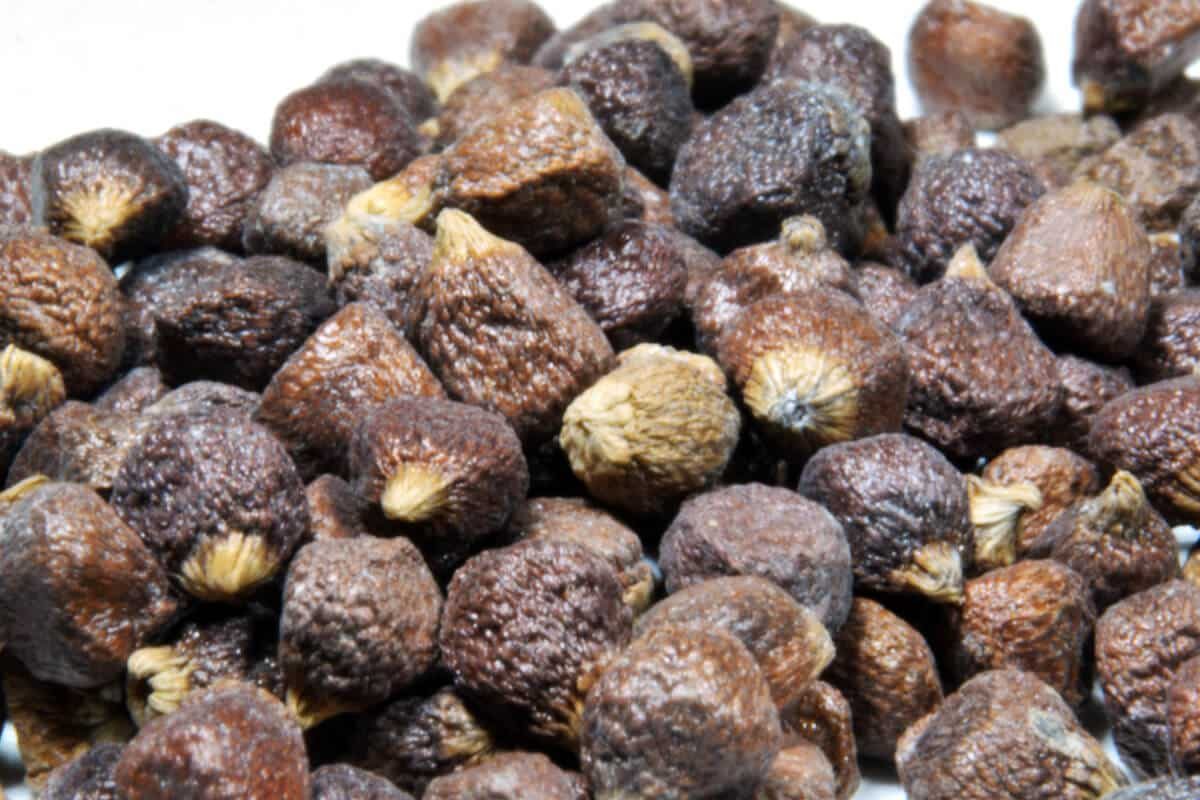
Grains of paradise are the seeds of Aframomum melegueta, a reedlike West African plant in the ginger family.1 They bite like black pepper but with less force, and they carry a resinous, faintly citrus warmth. In 15th-century Europe they were an important spice and a common stand-in for black pepper;2 today they turn up in North African blends, craft beer and the spice racks of cooks who like their pepper a little more aromatic.
At a glance
| Botanical name | Aframomum melegueta K.Schum.3 (listed by FDA under the older name Amomum melegueta4) |
| Plant family | Zingiberaceae (ginger family)31 |
| Part used | The seeds, which sit in the acid pulp of the fruit1 |
| Native range | West tropical Africa to Angola (Kew)3 |
| Main exporter | Ghana12 |
| Other names | Guinea grains, melegueta pepper, alligator pepper2 |
| Pungent compounds | (6)-paradol, (6)-shogaol and (6)-gingerol2 |
| U.S. status | On FDA’s list of spices generally recognized as safe4 |
What it is
The seeds sit inside the sour pulp of the fruit. Each has a glossy, dark brown husk with a pale, cone-shaped caruncle at its base, and they contain a neutral essential oil and a sticky brown resin.1 Kew classes the plant as a rhizomatous geophyte (it grows from an underground stem) of the seasonally dry tropics.3
Several names overlap. Katzer lists Guinea grains, melegueta pepper and alligator pepper as English names for this spice, and notes that most languages call it something like “pepper of Guinea”.2 The name “grains of paradise” itself was coined in the Middle Ages, Katzer says, because of the spice’s high value.2
Flavor and aroma
Katzer describes the taste as spicy, hot and warm, a little bitter, with a heat that is less strong than pepper’s and more subtle.2 To our taste the aroma is resinous and faintly citrus and cardamom-like, and the heat builds slowly and lingers without burning. That is our description, not a measurement.
The compounds
The pungency comes from the same family of compounds that makes ginger hot. Katzer names (6)-paradol, (6)-shogaol and (6)-gingerol as the main pungent compounds (hydroxyarylalkanones).2 These are not essential oils. The essential oil, which carries the aroma, is dominated by the sesquiterpene hydrocarbon humulene.2
Origin and history
Native range. Kew gives the native range as West tropical Africa to Angola, listing Ghana, Liberia, Ivory Coast, Nigeria, Sierra Leone, Cameroon and others, and records the plant as introduced in French Guiana, Guyana, Trinidad and Tobago and the Windward Islands.3 Britannica adds São Tomé and Príncipe in the Gulf of Guinea and says the plant is cultivated in other tropical countries.1
The Grain Coast. The Grain Coast was a stretch of West African coastline from roughly Cape Mesurado to Cape Palmas, in present-day Liberia, and mainly a sphere of Afro-Portuguese trade. Its name comes from the early trade in grains of paradise.5 (Katzer calls the same coast the “pepper coast”, for the same reason.2) It is a historical name, not today’s main source: Ghana is the exporter Britannica names, and Katzer says most imports come from Ghana.12
In Europe. Katzer describes grains of paradise as an important spice in 15th-century Europe, when they were a common substitute for black pepper. Once pepper overtook them, in the Renaissance, they became common as a beer flavoring.2 Old recipes also used them in sausages and spiced wine;2 Britannica names hippocras, a wine flavored with grains of paradise, ginger and cinnamon.1
Several popular stories could not be traced to a source meeting this site’s standard: that the seeds first reached Europe by caravan across the Sahara, that Elizabeth I was especially fond of them, and that they stayed common in English recipes into the 19th century.
How it is used
West and North Africa. In West Africa the seeds flavor food and are also chewed on cold days to warm the body.2 In Tunisia, stews are often flavored with a blend called gâlat dagga that contains grains of paradise, and the spice may also appear in Moroccan blends.2 It is one of 24 ingredients in World Spice Merchants’ ras el hanout, for example;6 recipes for that blend vary widely, and many do not include it.
Beer. Samuel Adams Summer Ale has been described as brewed with Hallertau and Saaz hops, lemon peel and grains of paradise, which give it “a subtle bite”.7 A widely repeated claim that grains of paradise flavor Scandinavian aquavit could not be confirmed for this review.
At home. Grind them as you would peppercorns, over steak, fish, roast vegetables or eggs. Katzer singles out potatoes, eggplant and pumpkin as good partners for its gentle heat.2
Buying and quality
Buy whole seeds and grind them as needed. No grade standard for grains of paradise was found for this review. Whole seeds are small, angular and glossy dark brown;1 in our judgment, a dull, dusty look or a faint smell when crushed points to old stock.
Storage
Keep the seeds whole, airtight and away from heat and light. Katzer notes that in storage gingerols can turn into shogaols, which means a loss of pungency.2 We found no shelf-life figure from a regulator or standards body.
Safety and health claims
FDA lists grains of paradise among spices generally recognized as safe for their intended use.4 No contamination findings or recalls specific to the spice were found for this review.
Most of the research interest is in weight and energy use, and the human evidence is limited to small trials of concentrated extracts, not the spice in food:
| Study | Who and what | Finding | Source |
|---|---|---|---|
| Sugita et al. 2013 | 19 healthy men; single dose of 40 mg extract in four capsules vs placebo, crossover; energy use measured over 2 hours | Energy use rose after the extract in the 12 men with detectable brown fat, not in the 7 without; the compounds responsible were not known | 8 |
| Sudeep et al. 2022 | 70 overweight adults; 250 mg of a standardized seed extract (AfperFit) or placebo, twice daily for 12 weeks | Authors report changes in energy expenditure and visceral fat vs placebo, and no adverse effects | 9 |
These are short, small studies of extracts, and the results apply to those extracts and those participants. This page makes no claim that grains of paradise cause weight loss or treat any condition. Widely repeated claims about its mineral and vitamin content, and about effects on libido, pregnancy nausea, heartburn, inflammation or cancer, were not supported by any source we reviewed.
Substitutes and comparisons
- Grains of paradise substitutes
- Black pepper, the spice it once stood in for
- Cardamom, a ginger-family relative
- Long pepper and cubeb pepper, other historical pepper alternatives
- Ras el hanout
Footnotes
-
“Grains of paradise”, Encyclopaedia Britannica. britannica.com · Reference work ↩ ↩2 ↩3 ↩4 ↩5 ↩6 ↩7 ↩8 ↩9
-
Gernot Katzer, Grains of Paradise (Aframomum melegueta), Gernot Katzer’s Spice Pages. gernot-katzers-spice-pages.com · Reference work ↩ ↩2 ↩3 ↩4 ↩5 ↩6 ↩7 ↩8 ↩9 ↩10 ↩11 ↩12 ↩13 ↩14 ↩15 ↩16 ↩17
-
Aframomum melegueta K.Schum., Plants of the World Online, Royal Botanic Gardens, Kew. powo.science.kew.org · Reference work ↩ ↩2 ↩3 ↩4 ↩5
-
21 CFR 182.10, Spices and other natural seasonings and flavorings, eCFR. ecfr.gov · Regulator ↩ ↩2 ↩3
-
“Grain Coast”, Encyclopaedia Britannica. britannica.com · Reference work ↩
-
Ras El Hanout, World Spice Merchants. worldspice.com · Merchant ↩
-
“Samuel Adams Summer Ale”, Beverage Business, 2014. beveragebusiness.com · Publication ↩
-
Sugita et al., Grains of paradise (Aframomum melegueta) extract activates brown adipose tissue and increases whole-body energy expenditure in men, Cambridge University Press, 2013. core-cms.cambridgecore.org · Peer-reviewed ↩
-
Sudeep et al., Aframomum melegueta seed extract with standardized content of 6-paradol reduces visceral fat and enhances energy expenditure in overweight adults, Drug Design, Development and Therapy, 2022. doaj.org · Peer-reviewed ↩