Spice Substitutes · Substitutes
Grains of Paradise Substitutes, Ranked by the Job the Spice Is Doing
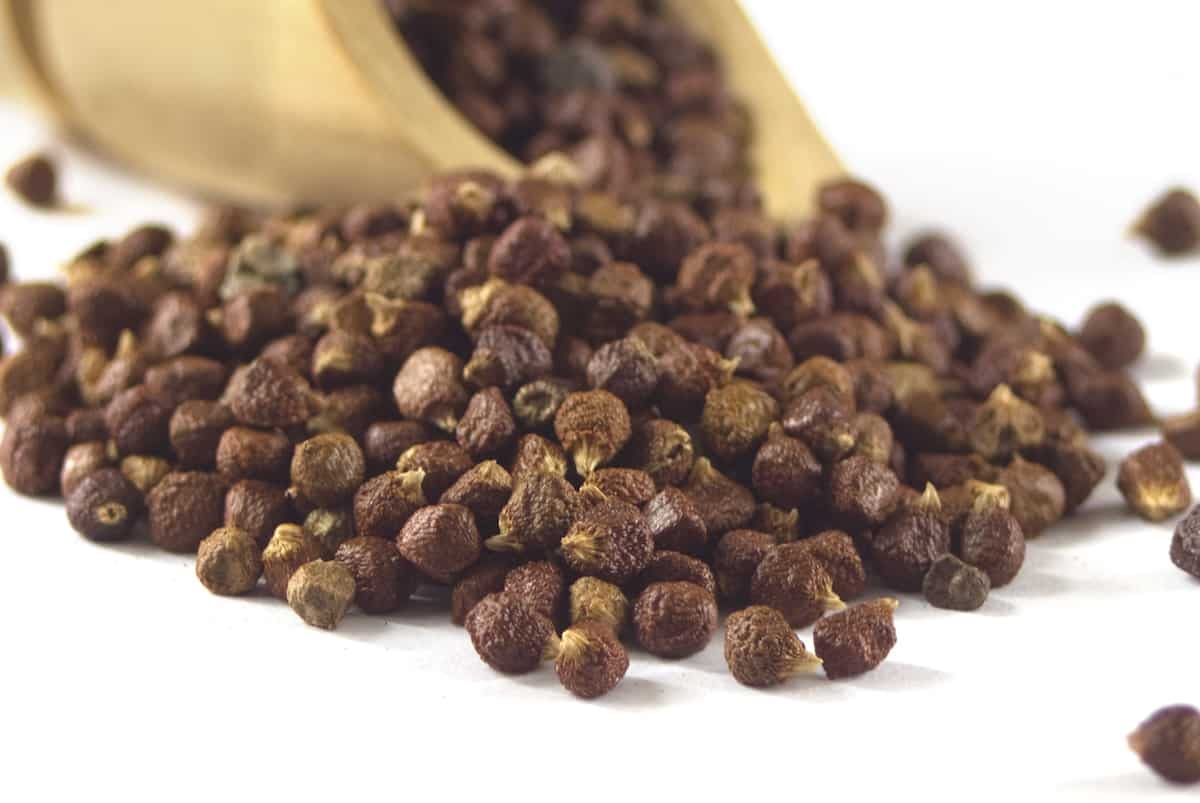
Grains of paradise are the seeds of Aframomum melegueta, a reedlike plant of the ginger family (Zingiberaceae)1 native from West tropical Africa to Angola.2 Gernot Katzer describes their taste as spicy, hot and warm, a little bitter, with heat that is less strong than pepper’s but more subtle.3 The Spice House describes the flavor as peppery, floral and slightly citrusy, with hints of cardamom, coriander and a touch of clove.4 A good substitute depends on which of those qualities your recipe is relying on.
Quick answer
| What grains of paradise are doing | Best substitute | Starting amount, per 1 part grains of paradise | Treatment |
|---|---|---|---|
| Peppery heat (pepper mill, steak, eggs, vegetables) | Black pepper | 1/2 part, then taste | Method |
| Floral, citrusy warmth (spice blends, beer, spiced wine) | Black pepper plus a pinch of cardamom or coriander | 1/2 part pepper plus a pinch | Method |
| A slow, ginger-like burn | Black pepper plus a little ground ginger | 1/2 part pepper plus a pinch | Method |
| Lemony bite on a finished dish | Sansho (Japanese pepper) | 1/4 part, then taste | Method |
| Switching between whole and ground pepper | Ground black pepper for whole | 1 tsp whole = 1½ tsp ground | Computed |
If a West African recipe calls for alligator pepper, you may not need a substitute at all: that is a common name for the same plant (see below).
How the ratios on this page are labeled
Every ratio carries one of four labels.
- Computed: based on a measurable physical relationship, with the source named.
- Attributed: a named source publishes this ratio. We quote it as theirs.
- Disputed: named sources give different answers to the same swap. We show each one and do not average them.
- Method: we found no published ratio. We give a direction and a cautious starting point, and say so.
The Spice House, which sells grains of paradise, says you can use them in place of black pepper but that “their flavors are uniquely different,” and neither its article nor its product page gives a ratio.54 A 1:1 figure credited to the company elsewhere online does not come from these pages. We found no credible published ratio for any substitute.
Why the flavor is hard to copy
The heat comes from ginger-family compounds, not from piperine. Katzer names (6)-paradol, (6)-shogaol and (6)-gingerol as the main pungent compounds, and says the essential oil, which carries the aroma, is dominated by humulene.3 Black pepper’s chief pungent compound is piperine, at 4.9 to 7.7% of the berry in PROSEA’s figures.6 Ginger’s pungent principles are gingerols, the same family Katzer names for grains of paradise.73
That is why the best substitutes are combinations: black pepper for the bite, plus a small amount of a second spice for the floral, citrus or ginger side.
If grains of paradise are the peppery heat
1. Black pepper
This is the historical substitution run in reverse. Katzer writes that grains of paradise were a common substitute for black pepper in 15th-century Europe,3 and a 2026 review still describes them as used in place of black pepper.8 The claim that this happened in the 14th century as well was not found in the sources we checked.
Black pepper will taste sharper. Katzer says the heat of grains of paradise is less strong than pepper’s.3 The Spice House’s staff writer puts them closer, calling them “almost as hot as black pepper.”5 Both point the same way: use less black pepper than the grains called for. You lose the floral, citrus note.
Ratio (Method): No published ratio was found. Start with about half as much black pepper, taste, and add more a little at a time.
Whole or ground (Computed): McCormick’s conversion is 1 teaspoon peppercorns = 1½ teaspoons ground pepper.9 This is a volume figure for black pepper only. It says nothing about the strength of grains of paradise.
If grains of paradise are floral, citrusy warmth
This is the job they do in long spice blends, in beer and in old spiced-wine recipes. Katzer says that once pepper overtook them in the Renaissance they became common as a beer flavoring, and old recipes used them in sausages and spiced wine.3 Samuel Adams Summer Ale has been described as brewed with grains of paradise, which give it “a subtle bite.”10 They may appear in Moroccan spice blends,3 and they are one of 24 ingredients in World Spice Merchants’ ras el hanout,11 though many ras el hanout recipes leave them out.
1. Black pepper with cardamom
Cardamom is a ginger-family relative: Kew places Elettaria cardamomum in the Zingiberaceae and gives its native range as southwestern India.12 The Spice House finds hints of cardamom in grains of paradise.4 The chemistry is not shared, though. PROSEA gives cardamom oil as mainly 1,8-cineole (20 to 60%) and alpha-terpinyl acetate (20 to 53%),13 while Katzer gives humulene as the main compound in grains of paradise oil.3 In our judgment, cardamom adds a cool, floral lift rather than heat, which is why it needs black pepper alongside.
Ratio (Method): No published ratio. Use half as much black pepper as the grains called for, plus a small pinch of ground cardamom per teaspoon, then taste. Cardamom is easy to overdo.
2. Black pepper with coriander
The Spice House’s staff writer notes a tangerine sweetness in freshly ground grains of paradise, “similar to freshly ground coriander,”5 and the product page also mentions coriander.4 Coriander is the gentler option of the two.
Ratio (Method): No published ratio. Use half as much black pepper as the grains called for, plus a pinch of ground coriander per teaspoon, then taste.
3. A blend that already contains cardamom
If grains of paradise are one of many spices, a ready blend can fill the gap. The USDA purchasing specification for curry powder lists cardamom with turmeric, coriander, fenugreek, cinnamon, cumin, black pepper and ginger.14 That brings a lot of other flavor with it, so use it only where those spices suit the dish.
Ratio (Method): No published ratio. Start with half the amount and taste.
If grains of paradise are a slow, ginger-like burn
Black pepper with ground ginger
Ginger’s heat comes from gingerols,7 the same group of compounds Katzer lists for grains of paradise,3 and The Spice House’s writer compares the bite of grains of paradise to ginger’s, “but deliciously amplified.”5 A little ground ginger with black pepper gets closer to that slow burn than pepper alone.
Ratio (Method): No published ratio. Use half as much black pepper as the grains called for, plus a pinch of ground ginger, then taste.
If grains of paradise are a finishing spice
Sansho (Japanese pepper)
Sansho comes from Zanthoxylum piperitum, a relative of the Chinese Sichuan pepper plants, and its aroma and pungency sit in the fruit wall.15 Katzer describes it as having a fresh, pleasant lime fragrance and a well-developed pungency, and notes that it produces a numbing, almost anaesthetic feeling on the tongue.15 The lime note is a reasonable echo of the citrus in grains of paradise; the numbing is not. In Japan, ground sansho is sprinkled over unagi don,16 and it is one of the ingredients in shichimi, the seven-spice blend.17 Chinese five-spice uses Sichuan pepper, not sansho.18
Ratio (Method): No published ratio. Start with about a quarter of the grains-of-paradise amount, ground, and sprinkle it on at the end.
Substitutes that do not work well
Pink peppercorns. They come from Schinus trees in the cashew family, not from pepper, and Katzer says they are named for their shape only, not their flavor; he describes them as sweet and aromatic, similar to juniper.19 Atlas Obscura calls the flavor only slightly peppery,20 so they add color and a resinous sweetness but little of the heat. Atlas Obscura also reports an allergic reaction in a person with a tree nut allergy.20
Ratio (Method): No published ratio. If you use them for looks, crush them and add black pepper for the bite.
Grains of paradise and alligator pepper
A 2026 review calls grains of paradise “also known as Alligator pepper or Guinea pepper,”8 and Katzer lists alligator pepper among its English names.3 Food writer Yewande Komolafe includes alligator pepper seeds in the spice for pepper soup.21 If your recipe calls for alligator pepper and you have grains of paradise, you already have the right spice. See alligator pepper.
What isn’t known
- No published ratio exists for any grains-of-paradise substitute. Every amount above is a starting point for tasting.
- No study measures the heat of grains of paradise against black pepper. Katzer and The Spice House both describe grains of paradise as less hot, to different degrees.35
- It is often said that grains of paradise should be added only at the end of cooking because they do not handle heat well. No source we found says so.
- The claim that grains of paradise are a standard ingredient of ras el hanout overstates it. They appear in some versions.311
Related
- Grains of paradise, the full profile, and alligator pepper
- Black pepper and black pepper substitutes
- Cardamom, cardamom substitutes, ginger, coriander
- Sansho pepper, Sichuan pepper, pink pepper
- Cubeb pepper and long pepper, other old pepper alternatives
- Ras el hanout, Moroccan spices, Nigerian spices
Footnotes
-
Grains of paradise, Encyclopaedia Britannica. britannica.com · Reference work ↩
-
Aframomum melegueta, Plants of the World Online, Royal Botanic Gardens, Kew. powo.science.kew.org · Reference work ↩
-
Gernot Katzer, Grains of Paradise (Aframomum melegueta), Gernot Katzer’s Spice Pages. gernot-katzers-spice-pages.com · Reference work ↩ ↩2 ↩3 ↩4 ↩5 ↩6 ↩7 ↩8 ↩9 ↩10 ↩11 ↩12
-
Grains of Paradise (product page), The Spice House. thespicehouse.com · Merchant ↩ ↩2 ↩3 ↩4
-
Marshall, Spicelight: Grains of Paradise, The Spice House, 2018. thespicehouse.com · Merchant ↩ ↩2 ↩3 ↩4 ↩5
-
Piper nigrum (PROSEA), Pl@ntUse. uses.plantnet-project.org · Reference work ↩
-
Zingiber officinale (PROSEA), Pl@ntUse. uses.plantnet-project.org · Reference work ↩ ↩2
-
Asemota, Cubbin, Nahar and Sarker, Aframomum melegueta K. Schum. (Grains of Paradise) and Its Therapeutic Applications, Journal of Medicinal Natural Product, 2026. researchonline.ljmu.ac.uk · Peer-reviewed ↩ ↩2
-
How to Grind Your Own Spices, McCormick. mccormick.com · Merchant ↩
-
Samuel Adams Summer Ale, Beverage Business, 2014. beveragebusiness.com · Publication ↩
-
Ras El Hanout, World Spice Merchants. worldspice.com · Merchant ↩ ↩2
-
Elettaria cardamomum, Plants of the World Online, Royal Botanic Gardens, Kew. powo.science.kew.org · Reference work ↩
-
Elettaria cardamomum (PROSEA), Pl@ntUse. uses.plantnet-project.org · Reference work ↩
-
Commercial Item Description A-A-20001C, Spices and Spice Blends, USDA Agricultural Marketing Service, 2023. ams.usda.gov · Regulator ↩
-
Gernot Katzer, Sichuan pepper (Zanthoxylum species), Gernot Katzer’s Spice Pages. gernot-katzers-spice-pages.com · Reference work ↩ ↩2
-
Hirasawa Chen, Unagi Don, Just One Cookbook. justonecookbook.com · Publication ↩
-
七味について (About shichimi), Yagenbori. yagenbori.jp · Merchant ↩
-
Hill, Five-spice powder, Encyclopaedia Britannica. britannica.com · Reference work ↩
-
Gernot Katzer, Pink Pepper (Schinus), Gernot Katzer’s Spice Pages. gernot-katzers-spice-pages.com · Reference work ↩
-
Ewbank, When People Panicked Over Pink Peppercorns, Atlas Obscura, 2018. atlasobscura.com · Publication ↩ ↩2
-
Komolafe, How to Stock a Nigerian Pantry, Saveur, 2017. saveur.com · Publication ↩