Seasonings · Profile
Ras el Hanout: What’s in North Africa’s “Top of the Shop” Blend and How to Use It
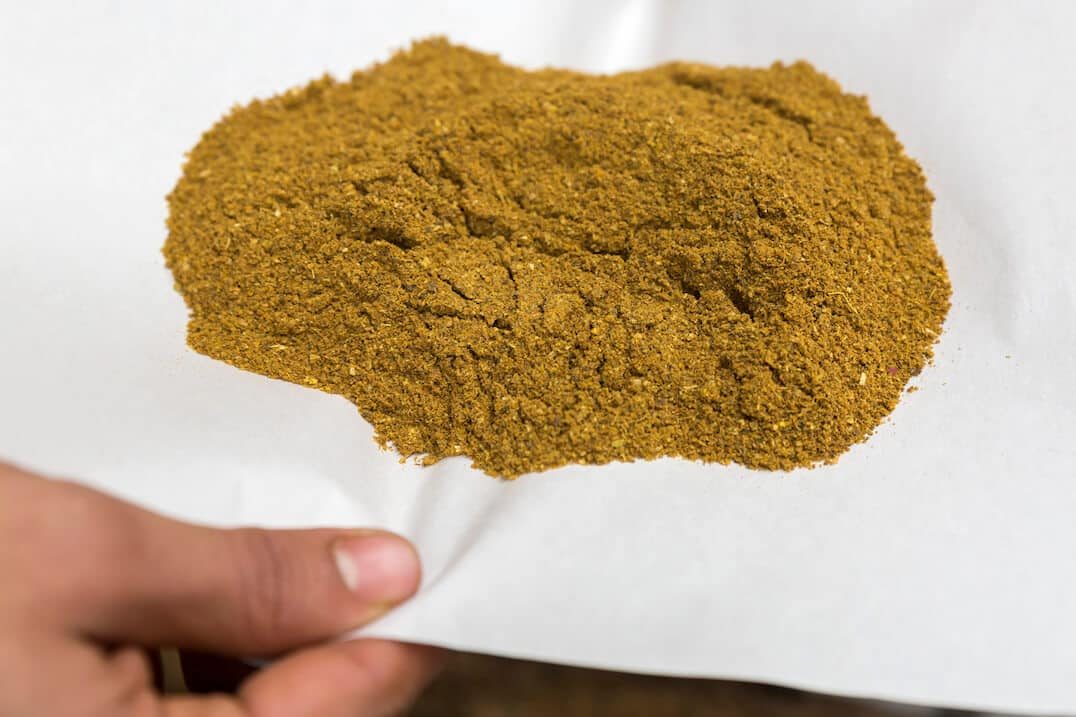
Ras el hanout is a ground spice blend found in varying forms in Morocco, Algeria and Tunisia, and one of the most complex spice mixtures anywhere.1 The name means something like “top of the shop”: a merchant’s best.12 There is no fixed recipe. Published versions range from eight spices to more than two dozen, and the longer ones bring in rosebuds, lavender and other aromatics that rarely show up in other blends.123 This page covers what goes into it, the compounds behind its aroma, how it is used, and how to buy and store it.
At a glance
| What it is | A ground spice blend; no fixed recipe1 |
| Name | “Top of the shop” (Oxford Companion to Food, Saveur); “head of the shop” (World Spice)123 |
| Where | Morocco, Algeria and Tunisia1 |
| Standard ingredients | Cumin, coriander seed, turmeric, ginger, cardamom and nutmeg (Oxford Companion)1 |
| Often added | Cinnamon, cayenne, rosebud, oregano (Oxford Companion); lavender, chamomile and others in some commercial blends13 |
| Number of spices | 8 (Saveur) to 24 (World Spice) to 27 (a list recorded by Mme Guinaudeau)123 |
| Used in | Tagines, couscous, stews and roasted vegetables23 |
| Official standard | None found; the USDA spice-blend specification does not include it4 |
| Keeps | Up to 2 months (Saveur)2 |
What is in it
The Oxford Companion to Food names cumin, coriander seed, turmeric, ginger, cardamom and nutmeg as standard, with cinnamon, cayenne, rosebud (of the damask rose) and oregano usually included, all ground.1 It notes that Mme Guinaudeau gave a list of 27 ingredients, which Paula Wolfert’s English version followed.1
Three published versions show how wide the range is:
| Version | Spices | Count | Source |
|---|---|---|---|
| Saveur (2012) | Allspice, black peppercorns, coriander, cloves, cumin, cinnamon, ground ginger, cayenne | 8 | 2 |
| World Spice Merchants (label) | Black peppercorn, nutmeg, cumin, paprika, coriander, allspice, grains of paradise, ginger, nigella, caraway, Indonesian cinnamon, true cinnamon, roses, brown mustard, anise, mace, turmeric, long pepper, chamomile, fenugreek, cardamom, cloves, red chile flake, lavender | 24 | 3 |
| Mme Guinaudeau, as recorded by the Oxford Companion | Not reproduced in the entry | 27 | 1 |
World Spice adds that some versions run past 30 spices.3 Counts of 80 or 100 ingredients circulate widely; no source for them was found.
The Saveur version has no turmeric, cardamom or nutmeg, three of the Oxford Companion’s standard six.12 It is closer to a hot, clove-and-allspice mix than to the floral style. That is why two jars labeled ras el hanout can taste very different.
Flavor and the compounds behind it
A typical ras el hanout smells warm and sweet, with clove, cinnamon and cardamom up front, an earthy base of cumin and turmeric, and, in the longer blends, a floral lift from rose and lavender. That description is ours. The measured compounds belong to the individual spices:
| Spice | Key compound and measured share | Source |
|---|---|---|
| Coriander seed | Linalool and related terpene alcohols, 60 to 80% of the oil | 5 |
| Cumin | Cuminaldehyde, 20 to 72% of the oil | 6 |
| Cinnamon (Ceylon) | Cinnamaldehyde, about 49.9 to 62.8% of bark oil | 7 |
| Clove | Eugenol, about 85 to 92% of clove oil | 8 |
| Cardamom | α-Terpinyl acetate (36 to 62%) and 1,8-cineole (up to about 31%) in one 2025 study | 9 |
| Allspice | Eugenol, 50 to 80% of the berry oil | 10 |
| Ginger | Pungency from gingerols, which are non-volatile | 11 |
| Black pepper | Piperine, the main pungent alkaloid | 12 |
| Turmeric | Curcumin gives the yellow color | 13 |
No analysis of a ras el hanout blend as a whole was found. The figures above come from separate studies of each spice and are not combined.
Name and history
The Oxford Companion to Food renders the name as something like “top of the shop.”1 Saveur gives the same translation, and World Spice describes the idea as a spice merchant’s finest offering.23
Several origin stories circulate: that the blend arose from North Africa’s place in the spice trade, that merchants mixed it to clear out old stock, or that the name comes from an Ethiopian title meaning king. None could be traced to a source, and the clear-out story sits oddly with a name that means the best in the shop.
How ras el hanout is used
Saveur’s headnote says the mix is used in virtually every dish of the region, and points to mrouzia, Moroccan honey-braised lamb shanks.2 World Spice lists tagines, couscous, stews and roasted vegetables, and even fruit pies.3
Technique. When the blend goes in early, as in a tagine, America’s Test Kitchen’s advice on ground spices applies: bloom them in fat, since ground spices added straight to the pot can taste bland and musty, and watch them, because they burn fairly quickly.14 Rubbing it on lamb or chicken before roasting, or stirring a little into yogurt for a dip, are common uses; that is kitchen practice rather than a sourced finding.
Buying and quality
The USDA’s specification for spice blends does not include ras el hanout,4 and no other standard was found. The ingredient list tells you which style you are buying. A blend with rose, lavender or chamomile will be floral; one built on allspice, clove, pepper and cayenne will be hotter and more pungent.23 Check, too, which cinnamon is used: World Spice lists both Indonesian cinnamon and true cinnamon.3 See Ceylon vs. cassia cinnamon for how they differ.
Storage
Saveur says to keep its blend in an airtight container for up to 2 months.2 That is recipe guidance, not a measured shelf life. The University of California Cooperative Extension names air, light, moisture and heat as what speed flavor and color loss in spices.15 America’s Test Kitchen suggests the smell test: if a spice still smells strong, it is probably still potent.16
Safety
Spanish fly. The Oxford Companion to Food records that some Moroccan formulas include supposed aphrodisiacs such as green metallic beetles called Spanish fly, and says these seem irrelevant for flavor.1 Spanish fly is the blister beetle Lytta vesicatoria; its active substance, cantharidin, blisters skin on contact, and Britannica describes eating it as an aphrodisiac as extremely hazardous.17 None of the published versions compared above contains it.23
Lead in spices generally. A New York City health department review of 1,496 spice samples collected from 2008 to 2017 found detectable lead in more than half.18 The abstract does not break the results out by blend.
Health claims
Lists crediting ras el hanout’s spices with lowering cholesterol, preventing constipation or curing digestive complaints could not be traced to any regulator or systematic review, and this page makes no such claims.
Substitutes and comparisons
- Ras el hanout substitutes
- Ras el hanout vs. garam masala (see also garam masala)
- Other regional blends: baharat, berbere, advieh
The individual spices: cumin, coriander, turmeric, ginger, cardamom, nutmeg, mace, cinnamon, cloves, allspice, black pepper, cayenne pepper, paprika, fenugreek, nigella seeds, caraway seeds, anise seed and lavender.
Footnotes
-
Alan Davidson, “Ras-el-hanout”, The Oxford Companion to Food, 2014. app.ckbk.com · Reference work ↩ ↩2 ↩3 ↩4 ↩5 ↩6 ↩7 ↩8 ↩9 ↩10 ↩11 ↩12 ↩13 ↩14 ↩15
-
“Ras el Hanout (North African Spice Mix)”, Saveur, 2012. saveur.com · Publication ↩ ↩2 ↩3 ↩4 ↩5 ↩6 ↩7 ↩8 ↩9 ↩10 ↩11 ↩12 ↩13
-
World Spice Merchants, Ras El Hanout, product page. worldspice.com · Merchant ↩ ↩2 ↩3 ↩4 ↩5 ↩6 ↩7 ↩8 ↩9 ↩10 ↩11 ↩12
-
Commercial Item Description A-A-20001C, Spices and Spice Blends, USDA Agricultural Marketing Service, 2023. ams.usda.gov · Regulator ↩ ↩2
-
Al-Khayri et al., “Essential Oil from Coriandrum sativum: A Review”, Molecules, 2023. mdpi.com · Peer-reviewed ↩
-
P.C.M. Jansen, Cuminum cyminum, Plant Resources of South-East Asia (PROSEA). uses.plantnet-project.org · Reference work ↩
-
Ranasinghe et al., “Medicinal properties of ‘true’ cinnamon: a systematic review”, BMC Complementary and Alternative Medicine, 2013. link.springer.com · Peer-reviewed ↩
-
Batiha et al., “Syzygium aromaticum L. (Myrtaceae)”, Biomolecules, 2020. mdpi.com · Peer-reviewed ↩
-
Blažeković et al., “Content and Chemical Composition of Essential Oil from Cardamom”, Croatica Chemica Acta, 2025. hrcak.srce.hr · Peer-reviewed ↩
-
D. Sulistiarini, Pimenta dioica, Plant Resources of South-East Asia (PROSEA). uses.plantnet-project.org · Reference work ↩
-
Sutarno, Hadad and Brink, Zingiber officinale, Plant Resources of South-East Asia (PROSEA). uses.plantnet-project.org · Reference work ↩
-
McNamara, Randall and Gunthorpe, “Effects of piperine at the human vanilloid receptor (TRPV1)”, British Journal of Pharmacology, 2005. pmc.ncbi.nlm.nih.gov · Peer-reviewed ↩
-
“Turmeric: Usefulness and Safety”, National Center for Complementary and Integrative Health, 2025. nccih.nih.gov · Regulator ↩
-
“How to Bloom Spices”, America’s Test Kitchen, 2023. americastestkitchen.com · Publication ↩
-
Anna Martin, “Add a Little Spice to Your Life! Part II”, University of California Cooperative Extension, San Joaquin County, 2002. ucanr.edu · Reference work ↩
-
“Keeping Spices and Dried Herbs Fresher Longer”, America’s Test Kitchen. americastestkitchen.com · Publication ↩
-
“Spanish fly”, Encyclopaedia Britannica. britannica.com · Reference work ↩
-
Hore et al., “A Spoonful of Lead: A 10-Year Look at Spices as a Potential Source of Lead Exposure”, Journal of Public Health Management and Practice, 2019. scholars.mssm.edu · Peer-reviewed ↩