Spices · Profile
Black Pepper: Flavor, Piperine, History, Grades and Uses
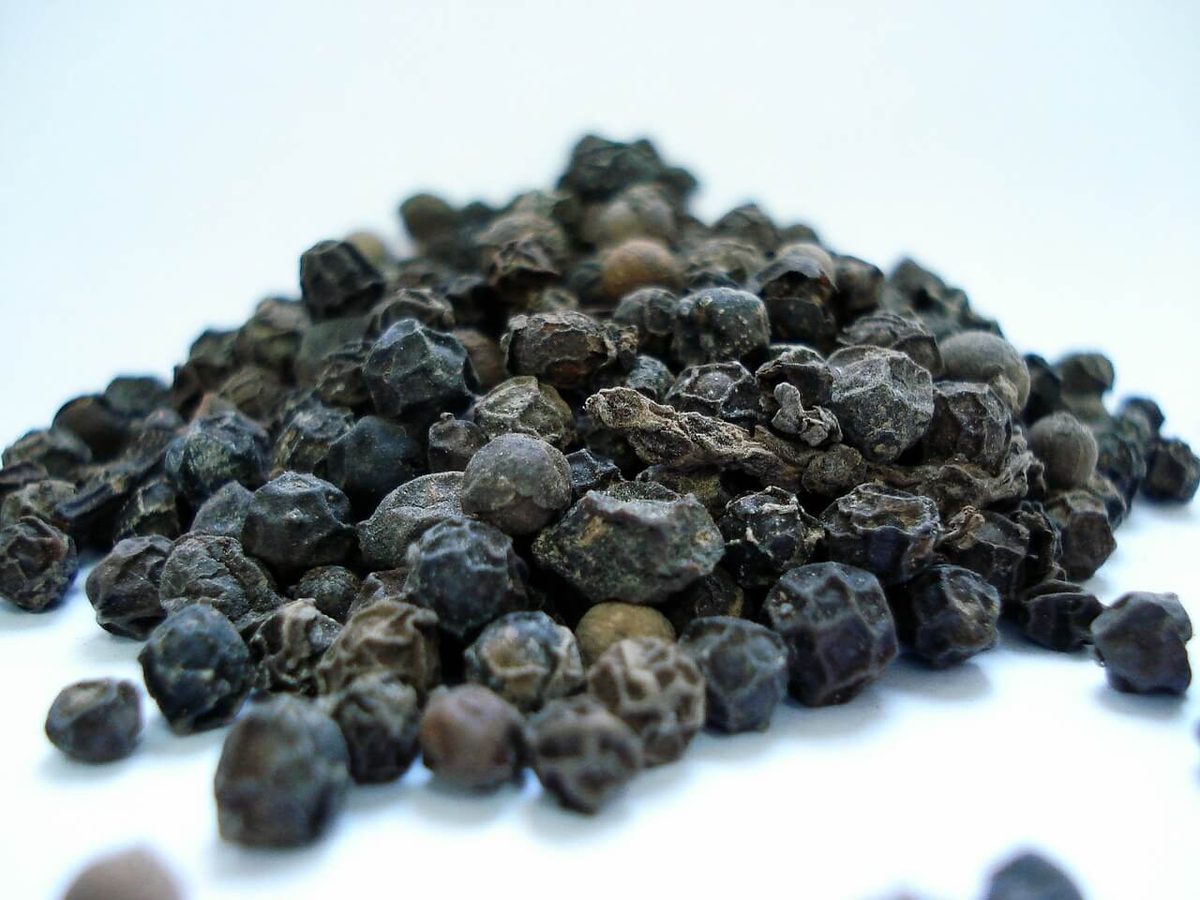
Black pepper is the dried fruit of Piper nigrum, a tropical climbing vine.12 Kew calls it one of the earliest known and most widely used spices in the world.1 Its bite comes from piperine, an alkaloid, and its smell from a small amount of essential oil. This page covers where pepper comes from, how black, white and green pepper are made, what the international grades require, how it is used, and what the health research and safety record show.
At a glance
| Botanical name | Piper nigrum L.1 |
| Plant family | Piperaceae1 |
| Part used | The fruit (berry), dried whole as a peppercorn23 |
| Native range | The Western Ghats of Kerala, India (Kew species profile, PROSEA); Kew’s distribution data list only Sri Lanka as native (see Origin)14 |
| Pungent compound | Piperine, 4.9–7.7% of black pepper (PROSEA)42 |
| Essential oil | 1.0–1.8% in commercial cultivars (PROSEA); up to 3% in ground pepper (Britannica)42 |
| Main producers | Vietnam, Brazil and Indonesia together grow more than 60% of world pepper (AramcoWorld, 2021); India 104,751 tonnes in 2024-2556 |
| Forms sold | Whole black, white and green peppercorns, cracked and ground pepper, essential oil43 |
| International standard | Codex CXS 326-2017 (black, white and green peppers)3 |
Measured values
13 figures, sourced| Measure | Value | Scope | Source |
|---|---|---|---|
| Piperine | 4.9–7.7 % of black pepper | PROSEA | uses.plantnet-project.org |
| Essential oil | 1.0–1.8 % of black pepper | commercial cultivars (PROSEA)Sources differ; different references and likely different samples | uses.plantnet-project.org |
| Essential oil | up to 3 % of ground black pepper | BritannicaSources differ | britannica.com |
| Monoterpene and sesquiterpene hydrocarbons | about 90 % of oil | PROSEA | uses.plantnet-project.org |
| Limonene / sabinene / β-pinene / β-caryophyllene | 24.0 / 17.9 / 15.7 / 5.3 % of oil | one Indian oil sample reported by PROSEAOne sample, not a typical profile | uses.plantnet-project.org |
| Piperine loss in cooking | 50–60 % lost | spices boiled in curry powder for 15 to 30 minutes (1992 study, abstract)Losses smaller when pepper cooked alone; no figure given | agris.fao.org |
| Bulk density, minimum Limit | 550 / 500 / 400 g/L | Codex CXS 326-2017, whole black pepper, Grade I / Grade II / Grade III | fao.org |
| Light berries, maximum Limit | 2.0 / 5.0 / 10.0 % | Codex CXS 326-2017, whole black pepper, Grade I / Grade II / Grade III | fao.org |
| Pinheads, maximum Limit | 1.0 / 2.0 / 4.0 % | Codex CXS 326-2017, whole black pepper, Grade I / Grade II / Grade III | fao.org |
| Moisture, maximum Limit | 12.0 / 12.0 / 13.0 % | Codex CXS 326-2017, whole black pepper, Grade I / Grade II / Grade III | fao.org |
| Total ash, maximum Limit | 6.0 / 7.0 / 7.0 % dry basis | Codex CXS 326-2017, whole black pepper, Grade I / Grade II / Grade III | fao.org |
| Volatile oil, minimum Limit | 2.0 / 1.5 / 1.0 mL/100 g dry basis | Codex CXS 326-2017, whole black pepper, Grade I / Grade II / Grade III | fao.org |
| Piperine, minimum Limit | 3.5 / 3.0 / 2.0 % dry basis | Codex CXS 326-2017, whole black pepper, Grade I / Grade II / Grade III | fao.org |
Each figure is quoted as its source states it, with the samples or standard it applies to. Where sources differ, both are shown; nothing is averaged. All measured values
Black, white and green: one plant
Black, white and green pepper all come from Piper nigrum; FDA’s list of spices generally recognized as safe names the species for both black and white pepper.7 The Codex standard defines them by how the berries are handled:3
- Black pepper is made from dried berries with the outer layer (pericarp) unbroken. For black pepper the whole fruit spikes are picked when the fruits are full-grown.4 The berries are dried in the sun until, in Ibn Battuta’s words quoted by AramcoWorld, they “are thoroughly dried and become black”; spice author Ian Hemphill explains that a naturally occurring enzyme in the skin turns them black.5
- White pepper is made from dried berries after the pericarp is removed.3 For white pepper the spikes are collected later, when a few fruits have turned red or yellow.4 Britannica describes its flavor as milder than black pepper’s.2 See white pepper vs. black pepper and white peppercorns.
- Green pepper is made from green berries with the moisture removed under controlled conditions.3 See green peppercorns.
Flavor and the compounds behind it
Black pepper tastes sharp and hot, with a woody, piney, slightly citrusy aroma. That description is ours, and PepperScale’s is close: it gives freshly ground black pepper a relatively complex flavor “with notes of pine and citrus” and only “a mild heat at best.”8 The two parts of the flavor, the heat and the smell, come from different compounds.
The bite: piperine
Britannica says pepper’s characteristic flavor comes principally from piperine,2 and a 2005 receptor study calls it the primary pungent alkaloid of black peppercorns.9 PROSEA gives a piperine content of 4.9–7.7% in black pepper.4 Piperine acts on TRPV1, the same heat receptor that capsaicin from chiles activates, but in that cell study it was far less potent than capsaicin: it took about 37.9 µM of piperine to reach half its maximum effect, against 0.29 µM of capsaicin.9 That is a laboratory measure on human receptors expressed in cultured cells, not a taste-panel result, so it does not translate directly into how hot a dish tastes. For how pepper compares with chile heat in cooking, see black pepper vs. cayenne.
The aroma: the essential oil
The smell comes from the essential oil, which PROSEA puts at 1.0–1.8% of black pepper in commercial cultivars and Britannica at up to 3% of ground black pepper.42 The two figures come from different references and likely different samples; they are shown side by side, not combined. Britannica notes that the oil is aromatic but has little pungency.2 About 90% of it is monoterpene and sesquiterpene hydrocarbons; in one Indian oil sample reported by PROSEA, the main components were limonene (24.0%), sabinene (17.9%), β-pinene (15.7%) and β-caryophyllene (5.3%).4 That is one sample, not a typical profile.
Does cooking weaken it?
In a 1992 study of spices boiled in curry powder for 15 to 30 minutes, 50–60% of the piperine was lost; losses were smaller when pepper was cooked on its own, though the abstract gives no figure for that case.10 This is one reason many cooks grind pepper over a dish at the end, though no sensory study we found measured how much of the perceived bite survives long cooking.
Origin and history
Where it comes from
Kew’s species profile says black pepper is native to the Western Ghats of Kerala, where it grows wild in the mountains,1 and PROSEA and AramcoWorld also place its origin in the Western Ghats.45 Britannica says the Malabar Coast of India.2 Kew’s own distribution data, however, list Sri Lanka as the only native area and record India as introduced.1 We report both rather than pick one.
Trade and price
- Rome. PROSEA notes that pepper was already used as a food flavoring in classical Rome,4 and Britannica that tributes were levied in pepper in ancient Greece and Rome.2 Of the 468 recipes in the first-century Apicius collection, 349 call for pepper, according to AramcoWorld.5
- Southeast Asia. Pepper reached Southeast Asia as early as 100 BCE.4
- The Middle Ages. The Venetians and Genoese became pepper’s main distributors in Europe, and their near-monopoly helped spur the search for a sea route east.2 Kew notes that the English term “peppercorn rent” comes from pepper’s high price in medieval Europe.1
- The Portuguese. Vasco da Gama reached India by sailing around Africa at the end of the 15th century, and the Portuguese later shifted their pepper business to Cochin (Kochi).5
A widely repeated claim says pepper has been prized for “over 4,000 years”; we found no source giving that figure.
Production and trade
AramcoWorld reported in 2021 that Vietnam, Brazil and Indonesia together produce more than 60% of the world’s pepper; the article gives no year or source for the figure.5 We could not open FAO production statistics for pepper to check it.
India publishes its own figures. The Spices Board of India reports pepper at 104,751 tonnes from 290,303 hectares in 2024-25 (final figure) and an advance estimate of 93,716 tonnes from 288,602 hectares for 2025-26.6 Output in the Board’s table peaked at 126,038 tonnes in 2023-24, after 95,000 tonnes in 2021-22 and 117,067 tonnes in 2022-23.6 The Board notes that its pepper production figures from 2021-22 onward come from the Directorate of Arecanut and Spices Development in Kozhikode, and that figures from 2020-21 onward are subject to revision.6
For historical scale, PROSEA gives world production in 1997 as 215,000 tonnes, including 62,000 tonnes from India and 50,000 tonnes from Indonesia.4
How black pepper is used
Britannica describes pepper as widely used as a spice around the world.2 Most of what follows is cooking judgment rather than measured fact:
- Finishing. Grinding pepper over a dish at the end is the most common way to use it.
- Crusts and rubs. By common practice, coarsely cracked pepper is the main seasoning in steak au poivre and many beef rubs. See cracked vs. ground black pepper.
- Dressings and sauces. Pepper works well with lemon in oil-based dressings, and by common practice it is the backbone of Roman cacio e pepe.
- Blends. By common practice it goes into lemon pepper, garam masala and many curry powders.
If a dish has gone over, see too much pepper.
Buying and quality
The Codex standard (CXS 326-2017) sets three grades for whole black pepper.3 Key requirements:
| Requirement | Grade I | Grade II | Grade III |
|---|---|---|---|
| Bulk density, minimum (g/L) | 550 | 500 | 400 |
| Light berries, maximum (%) | 2.0 | 5.0 | 10.0 |
| Pinheads, maximum (%) | 1.0 | 2.0 | 4.0 |
| Moisture, maximum (%) | 12.0 | 12.0 | 13.0 |
| Total ash, maximum (% dry basis) | 6.0 | 7.0 | 7.0 |
| Volatile oil, minimum (mL/100 g dry basis) | 2.0 | 1.5 | 1.0 |
| Piperine, minimum (% dry basis) | 3.5 | 3.0 | 2.0 |
Higher grades require denser lots with fewer light berries and pinheads, and more volatile oil and piperine.3 Named origins such as Tellicherry, Malabar, Lampong and Kampot are trade names, not Codex grades.
On adulteration, PROSEA mentions pepper of lower quality and various foreign matter, and notes that pepper oil can be cut with synthetic compounds or volatiles isolated from cheaper sources.4
Storage
After drying, peppercorns are bagged and stored for sale, usually at 10–14% moisture.4 We found no shelf-life figure for whole or ground pepper from a regulator or standards body. Whole peppercorns ground as needed are the common kitchen advice; the practical test for ground pepper is smell.
Health evidence and safety
What the research shows
Pepper has a long record in traditional medicine: Kew notes that peppercorns feature as remedies in Ayurveda, Siddha and Unani medicine,1 and Britannica that pepper has limited medicinal use as a carminative (to relieve gas).2 None of that is evidence that pepper treats the long lists of conditions often attached to it, from colds to heart disease, and we found no review supporting those claims.
The “bioavailability” claim is narrower than it is usually made to sound. NCCIH says combining curcumin, the main compound studied in turmeric, with piperine is one way to improve curcumin’s bioavailability.11 That is a finding about curcumin supplements, not a general effect of pepper on all nutrients. NCCIH also cautions that highly bioavailable curcumin formulations may harm the liver.11 See our turmeric profile.
Pepper is often described as rich in minerals and vitamins; at the amounts used for seasoning, no source we reviewed supports it as a meaningful dietary source.
Salmonella
Pepper has been linked to Salmonella outbreaks. In a 2009–10 US outbreak, 272 people in 44 states and the District of Columbia were infected with Salmonella Montevideo; 52 of the 203 with available information were hospitalized, and no deaths were reported.12 Investigators linked the illnesses to Italian-style salami made with black pepper, and state testing found the outbreak strain in an opened container of black pepper used in manufacturing and in samples of black and red pepper.12
Substitutes and comparisons
White pepper is the closest swap, with less aroma; see black pepper substitutes for the ranked list. Comparisons: long pepper vs. black pepper, allspice vs. black pepper, Tellicherry vs. black pepper and peppercorn medley vs. black pepper. Other “peppers” that are separate plants: long pepper, cubeb pepper, Szechuan pepper and pink pepper.
Footnotes
-
Piper nigrum L., Plants of the World Online and Kew Species Profiles, Royal Botanic Gardens, Kew. powo.science.kew.org · Reference work ↩ ↩2 ↩3 ↩4 ↩5 ↩6 ↩7 ↩8 ↩9
-
“Black pepper”, Encyclopaedia Britannica. britannica.com · Reference work ↩ ↩2 ↩3 ↩4 ↩5 ↩6 ↩7 ↩8 ↩9 ↩10 ↩11 ↩12 ↩13
-
Standard for Black, White and Green Peppers, CXS 326-2017, Codex Alimentarius. fao.org · Standard ↩ ↩2 ↩3 ↩4 ↩5 ↩6 ↩7 ↩8
-
Piper nigrum, Plant Resources of South-East Asia (PROSEA). uses.plantnet-project.org · Reference work ↩ ↩2 ↩3 ↩4 ↩5 ↩6 ↩7 ↩8 ↩9 ↩10 ↩11 ↩12 ↩13 ↩14 ↩15
-
Jeff Koehler, “Spice Migrations: Pepper”, AramcoWorld, 2021. aramcoworld.com · Publication ↩ ↩2 ↩3 ↩4 ↩5 ↩6
-
Spice wise area and production in India, 2021-22 to 2025-26, Spices Board India. indianspices.com · Regulator ↩ ↩2 ↩3 ↩4
-
21 CFR 182.10, U.S. Food and Drug Administration. ecfr.gov · Regulator ↩
-
Matt Bray, “Black Pepper Vs. Red Pepper”, PepperScale, 2023. pepperscale.com · Publication · PepperScale is also owned by Matt Bray, the editor of this site. ↩
-
McNamara, Randall and Gunthorpe, “Effects of piperine, the pungent component of black pepper, at the human vanilloid receptor (TRPV1)”, British Journal of Pharmacology, 2005. pmc.ncbi.nlm.nih.gov · Peer-reviewed ↩ ↩2
-
Srinivasan, Sambaiah and Chandrasekhara, “Loss of active principles of common spices during domestic cooking”, Food Chemistry, 1992. agris.fao.org · Peer-reviewed ↩
-
“Turmeric: Usefulness and Safety”, National Center for Complementary and Integrative Health, 2025. nccih.nih.gov · Regulator ↩ ↩2
-
“2010 Salmonella Outbreak Linked to Red and Black Pepper/Italian-Style Meats”, Centers for Disease Control and Prevention, 2010. archive.cdc.gov · Regulator ↩ ↩2