Spice Substitutes · Substitutes
Mango Powder (Amchur) Substitutes, Ranked by the Job the Sourness Is Doing
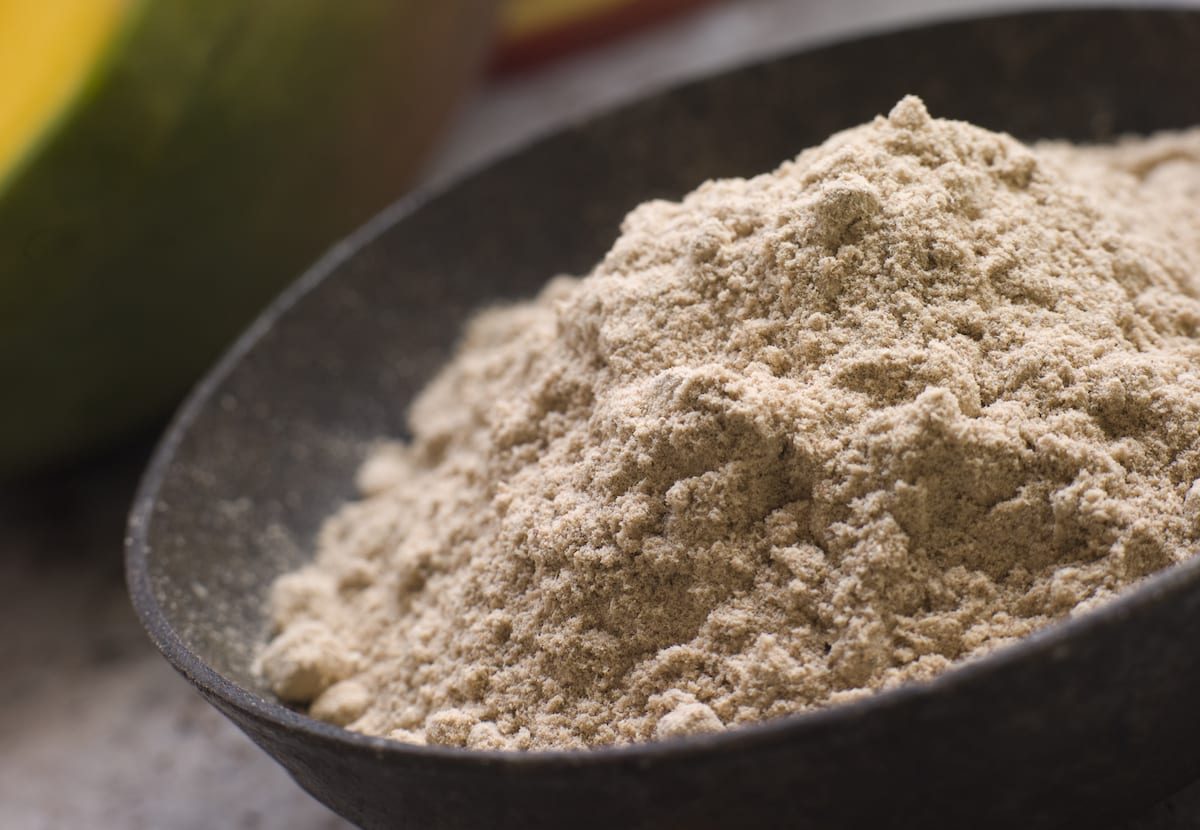
Mango powder, or amchur, is unripe mango that has been peeled, sliced, dried and ground.12 Gernot Katzer attributes its sourness to citric acid and related compounds and describes the taste as subtle and resin-like, and much weaker than tamarind.2 He says it is used in northern Indian cooking in place of tamarind, mainly when only a hint of tartness is wanted or when tamarind’s dark color would show.2 It is more common with vegetables than with meat, appears in tikka spice mixes and tandoori marinades,2 and gives chaat masala its tang.3
That points to the two things amchur does that most souring agents don’t: it adds sourness without adding liquid, and without darkening the dish. The best substitute depends on which of those matters in your recipe.
Quick answer
| What amchur is doing | Best substitute | Starting amount, per 1 teaspoon amchur | Treatment |
|---|---|---|---|
| Tang in a curry, dal or marinade (liquid is fine) | Tamarind paste | 1/2 teaspoon, then taste | Method |
| Bright sourness added at the end (liquid is fine) | Lemon or lime juice | 1 teaspoon, then taste | Method |
| Dry sourness in a dry vegetable dish, stuffing or rub | Ground anardana | 1/2 teaspoon, then taste | Method |
| Sour finishing sprinkle, where red is welcome | Sumac | 1/2 teaspoon, then taste | Method |
| Pure dry sourness, no color or flavor | Citric acid | A small pinch, then taste | Method |
| Chaat and snack dishes | Chaat masala | 1 teaspoon, then adjust the salt | Method |
The rest of the page explains each choice and where it falls short.
How the ratios on this page are labeled
Every ratio carries one of four labels.
- Computed: based on a measurable physical relationship, with the source named.
- Attributed: a named source publishes this ratio. We quote it as theirs.
- Disputed: named sources give different answers to the same swap. We show each one and do not average them.
- Method: we found no published ratio. We give a direction and a cautious starting point, and say so.
Every amount on this page is Method. We found no credible source that publishes a ratio for any amchur substitute. The amounts are opening points for tasting, not measured equivalents.
Amchur’s own strength is not fixed, which is one more reason to start low. India’s standard for amchur sets a minimum acidity of 2.0 percent by mass, measured as citric acid, and no maximum (that is our reading of a partly garbled scan of the standard).1 We found no published measurement of how sour retail amchur actually is.
If liquid is fine: curries, dals and marinades
1. Tamarind
Tamarind is the swap the sources point to, because amchur is itself used in its place.2 Tamarind pulp is rich in tartaric acid and also contains other organic acids, and a 2016 study describes ripe tamarind’s appeal as its “acidic sweetness.”4 In our judgment, that sweet-sour, fruity character is the closest match to amchur among common souring agents. Kew places tamarind in the legume family, Fabaceae.5
Where it falls short: tamarind is stronger and darker. Katzer calls amchur much weaker than tamarind, and says amchur is chosen when tamarind’s dark color would show.2 Paste and pulp also add liquid. And tamarind varies: the same 2016 study found pulp pH differed between genotypes, lowest in sour varieties.4
Ratio (Method): We found no published ratio, and none that compares paste, pulp, concentrate or powder. Start with about half as much tamarind paste as the amchur called for, stir it in during the last stage of cooking, taste, and add more.
2. Lemon or lime juice
Katzer gives lime juice as about 8 percent citric acid and says lemon juice is similar in acidity.6 Citric acid is the same acid Katzer names for amchur’s sourness,2 so juice gives the same kind of sour note. Lime juice is the more aromatic of the two, by Katzer’s account.6
Where it falls short: juice is mostly liquid and has none of amchur’s fruity, resin-like note. Don’t use it in a dry rub or a stuffing that has to stay dry.
The two acid figures can’t be turned into a ratio: the juice figure describes lime juice in general, while the amchur figure is a legal minimum.61
Ratio (Method): No published ratio was found. Start with about 1 teaspoon of juice per teaspoon of amchur, added near the end of cooking, taste, and add more.
3. Grated green (unripe) mango
Amchur is made from unripe mangoes, generally wind-fallen sour ones, according to India’s standard,1 so fresh green mango is the same fruit before drying. Katzer describes unripe mango as sour and astringent, with a slight resinous overtone.2 It is the closest flavor match on this page if you can find it.
Where it falls short: it adds moisture and texture, which suits a chutney or salad better than a dry dish.
Ratio (Method): No published ratio was found. Start with about 1 tablespoon of finely grated green mango per teaspoon of amchur, taste, and add more.
If the dish must stay dry: vegetables, stuffings and rubs
1. Ground anardana
Anardana is pomegranate seed dried with its pulp still attached,7 and a 2018 review describes it as an acidulant in many Asian cuisines and in curries.8 Like amchur, it is a dried fruit used for sourness, so it drops into the same dry dishes without adding liquid.
Where it falls short: food writer Susan Jung describes anardana as deeper and stronger than fresh pomegranate, with an astringent note, and says it is used sparingly.9 It is also dark, and its sourness varies. Wild Himalayan pomegranate, the traditional raw material, has measured titratable acidity from 3.20 to 6.80 percent, depending on the study and the trees sampled.78
Ratio (Method): No published ratio was found. Start with about half as much ground anardana as amchur, taste, and add more.
2. Sumac
Sumac is the dried fruit of Rhus coriaria, ground to a dark red powder, and its sourness is attributed mainly to malic acid.10 Katzer describes it as tart and sour with slightly astringent overtones.11 It is dry, so it works where amchur works, and it is best sprinkled on at the end.
Where it falls short: it is red and lemony rather than pale and fruity, and Katzer notes the ground spice is often mixed with salt.11 Check the label before you salt the dish.
Ratio (Method): No published ratio was found. Start with about half as much sumac as amchur and add to taste.
3. Citric acid
Food-grade citric acid gives sourness with no color, moisture or flavor of its own. Katzer credits citric acid and related compounds with amchur’s sourness,2 so this replaces the acid and nothing else.
Where it falls short: it has none of amchur’s fruitiness, and it is easy to overdo. The Indian standard asks only that amchur reach 2.0 percent acidity, measured as citric acid,1 while citric acid powder is the acid itself.
Ratio (Method): No published ratio was found. Start with a small pinch per teaspoon of amchur, dissolve it in the dish, taste, and add more a pinch at a time.
4. Ground loomi
Loomi is a lime boiled in brine and sun-dried until dark.612 Saveur describes its flavor as “at once sour and musky,”12 and Katzer notes that powdered loomi flavors rice in Iran and northern India.6
Where it falls short: it brings a lime aroma and a dark, musky note that amchur doesn’t have.
Ratio (Method): No published ratio was found. Start with about half as much ground loomi as amchur and add to taste.
5. Chaat masala, in chaat and snacks
Amchur is the ingredient that gives chaat masala its tangy taste, according to Tarla Dalal.3 It is one ingredient among several, though. Gulf News’s recipe uses amchur, black salt and roasted cumin at a tablespoon each.13
Where it falls short: you get salt and cumin along with the sourness, so it only makes sense where those belong.
Ratio (Method): No published ratio was found. Use about the same amount as the amchur called for and cut back on salt elsewhere in the dish.
What isn’t known
- No credible source we found publishes a ratio for any amchur substitute. Every amount on this page is a starting point for tasting.
- No published measurement of retail amchur’s acidity was found. India’s standard gives only a minimum.1
- No study compares the sourness of amchur with tamarind, citrus juice, anardana, sumac or loomi directly. The acidity figures above come from different products, samples and methods and shouldn’t be compared as if they were.
- We found no published guidance on commercial tamarind powder as a substitute, and no source for what goes into it, so it isn’t ranked here.
Related
- Mango powder (amchur)
- Anardana and anardana substitutes
- Sumac, loomi and loomi substitutes
- Tandoori masala
- Too much tamarind? How to fix a too-sour dish
Footnotes
-
IS 13242:1991, Amchur, Raw Mango (Mangifera indica Linn) Powder, Specification, Bureau of Indian Standards. law.resource.org · Standard ↩ ↩2 ↩3 ↩4 ↩5 ↩6
-
Gernot Katzer, “Mango”, Gernot Katzer’s Spice Pages. gernot-katzers-spice-pages.com · Reference work ↩ ↩2 ↩3 ↩4 ↩5 ↩6 ↩7 ↩8 ↩9
-
Tarla Dalal, “Chaat Masala”, TarlaDalal.com. cdn.tarladalal.com · Publication ↩ ↩2
-
Ayala-Silva et al., “Pomological and physicochemical characterization of Tamarindus indica (tamarind) grown in Florida”, Journal of Agriculture of the University of Puerto Rico, 2016. revistas.upr.edu · Peer-reviewed ↩ ↩2
-
Tamarindus indica L., Plants of the World Online, Royal Botanic Gardens, Kew. powo.science.kew.org · Reference work ↩
-
Gernot Katzer, “Lime”, Gernot Katzer’s Spice Pages. gernot-katzers-spice-pages.com · Reference work ↩ ↩2 ↩3 ↩4 ↩5
-
Bakshi et al., “Studies on variability in physico-chemical traits and multiplication of Daru (wild pomegranate) collections”, Indian Journal of Horticulture, 2014. journal.iahs.org.in · Peer-reviewed ↩ ↩2
-
Sharma and Thakur, “Wild pomegranate (Punica granatum L.): A review on physical and chemical attributes of himalayan wild pomegranate fruit”, Journal of Pharmacognosy and Phytochemistry, 2018. phytojournal.com · Peer-reviewed ↩ ↩2
-
Susan Jung, “How to use dried pomegranate seeds, or anardana”, South China Morning Post, 2025. scmp.com · Publication ↩
-
Alsamri et al., “Pharmacological and Antioxidant Activities of Rhus coriaria L. (Sumac)”, Antioxidants, 2021. mdpi.com · Peer-reviewed ↩
-
Gernot Katzer, “Sumac (Rhus coriaria L.)”, Gernot Katzer’s Spice Pages. gernot-katzers-spice-pages.com · Reference work ↩ ↩2
-
Gabriella Gershenson, “Sour Power: Cooking With Dried Limes”, Saveur, 2011. saveur.com · Publication ↩ ↩2
-
Anupa Kurian, “Homemade Indian chaat masala”, Gulf News, 2022. gulfnews.com · Publication ↩