Spice Substitutes · Substitutes
Loomi Substitutes, Ranked by What the Dried Lime Is Doing
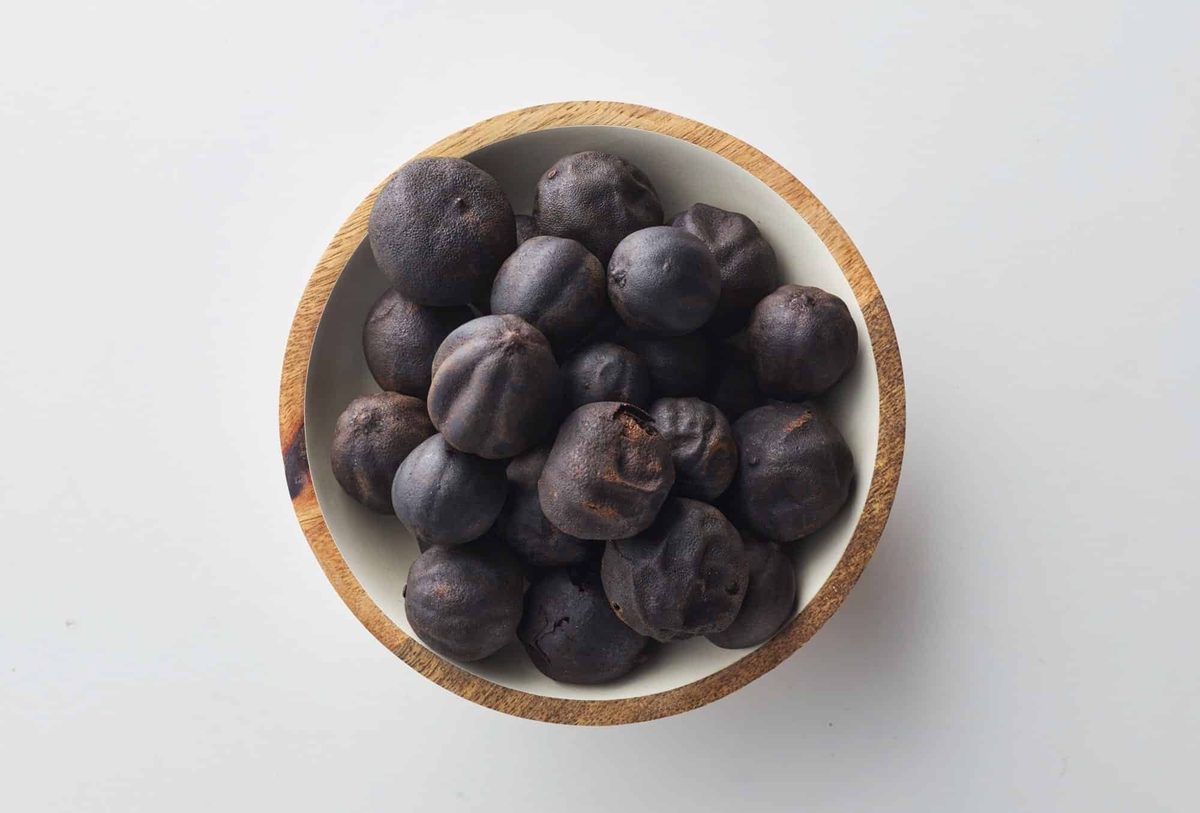
Loomi is a whole lime that has been boiled in salt water and dried in the sun until its inside turns dark.1 Cooks around the Persian Gulf and in Iran use it two ways: whole, pierced or crushed and simmered in stews, where Gernot Katzer says it gives legumes and meat dishes “a distinct citrus odour and a sour tang,” and ground, to flavor rice.12 Saveur describes the flavor as “at once sour and musky,”2 and the Cook’s Illustrated editors credit dried limes with a fermented complexity in the region’s soups and stews.3
So loomi brings three things: sourness, lime aroma, and a dark, musky depth. No single substitute has all three. Choose by the job loomi is doing in your recipe.
Quick answer
| What loomi is doing | Best substitute | Starting amount | Treatment |
|---|---|---|---|
| Simmering whole in a stew, soup or bean pot | Homemade dried limes | 1 homemade lime per dried lime | Method |
| Same job, no time to dry limes | Fresh lime zest, plus lime juice at the end | Zest of 1/2 lime per dried lime; juice to taste | Method |
| Ground, in rice, a rub or a finishing sprinkle | Sumac | 1/2 part per 1 part ground loomi, then add to taste | Method |
| Sourness in a dark stew, aroma not needed | Tamarind paste | 1/2 teaspoon per dried lime, then taste | Method |
| Dry sourness in a pale dish | Amchur (mango powder) | 1/2 part per 1 part ground loomi, then add to taste | Method |
The rest of the page explains each choice and where it falls short.
How the ratios on this page are labeled
Every ratio carries one of four labels.
- Computed: based on a measurable physical relationship, with the source named.
- Attributed: a named source publishes this ratio. We quote it as theirs.
- Disputed: named sources give different answers to the same swap. We show each one and do not average them.
- Method: we found no published ratio. We give a direction and a cautious starting point, and say so.
Every amount on this page is Method. Katzer, Saveur and the Cook’s Illustrated editors describe how dried limes are made and used, but none gives a substitution ratio, and we found no credible source that does. The amounts are opening points for tasting, not measured equivalents.
Dried limes are not uniform either. Saveur notes that they range from parchment brown to charcoal, and that paler limes go into lighter dishes and black ones into darker stews.2 A recipe’s “one dried lime” is itself an approximate amount.
If loomi is simmering whole in a stew
Whole dried limes are crushed or pierced with a skewer and added to slow-simmering food,1 and Saveur says a few pricks with a knife let the cooking liquid get into the fruit.2 Common practice is to taste as the dish cooks and fish the lime out before serving.
1. Make your own dried limes
This is the only substitute that gives you the real thing. Saveur says you can make your own by blanching fresh limes in salted water, then drying them on a rack in the sun or in an airy pantry for at least a week.2 That follows the commercial method, in which ripe limes are boiled in salt water and sun-dried until their insides darken.1
Plan for more than a week if you can. A 2021 drying study notes that traditional open-air sun drying of whole limes in Oman takes 25 to 35 days.4 We found no tested time or temperature for drying limes in a home oven or a food dehydrator.
Make a batch, not just one. Saveur says whole dried limes can last two years, while grinding releases their volatile oils and shortens their shelf life.2
Ratio (Method): One homemade lime for each dried lime in the recipe. Taste before serving.
2. Fresh lime zest, plus a little lime juice
Katzer’s account of the lime explains why this pair works. The peel holds an essential oil, about 7 percent of it, whose main components include citral and limonene, while the juice is about 8 percent citric acid and is used for its sour, refreshing fragrance.1 Zest covers the aroma and juice covers the sourness.
Where it falls short: neither has loomi’s musky, fermented depth,23 and juice adds liquid. Use limes, not lemons, if you can. Katzer writes that lime juice is much more aromatic than lemon juice, and that swapping lemon juice for lime always gives a disappointing result.1
Ratio (Method): We found no published ratio. Add the zest of about half a fresh lime per dried lime with the liquid, then add lime juice a little at a time near the end and taste.
3. Tamarind
Tamarind pulp is rich in tartaric acid and also contains other organic acids, and a 2016 study describes ripe tamarind’s appeal as its “acidic sweetness.”5 Katzer calls tamarind one of the two important sour ingredients in Indian cooking.6 Kew places it in the legume family, Fabaceae, native to Madagascar and the Comoros.7
Where it falls short: tamarind adds sourness and a fruity sweetness but no citrus aroma, and it is dark brown, so keep it for darker stews. Its strength varies too: the same 2016 study found pulp pH differed between tamarind genotypes, with the lowest pH in sour varieties.5
Ratio (Method): No published ratio was found. Start with about 1/2 teaspoon of tamarind paste per dried lime, stir it in during the last stage of cooking, taste, and add more.
If ground loomi is going into rice, a rub or a sprinkle
1. Sumac
Katzer writes that in Iran and northern India, powdered loomi is used to flavor rice “as an alternative to sumac.”1 The two do the same job in that dish, which makes sumac the most natural stand-in for the powder.
Sumac is the dried fruit of Rhus coriaria, ground to a dark red powder,8 from a shrub native from Macaronesia and the Mediterranean to Afghanistan.9 Its sourness is attributed mainly to malic acid,8 and Katzer describes the taste as tart and sour with slightly astringent overtones.10 A 2021 review notes that it is served with minced meat to give a lemony taste.8
Where it falls short: sumac is lemony rather than musky, and it turns food red. Katzer also notes that ground sumac is often mixed with salt,10 so check the label before you salt the dish.
Ratio (Method): We found no published ratio. Start with about half as much sumac as ground loomi, taste, and add more. It works best stirred in at the end or sprinkled over the finished dish.
2. Amchur (mango powder)
Amchur is ground dried unripe mango. Katzer attributes its sourness to citric acid and related compounds and describes its taste as subtle and resin-like.6 Lime juice also contains citric acid, about 8 percent by Katzer’s figure,1 so amchur adds a related sourness without adding liquid or dark color.
Where it falls short: it has no lime aroma and none of loomi’s dark depth.
Ratio (Method): No published ratio was found. Start with about half as much amchur as ground loomi and add to taste.
What isn’t known
- No credible source we found publishes a ratio for any loomi substitute. Every amount above is a starting point for tasting.
- No study of loomi’s aroma compounds was found, so we cannot say which substitute shares them. The musky, fermented note is described by cooks and editors,23 not measured.
- No tested home oven or dehydrator method for drying limes was found.
- A widely repeated claim says loomi offsets gamey or fishy flavors. No source we read supports it.
Related
- Loomi
- Sumac, sumac substitutes and cooking with sumac
- Mango powder and mango powder substitutes
- Anardana, kaffir lime leaves and lemon pepper
- Too much tamarind? How to fix a too-sour dish
Footnotes
-
Gernot Katzer, “Lime”, Gernot Katzer’s Spice Pages. gernot-katzers-spice-pages.com · Reference work ↩ ↩2 ↩3 ↩4 ↩5 ↩6 ↩7 ↩8
-
Gabriella Gershenson, “Sour Power: Cooking With Dried Limes”, Saveur, 2011. saveur.com · Publication ↩ ↩2 ↩3 ↩4 ↩5 ↩6 ↩7 ↩8
-
“Four Ways to Use Dried Limes”, Cook’s Illustrated editors, America’s Test Kitchen. americastestkitchen.com · Publication ↩ ↩2 ↩3
-
M.A. Basunia, “Best-fitted mathematical model to represent the moisture desorption characteristics of whole limes”, CIGR Journal, 2021. cigrjournal.org · Peer-reviewed ↩
-
Ayala-Silva et al., “Pomological and physicochemical characterization of Tamarindus indica (tamarind) grown in Florida”, Journal of Agriculture of the University of Puerto Rico, 2016. revistas.upr.edu · Peer-reviewed ↩ ↩2
-
Gernot Katzer, “Mango”, Gernot Katzer’s Spice Pages. gernot-katzers-spice-pages.com · Reference work ↩ ↩2
-
Tamarindus indica L., Plants of the World Online, Royal Botanic Gardens, Kew. powo.science.kew.org · Reference work ↩
-
Alsamri et al., “Pharmacological and Antioxidant Activities of Rhus coriaria L. (Sumac)”, Antioxidants, 2021. mdpi.com · Peer-reviewed ↩ ↩2 ↩3
-
Rhus coriaria L., Plants of the World Online, Royal Botanic Gardens, Kew. powo.science.kew.org · Reference work ↩
-
Gernot Katzer, “Sumac (Rhus coriaria L.)”, Gernot Katzer’s Spice Pages. gernot-katzers-spice-pages.com · Reference work ↩ ↩2