Spice Substitutes · Substitutes
Celery Seed Substitutes, Ranked by What the Seed Is Doing
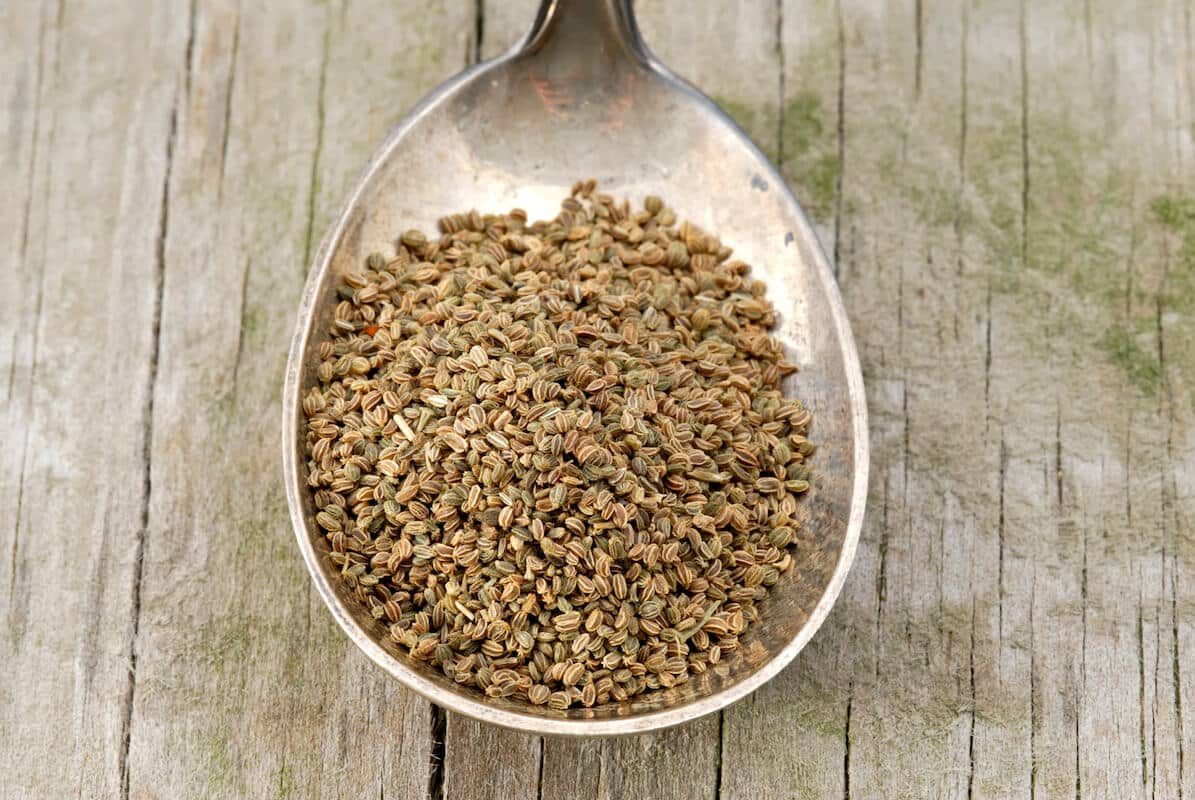
Celery seeds are the small dried fruits of the celery plant, Apium graveolens. Katzer describes their aroma as similar to the leaf and root but much stronger, and slightly bitter.1 The aroma sits in an essential oil that makes up about 3% of the seed’s dry weight, and a group of compounds called phthalides gives it the smell we recognize as celery.2 The closest substitutes are other forms of celery; the seed spices that stand in for it bring different main compounds. Which one works depends on what the seed is doing in your recipe.
Quick answer
| What celery seed is doing | Best substitute | Starting amount, per 1/2 tsp celery seed | Treatment |
|---|---|---|---|
| Celery flavor in a cooked dish (soups, stews, stuffing, braises) | Minced fresh celery tops | 2 tablespoons | Attributed |
| Celery flavor in a dry or no-cook mix (rubs, dressings, brines) | Celery salt, with the recipe’s salt cut | About 1/2 tsp, cutting about 1/4 tsp table salt | Method (flavor), Computed (salt) |
| A visible, savory seed in slaw, potato salad or pickles | Caraway seeds | About 1/4 tsp, then taste | Method |
The rest of the page explains each choice and the alternatives.
How the ratios on this page are labeled
- Computed: based on a measurable physical relationship, with the source named.
- Attributed: a named source publishes this ratio. We quote it as theirs.
- Disputed: named sources give different answers to the same swap. We show each one and do not average them.
- Method: we found no published ratio. We give a direction and a cautious starting point, and say so.
Only one published ratio turned up for celery seed, and it does not say how it was arrived at. McCormick’s advice for celery seed itself sets the tone: its pungent, somewhat bitter flavor “goes a long way,” so start with a pinch.3
If celery seed is flavoring a cooked dish
In soups, stews, stuffings and braises, the seed is a way to get celery flavor without the stalk’s stringy texture, which is how The Spice House describes its job.4 Here the plant itself is the best stand-in, as long as a little texture and moisture don’t matter.
1. Fresh celery tops (the leafy ends)
Ratio (Attributed): The Spice House says to use 2 tablespoons of minced celery tops for every 1/2 teaspoon of celery seed.4 That is 1/4 cup of tops per teaspoon of seed. Mince them fine and add them early enough to soften.
The large volume reflects how much more concentrated the seed is: Katzer calls the seed’s aroma much stronger than the leaf’s.1
2. Dried celery or celery flakes
The Spice House lists dried celery as a celery seed substitute, without an amount.4 McCormick’s celery flakes are dried celery stalk and are suggested for soups, sauces and stuffings.5
Ratio (Method): No published flakes-for-seed ratio was found. In our judgment flakes are milder than seed, so start with about 1 teaspoon of flakes per 1/2 teaspoon of seed in a simmered dish, taste once they have softened, and add more.
If celery seed is flavoring a dry or no-cook mix
In rubs, dressings, pickling brines and Bloody Mary mixes, there is no time or liquid to soften fresh celery, so you need a dry, concentrated form.
1. Celery salt
The Spice House calls celery salt a great substitute because it is made of celery seed and salt, and says to reduce the salt elsewhere in the recipe.4 McCormick’s celery salt lists just “Salt & Celery Seed.”6
Salt adjustment (Computed): McCormick’s label gives 270 mg of sodium per 1/4 teaspoon,6 about 1,080 mg per teaspoon. The FDA says 2,300 mg of sodium is about 1 teaspoon of table salt.7 So each teaspoon of this celery salt carries a little under half the sodium of a teaspoon of table salt. For every teaspoon of celery salt you add, cut about 1/2 teaspoon of table salt from the recipe. Check your own brand’s label; it may differ.
Celery flavor (Method): We found no figure for how much seed a commercial celery salt contains, so no one can say how much celery salt equals a given amount of seed. Start with an equal amount, cut the recipe’s salt as above, and taste. Be wary of doubling up for flavor: 2 teaspoons of McCormick’s celery salt would carry about 2,160 mg of sodium, close to the FDA’s Daily Value of less than 2,300 mg.67
2. Celery powder made from seed
Some celery powder is simply ground celery seed; other powders are ground dried celery. Read the label.
Ratio (Method): For seed-based powder, start with a little less ground powder than the whole seed called for, and taste. We found no whole-to-ground figure for celery seed.
If celery seed is a visible seed in slaw, potato salad or pickles
Here the seed contributes flecks, a little crunch and a savory note. Other parsley-family seeds can supply the look and the bite, but the compounds the sources name as their main ones are not celery’s phthalides, so the flavor will shift.
1. Caraway seeds
The Spice House calls caraway seeds “an excellent substitute” for celery seed in coleslaw, and says they also work in potato and pasta salads.4 Caraway oil is dominated by carvone and limonene,8 and celery oil is mostly limonene,2 so the two share one major compound. What caraway adds is its own aroma, which Britannica describes as reminiscent of anise, with a warm, slightly sharp taste.8
Ratio (Method): No published ratio was found. Caraway’s essential oil runs about 5% of the seed,8 against about 3% for celery seed.2 Oil content is not a measure of flavor strength, but it is a reason to start low: about half as much caraway as celery seed, then taste.
2. Dill seed
The Spice House lists dill seeds as a substitute.4 Dill seed is a classic pickling spice: PROSEA notes that its ripe fruits flavor pickled cucumbers, onions and vinegar.9 Its oil is mostly limonene and carvone,9 and Britannica describes dill’s flavor as warm, slightly sharp and somewhat reminiscent of caraway.10 Expect a result closer to dill pickle than to celery.
Ratio (Method): No published ratio was found. Dill seed’s essential oil content is about 3%,10 similar to celery seed’s.2 Start with the same amount or a little less, and taste.
3. Fennel seed
The Spice House also lists fennel seeds.4 Fennel brings a sweet, anise-like note, from anethole,11 that celery seed doesn’t have. Use it where sweetness suits the dish.
Ratio (Method): No published ratio was found. Start with about half as much fennel as celery seed.
4. Lovage seed, if you have it
Lovage is a separate plant whose flavor Britannica describes as sweet and similar to celery; its seeds are used to flavor confectionery and liqueurs.12
Ratio (Method): We found no published ratio for lovage seed in place of celery seed. Start with the same amount and taste.
Not recommended: nigella
Nigella seed is sometimes suggested as a celery seed substitute. It comes from a different family, the buttercups (Ranunculaceae), and Katzer describes its taste as aromatic and slightly bitter, with a vaguely oregano-like scent when ground or chewed.13 We found no source that recommends it in place of celery seed.
What isn’t known
- No published study compares the flavor strength of celery seed with any substitute. The Spice House’s celery-tops figure is the only published ratio we found, and it gives no method.
- The salt-to-seed ratio of commercial celery salts is not published by the sources we read, so a celery salt amount for celery flavor can only be a starting point.
- No whole-to-ground volume figure for celery seed was found.
Related
- Celery seeds and celery seed uses
- Celery seed vs. celery salt and celery seed vs. celery powder
- Celery salt, celery powder, celery flakes and celery leaves
- Caraway seeds, dill, dill seed vs. dill weed, fennel seed, lovage and nigella seeds
- Celery salt substitutes and celery powder substitutes
Footnotes
-
Gernot Katzer, Celery (Apium graveolens), Gernot Katzer’s Spice Pages. gernot-katzers-spice-pages.com · Reference work ↩ ↩2
-
Salehi et al., Apium Plants: Beyond Simple Food and Phytopharmacological Applications, Applied Sciences, 2019. mdpi.com · Peer-reviewed ↩ ↩2 ↩3 ↩4
-
McCormick Whole Celery Seed, product page, McCormick & Company. mccormick.com · Merchant ↩
-
Celery Seed Substitute, The Spice House. thespicehouse.com · Merchant ↩ ↩2 ↩3 ↩4 ↩5 ↩6 ↩7
-
McCormick Celery Flakes, product page, McCormick & Company. mccormick.com · Merchant ↩
-
McCormick Celery Salt, label ingredients and Nutrition Facts as listed by Stop & Shop. stopandshop.com · Merchant ↩ ↩2 ↩3
-
Sodium in Your Diet, U.S. Food and Drug Administration. fda.gov · Regulator ↩ ↩2
-
Caraway, Encyclopaedia Britannica. britannica.com · Reference work ↩ ↩2 ↩3
-
Anethum graveolens (PROSEA), Plant Resources of South-East Asia. uses.plantnet-project.org · Reference work ↩ ↩2
-
Dill, Encyclopaedia Britannica. britannica.com · Reference work ↩ ↩2
-
Foeniculum vulgare (PROSEA), Plant Resources of South-East Asia. uses.plantnet-project.org · Reference work ↩
-
Lovage, Encyclopaedia Britannica. britannica.com · Reference work ↩
-
Gernot Katzer, Nigella (Nigella sativa L.), Gernot Katzer’s Spice Pages. gernot-katzers-spice-pages.com · Reference work ↩