Cooking · Cooking with
Cooking With Caraway Seeds: Toasting, Grinding and Where They Belong
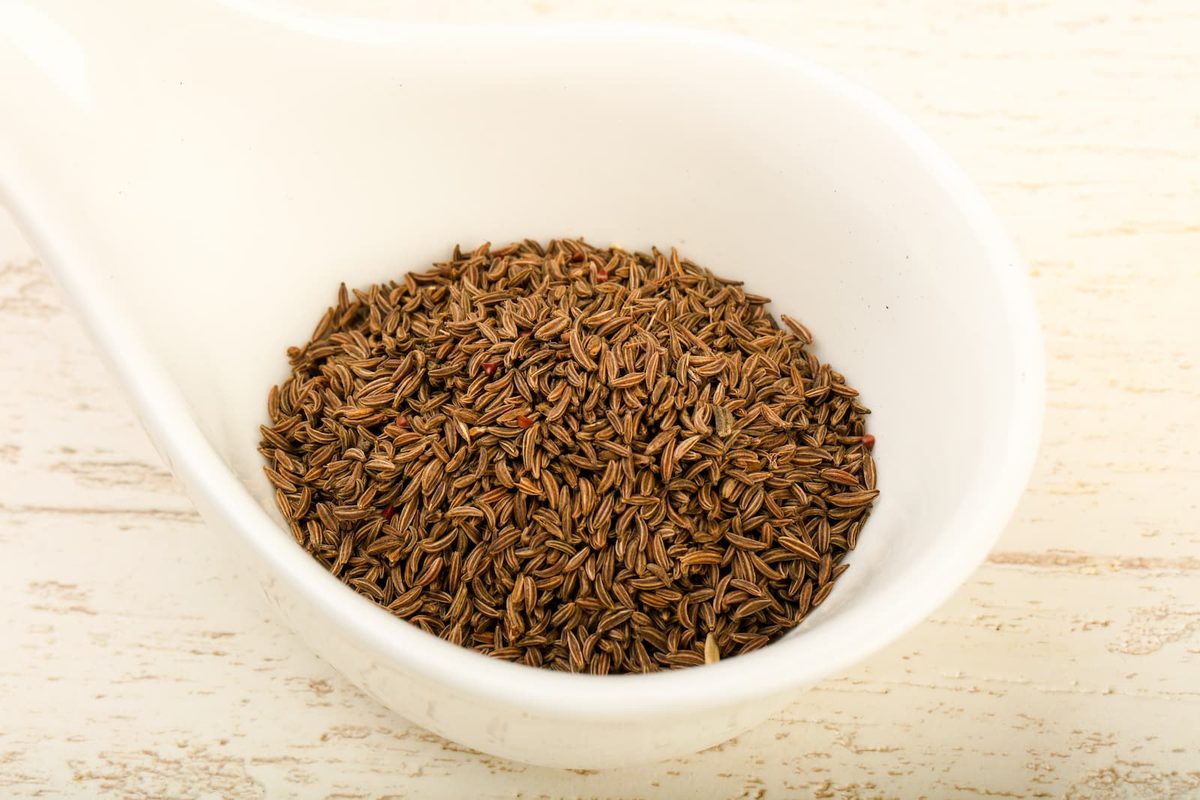
Caraway is the seed (botanically, the dried fruit) of Carum carvi, and its flavor is the one most people know from seeded rye bread. Britannica describes its aroma as reminiscent of anise, with a warm, slightly sharp taste;1 PROSEA identifies carvone as the compound behind its characteristic flavor.2 Caraway is assertive and particular about company, so the useful questions are how to bring out its flavor, whether to grind it, and which dishes it suits. For the plant, its chemistry and its history, see the caraway seeds profile.
At a glance
| Question | Answer | Source |
|---|---|---|
| Whole or ground? | Generally whole; once ground, the flavor fades quickly | Susan Jung, SCMP3 |
| Toast it? | Optional; toasting makes the flavor stronger | Susan Jung3 |
| How much in a loaf of rye? | 1 tablespoon of seeds per loaf in one tested recipe | ATK, Deli Rye Bread4 |
| Best partners | Rye, cabbage and sauerkraut, potatoes, meat, cheese | Katzer; Jung; Britannica531 |
| Other spices? | Use sparingly with them; caraway does not harmonize with most | Katzer5 |
Toasting
Caraway can be used straight from the jar, but Susan Jung, writing in the South China Morning Post, notes that its flavor becomes stronger when the seeds are toasted. Her method is to shake them constantly in a small, dry skillet over a medium flame until they darken slightly and their fragrance becomes more pronounced.3
A widely repeated instruction is to toast the seeds over low heat for three minutes. We found no source for the timing. Watch the color and smell instead, and tip the seeds onto a plate as soon as they are done so the hot pan does not keep cooking them; that last step is kitchen practice.
Toasting is a choice, not a requirement. America’s Test Kitchen’s deli rye whisks the whole seeds into the flour with no toasting step.4
Whole or ground
Most caraway is used whole. Jung says the seeds are generally used whole, and that once ground the flavor fades quickly, so grind just before you need it.3 That makes whole seed the form to buy and keep. PROSEA notes that the dried fruit stores and transports very well.2
When you do want it ground, for a rub, a sausage mix or a smooth sauce, a mortar and pestle or an electric spice grinder both work; that is common kitchen practice. A widely repeated claim says crushing releases more flavor than grinding; we found no source that tests it.
Removing whole seeds. Whole seeds stay whole in a dish. If you want caraway’s flavor in a broth or braise without the seeds, tie them in cheesecloth and lift the bundle out before serving. Saveur’s choucroute garnie uses the same trick for its juniper, cloves, garlic and bay leaf.6 Whether you find whole seeds pleasant to chew is a matter of taste.
Where caraway belongs
- Rye bread. Jung says caraway is almost always added to rye bread.3 Andrew Janjigian’s Deli Rye Bread for America’s Test Kitchen uses 1 tablespoon of caraway seeds per loaf, whisked into the flours with the yeast.4
- Sauerkraut and cabbage. Katzer says traditional sauerkraut is always flavored with caraway,5 and Jung singles out vegetables, especially potatoes and cabbage, as good matches.3
- Southern German and Austrian cooking. Katzer calls caraway the spice that gives that food its characteristic flavor, whether meat, vegetable or rye bread.5
- Cheese. Some Central European cheeses contain caraway seeds.5 Britannica lists meat dishes, breads and cheese among its main uses.1
- Baking. Caraway is one of the essential ingredients in old-fashioned seed cake, according to Jung.3
- Fish. Jung notes that caraway is often among the spices used to flavor gravlax.3
- Spirits. Its oil flavors aquavit and kümmel.1
- North Africa. In Tunisia, caraway goes into harissa, the chile paste.5
Indian recipes. Katzer warns that many languages lack a specific word for caraway and use the word for cumin instead.5 An English translation of an Indian recipe that says “caraway” may mean cumin, and the reverse. Check the recipe’s context before reaching for the jar.
What it goes with
Katzer observes that caraway does not harmonize with most other spices.5 In practice that means it usually leads rather than blends: one dominant seasoning against bread, cabbage, potatoes or meat, with garlic, onion, juniper or black pepper in support. Those partners reflect common practice in the dishes above rather than a published pairing study. A widely repeated claim says caraway pairs especially well with dill, parsley and cumin as fellow members of the carrot family (Apiaceae).1 No source checked here makes that pairing claim, so treat it as opinion.
Substitutes, briefly
Caraway is sometimes offered as a stand-in for anise, fennel or cumin. The sources point the other way. The Spice House calls fennel seed the closest substitute for caraway, and says cumin can stand in but is more pungent than fennel and should be used more sparingly.7 We found no source that recommends caraway as a replacement for those spices. See caraway seed substitutes, caraway vs. cumin and caraway vs. fennel seeds.
How much to use
The only tested amount found is ATK’s 1 tablespoon of seeds in a single loaf of deli rye.4 For a pot of sauerkraut, a braise or roasted potatoes, no published figure was found; start with about a teaspoon of whole seed and add more next time if you want it stronger. That is a method, not a measurement. Because caraway is assertive and does not blend easily,5 it is easier to add than to take away.
Storage
PROSEA says the dried fruit keeps well,2 but no regulator or standards body gives a shelf-life figure. Claims that whole caraway lasts “up to two years,” or that refrigeration extends it, could not be traced. Keep whole seeds sealed, cool and dark, and crush one to check: if it smells faint, replace it. Given how fast ground caraway fades,3 buy it whole.
Safety
Culinary amounts of caraway raise no specific safety concern in the sources checked. The European Medicines Agency’s monograph on caraway as a traditional herbal medicine does not recommend medicinal use during pregnancy and breastfeeding.8 That advice concerns medicinal doses, not seeds in bread.
Related
- Caraway seeds, the full profile
- Caraway seed substitutes
- Caraway vs. cumin and caraway vs. fennel seeds
- Pickling spice
Footnotes
-
“Caraway”, Encyclopaedia Britannica. britannica.com · Reference work ↩ ↩2 ↩3 ↩4 ↩5
-
H. Toxopeus and J.H. Lubberts, Carum carvi, Plant Resources of South-East Asia (PROSEA). uses.plantnet-project.org · Reference work ↩ ↩2 ↩3
-
Susan Jung, “How to use caraway seeds to flavour bread, cakes and sauerkraut”, South China Morning Post, 2026. scmp.com · Publication ↩ ↩2 ↩3 ↩4 ↩5 ↩6 ↩7 ↩8 ↩9 ↩10
-
Andrew Janjigian, “Deli Rye Bread”, America’s Test Kitchen, 2017. americastestkitchen.com · Publication ↩ ↩2 ↩3 ↩4
-
Gernot Katzer, “Caraway (Carum carvi L.)”, Gernot Katzer’s Spice Pages. gernot-katzers-spice-pages.com · Reference work ↩ ↩2 ↩3 ↩4 ↩5 ↩6 ↩7 ↩8 ↩9
-
“Sauerkraut With Pork and Sausages (Choucroute Garnie)”, Saveur. saveur.com · Publication ↩
-
“Caraway Seeds Substitute”, The Spice House, 2018. thespicehouse.com · Merchant ↩
-
European Union herbal monograph on Carum carvi L., fructus, European Medicines Agency. ema.europa.eu · Regulator ↩