Spices · Profile
Caraway Seeds: Flavor, Carvone Chemistry, History and Uses
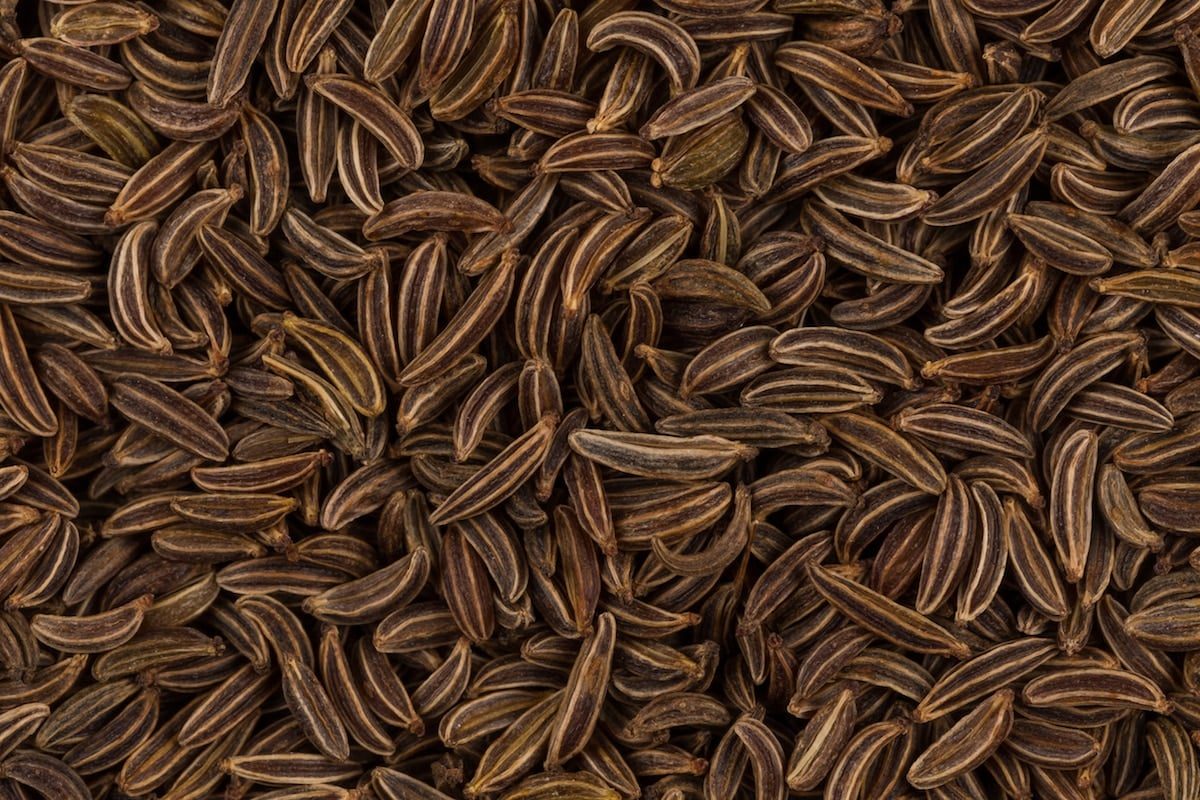
Caraway is the dried fruit of Carum carvi, a member of the carrot and parsley family, sold as “seed.” It is the flavor most people know from seeded rye bread, and it carries much of the seasoning in sauerkraut, Central European cheeses and the Scandinavian spirit aquavit. Its smell comes mostly from two compounds, carvone and limonene, in roughly equal measure.
At a glance
| Botanical name | Carum carvi L.1 |
| Plant family | Apiaceae (carrot/parsley family)1 |
| Part used | The dried fruit, sold as “seed”2 |
| Native range | Temperate Eurasia (Kew)1 |
| Main producers | Netherlands, Poland, Hungary and Russia (winter type); Egypt and western India (spring type), per PROSEA3 |
| Key aroma compounds | Carvone and limonene23 |
| Essential oil in the fruit | About 5% (Britannica); 1.5–7.0% depending on type (PROSEA)23 |
| Forms sold | Whole seed, ground, essential oil |
Measured values
5 figures, sourced| Measure | Value | Scope | Source |
|---|---|---|---|
| Essential oil | about 5 % of fruit | BritannicaSources differ | britannica.com |
| Essential oil | 1.5–5.0 % of fruit | spring-type fruit (PROSEA)Sources differ | uses.plantnet-project.org |
| Essential oil | 3.0–7.0 % of fruit | winter-type fruit (PROSEA)Sources differ | uses.plantnet-project.org |
| d-Carvone (S-(+)-carvone) | 45–60 % of oil | PROSEA | uses.plantnet-project.org |
| d-Limonene | 35–55 % of oil | PROSEA | uses.plantnet-project.org |
Each figure is quoted as its source states it, with the samples or standard it applies to. Where sources differ, both are shown; nothing is averaged. All measured values
What caraway is
Caraway is a biennial herb with finely cut leaves and flat-topped clusters of small white flowers.2 The “seed” is a crescent-shaped fruit about 5 mm long with five prominent ridges along its back.2 Its look and its name cause steady confusion with cumin, a separate plant in the same family; see caraway vs. cumin.
PROSEA distinguishes two crop types. Winter (biennial) caraway, grown mainly in the Netherlands, Poland, Hungary and Russia, carries more oil and the stronger taste; spring (annual) caraway is grown in Egypt and western India.3 Britannica notes that Dutch caraway has long had a reputation for high quality.2
Flavor and the compounds behind it
Britannica describes caraway’s aroma as reminiscent of anise, with a warm, slightly sharp taste.2 In the kitchen it reads as sweetish, a little bitter and faintly minty, and it is assertive enough that a small amount goes a long way. That last part is cooking judgment, not a measurement.
The aroma sits in the essential oil, which Britannica puts at about 5% of the fruit.2 PROSEA gives 1.5–5.0% for spring-type fruit and 3.0–7.0% for winter-type fruit.3 Two compounds dominate that oil:
PROSEA identifies carvone as the compound responsible for caraway’s characteristic flavor.3
Origin and history
Kew gives caraway’s native range as temperate Eurasia, and Britannica says it is native to Europe and western Asia.12 PROSEA adds that the spring type is indigenous to the eastern Mediterranean, including Egypt.3
- Prehistory. Caraway fruits have been found at Neolithic village sites, though Gernot Katzer points out that this shows only that the plant grew there, not that people cooked with it.4
- Rome onward. Katzer finds plenty of documentation of culinary and medicinal use from Roman times, and notes that medieval monasteries grew it chiefly as a remedy for flatulence.4
- Shakespeare. In Henry IV, Part 2, Justice Shallow invites Falstaff to eat apples of his own grafting “with a dish of caraways.”5
Several popular claims about caraway’s history could not be traced to a source: that its use began with the ancient Arabs, that it appears in a medical text from 1500 BCE, that the Romans brought it to England, and that Elizabethans used it mainly as a breath freshener. Katzer suggests the English word itself probably came to Europe by way of Arabic, from a form of Latin carum, which may be where the “Arab” story began.4
How caraway is used
Britannica lists meat dishes, breads, cheese, sauerkraut and coleslaw as caraway’s main culinary uses, and names aquavit and kümmel among the spirits flavored with its oil.2
- Germany and Austria. Katzer calls caraway the spice that gives Southern German and Austrian food its characteristic flavor, and says traditional sauerkraut is always seasoned with it, alongside juniper.4
- Breads and baking. PROSEA notes that the whole fruit goes into bakery products in parts of Europe and North America; rye bread is the best-known example.34
- Cheese. Some Central European cheeses are made with whole caraway.4
- Spirits. Kümmel, a caraway liqueur, is made and drunk mostly in northern Germany and Scandinavia; the oil also flavors akvavit.34
- North Africa. Katzer singles out Tunisia, where caraway often goes into harissa, the chile paste.4
- India. PROSEA counts caraway among the spicy fruits of Indian cooking.3 Treat translated recipes with care: Katzer notes that many languages have no separate word for caraway and use the word for cumin instead (in Hindi, caraway is “foreign cumin”).4 An Indian recipe calling for “caraway” may mean cumin, and the reverse.
Whole seeds release more flavor when lightly toasted or simmered in a dish; ground caraway disperses evenly in rubs and sausage mixes. Both are common kitchen practice. For more, see cooking with caraway seeds.
Pairings
By common practice caraway sits well with pork, cabbage, potatoes, apples, onions, rye and other carrot-family spices such as dill and coriander. These pairings are cooking judgment.
Buying and quality
Look for whole, intact, uniformly brown seeds with a strong smell when crushed; dusty or faint-smelling seed has lost oil. That is a practical check, not a standard. PROSEA records that caraway oil is often adulterated with synthetic d-carvone, and that dill fruit oil is sometimes used in its place.3
Production statistics are thin. PROSEA estimates world caraway oil output at about 30 tonnes a year and US imports of the fruit at about 3,000 tonnes a year in the early 1990s; both figures are old and the oil figure is undated.3 No current statistical source for world caraway production was found.
Storage
PROSEA notes that the dried fruit stores and transports very well.3 No regulator or standards body gives a shelf-life figure. Keep the seed whole, sealed and away from heat and light, and judge it by smell: if a crushed seed smells faint, it has faded.
Safety and health claims
In the United States, caraway and caraway fruit oil are “generally recognized as safe” for food use, according to PROSEA, which also gives a maximum level for the oil in food products of about 0.02%.3
The European Medicines Agency recognizes caraway fruit as a traditional herbal medicine for the relief of digestive complaints such as bloating and flatulence. That status rests on long-standing use, not on clinical trials.6 The monograph advises against medicinal use during pregnancy and breastfeeding (for lack of data) and lists allergy to caraway or other carrot-family plants as a contraindication.6 None of this concerns the small amounts used in cooking. Mineral, vitamin and fiber figures that circulate for caraway were not checked against a nutrient database for this page, and the disease-prevention claims often attached to them have no support here.
Substitutes and comparisons
Footnotes
-
Carum carvi L., Plants of the World Online, Royal Botanic Gardens, Kew. powo.science.kew.org · Reference work ↩ ↩2 ↩3 ↩4
-
“Caraway”, Encyclopaedia Britannica. britannica.com · Reference work ↩ ↩2 ↩3 ↩4 ↩5 ↩6 ↩7 ↩8 ↩9 ↩10
-
H. Toxopeus and J.H. Lubberts, Carum carvi, Plant Resources of South-East Asia (PROSEA). uses.plantnet-project.org · Reference work ↩ ↩2 ↩3 ↩4 ↩5 ↩6 ↩7 ↩8 ↩9 ↩10 ↩11 ↩12 ↩13 ↩14 ↩15 ↩16
-
Gernot Katzer, “Caraway (Carum carvi L.)”, Gernot Katzer’s Spice Pages. gernot-katzers-spice-pages.com · Reference work ↩ ↩2 ↩3 ↩4 ↩5 ↩6 ↩7 ↩8 ↩9
-
William Shakespeare, Henry IV, Part 2, Act 5, Scene 3, Folger Shakespeare Library. folger.edu · Reference work ↩
-
European Union herbal monograph on Carum carvi L., fructus, European Medicines Agency, 2015. ema.europa.eu · Regulator ↩ ↩2