Spice Comparisons · Comparison
Caraway Seeds vs. Cumin: Two Look-Alike Seeds With Different Chemistry
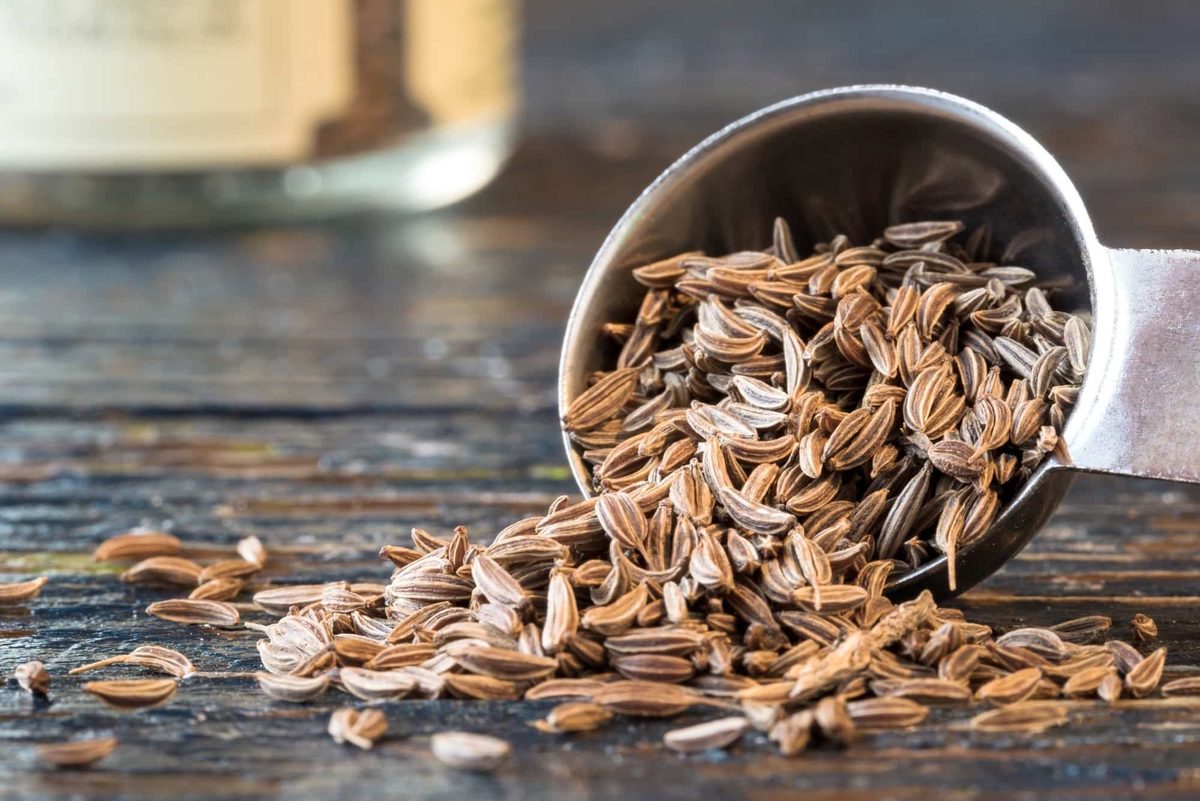
Caraway and cumin are two different plants in the same family, and their seeds are easy to mix up on sight. PROSEA’s spice handbook says the fruits of the two crops look very similar and are easily confused, but that the taste is very different: bite one and you will know.1 The chemistry explains why. Caraway’s oil is mostly carvone and limonene,1 while cumin’s is led by cuminaldehyde.2 In a recipe, each can stand in for the other in small amounts, but neither will taste like the original.
Side by side
| Caraway | Cumin | |
|---|---|---|
| Species | Carum carvi3 | Cuminum cyminum4 |
| Family | Apiaceae (carrot/parsley family)3 | Apiaceae (carrot/parsley family)45 |
| Native range | Temperate Eurasia (Kew)3 | Iraq to Afghanistan (Kew)4 |
| Part used | The dried fruit, sold as “seed”1 | The dried fruit, sold as “seed”5 |
| What it looks like | Brown, ribbed, often curved (sickle-shaped) halves of a fruit 3–5 mm long (PROSEA); about 5 mm with five prominent ridges (Britannica)16 | Thin, yellowish-brown elongated ovals about 6 mm long5 |
| Essential oil in the seed | About 5% (Britannica); 1.5–7.0% depending on crop type (PROSEA)61 | 2.5–4.5% (Britannica)5 |
| Main aroma compounds | d-carvone 45–60% and d-limonene 35–55% of the oil; carvone gives the characteristic flavor1 | Cuminaldehyde, the most important constituent, at 20–72% of the oil across the literature PROSEA summarizes2 |
| Aroma (sourced) | Reminiscent of anise, with a warm, slightly sharp taste6 | Strong, warm, pungent and persistent2 |
| Flavor (editorial) | Sweetish, faintly minty, rye-bread familiar | Earthy, savory, slightly bitter; rounder when toasted |
| Forms | Whole, ground, essential oil | Whole, ground, essential oil |
| Typical uses | Meat dishes, breads and cheese;6 rye bread and sauerkraut in Germany and Austria7 | Mixed spices, chutneys, chili and curry powders; Asian, North African and Latin American cooking5 |
The two compound rows come from separate PROSEA entries, each summarizing its own literature, so they show which compound leads each oil rather than a like-for-like measurement. Cumin’s figures in particular vary widely with the seed and with how the oil was made; see cumin for study-by-study numbers.
Why they get confused
They look alike. Both are small, ribbed, brown fruits from carrot-family plants, sold as seed.65 PROSEA notes that caraway’s half-fruits are often curved,1 while Britannica describes cumin as an elongated oval and gives it as slightly longer, about 6 mm against caraway’s 5 mm.56 The color difference is in the descriptions too: brown for caraway, yellowish-brown for cumin.15 In practice, a curved, darker seed is more likely caraway and a straighter, paler one cumin, but that is a rule of thumb, not a test. Crushing one and smelling it is the reliable check.
The names are tangled. Gernot Katzer traces the German word for caraway, Kümmel, to the Latin for cumin, cuminum, misapplied to the plant popular in Germany.7 In Hindi, caraway is vilayati jeera, “foreign cumin,” and some French texts write “cumin” when they mean caraway.7 Katzer warns that a reference to caraway in a Middle Eastern, Indian or Far Eastern cookbook is most probably a translation mistake.7 PROSEA reports the same muddle in Southeast Asia: the Malay name jintan, once given for caraway, “is clearly cumin.”1 When a translated recipe calls for one, consider whether it meant the other.
Both belong to the Apiaceae, the family of parsley and coriander, whose leaves are cilantro.348
Do they taste alike?
Sources disagree, and the disagreement is about emphasis:
| Source | What it says |
|---|---|
| Britannica, on cumin | Its taste is warm and “reminiscent of caraway”5 |
| PROSEA, on caraway | The two fruits look similar, but “the taste is very different and distinctive”1 |
Both can be true. The shared notes are warmth and a slightly sharp, seedy edge; the difference is in the dominant aroma. Carvone gives caraway its characteristic flavor,1 and Britannica likens caraway’s aroma to anise.6 Cumin has no carvone at the top of its oil; cuminaldehyde leads.2 That is why caraway reads as rye bread and cumin as chili or curry, in our judgment.
How each is used
Caraway. Britannica names meat dishes, breads and cheese as its main seasoning uses.6 Katzer calls caraway the spice that gives Southern German and Austrian food, rye bread included, its characteristic flavor, says German sauerkraut is always flavored with it, and notes that some Central European cheeses contain the seeds.7 For more, see cooking with caraway seeds.
Cumin. Britannica calls it an essential ingredient in many mixed spices, chutneys, and chili and curry powders, and especially popular in Asian, North African and Latin American cooking.5 The USDA’s purchasing specification lists cumin in both its chili powder and its curry powder.9 The Spice House describes chili and tacos as very cumin-forward.10 Garam masala often contains cumin, but not always: The Spice House says it “often” does,10 and the Madhur Jaffrey recipe Saveur publishes uses black cumin seeds instead.11 For more, see cumin uses.
Can one stand in for the other?
Yes, at a reduced amount, with a flavor change you will notice. Our substitute pages give the full treatment; the ratios below are carried over from them.
Caraway in place of cumin (Attributed). The Spice House says to start with half to three quarters as much caraway as cumin and add more if needed.10 Healthline and Tasting Table both say to start with half.1213 All three say to start low; none gives a final figure. Crush or grind the caraway if the recipe uses ground cumin. Expect an anise-tinged, rye-bread note in place of cumin’s heavier aroma. See cumin substitutes.
Cumin in place of caraway (Method). The Spice House lists cumin seeds among caraway alternatives but gives no amount, and names fennel as the best substitute.14 We found no published ratio. Start with half the caraway amount and taste. It works best in savory spice blends and rubs, and least well in rye bread or sauerkraut, where caraway is the defining flavor; that is our judgment. See caraway seed substitutes.
What isn’t known
- No study compares the flavor strength of caraway and cumin, so every swap amount is a rule of thumb.
- No dated, sourced retail price comparison was found. Claims that caraway is the pricier of the two could not be checked.
- Composition figures for both oils vary with crop type, origin and distillation method; the ranges above are summaries, not the content of any jar.
Related
- Caraway seeds and caraway seed substitutes
- Cumin, cumin substitutes and cumin seeds vs. ground cumin
- Caraway seeds vs. fennel seeds, fennel seeds vs. cumin seeds, coriander vs. cumin
- Chili powder, curry powder, nigella seeds (sometimes sold as “black cumin”)
Footnotes
-
H. Toxopeus and J.H. Lubberts, Carum carvi, Plant Resources of South-East Asia (PROSEA). uses.plantnet-project.org · Reference work ↩ ↩2 ↩3 ↩4 ↩5 ↩6 ↩7 ↩8 ↩9 ↩10 ↩11
-
P.C.M. Jansen, Cuminum cyminum, Plant Resources of South-East Asia (PROSEA). uses.plantnet-project.org · Reference work ↩ ↩2 ↩3 ↩4
-
Carum carvi L., Plants of the World Online, Royal Botanic Gardens, Kew. powo.science.kew.org · Reference work ↩ ↩2 ↩3 ↩4
-
Cuminum cyminum L., Plants of the World Online, Royal Botanic Gardens, Kew. powo.science.kew.org · Reference work ↩ ↩2 ↩3 ↩4
-
“Cumin”, Encyclopaedia Britannica. britannica.com · Reference work ↩ ↩2 ↩3 ↩4 ↩5 ↩6 ↩7 ↩8 ↩9 ↩10
-
“Caraway”, Encyclopaedia Britannica. britannica.com · Reference work ↩ ↩2 ↩3 ↩4 ↩5 ↩6 ↩7 ↩8
-
Gernot Katzer, “Caraway (Carum carvi L.)”, Gernot Katzer’s Spice Pages. gernot-katzers-spice-pages.com · Reference work ↩ ↩2 ↩3 ↩4 ↩5
-
“Coriander”, Encyclopaedia Britannica. britannica.com · Reference work ↩
-
Commercial Item Description A-A-20001C, Spices and Spice Blends, USDA Agricultural Marketing Service, 2023. ams.usda.gov · Regulator ↩
-
“Cumin Substitute”, The Spice House, 2017. thespicehouse.com · Merchant ↩ ↩2 ↩3
-
Madhur Jaffrey, “Garam Masala”, Saveur, 2014. saveur.com · Publication ↩
-
Lisa Wartenberg, “8 Good Substitutes for Cumin”, Healthline, 2023. healthline.com · Publication ↩
-
Steve Peters, “12 Best Substitutes for Cumin”, Tasting Table, 2024. tastingtable.com · Publication ↩
-
“Caraway Seeds Substitute”, The Spice House, 2018. thespicehouse.com · Merchant ↩