Spice Comparisons · Comparison
Caraway Seeds vs. Fennel Seeds: Carvone, Anethole and When to Swap
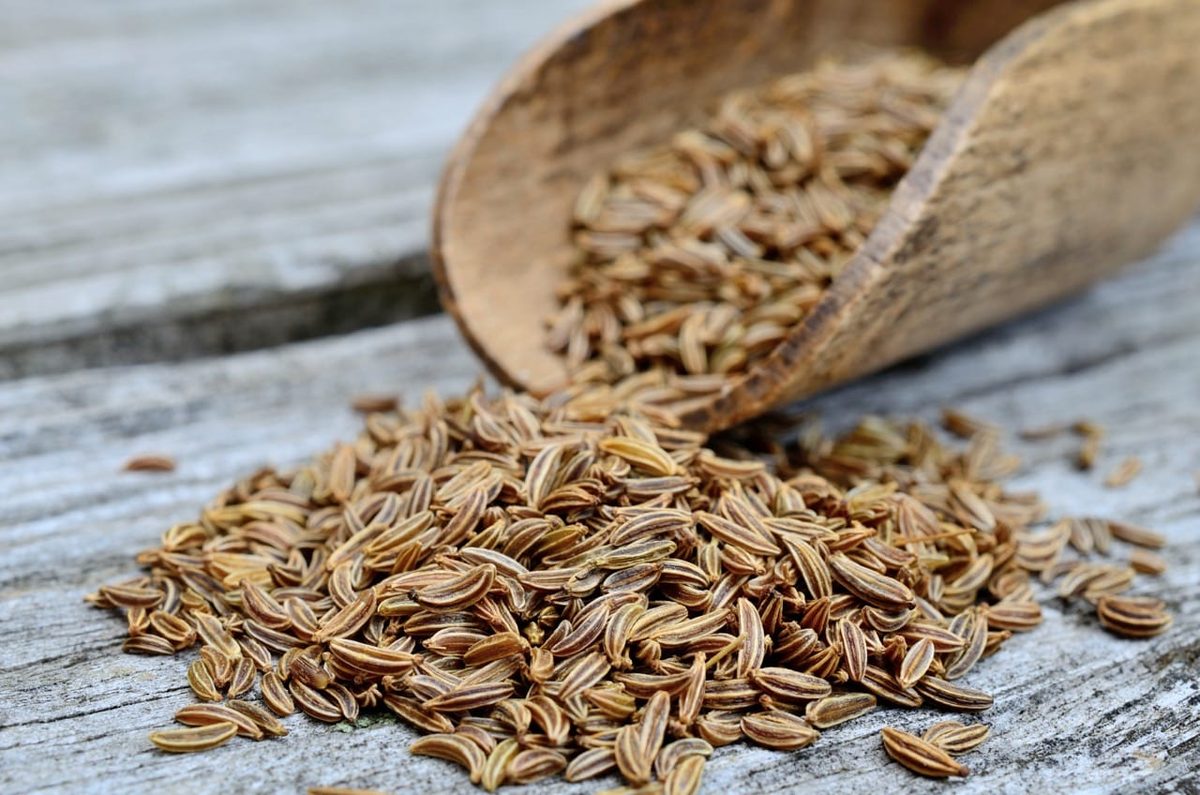
Caraway and fennel seeds come from two different plants in the carrot family, and they taste of two different compounds. Caraway’s oil is mostly carvone and limonene, with carvone giving its characteristic flavor;1 sweet fennel’s oil is dominated by anethole, the compound behind its anise fragrance and sweet taste.2 That is the whole story in brief: fennel is the sweeter, more licorice-like seed, caraway the sharper, rye-bread one. Each can replace the other in savory cooking, with a noticeable change in flavor.
Side by side
| Caraway | Fennel seed | |
|---|---|---|
| Species | Carum carvi3 | Foeniculum vulgare4 |
| Family | Apiaceae (carrot/parsley family)3 | Apiaceae45 |
| Native range (Kew) | Temperate Eurasia3 | Mediterranean to Ethiopia and western Nepal4 |
| Part used | The dried fruit, sold as “seed”1 | The dried fruit, sold as “seed”5 |
| What it looks like | Brown, ribbed, often curved half-fruits, from a fruit 3–5 mm long (PROSEA); about 5 mm (Britannica)16 | Greenish-brown to yellowish-brown oblong ovals about 6 mm long5 |
| Essential oil in the seed | About 5% (Britannica)6 | 3–4% (Britannica)5 |
| Main aroma compounds | d-carvone 45–60% and d-limonene 35–55% of the oil1 | Sweet fennel: anethole up to 70–80% of the oil; bitter fennel: fenchone is the character compound2 |
| Aroma and taste (sourced) | Reminiscent of anise, with a warm, slightly sharp taste6 | Sweet fennel: anise fragrance and sweet taste; bitter fennel: pungent, camphor-like2 |
| Flavor (editorial) | Sharper, slightly bitter, faintly minty; the taste of seeded rye | Sweet, lighter licorice; the taste of Italian sausage |
| Typical uses | Meat dishes, breads and cheese;6 rye bread and sauerkraut in Germany and Austria7 | Pastries, sweet pickles and fish;5 sausage;8 one of the five spices in Chinese five-spice9 |
Both chemistry rows come from PROSEA, but from separate entries that summarize their own literature. They show which compound leads each oil, not a side-by-side measurement of the same samples.
The anise and licorice question
Both seeds get described as “anise-like” or “licorice-like,” which is where most of the confusion starts. The compounds sort it out:
- Anise (Pimpinella anisum) is a third member of the same family, Apiaceae.10 Its oil is 80–95% anethole, its character-impact compound.11 Fennel shares that compound;2 caraway does not lead with it.1
- Licorice is not a relative. The licorice plant, Glycyrrhiza glabra, belongs to the legume family, Fabaceae.12 PROSEA notes that anise’s flavor is often confused with licorice’s.11
PROSEA adds that anise oil is traditionally used together with licorice in licorice candy.11 So when fennel is called licorice-like, the shared flavor is anethole, the compound fennel has in common with anise. Caraway’s anise note, which Britannica describes,6 sits on top of carvone, a different compound altogether.1
How the differences show up in cooking
Sweetness. The Spice House, comparing them in lasagna, says caraway has a similar effect but is not as sweet as fennel.13 That matches the chemistry: anethole is responsible for fennel’s sweet taste.2
Where each is traditional. Katzer calls caraway the spice that gives Southern German and Austrian food, meat, vegetables and rye bread alike, its characteristic flavor, and says German sauerkraut is always flavored with it.7 He also says unfermented boiled cabbage without caraway lacks character.7 Fennel’s sourced uses run sweeter and more Mediterranean: Britannica lists pastries, sweet pickles and fish,5 and the University of Illinois Extension notes its use in sausage.8 Fennel, not caraway, is one of the five spices in Chinese five-spice powder, with cassia, cloves, star anise and Sichuan pepper.9
Pairing. Katzer finds that caraway’s aroma does not harmonize with most other spices,7 which is one reason it tends to be used on its own. Fennel mixes more easily into blends, as five-spice shows;9 that comparison is our reading.
Bitter fennel. Labels rarely say which fennel is in the jar. Bitter fennel smells pungent and camphor-like,2 so a jar that tastes harsh rather than sweet may be the bitter type. That is a practical inference, not a test.
Can one stand in for the other?
Yes, in most savory dishes. The amounts below are carried over from our substitute pages.
Fennel in place of caraway (Method). The Spice House calls fennel seeds the closest alternative to caraway, and the best substitute in sauerkraut.14 It gives no amount. Start with three quarters of the caraway amount and taste, because fennel adds a sweetness caraway does not have. That starting point is ours. See caraway seed substitutes.
Caraway in place of fennel (Attributed). The Spice House says to use caraway 1 to 1 in place of fennel.13 Expect a rye-bread flavor with only a hint of anise, and less sweetness. In sweet baking, where fennel’s anethole is doing the work, anise seed is the closer match. See fennel seed substitutes.
The two ratios come from the same merchant and are not symmetrical, which is a reminder that they are rules of thumb rather than measurements.
What isn’t known
- No study compares the flavor strength of caraway and fennel seed, so every swap amount is a rule of thumb.
- Fennel jars do not say whether they hold sweet or bitter fennel, and anethole content varies with type and sample.2
- No dated, sourced retail price comparison was found.
Related
- Caraway seeds, caraway seed substitutes, cooking with caraway seeds
- Fennel seed, fennel seed substitutes, fennel pollen vs. fennel seed
- Caraway seeds vs. cumin, fennel seed vs. anise seed, fennel seeds vs. cumin seeds, fennel vs. dill
- Anise seed, Chinese five-spice powder, our master list of herbs and spices
Footnotes
-
H. Toxopeus and J.H. Lubberts, Carum carvi, Plant Resources of South-East Asia (PROSEA). uses.plantnet-project.org · Reference work ↩ ↩2 ↩3 ↩4 ↩5 ↩6
-
Purwaningsih, Harmida and M. Brink, Foeniculum vulgare, Plant Resources of South-East Asia (PROSEA). uses.plantnet-project.org · Reference work ↩ ↩2 ↩3 ↩4 ↩5 ↩6 ↩7
-
Carum carvi L., Plants of the World Online, Royal Botanic Gardens, Kew. powo.science.kew.org · Reference work ↩ ↩2 ↩3
-
Foeniculum vulgare Mill., Plants of the World Online, Royal Botanic Gardens, Kew. powo.science.kew.org · Reference work ↩ ↩2 ↩3
-
“Fennel”, Encyclopaedia Britannica. britannica.com · Reference work ↩ ↩2 ↩3 ↩4 ↩5 ↩6
-
“Caraway”, Encyclopaedia Britannica. britannica.com · Reference work ↩ ↩2 ↩3 ↩4 ↩5
-
Gernot Katzer, “Caraway (Carum carvi L.)”, Gernot Katzer’s Spice Pages. gernot-katzers-spice-pages.com · Reference work ↩ ↩2 ↩3 ↩4
-
“Fennel”, Herb Gardening, University of Illinois Extension. extension.illinois.edu · Reference work ↩ ↩2
-
Tony Hill, “Five-spice powder”, Encyclopaedia Britannica. britannica.com · Reference work ↩ ↩2 ↩3
-
Pimpinella anisum L., Plants of the World Online, Royal Botanic Gardens, Kew. powo.science.kew.org · Reference work ↩
-
L.B. Cardenas and C.C. de Guzman, Pimpinella anisum, Plant Resources of South-East Asia (PROSEA). uses.plantnet-project.org · Reference work ↩ ↩2 ↩3
-
Glycyrrhiza glabra L., Plants of the World Online, Royal Botanic Gardens, Kew. powo.science.kew.org · Reference work ↩
-
“12 Best Fennel Substitutes”, The Spice House, 2018. thespicehouse.com · Merchant ↩ ↩2
-
“Caraway Seeds Substitute”, The Spice House, 2018. thespicehouse.com · Merchant ↩