Spice Substitutes · Substitutes
Kokum Substitutes, Ranked by the Job Kokum Is Doing
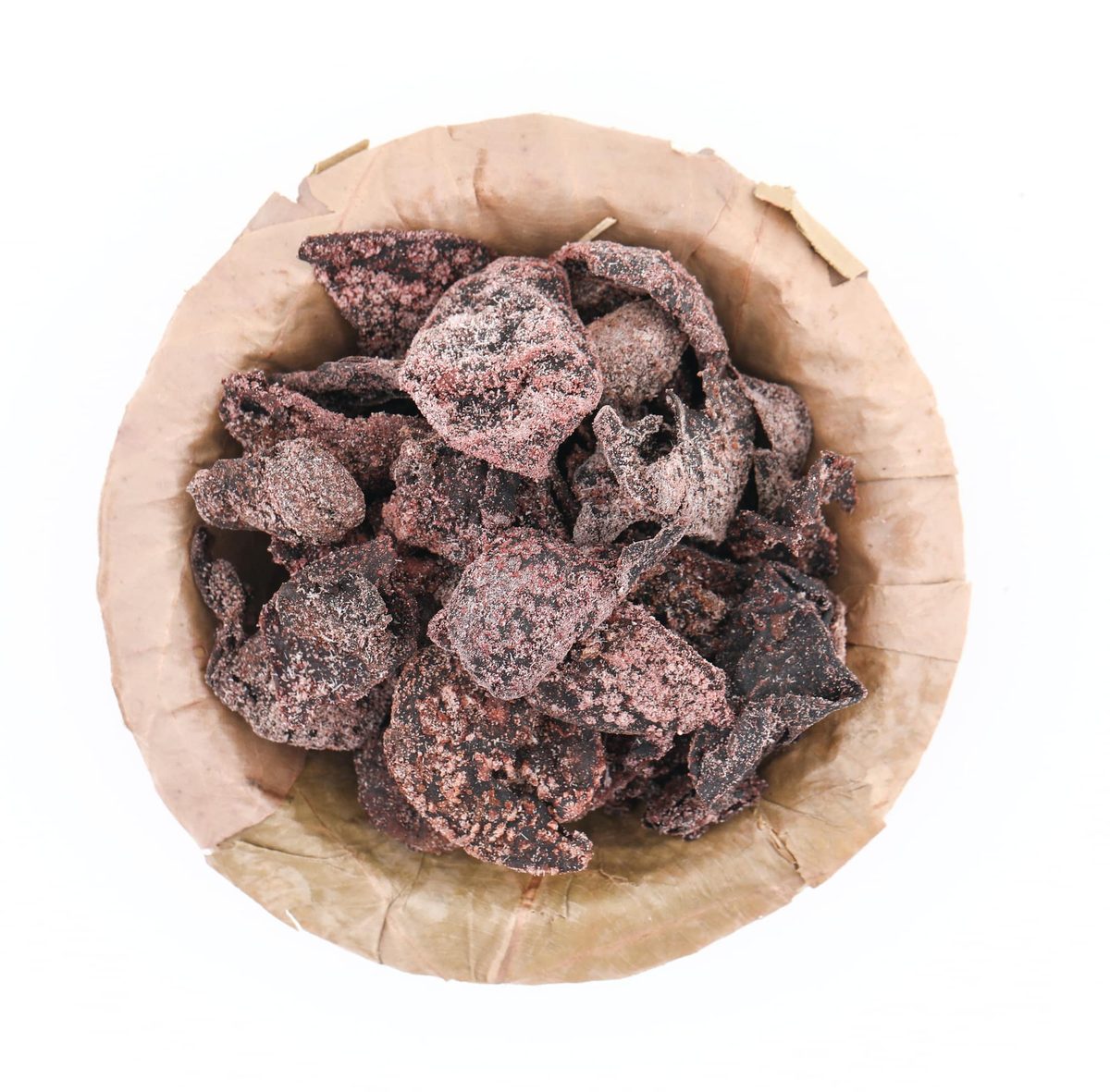
Kokum is the dried rind of the fruit of Garcinia indica, a tree of India’s west coast. Cooks in the Konkan region and Goa use it to sour curries, dals and seafood, and to make drinks such as solkadhi.1 Its sourness comes mainly from hydroxycitric acid, and its deep pink-purple color from anthocyanins, mainly cyanidin glycosides.2 A review of the plant notes that kokum is widely used as a substitute for tamarind.2 Going the other way works too, but the best swap depends on whether you need kokum’s sourness in a simmered dish, its color in a drink, or a dry tartness.
Quick answer
| What kokum is doing | Best substitute | Starting amount, per 3 pieces of dried kokum | Treatment |
|---|---|---|---|
| Souring a curry, dal or fish dish as it simmers | Tamarind pulp or paste | About 1 teaspoon, then taste | Method |
| Same job, if you can find it | Malabar tamarind (kudampuli) | 1 to 2 pieces, then taste | Method |
| Sourness in a dry dish or a finishing sprinkle | Amchur (mango powder) | About 1/2 teaspoon, then taste | Method |
| Sourness in a drink such as solkadhi | Lime juice | About 1 teaspoon, then taste | Method |
How the ratios on this page are labeled
Every ratio carries one of four labels.
- Computed: based on a measurable physical relationship, with the source named.
- Attributed: a named source publishes this ratio. We quote it as theirs.
- Disputed: named sources give different answers to the same swap. We show each one and do not average them.
- Method: we found no published ratio. We give a direction and a cautious starting point, and say so.
We found no published ratio for any kokum substitute. Kokum pieces also vary in size and sourness, and no source gives a standard acidity for dried kokum. Every amount on this page is a starting point to adjust by taste, not a measured equivalence.
If kokum is souring a simmered dish
1. Tamarind
Tamarind is the swap the sources point to. The kokum review says kokum is used in place of tamarind,2 and the Tarla Dalal site says kokum has the same souring qualities as tamarind, especially in coconut-based curries, dals and vegetable dishes.3
The acids are different, though. Tamarind pulp is rich in tartaric acid and also contains acetic and citric acid, and one study’s background notes 25 to 30 percent invert sugar, which is why ripe tamarind is valued for its “acidic sweetness.”4 Kokum’s main acid is hydroxycitric acid.2 Expect tamarind to taste sweeter and fruitier, and to turn the dish brown rather than pink.
Ratio (Method): No published ratio was found. Start with about 1 teaspoon of thick tamarind pulp or paste for every 3 pieces of dried kokum, stir it in, simmer a few minutes and taste before adding more. Commercial concentrates vary in strength, so start lower with a concentrate.
2. Malabar tamarind (kudampuli)
Malabar tamarind is the closest match on paper. Spices Board India gives it as Garcinia cambogia, called kodampuli in Malayalam, native to the Western Ghats of Kerala, and says its dried rind is used as a condiment to flavor curries.5 Spices Board India says the rind contains hydroxycitric acid,5 and NIH’s Office of Dietary Supplements says the pulp and rind of the fruit contain high amounts of it.6 That is the same acid that leads in kokum.2 No source we found compares the two rinds’ acidity directly, and the Malabar rind does not give kokum’s pink color.
Ratio (Method): No published ratio was found. Start with 1 or 2 pieces of Malabar tamarind for every 3 pieces of kokum, soaked or simmered the same way, and taste after 10 minutes. Remove the pieces before serving, as you would kokum.
If kokum is adding a dry tartness
Use these where you’d add a little soaked kokum or kokum pulp to a dry vegetable dish, a chutney or a spice mix.
1. Amchur (mango powder)
Amchur is ground dried raw mango; India’s standard for it says it is generally made from unripe, wind-fallen sour mangoes.7 Katzer attributes its sourness to citric acid, says it is used frequently instead of tamarind, and calls it much weaker than tamarind, used where only a hint of tartness is wanted.8 It has no color to speak of.
Ratio (Method): No published ratio was found. Start with about 1/2 teaspoon per 3 pieces of kokum and add more in small steps, since it is mild.
2. Anardana
Anardana is sun-dried pomegranate seed with its pulp,9 and a review describes it as an acidulant in many Asian cuisines and curries.10 Ground, it adds a fruity sourness.
Ratio (Method): No published ratio was found. Start with about 1 teaspoon ground anardana per 3 pieces of kokum and taste.
3. Sumac
Sumac’s sourness is attributed to malic acid in one review.11 In our judgment it works as a sour finishing powder, with a fruitier, more astringent character than kokum. Ratio (Method): start with about 1/2 teaspoon per 3 pieces of kokum.
If kokum is in a drink
Kokum is the key ingredient in solkadhi, a traditional drink, and is also made into a syrup, amrut kokum, diluted for summer drinks.1 The review mentions kokum kadi, made by mixing kokum juice with coconut milk.2 Here the color matters as much as the sourness: the ICAR article gives 1,000 to 2,400 mg of anthocyanins per 100 g of rind.1 None of the substitutes on this page supplies that color.
Ratio (Method): For sourness alone, lime juice is the simplest choice. Start with about 1 teaspoon per 3 pieces of kokum and add more to taste. No published ratio was found, and the drink will be pale.
Other sour ingredients
- Vinegar and lemon juice add sharpness and can be stirred in near the end of cooking. That is common kitchen practice; no source compares them with kokum.
- Tomato adds mild acidity and body, but also its own flavor and color. That is our judgment.
What isn’t known
- No published ratio for any substitute in place of kokum was found.
- No source gives a standard acidity for dried kokum. The ICAR article’s composition table lists acid as hydroxycitric acid at 22.8 percent but does not state whether that figure is on a fresh or dry basis.1
- No study we found compares the sourness of kokum with tamarind, Malabar tamarind, amchur or anardana.
Related
- Kokum
- Mango powder, mango powder substitutes
- Anardana, anardana substitutes
- Sumac, sumac substitutes
- Too much tamarind, too much vinegar
Footnotes
-
Rane et al., “Kokum: The purple pulse of the Konkan”, Indian Horticulture, ICAR, 2025. epubs.icar.org.in · Publication ↩ ↩2 ↩3 ↩4
-
Ananthakrishnan and Rameshkumar, “Phytochemicals and bioactivities of Garcinia indica (Thouars) Choisy: A review”, Jawaharlal Nehru Tropical Botanic Garden and Research Institute. jntbgri.res.in · Reference work ↩ ↩2 ↩3 ↩4 ↩5 ↩6
-
“Kokum, dried kokum, dry kokum”, Tarla Dalal. tarladalal.com · Publication ↩
-
Ayala-Silva et al., “Pomological and physicochemical characterization of Tamarindus indica grown in Florida”, Journal of Agriculture of the University of Puerto Rico, 2016. revistas.upr.edu · Peer-reviewed ↩
-
“Cambodge”, Spices Board India. indianspices.com · Regulator ↩ ↩2
-
“Dietary Supplements for Weight Loss: Fact Sheet for Health Professionals”, Office of Dietary Supplements, NIH. ods.od.nih.gov · Regulator ↩
-
IS 13242:1991, Amchur, Raw Mango Powder, Specification, Bureau of Indian Standards. law.resource.org · Standard ↩
-
Gernot Katzer, “Mango (Mangifera indica L.)”, Gernot Katzer’s Spice Pages. gernot-katzers-spice-pages.com · Reference work ↩
-
Bakshi et al., “Studies on variability in physico-chemical traits and multiplication of Daru (wild pomegranate) collections”, Indian Journal of Horticulture, 2014. journal.iahs.org.in · Peer-reviewed ↩
-
Sharma and Thakur, “Wild pomegranate (Punica granatum L.): A review”, Journal of Pharmacognosy and Phytochemistry, 2018. phytojournal.com · Peer-reviewed ↩
-
Alsamri et al., “Pharmacological and Antioxidant Activities of Rhus coriaria L. (Sumac)”, Antioxidants, 2021. mdpi.com · Peer-reviewed ↩