Spices · Profile
Poppy Seeds: Flavor, Uses, Opium Alkaloids and Where They Grow
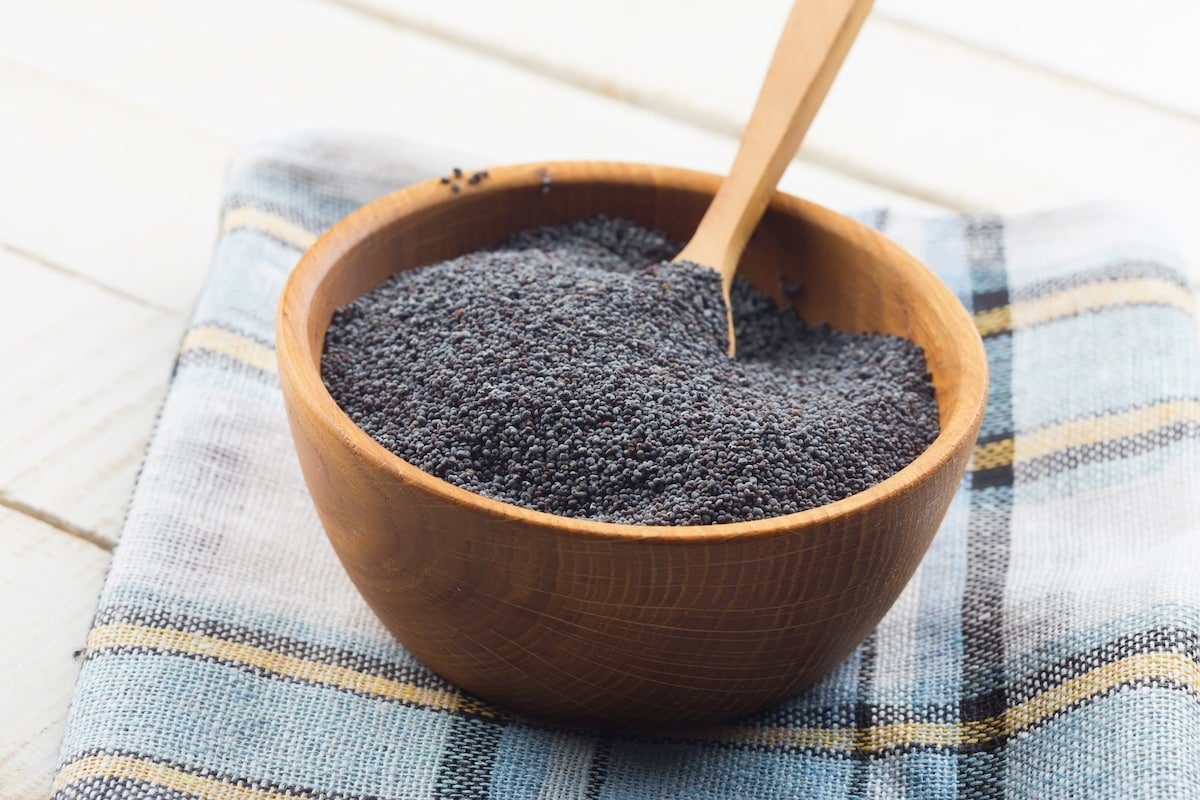
Poppy seeds are the tiny, kidney-shaped seeds of the opium poppy, Papaver somniferum. They taste mild and nutty, they bring crunch to breads and bagels, and ground with sugar they become the dense, dark filling of Central and Eastern European pastries. The same plant yields opium from its unripe seed pods, which is why poppy seeds carry a contaminant limit in the EU and why a heavy dose can show up on a drug test.
At a glance
| Botanical name | Papaver somniferum L.1 |
| Plant family | Papaveraceae (poppy family)1 |
| Part used | Seed |
| Native range | Disputed: Macaronesia and the western and central Mediterranean (Kew); Turkey (Britannica); see below12 |
| Seed color | Grayish blue to dark blue;2 gray and white types are both traded3 |
| Key aroma compound | 2-pentylfuran3 |
| Leading producers | Czech Republic and Turkey, about a third of world output each in 20094 |
| Forms sold | Whole seed (blue/gray or white), ground seed, sweetened poppy seed filling, poppy seed oil |
| EU limit | 20 mg/kg opium alkaloids in poppy seeds sold to consumers5 |
Measured values
10 figures, sourced| Measure | Value | Scope | Source |
|---|---|---|---|
| Fat Nutrient | about 42 % by weight | USDA FoodData Central, poppy seed (FDC ID 171330, SR Legacy) | fdc.nal.usda.gov |
| Protein Nutrient | 18 % by weight | USDA FoodData Central, poppy seed (FDC ID 171330, SR Legacy) | fdc.nal.usda.gov |
| Energy Nutrient | 525 kcal per 100 g | USDA FoodData Central, poppy seed (FDC ID 171330, SR Legacy) | fdc.nal.usda.gov |
| Calcium Nutrient | 1,440 mg per 100 g | USDA FoodData Central, poppy seed (FDC ID 171330, SR Legacy) | fdc.nal.usda.gov |
| Magnesium Nutrient | 347 mg per 100 g | USDA FoodData Central, poppy seed (FDC ID 171330, SR Legacy) | fdc.nal.usda.gov |
| Manganese Nutrient | 6.71 mg per 100 g | USDA FoodData Central, poppy seed (FDC ID 171330, SR Legacy) | fdc.nal.usda.gov |
| Fiber Nutrient | 19.5 g per 100 g | USDA FoodData Central, poppy seed (FDC ID 171330, SR Legacy) | fdc.nal.usda.gov |
| Iron Nutrient | 9.76 mg per 100 g | USDA FoodData Central, poppy seed (FDC ID 171330, SR Legacy) | fdc.nal.usda.gov |
| Opium alkaloids (inherent in seed) | about 50 ppm | Seed itself, per KatzerEFSA notes seeds can be contaminated with more alkaloid through pest damage and harvesting. | gernot-katzers-spice-pages.com |
| Opium alkaloids, maximum Limit | 20 mg/kg (morphine plus 0.2 times codeine) | EU Regulation 2023/915, whole, ground or milled poppy seeds sold to the final consumer | eur-lex.europa.eu |
Each figure is quoted as its source states it, with the samples or standard it applies to. Where sources differ, both are shown; nothing is averaged. All measured values
What poppy seeds are
The opium poppy is an annual with lobed or toothed silver-green leaves and large blue-purple or white flowers.2 Its numerous small seeds are kidney-shaped and grayish blue to dark blue.2 Britannica lists them as edible and nonnarcotic, used in baking, for seasoning, for oil and as birdseed.2
Opium itself is something else: it is the dried latex from the unripe seed capsules, not the seed.3
Blue, gray and white seed
The dark seed familiar in Western baking is the usual type. Katzer describes the regular seed as gray and notes a white type associated with India, plus a crème-white variety bred for use in light-colored sauces.3 Which color a recipe wants is mostly a matter of appearance and tradition; no source checked compares their flavor.
Flavor and aroma
Katzer sums up the taste as “nutty and pleasant.”3 The volatile compounds reported in the seed include aliphatic hydrocarbons and aldehydes, and 2-pentylfuran is identified as a key aroma compound.3 The nutty character develops further when seeds sprinkled on breads and pastries are baked.3
Raw, the seed is subtle, and its main contribution on a roll or a muffin is the crunch. That judgment is ours.
Where it comes from
Sources disagree on where the opium poppy is native:
| Source | Native range or origin |
|---|---|
| Kew Plants of the World Online | Macaronesia and the western and central Mediterranean, including Spain, France, Italy and North Africa1 |
| Britannica | Turkey2 |
| Katzer | Generally believed to be West Asia, with a western Mediterranean origin suggested more recently3 |
Kew records it as introduced across well over a hundred regions worldwide.1 Katzer adds that poppy has been cultivated in Europe since the Neolithic era, and that the ancients valued it for the culinary oil pressed from its seeds.3
History
The documented history in the sources checked is brief. Ancient Greek physicians knew of opium’s narcotic and painkilling power, and poppy recipes traveled from Rome to Byzantium and from there into the cuisines of Islamic states in the Near East.3 Medieval European medicine, by contrast, did not use opium.3
Many popular accounts say the Sumerians first cultivated the poppy around 3400 BCE, that Egyptian texts from about 1550 BCE describe poppy seed as a sedative, and that a favorite dessert of the Roman gourmet Apicius used poppy seed. None of these could be traced to a source opened for this page, so they are not repeated here as fact.
Production
Most food poppy seed comes from a handful of countries. An economics paper using FAOSTAT data for 2009 put world production at about 100,000 tonnes, with Turkey at 34.6% and the Czech Republic at 33%, followed by France at 6.6% and then Hungary, Germany, Romania, Austria and Slovakia.4 The authors call the Czech Republic the main world producer and a price maker, and credit it with about 44% of world trade in poppy seed.4 By their own production shares, Turkey was slightly ahead that year, so the two are best read as joint leaders. No more recent statistical figure was opened for this page.
In much of Asia the plant is grown mainly for opium rather than for food.3
How poppy seeds are used
- Central and Eastern Europe. Sweet poppy seed pastries are known across the region.3 In Austria poppy seed is a popular strudel filling, and Germknödel, steamed yeast dumplings, are served with powdered sugar, ground poppy seed and melted butter.3
- Jewish baking. Katzer notes that poppy seeds are particularly associated with Yiddish baking.3
- India. Ground poppy seed is a common thickener in the Mughal cooking style of northern India.3
- Japan. The nutty taste suits the subtly flavored dishes typical of Japanese cooking, according to Katzer.3
- United States. By common practice, poppy seeds top bagels, kaiser rolls and muffins, and lemon poppy seed muffins and poppy seed dressing are familiar uses. See also everything bagel seasoning.
For pastry fillings, poppy seeds are usually ground first and cooked into a paste; whole seeds are for texture and decoration. That is common kitchen practice rather than a sourced finding.
Nutrition
Poppy seeds are about 42% fat and 18% protein by weight, with 525 kcal per 100 g.6 They are unusually high in calcium. USDA’s figures per 100 g and what they mean in a realistic serving:
| Nutrient (USDA, per 100 g) | Per tablespoon (8.8 g) | % Daily Value per tablespoon |
|---|---|---|
| Calcium, 1,440 mg | about 127 mg | about 10% |
| Magnesium, 347 mg | about 31 mg | about 7% |
| Manganese, 6.71 mg | about 0.59 mg | about 26% |
| Fiber, 19.5 g | about 1.7 g | about 6% |
| Iron, 9.76 mg | about 0.86 mg | about 5% |
Per-tablespoon values are computed from USDA’s per-100 g values and its 8.8 g tablespoon weight; Daily Values are the FDA’s (calcium 1,300 mg, magnesium 420 mg, manganese 2.3 mg, fiber 28 g, iron 18 mg).67 A teaspoon (2.8 g) holds about 40 mg of calcium, roughly 3% of the Daily Value.67 Most recipes use poppy seed by the teaspoon or tablespoon, so these are modest contributions. This page makes no claim that poppy seeds prevent or treat any condition.
Safety
Opium alkaloids
Poppy seeds themselves contain little alkaloid. Katzer gives about 50 ppm, too low to have any pharmacological effect.3 But the seeds can pick up alkaloids from the plant: EFSA notes they can become contaminated through pest damage and during harvesting.8
The EU regulates this directly. Under Regulation (EU) 2023/915, whole, ground or milled poppy seeds sold to the final consumer may contain no more than 20 mg/kg of opium alkaloids, and bakery products containing poppy seeds no more than 1.5 mg/kg.5 The limit is expressed as morphine plus 0.2 times codeine.5
EFSA’s contaminants panel confirmed an acute reference dose of 10 micrograms of morphine per kilogram of body weight, with codeine counted as morphine equivalents.8 It found that for seeds from varieties grown mainly for pharmaceutical use, which are high in alkaloids, mean and high dietary exposure exceeded that dose in most age groups. Even for seeds with relatively low alkaloid levels, it saw some exceedance among high consumers in most surveys.8
No US limit for opium alkaloids in poppy seeds was found in the sources checked.
Drug tests
Even at normal levels, Katzer notes, morphine can be detected in urine after eating a lot of poppy seed.3 Anyone facing a drug test may want to avoid poppy seed foods beforehand.
Buying and storage
No international grade standard for poppy seed was checked for this page. Poppy seeds are oil-rich (about 42% fat by USDA’s analysis),6 and many cooks keep them airtight in the refrigerator or freezer and smell them before use, discarding any that smell bitter or stale. That is common practice; no published shelf-life figure was found.
Substitutes and comparisons
Sesame seeds can stand in for crunch on breads, though their flavor is different; that is a kitchen judgment. See poppy seed substitutes for options by job, and the sesame seeds, black sesame seeds and nigella seeds profiles.
Footnotes
-
Papaver somniferum L., Plants of the World Online, Royal Botanic Gardens, Kew. powo.science.kew.org · Reference work ↩ ↩2 ↩3 ↩4 ↩5
-
“Opium poppy”, Encyclopaedia Britannica. britannica.com · Reference work ↩ ↩2 ↩3 ↩4 ↩5 ↩6
-
Gernot Katzer, “Poppy (Papaver somniferum L.)”, Gernot Katzer’s Spice Pages. gernot-katzers-spice-pages.com · Reference work ↩ ↩2 ↩3 ↩4 ↩5 ↩6 ↩7 ↩8 ↩9 ↩10 ↩11 ↩12 ↩13 ↩14 ↩15 ↩16 ↩17 ↩18 ↩19
-
P. Procházka and L. Smutka, “Czech Republic as an Important Producer of Poppy Seed”, Agris on-line Papers in Economics and Informatics, 2012. ageconsearch.umn.edu · Peer-reviewed ↩ ↩2 ↩3
-
Commission Regulation (EU) 2023/915 on maximum levels for certain contaminants in food, EUR-Lex. eur-lex.europa.eu · Regulator ↩ ↩2 ↩3
-
Spices, poppy seed (FDC ID 171330), USDA FoodData Central. fdc.nal.usda.gov · Regulator ↩ ↩2 ↩3 ↩4
-
Daily Value on the Nutrition and Supplement Facts Labels, U.S. Food and Drug Administration. fda.gov · Regulator ↩ ↩2
-
EFSA Panel on Contaminants in the Food Chain, “Update of the Scientific Opinion on opium alkaloids in poppy seeds”, EFSA Journal. efsa.europa.eu · Regulator ↩ ↩2 ↩3