Spices · Profile
Sesame Seeds: Flavor, History, Uses, Nutrition and Allergen Rules
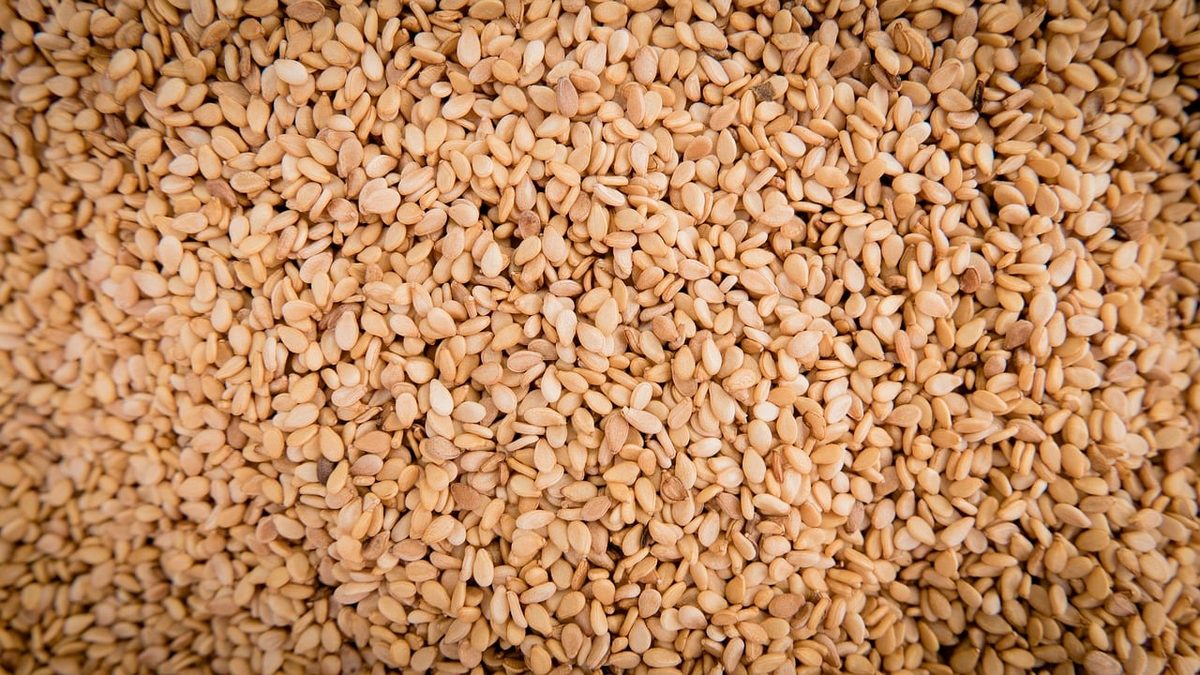
Sesame seeds are the small, flat, oil-rich seeds of Sesamum indicum, one of the oldest oilseeds people have grown. Raw they are mild; toasted they turn deeply nutty. They are ground into tahini in the Middle East, pressed into the dark toasted oil of East Asian cooking, and known as benne in the Carolina Lowcountry. Sesame is also one of the nine major food allergens in the United States, and in 2020 contaminated sesame from India triggered recalls across the EU.
At a glance
| Botanical name | Sesamum indicum L.1 |
| Plant family | Pedaliaceae1 |
| Part used | Seed, whole or hulled; pressed for oil2 |
| Native range | Disputed: Indian subcontinent (Kew); Africa, probably Ethiopia (PROSEA)12 |
| Seed color | White, gray, yellow-white, brown or black, depending on cultivar2 |
| Oil content | Fat 45-50 g per 100 g of seed (PROSEA); 49.7 g (USDA)23 |
| Flavor of toasted seed | Pyrazines dominate under mild toasting4 |
| World production | 2.7 million tonnes in 2000 (PROSEA; no more recent figure checked)2 |
| Forms sold | Hulled (white) and unhulled seed, black seed, toasted seed, tahini and other pastes, refined and toasted oils |
| US allergen status | Ninth major food allergen since 1 January 20235 |
Measured values
7 figures, sourced| Measure | Value | Scope | Source |
|---|---|---|---|
| Fat Nutrient | 45-50 g per 100 g of seed | Sesame seed, PROSEASources differ in scope: USDA gives 49.7 g for whole dried seed. | uses.plantnet-project.org |
| Fat Nutrient | 49.7 g per 100 g | USDA FoodData Central, sesame seeds, whole, dried (FDC ID 170150, SR Legacy) | fdc.nal.usda.gov |
| Energy Nutrient | 573 kcal per 100 g | USDA FoodData Central, sesame seeds, whole, dried (FDC ID 170150, SR Legacy) | fdc.nal.usda.gov |
| Protein Nutrient | 17.7 g per 100 g | USDA FoodData Central, sesame seeds, whole, dried (FDC ID 170150, SR Legacy) | fdc.nal.usda.gov |
| Calcium Nutrient | 989 mg per 100 g | USDA FoodData Central, sesame seeds, whole, roasted and toasted (FDC ID 170151) | fdc.nal.usda.gov |
| Calcium Nutrient | 131 mg per 100 g | USDA FoodData Central, sesame seed kernels, toasted, hulled (FDC ID 170152) | fdc.nal.usda.gov |
| Ethylene oxide, maximum residue level Limit | 0.05 mg/kg | EU maximum residue level for sesame seeds, set at the limit of quantification (European Commission, 2020)The 2020 Indian-origin sesame recalls involved "severe exceedances" of this level. | food.ec.europa.eu |
Each figure is quoted as its source states it, with the samples or standard it applies to. Where sources differ, both are shown; nothing is averaged. All measured values
What sesame is
Kew describes sesame as an annual of the seasonally dry tropics.1 Seed color is a cultivar trait: PROSEA lists white, gray, yellow-white, brown and black seed.2 The black color comes from a melanin-like pigment in the seed coat, and flavonoid content rises as the coat gets darker.6 See black sesame seeds and black vs. white sesame seeds.
Sesame is sold both hulled and unhulled, and hulling changes the seed more than its color. USDA’s figures for toasted sesame show 989 mg of calcium per 100 g in whole seed but 131 mg in hulled kernels.78 See hulled vs. unhulled sesame seeds.
Flavor and aroma
Raw sesame tastes mild, sweet and nutty, and toasting deepens it a great deal; that description is ours. The flavor of toasted sesame and of dark sesame oil comes from a large number of compounds that form only during toasting.4 Katzer reports research finding that pyrazines dominate the flavor under mild toasting (160°C), while toasting at 200°C produces more furans.4 PROSEA notes a slight bitterness in sesame that comes from phytic and oxalic acids binding with calcium.2
Black seed has a stronger, slightly more bitter taste than white. That is our description; no sensory study comparing them was found.
Origin and history
Sesame is old. PROSEA calls it probably the most ancient oilseed used by humans, with its domestication “lost in the mists of antiquity.”2 Where it began is not settled:
| Source | Native range or origin |
|---|---|
| Kew Plants of the World Online | Indian subcontinent1 |
| PROSEA | Africa, most probably Ethiopia, with some evidence for India2 |
| Katzer | Probably tropical Africa, though some sources favor India4 |
The archaeological and written record in these sources:
- Indus Valley. Sesame from excavations at Harappa, in present-day Pakistan, has been dated to 2000 BCE, and Katzer notes sesame has been grown in India since the Harappan period.24
- Mesopotamia. PROSEA describes sesame as an important Mesopotamian crop by about 2100-2000 BCE, and the region as the main center from which domesticated sesame spread.2
- Egypt. The Egyptian medical papyrus of Thebes, about 1500 BCE, lists remedies that include sesame oil and seed.2
- China. By the 6th century BCE sesame had become so prominent in China that it was used as currency.2
The name. English “sesame” comes through Latin and Greek, which borrowed the word very early via Phoenician from Late Babylonian; the Assyrian form is glossed as “oil-seed.”9 The phrase “open sesame” first appears in English as a magic charm in 1722.9
The American South. “Benne,” the name still used in the Carolina Lowcountry, is one of several West African names for the plant, and the Charleston County Public Library’s history says benne came to the region with enslaved people brought from West Africa.10 The earliest record it cites dates to 1730.10
Several widely repeated claims could not be traced: an Assyrian myth in which the gods drank sesame wine before creating the earth, Chinese use of sesame oil as lamp fuel 5,000 years ago, an Egyptian word sesemt, and sesame as one of the leading crops of the 18th-century South.
Production
PROSEA gives world production at 2.7 million tonnes in 2000, having grown only gradually since the 1970s.2 In the same account, India’s output was stable at about 500,000 tonnes, China’s reached about 700,000 tonnes and Myanmar’s about 300,000, and Sudan frequently accounted for half of world exports; Japan, Italy and China were major import markets.2 These are figures from around 2000. No current statistical source (FAOSTAT) could be opened for this page.
How sesame seeds are used
- Middle East. Ground into tahini, a paste used to thicken and flavor sauces.24 Sesame also appears in the Jordanian za’atar mixture.4 See za’atar and dukkah.
- Japan and Korea. Toasted sesame is sprinkled over Japanese and Korean dishes.4 Gomashio is toasted sesame mixed with about 10% salt, usually sprinkled over rice.4 See gomasio, furikake and shichimi togarashi.
- China. Chinese sesame paste (zhi ma jiang) is made from toasted seed, has a very strong flavor, and is used mainly in salad dressings and sauces for cold appetizers.4
- Mexico. Sesame is common in Mexican cooking and appears, with almonds, in one of the country’s most famous dishes, mole.4
- Breads and sweets. PROSEA lists sesame as a major ingredient in sweets and a garnish for breads and pastries.2 The sesame-topped hamburger bun is the obvious American example; see also everything bagel seasoning.
Sesame oil
Refined sesame oil is bland and common in Europe and the US; cold-pressed oil is sold in health shops; and the dark, toasted oil of East Asia gets its flavor from toasting.4 Katzer advises that dark sesame oil is not suitable as a frying medium unless diluted with a bland oil.4 Sesame oil resists oxidation well, which PROSEA attributes to its lignans.2
Toasting at home
Common practice is to toast seeds in a dry pan over medium heat, shaking often, until golden and fragrant, then tip them out of the pan. Toasting temperature changes which aroma compounds dominate, as the research above shows;4 exact timing is a kitchen judgment.
Nutrition
USDA lists whole dried sesame at 573 kcal, 17.7 g protein and 49.7 g fat per 100 g.3 Per tablespoon (9 g), computed from USDA’s values and FDA Daily Values:311
| Nutrient | Per tablespoon | % Daily Value |
|---|---|---|
| Copper | about 0.37 mg | about 41% |
| Magnesium | about 32 mg | about 8% |
| Calcium | about 88 mg | about 7% |
| Iron | about 1.3 mg | about 7% |
| Fiber | about 1.1 g | about 4% |
| Protein | about 1.6 g |
These are for whole seed of unstated color. Hulled seed has far less calcium (see above).78
On heart health, a 2016 systematic review and meta-analysis of ten controlled trials found that sesame consumption lowered blood triglycerides, an effect seen with sesame oil rather than seeds, and did not significantly change total cholesterol; the authors noted the trials’ limitations.12 This page makes no claim that sesame seeds prevent or treat any disease.
Safety
Allergy
Sesame became the ninth major food allergen in the United States under the FASTER Act, effective 1 January 2023, so packaged foods must declare it.5 The FDA has reported that some manufacturers responded by intentionally adding sesame to products that previously did not contain it, and advises checking the label every time you buy a product.13
The 2020 ethylene oxide recalls
In September 2020 Belgium notified the EU’s rapid alert system (RASFF) of sesame seeds from India with high levels of ethylene oxide.14 The European Commission recorded “severe exceedances” of the EU maximum residue level of 0.05 mg/kg, set at the limit of quantification, with affected products distributed to 24 member states and 9 other countries.14 Affected seed and products made from it had to be withdrawn or recalled, and the Commission planned to require pre-export testing by India and to check 50% of consignments at the EU border.14
Buying and storage
Look for seeds that are uniform in color and smell clean and nutty, not bitter or paint-like; that is kitchen judgment rather than a standard. PROSEA notes that seed with less than 8% moisture can be stored for up to two years in airtight containers,2 a figure for dried seed in storage rather than for an opened jar in a kitchen. Toasted seeds and tahini lose their aroma faster; no published figure was found.
Substitutes and comparisons
See sesame seed substitutes for options ranked by job, and the black sesame seeds and poppy seeds profiles.
Footnotes
-
Sesamum indicum L., Plants of the World Online, Royal Botanic Gardens, Kew. powo.science.kew.org · Reference work ↩ ↩2 ↩3 ↩4 ↩5
-
E.A. Weiss and Q.D. de la Cruz, Sesamum orientale, Plant Resources of South-East Asia (PROSEA). uses.plantnet-project.org · Reference work ↩ ↩2 ↩3 ↩4 ↩5 ↩6 ↩7 ↩8 ↩9 ↩10 ↩11 ↩12 ↩13 ↩14 ↩15 ↩16 ↩17 ↩18 ↩19
-
Seeds, sesame seeds, whole, dried (FDC ID 170150), USDA FoodData Central. fdc.nal.usda.gov · Regulator ↩ ↩2 ↩3
-
Gernot Katzer, “Sesame (Sesamum indicum)”, Gernot Katzer’s Spice Pages. gernot-katzers-spice-pages.com · Reference work ↩ ↩2 ↩3 ↩4 ↩5 ↩6 ↩7 ↩8 ↩9 ↩10 ↩11 ↩12 ↩13 ↩14
-
Food Allergies, U.S. Food and Drug Administration. fda.gov · Regulator ↩ ↩2
-
Dossou et al., “The Dark Pigment in the Sesame Seed Coat”, Frontiers in Nutrition, 2022. frontiersin.org · Peer-reviewed ↩
-
Seeds, sesame seeds, whole, roasted and toasted (FDC ID 170151), USDA FoodData Central. fdc.nal.usda.gov · Regulator ↩ ↩2
-
Seeds, sesame seed kernels, toasted (FDC ID 170152), USDA FoodData Central. fdc.nal.usda.gov · Regulator ↩ ↩2
-
“sesame (n.)”, Online Etymology Dictionary. etymonline.com · Reference work ↩ ↩2
-
“Benne Seeds in the Lowcountry”, Charleston Time Machine, Charleston County Public Library, 2018. ccpl.org · Reference work ↩ ↩2
-
Daily Value on the Nutrition and Supplement Facts Labels, U.S. Food and Drug Administration. fda.gov · Regulator ↩
-
Khalesi et al., “Sesame fractions and lipid profiles: a systematic review and meta-analysis of controlled trials”, British Journal of Nutrition, 2016. cambridge.org · Peer-reviewed ↩
-
Robert M. Califf, “An Update on Sesame Allergen Labeling on Food Packages”, FDA Voices, 2023. fda.gov · Regulator ↩
-
Summary record, Food and Feed Crisis Coordinators meeting of 9 October 2020, European Commission. food.ec.europa.eu · Regulator ↩ ↩2 ↩3