Spices · Profile
Black Sesame Seeds: What Makes Them Black, How They Taste and How to Use Them
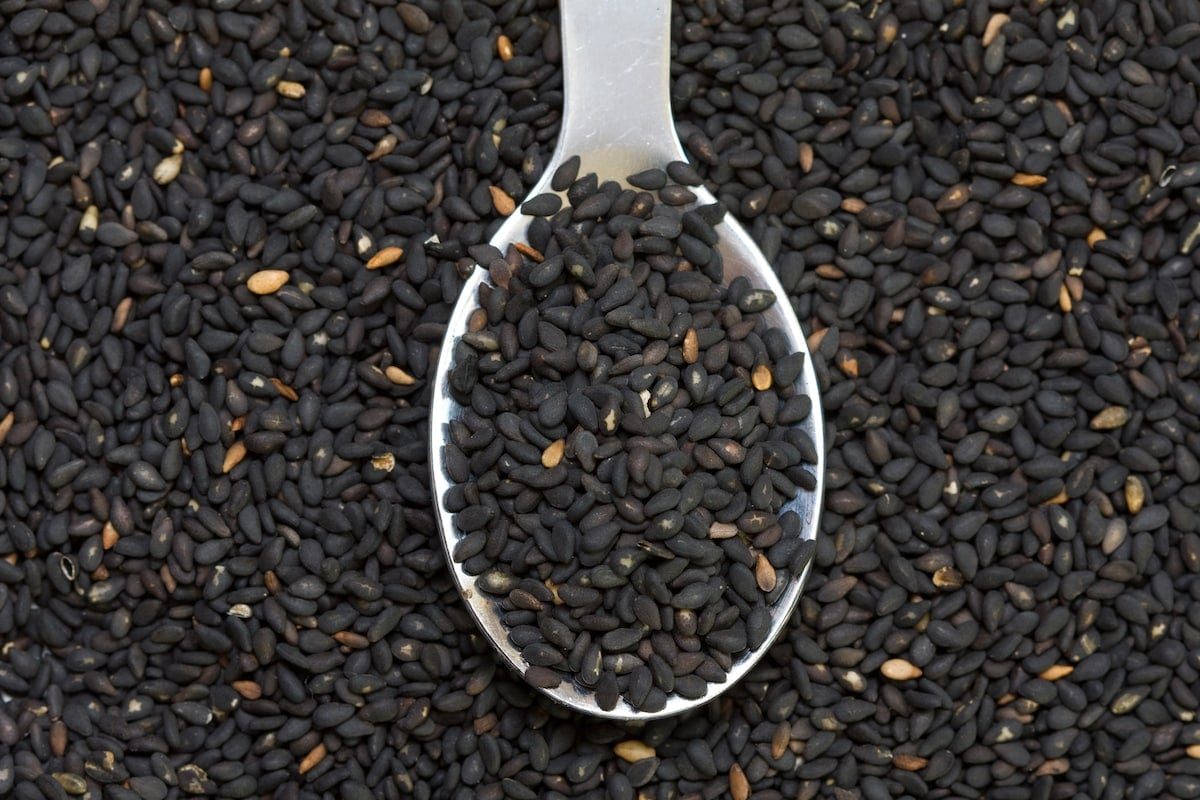
Black sesame seeds are the seeds of sesame (Sesamum indicum) cultivars whose seed coat is dark rather than pale. They are the same species as white sesame,12 with a stronger, slightly bitter, roasted flavor. In Chinese cooking they go into sweet black sesame soup, tang yuan, ice cream and cake.3 This page covers what makes them black, where sesame comes from, how they are used, what they contribute nutritionally, and sesame’s status as a major food allergen.
At a glance
| Botanical name | Sesamum indicum L.1 (PROSEA uses the synonym S. orientale2) |
| Plant family | Pedaliaceae1 |
| Part used | Seed |
| What makes them black | A dark, melanin-like pigment in the seed coat4 |
| Seed colors in the species | White, grey, yellow-white, brown or black, set by cultivar2 |
| Native range | Indian Subcontinent, per Kew; PROSEA and Katzer favor Africa (see Origin)125 |
| Key compounds | Lignans sesamin and sesamolin in the oil; pyrazines in toasted seed25 |
| Allergen status | One of the nine major food allergens in the US since 1 Jan 20236 |
| Forms sold | Whole (unhulled) seed, toasted seed, paste |
Measured values
13 figures, sourced| Measure | Value | Scope | Source |
|---|---|---|---|
| Sesamin | 0.1–0.6 % of oil | sesame oil (PROSEA); seed color not specified | uses.plantnet-project.org |
| Sesamolin | 0.25–0.3 % of oil | sesame oil (PROSEA); seed color not specified | uses.plantnet-project.org |
| Energy Nutrient | 573 kcal per 100 g | whole dried sesame seed, color not stated, USDA FoodData Central FDC 170150 | fdc.nal.usda.gov |
| Protein Nutrient | 17.7 g per 100 g | whole dried sesame seed, color not stated, USDA FDC 170150 | fdc.nal.usda.gov |
| Fat Nutrient | 49.7 g per 100 g | whole dried sesame seed, color not stated, USDA FDC 170150 | fdc.nal.usda.gov |
| Calcium Nutrient | 989 mg per 100 g | whole roasted and toasted sesame, color not stated, USDA FDC 170151 | fdc.nal.usda.gov |
| Calcium Nutrient | 131 mg per 100 g | hulled toasted sesame kernels, color not stated, USDA FDC 170152 | fdc.nal.usda.gov |
| Fiber Nutrient | about 1.1 g per 1 tbsp (9 g) | whole dried sesame, color not stated, USDA FDC 170150Per-tablespoon figure computed on the page from USDA values | fdc.nal.usda.gov |
| Calcium Nutrient | about 88 mg per 1 tbsp (9 g) | whole dried sesame, color not stated, USDA FDC 170150Per-tablespoon figure computed on the page from USDA values | fdc.nal.usda.gov |
| Iron Nutrient | about 1.3 mg per 1 tbsp (9 g) | whole dried sesame, color not stated, USDA FDC 170150Per-tablespoon figure computed on the page from USDA values | fdc.nal.usda.gov |
| Magnesium Nutrient | about 32 mg per 1 tbsp (9 g) | whole dried sesame, color not stated, USDA FDC 170150Per-tablespoon figure computed on the page from USDA values | fdc.nal.usda.gov |
| Zinc Nutrient | about 0.7 mg per 1 tbsp (9 g) | whole dried sesame, color not stated, USDA FDC 170150Per-tablespoon figure computed on the page from USDA values | fdc.nal.usda.gov |
| Copper Nutrient | about 0.37 mg per 1 tbsp (9 g) | whole dried sesame, color not stated, USDA FDC 170150Per-tablespoon figure computed on the page from USDA values | fdc.nal.usda.gov |
Each figure is quoted as its source states it, with the samples or standard it applies to. Where sources differ, both are shown; nothing is averaged. All measured values
What makes black sesame black
Sesame seed color is a cultivar characteristic: PROSEA lists white, grey, yellow-white, brown and black seeded types,2 and Katzer notes that sesame seeds can be off-white, brown, grey or black.5 The color sits in the seed coat. A 2022 study in Frontiers in Nutrition isolated the dark pigment from black sesame seed coats and found it similar to melanin from other sources; the authors also report that flavonoid content in sesame rises with seed-coat darkness.4
A common claim holds that black sesame is simply unhulled sesame and that hulling is the only difference between black and white. That is not right. Black seeds come from dark-coated cultivars,24 and sesame is sold both whole and hulled.78 What hulling does change is composition: USDA data show whole toasted sesame at 989 mg calcium per 100 g, against 131 mg for hulled, toasted kernels.98 USDA’s sesame entries do not specify seed color.
For the difference in the kitchen, see black vs. white sesame seeds and hulled vs. unhulled sesame seeds.
Flavor and the compounds behind it
Katzer describes dried sesame as tasting nutty, with the flavor dramatically increased by toasting, and notes that pyrazines dominate the flavor under mild toasting conditions (160 °C).5 PROSEA notes that sesame seed is rich in phytic and oxalic acid, which with calcium create a slightly bitter taste.2
Black sesame tastes stronger, earthier and a little more bitter than white, with a crunchier bite from the intact coat. That is our description; no sensory comparison of black and white seed was found.
The oil carries the lignans sesamin (0.1–0.6%) and sesamolin (0.25–0.3%), which PROSEA credits with giving sesame oil its remarkable resistance to oxidation.2
Origin and history
Sesame’s wild origin is disputed:
| Source | View |
|---|---|
| Kew Plants of the World Online | Native to the Indian Subcontinent (Assam, Bangladesh, India, western Himalaya); introduced across Africa, Asia and the Americas1 |
| PROSEA | Considered to have originated in Africa, most probably Ethiopia, though some evidence supports an Indian origin2 |
| Katzer’s Spice Pages | Probably tropical Africa, though some sources favor India5 |
The early record, per PROSEA: sesame excavated at Harappa (Pakistan) has been dated to 2000 BC; the Egyptian “Medical Papyrus” of Thebes, from about 1500 BC, lists sesame oil and seed among its remedies; and by the 6th century BC sesame was so prominent in China that it served as currency.2
The word. English “sesame” comes through Latin sesamum from Greek sēsamon, which the Online Etymology Dictionary traces, via Phoenician, to Late Babylonian shawash-shammu; Assyrian shamash-shammu means “oil-seed.”10 “Open sesame” entered English in a 1722 translation of the Thousand and One Nights.10 Katzer lists modern Arabic as-simsim among related names.5
Benne in the American South. The Charleston County Public Library notes that “benne” is one of several West African names for sesame, and that the traditional account holds it came to the Lowcountry with enslaved West Africans, who grew it in small private plots on rice plantations.11 The earliest record the library cites is a 1730 letter describing sesame grown in South Carolina.11
Widely repeated claims that sesame appears in an Assyrian creation myth, that ancient Chinese burned sesame oil for ink soot, that sesame came from the “Spice Isles,” and that Romans ground it with cumin into a spread could not be traced and are left out.
How black sesame seeds are used
- Chinese sweets. The Woks of Life describes sweet black sesame soup (zhī ma hú, 芝麻糊) as a traditional Chinese dessert, made from toasted black sesame, black rice and a sweetener, and lists black sesame tang yuan, ice cream and cake among other black sesame desserts.3 Even pre-roasted seeds are worth toasting briefly in a dry pan until fragrant, the recipe advises.3
- Japanese condiments. Toasted sesame mixed with about 10% salt is the Japanese condiment gomashio.5 See gomasio, furikake and shichimi togarashi.
- Everyday use, by common practice: sprinkled over rice, noodles, salads and roasted vegetables; pressed onto crusts of tuna or chicken; used in breads and crackers where the color contrast matters.
Technique
Toast in a dry pan over medium-low heat, shaking often, and stop when they smell nutty and begin to pop. Dark seeds don’t show browning, so go by smell. Grind toasted seeds just before use for pastes and fillings. These are kitchen judgments, consistent with the toasting advice above.3
Production
PROSEA gave world sesame seed production as 2.7 million tonnes in 2000, with India stable at about 500,000 t and Japan, Italy and China among the major markets.2 That figure is old and covers all sesame; no production figure for black sesame specifically was found, and FAOSTAT could not be reached for a current total.
Nutrition
USDA’s entry for whole dried sesame seed (color not stated) gives, per tablespoon (9 g):7
| Per 1 tbsp (9 g) whole sesame, computed from USDA | Amount | % Daily Value12 |
|---|---|---|
| Energy | about 52 kcal | |
| Fiber | about 1.1 g | about 4% |
| Calcium | about 88 mg | about 7% |
| Iron | about 1.3 mg | about 7% |
| Magnesium | about 32 mg | about 8% |
| Zinc | about 0.7 mg | about 6% |
| Copper | about 0.37 mg | about 41% |
Per 100 g, the same entry gives 573 kcal, 17.7 g protein and 49.7 g fat.7 Copper stands out; the rest are modest at a sprinkle.
Health claims
A 2016 systematic review and meta-analysis of ten controlled trials in the British Journal of Nutrition found that sesame consumption significantly lowered blood triglycerides, but that evidence for lowering cholesterol was insufficient.13 The authors found the triglyceride effect for sesame oil, not for whole or ground seeds, and noted the small number of trials and high heterogeneity among them.13 So the claim that black sesame seeds lower cholesterol is not supported by that review. No claim is made here that black sesame treats or prevents heart disease, cancer or any other condition.
Safety
Sesame is a major allergen. The FASTER Act, signed on 23 April 2021, made sesame the ninth major food allergen in the United States, effective 1 January 2023.6 US law requires labels to identify the food source of every major food allergen used to make a food.6
In July 2023, FDA Commissioner Robert Califf reported that some manufacturers had begun intentionally adding sesame to products that previously did not contain it, which keeps them compliant with the labeling law but limits options for people with sesame allergy; the FDA said it does not support that outcome.14 The FDA advises checking the label every time you buy a product, because ingredients can change.14
Storage
Sesame seeds are about half fat by weight.7 No published shelf-life figure from a regulator or standards body was found. Keep them airtight in a cool, dark place, or in the refrigerator or freezer for long storage, and smell before using: a stale, paint-like or bitter smell means they have turned. That is common kitchen practice.
Substitutes and comparisons
White sesame seeds are the obvious swap, one for one by volume, with a milder flavor and different look (Method starting point; no tested ratio found).
- Sesame seeds
- Black vs. white sesame seeds
- Hulled vs. unhulled sesame seeds
- Sesame seed substitutes
- Gomasio, furikake and shichimi togarashi
Footnotes
-
Sesamum indicum L., Plants of the World Online, Royal Botanic Gardens, Kew. powo.science.kew.org · Reference work ↩ ↩2 ↩3 ↩4 ↩5
-
E.A. Weiss and Q.D. de la Cruz, Sesamum orientale, Plant Resources of South-East Asia (PROSEA). uses.plantnet-project.org · Reference work ↩ ↩2 ↩3 ↩4 ↩5 ↩6 ↩7 ↩8 ↩9 ↩10 ↩11 ↩12
-
Judy, “Black Sesame Soup”, The Woks of Life, 2024. thewoksoflife.com · Publication ↩ ↩2 ↩3 ↩4
-
Dossou et al., “The Dark Pigment in the Sesame (Sesamum indicum L.) Seed Coat”, Frontiers in Nutrition, 2022. frontiersin.org · Peer-reviewed ↩ ↩2 ↩3
-
Gernot Katzer, “Sesame”, Gernot Katzer’s Spice Pages. gernot-katzers-spice-pages.com · Reference work ↩ ↩2 ↩3 ↩4 ↩5 ↩6 ↩7
-
Food Allergies, U.S. Food and Drug Administration. fda.gov · Regulator ↩ ↩2 ↩3
-
Seeds, sesame seeds, whole, dried (FDC 170150), USDA FoodData Central. fdc.nal.usda.gov · Regulator ↩ ↩2 ↩3 ↩4
-
Seeds, sesame seed kernels, toasted (decorticated) (FDC 170152), USDA FoodData Central. fdc.nal.usda.gov · Regulator ↩ ↩2
-
Seeds, sesame seeds, whole, roasted and toasted (FDC 170151), USDA FoodData Central. fdc.nal.usda.gov · Regulator ↩
-
sesame (n.), Online Etymology Dictionary. etymonline.com · Reference work ↩ ↩2
-
“Benne Seeds in the Lowcountry”, Charleston Time Machine, Charleston County Public Library, 2018. ccpl.org · Reference work ↩ ↩2
-
Daily Value on the Nutrition and Supplement Facts Labels, U.S. Food and Drug Administration. fda.gov · Regulator ↩
-
Khalesi et al., “Sesame fractions and lipid profiles: a systematic review and meta-analysis of controlled trials”, British Journal of Nutrition, 2016. cambridge.org · Peer-reviewed ↩ ↩2
-
Robert M. Califf, “An Update on Sesame Allergen Labeling on Food Packages”, FDA Voices, 2023. fda.gov · Regulator ↩ ↩2