Spices · Profile
Nigella Seeds (Kalonji): Flavor, Thymoquinone, Uses and What the Research Shows
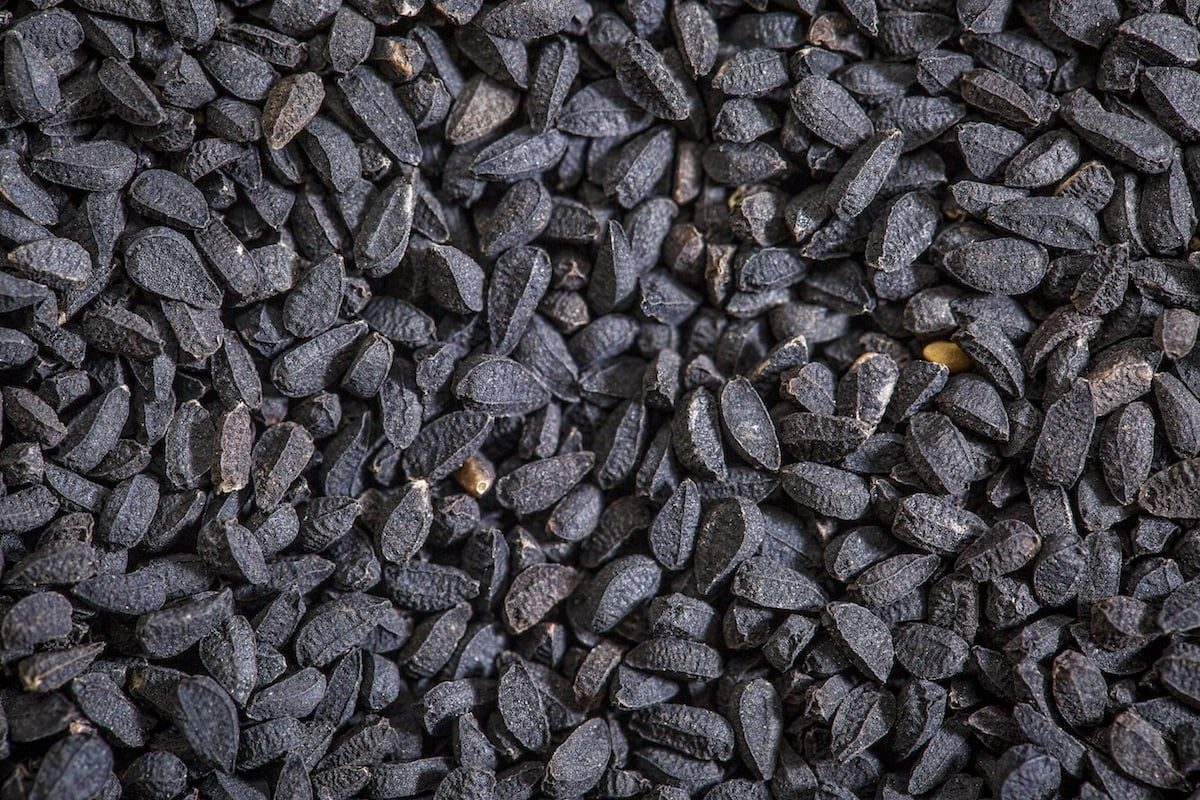
Nigella seeds are the small, angular black seeds of Nigella sativa, a member of the buttercup family. Sold as kalonji in Indian shops and as charnushka in parts of the US, they have little smell whole but release a faint, oregano-like scent when crushed, and taste aromatic and slightly bitter.12 They are scattered on breads in Turkey and the Middle East and fried whole in Bengali cooking as part of panch phoran.2 This page covers the plant, its names, flavor and chemistry, history, uses, and what systematic reviews say about its health claims.
At a glance
| Botanical name | Nigella sativa L.1 |
| Plant family | Ranunculaceae (buttercup family)12 |
| Part used | Seeds1 |
| Native range | Romania to western and southwestern Iran, per Kew1 |
| Grown | Cultivated from Egypt to India2 |
| Names | Kalonji (Hindi), charnushka (US), black cumin seed, kala jira12 |
| Key aroma compound | Thymoquinone, up to 50% of the essential oil2 |
| Essential oil | About 0.5% on average, up to 1.5%2 |
| Taste | Aromatic and slightly bitter2 |
| Forms sold | Whole seed, ground seed, pressed oil |
Measured values
7 figures, sourced| Measure | Value | Scope | Source |
|---|---|---|---|
| Essential oil | 0.5 % (about, on average) | Katzer's Spice Pages; reference-work ranges, not a single sample | gernot-katzers-spice-pages.com |
| Essential oil, upper figure | 1.5 % (up to about) | Katzer's Spice Pages; reference-work ranges, not a single sample | gernot-katzers-spice-pages.com |
| Essential oil: thymoquinone | up to 50 % of the essential oil | Katzer's Spice Pages; reference-work ranges, not a single sample | gernot-katzers-spice-pages.com |
| Essential oil: p-cymene | 40 % of the essential oil (about) | Katzer's Spice Pages; reference-work ranges, not a single sample | gernot-katzers-spice-pages.com |
| Fixed oil: linoleic acid | 50 to 60 % of the fixed oil | Katzer's Spice Pages; reference-work ranges, not a single sample | gernot-katzers-spice-pages.com |
| Fixed oil: oleic acid | 20 % of the fixed oil (about) | Katzer's Spice Pages; reference-work ranges, not a single sample | gernot-katzers-spice-pages.com |
| Fixed oil: saturated fatty acids | 30 or less % of the fixed oil (about) | Katzer's Spice Pages; reference-work ranges, not a single sample | gernot-katzers-spice-pages.com |
Each figure is quoted as its source states it, with the samples or standard it applies to. Where sources differ, both are shown; nothing is averaged. All measured values
What nigella is
Kew’s Plants of the World Online lists Nigella sativa as an annual of the temperate biome, native from Romania to western and southwestern Iran.1 Katzer gives its origin as probably western Asia and notes that it is now cultivated from Egypt to India.2 A related species, Nigella damascena, is a common garden ornamental in Europe.2
The many names
Kew’s economic-botany records list a long string of common names, including black cumin seed, black fennel seeds, false cumin, kala jira (Hindi) and siah daneh (Persian).1 Katzer notes that Indians widely use the Hindi name kalonji even when speaking English, and that in the US the seed is often called charnushka.2
“Black cumin” is the confusing one. Katzer points out that the name already belongs to a different, somewhat obscure spice from Central Asia and northern India,2 and “black cumin” can also mean a dark-seeded form of true cumin, as our cumin profile documents. Nigella is not related to cumin. Katzer also notes that nigella is sometimes confused with black sesame seeds and, more rarely, with ajwain.2
Flavor and aroma
Katzer describes whole nigella seeds as having little odor, developing a vaguely oregano-like scent when ground or chewed, with an aromatic, slightly bitter taste.2 Toasted or fried in oil, they read to us as nutty and faintly smoky with a peppery, onion-like edge; that description is ours.
The compounds
The seed’s essential oil averages about 0.5% and reaches about 1.5%, and thymoquinone has been identified as its main component, up to 50%, alongside p-cymene at about 40%.2 The seeds also hold a fixed (pressed) oil rich in unsaturated fatty acids: mainly linoleic acid (50 to 60%) and oleic acid (about 20%), with saturated fatty acids at about 30% or less, per Katzer.2 These are reference-work ranges, not a single sample, and they do not add up to a neat total. A widely repeated claim that nigella is a unique source of thymoquinone could not be traced to a source.
History
- The Bible. Nigella does not appear by name in common Bible translations, but Katzer reports good evidence that an obscure plant name in the Old Testament refers to it; if so, nigella has been cultivated for well over two thousand years.2
- Rome. Pliny the Elder described a black-seeded herb he called gith or git, which Katzer identifies with nigella.2
- Medieval Europe. The same name appears in Charlemagne’s Capitulare de Villis for nigella.2
- Ancient use generally. Kew’s records, citing the Flora of Somalia, say it has been cultivated since ancient times for aromatic seeds used to flavor bread.1
Several widely repeated stories could not be traced to a source we could open: that nigella seeds were found in Tutankhamun’s tomb, that Cleopatra and Nefertiti used the seed or its oil, that Hippocrates recommended it for digestion, that it was first used in Turkey and Syria, and that 16th-century herbals by “Hieronymus Bosch” and Tabernaemontanus discussed it. They are left out here.
How nigella is used
- Turkey, Lebanon and Iran. Katzer names these as nigella’s main area of use, and says Turkish bread frequently shows its characteristically shaped black grains.2
- North India and Bengal. From Iran, nigella spread to northern India, particularly Punjab and Bengal.2 It is mostly used for vegetable dishes, and Katzer singles out eggplant and pumpkin.2
- Panch phoran. The Bengali five-spice blend combines whole nigella, fenugreek, cumin, black mustard seed and fennel in equal parts, Katzer writes; in Bengal itself, cooks use a spice called radhuni in place of the black mustard seed.2 The blend is chiefly used for vegetables and fish.2 See panch phoran and panch phoran substitutes.
Nigella is also a familiar topping on naan in Indian restaurants and turns up in some Middle Eastern string cheeses; those uses are common practice and were not confirmed by a source we opened.
Technique
In panch phoran and many Indian dishes, the whole seeds go into hot oil at the start of cooking, and on breads they are pressed onto the dough before baking. Both are common practice. Brief heat brings out the aroma; burnt seeds turn harsh. Those are kitchen judgments, not measured findings.
Buying and quality
No international grading standard for nigella seed was found. Good seed is uniformly matte black and free of dust and stems; that is kitchen judgment.
Storage
We found no published shelf-life figure for nigella seed from a regulator or standards body. Whole seed is commonly kept in an airtight jar away from light and heat, and ground only as needed.
Health research
Nigella is also sold as a supplement, in capsules and as oil. A 2023 overview in Frontiers in Nutrition pooled 20 meta-analyses, built on between 3 and 50 randomized trials each, with 187 to 3,679 participants.3 The trials used capsules, oils and powders at doses of 0.5 to 6 g or 2.5 to 5 ml a day, for two weeks to a year.3
The meta-analyses mostly reported improvements in blood sugar, cholesterol and blood pressure measures.3 But the overview rated their overall methodological quality as relatively poor, and of 110 outcomes it graded, five had moderate-certainty evidence, 17 low and 88 very low; none reached high certainty.3 The authors concluded that nigella’s clinical efficacy still needs confirmation in large, high-quality trials.3 Where meta-analyses reported side effects, they were mainly digestive symptoms, and none reported serious adverse events.3
Those findings concern supplement doses, not a teaspoon on a flatbread. Claims that nigella prevents cancer or works as an antihistamine for allergies were not addressed by the overview’s results that we read, and this page makes no claim that nigella treats or prevents any condition.
Substitutes and comparisons
No single spice matches nigella. See nigella seed substitutes for ranked options. Related profiles: cumin, black sesame seeds, caraway seeds, oregano, fenugreek, black mustard seeds and fennel seed.
Footnotes
-
Nigella sativa L., Plants of the World Online, Royal Botanic Gardens, Kew. powo.science.kew.org · Reference work ↩ ↩2 ↩3 ↩4 ↩5 ↩6 ↩7 ↩8 ↩9
-
Gernot Katzer, “Nigella”, Gernot Katzer’s Spice Pages. gernot-katzers-spice-pages.com · Reference work ↩ ↩2 ↩3 ↩4 ↩5 ↩6 ↩7 ↩8 ↩9 ↩10 ↩11 ↩12 ↩13 ↩14 ↩15 ↩16 ↩17 ↩18 ↩19 ↩20 ↩21 ↩22 ↩23 ↩24
-
Li et al., “Nigella sativa and health outcomes: An overview of systematic reviews and meta-analyses”, Frontiers in Nutrition, 2023. frontiersin.org · Peer-reviewed ↩ ↩2 ↩3 ↩4 ↩5 ↩6