Spices · Profile
Annatto Seeds (Achiote): Color, Flavor, Bixin and How to Cook With Them
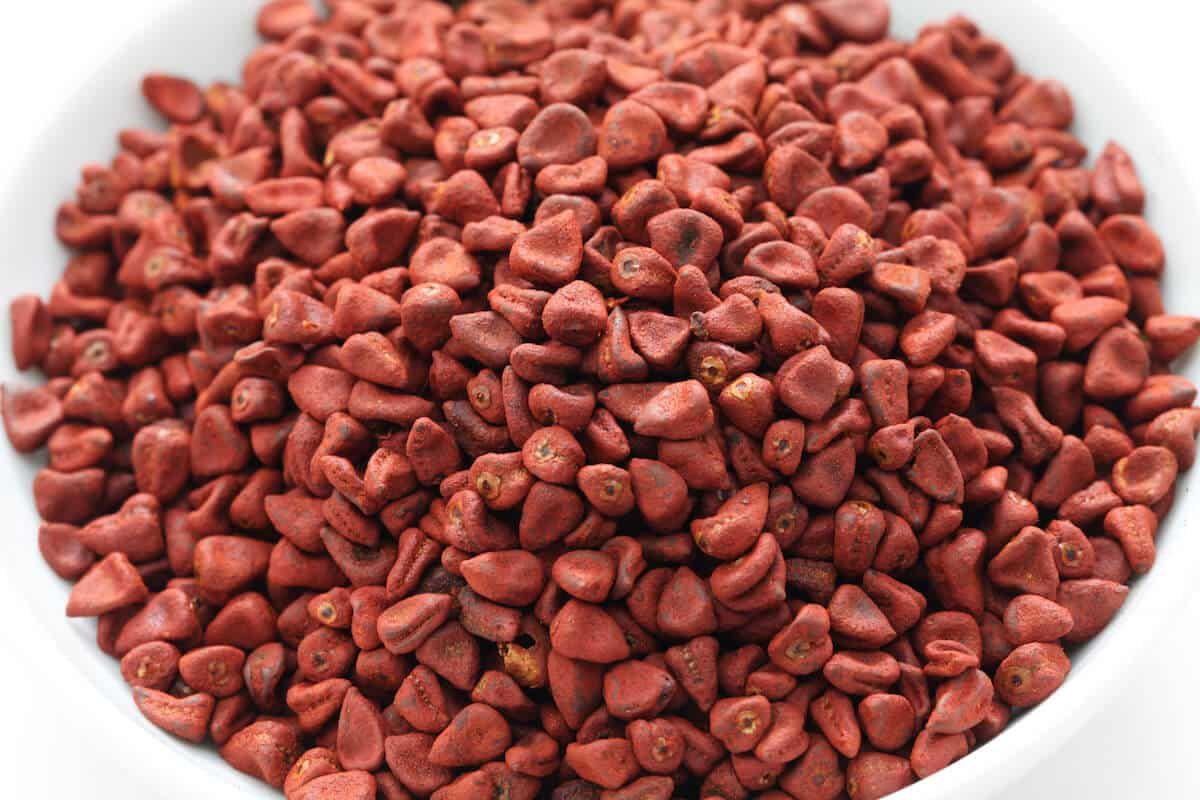
Annatto seeds, called achiote in Mexico, come from the fruit of Bixa orellana, a small tree native from Mexico to tropical South America. They are used far more for color than for flavor: the red-orange coating on the seed is the source of the annatto that colors cheese, butter and margarine, and of the brick-red marinades of Yucatán and the golden cooking fat of the Caribbean.
At a glance
| Botanical name | Bixa orellana L.1 |
| Plant family | Bixaceae, of which it is the only species (per Britannica)12 |
| Part used | The seeds, for the pigmented layer on their surface3 |
| Native range | Mexico to southern tropical America (Kew)1 |
| Main pigments | Bixin and its water-soluble counterpart norbixin, both apocarotenoids4 |
| Pigment content | Commonly 2–5% of seed dry mass (Katzer); 1.6–5.3% bixin in Papua New Guinea seed (PROSEA)35 |
| Main producers | South America (especially Peru), Central America, the Caribbean, India and Sri Lanka, per PROSEA5 |
| Forms sold | Whole seeds, ground (achiote powder), recado paste, annatto oil, food-grade extracts |
| US status | Annatto extract is a color additive exempt from certification, 21 CFR 73.306 |
Measured values
4 figures, sourced| Measure | Value | Scope | Source |
|---|---|---|---|
| Pigment content | 2–5 % of seed dry mass | commonly reported values (Katzer)Different measurement from the PROSEA bixin figure; not comparable | gernot-katzers-spice-pages.com |
| Bixin | 1.6–5.3 % of seed, oven-dry basis | seed from Papua New Guinea (PROSEA); figures up to 12% reported elsewhere | uses.plantnet-project.org |
| Bixin share of total pigment | as much as 80 % of total pigment | some seeds (2016 review) | frontiersin.org |
| Bixin or norbixin in commercial extracts | under 1 to over 85 % | commercial extracts, depending on type of extract (2016 review)Extracts, not seed | frontiersin.org |
Each figure is quoted as its source states it, with the samples or standard it applies to. Where sources differ, both are shown; nothing is averaged. All measured values
What annatto is
Annatto is a shrub or small tree of the wet tropics, now grown in tropical and subtropical regions worldwide.12 Its brown fruits are about 5 cm long.2 The seeds inside carry a coating of red pigment.3 The species name honors Francisco de Orellana, the Spanish explorer of the Amazon; “achiote” comes from Nahuatl, and “annatto” from a Carib word.3
Color, flavor and the compounds behind them
Color
The red comes from apocarotenoids, compounds formed when carotenoids are split, and bixin is the most important of them.43 Bixin can make up as much as 80% of the total pigment in some seeds.4 Norbixin is its water-soluble counterpart.4 Commercially, annatto comes as both oil-based and water-based preparations: PROSEA describes extracting the dye by soaking seeds in water, and preparing it as a solution in vegetable oil.5 EFSA likewise assesses bixin-based and norbixin-based extracts separately.7
How much pigment the seed holds varies. Katzer gives 2–5% of seed dry mass as common values, and PROSEA reports 1.6–5.3% bixin on an oven-dry basis in seed from Papua New Guinea, with figures up to 12% reported elsewhere.35 In commercial extracts the bixin or norbixin content ranges from under 1% to over 85%, depending on the type of extract.4 These are different measurements of different materials and should not be compared directly.
Flavor
Katzer describes dried annatto seeds as having a weak, perfumed smell, and notes that fresh seeds are much more aromatic but that the aroma does not carry into the food.3 Cooks often describe a faint earthy, peppery or slightly nutty note. That description is editorial; for most dishes annatto’s job is color.
Origin and history
Kew gives the native range as Mexico to southern tropical America.1 Annatto has been used since pre-colonial times as a culinary colorant and spice, and a 2016 review notes its use as a coloring agent in pre-Hispanic Maya religious ceremonies.4 Katzer notes reports that the Aztecs’ drinking chocolate contained annatto seeds, which he considers plausible, and that using annatto to deepen the color of chocolate was common in Europe until the 17th century.3
Several popular claims could not be traced for this page: that the Aztecs and Maya used annatto as a substitute for blood in rituals or as writing ink, and that Europeans began exporting it in the 18th century. PROSEA records body painting with the dye in Papua New Guinea, not in the Americas.5
How annatto is used
As a food color
Britannica lists butter, cheese and margarine among the foods annatto colors.2 PROSEA adds rice, candy, oils, ice cream and bakery products, and reports that about 70% of annatto imported into consuming countries goes into cheese-making.5 Rivera-Madrid and colleagues list dairy and bakery products, vegetable oils, beverages and dietary supplements.4
In cooking
- Mexico (Yucatán). Meat is often marinated in a spice paste called recado; food prepared this way is called pibil.3 For the ground form, see achiote powder.
- The Caribbean. Seeds are fried in animal or vegetable fat, and the colored fat is then used to cook vegetables or meat, giving them a golden yellow to golden brown color.3
- Philippines. The seeds are often ground and added to soups and stews.3
- Vietnam. Annatto oil is used to improve the color of coconut-based curries.3
To make annatto oil at home, warm the seeds gently in oil until the oil turns deep orange, then strain. Overheating turns the seeds dark and bitter. That is common kitchen practice rather than a measured method. For more, see cooking with annatto seeds.
Buying and quality
Whole seeds should be a bright, brick red rather than brown; dull seeds have lost pigment. That is a practical guide, not a standard. PROSEA notes that the dye is sensitive to light.5 In practice whole seeds are very hard, and many cooks soak them or use a dedicated grinder.
Storage
No published shelf-life figure for annatto seeds was found from a regulator or standards body. Given PROSEA’s note on light sensitivity, store seeds and powder in an opaque, sealed container away from heat and light.5
Safety and regulation
United States. Annatto extract, prepared from annatto seed, is listed as a color additive at 21 CFR 73.30. It may be used to color foods generally in amounts consistent with good manufacturing practice, except foods with standards of identity that do not allow added color, and batches are exempt from FDA certification.6
European Union. Annatto extracts are the food additive E 160b. In 2016 EFSA set an acceptable daily intake of 6 mg/kg body weight per day for bixin and 0.3 mg/kg body weight per day for norbixin.7 Estimated bixin exposure was below its ADI for all population groups; for norbixin, some high consumers could exceed it under a proposed extension of use.7
Allergy. Allergic reactions to annatto have been documented. A 1991 case report in Annals of Allergy described a patient who developed hives, swelling and severely low blood pressure within 20 minutes of eating a breakfast cereal that contained annatto dye. Skin tests to milk, wheat and corn were negative, while skin testing to annatto was strongly positive, and the patient’s IgE antibodies bound to a protein in the extract.8
PROSEA also notes that a very poisonous substance has been found in the seed’s embryo; it does not say whether this matters at culinary amounts, and no regulator source found here raises it.5
Health claims
Bixin and norbixin are carotenoid derivatives, and laboratory and animal work on their antioxidant activity exists.4 That is not evidence that annatto in food protects the eyes, bones or anything else, and this page makes no such claim. Calcium and folate figures that circulate for annatto seeds could not be checked against a nutrient database for this page.
Substitutes and comparisons
- Annatto seeds substitutes
- Achiote powder
- Saffron, turmeric and paprika, the other common food colors in the spice rack
Footnotes
-
Bixa orellana L., Plants of the World Online, Royal Botanic Gardens, Kew. powo.science.kew.org · Reference work ↩ ↩2 ↩3 ↩4 ↩5
-
“Annatto”, Encyclopaedia Britannica. britannica.com · Reference work ↩ ↩2 ↩3 ↩4
-
Gernot Katzer, “Annatto (Bixa orellana L.)”, Gernot Katzer’s Spice Pages. gernot-katzers-spice-pages.com · Reference work ↩ ↩2 ↩3 ↩4 ↩5 ↩6 ↩7 ↩8 ↩9 ↩10 ↩11 ↩12
-
Rivera-Madrid et al., “Carotenoid Derivates in Achiote (Bixa orellana) Seeds: Synthesis and Health Promoting Properties”, Frontiers in Plant Science, 2016. frontiersin.org · Peer-reviewed ↩ ↩2 ↩3 ↩4 ↩5 ↩6 ↩7 ↩8
-
R. Rajendran, Bixa orellana, Plant Resources of South-East Asia (PROSEA). uses.plantnet-project.org · Reference work ↩ ↩2 ↩3 ↩4 ↩5 ↩6 ↩7 ↩8 ↩9
-
21 CFR 73.30, Annatto extract, US Food and Drug Administration. ecfr.gov · Regulator ↩ ↩2
-
EFSA Panel on Food Additives and Nutrient Sources, “Safety of annatto extracts (E 160b) as a food additive”, EFSA Journal, 2016. efsa.europa.eu · Regulator ↩ ↩2 ↩3
-
“Anaphylaxis to annatto dye: a case report”, Annals of Allergy, 1991. pubmed.ncbi.nlm.nih.gov · Peer-reviewed ↩