Spices · Profile
Paprika: Grades, Pimentón, Color and History
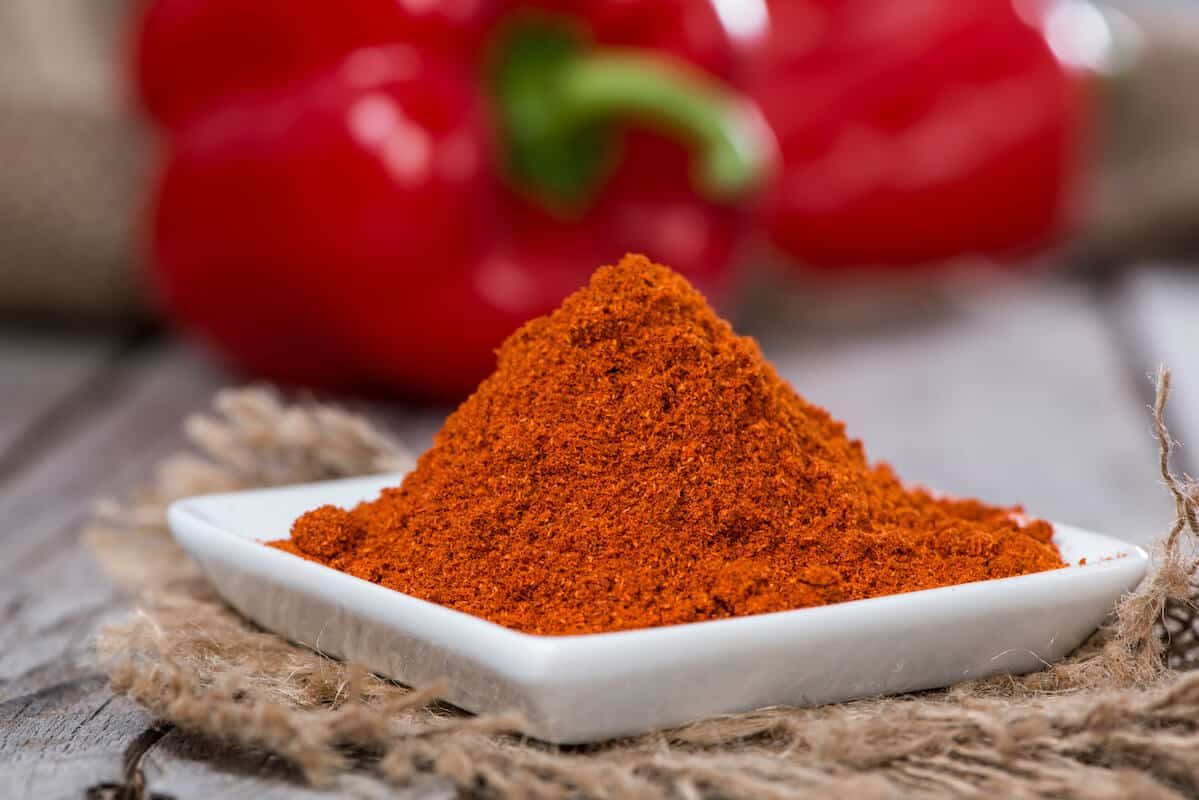
Paprika is the ground, dried fruit of Capsicum annuum peppers, selected and processed so that color and sweet pepper flavor come first and heat comes second, or not at all. It is a New World plant that became the national spice of Hungary and, as pimentón, a pillar of Spanish cooking. Two European countries now protect named paprikas by law, and the quality yardstick in all of them is the same: how much red pigment the powder holds, measured in ASTA color units.
At a glance
| Botanical name | Capsicum annuum12 |
| Plant family | Solanaceae (nightshade family)1 |
| Part used | Dried ripe fruit (pods), ground |
| Domesticated | Mexico; the evidence points to central-east Mexico3 |
| Main producers named by sources | Spain, Hungary, China, India and the United States (McCormick Science Institute’s list; no production tonnages checked)1 |
| Forms sold | Ground (the main form); in Szeged historically also broken, crushed and whole4 |
| Protected origins (EU PDO) | Kalocsai fűszerpaprika-őrlemény and Szegedi fűszerpaprika-őrlemény (Hungary); Pimentón de la Vera and Pimentón de Murcia (Spain)5678 |
| Color pigments | Mainly capsanthin and capsorubin9 |
| Heat compounds | Capsaicinoids; graded by mg/kg in Hungary, not by Scoville units10 |
Measured values
26 figures, sourced| Measure | Value | Scope | Source |
|---|---|---|---|
| Extractable color (ASTA), minimum Limit | 120 ASTA units | Hungarian Food Codex MÉ 2-108 (2013), premium class különleges ("special") | elelmiszerlanc.kormany.hu |
| Capsaicinoids, heat class boundary: non-pungent (sweet) Limit | below 30 mg/kg | Hungarian Food Codex MÉ 2-108 (2013), ground paprika heat classes | elelmiszerlanc.kormany.hu |
| Capsaicinoids, heat class boundary: mildly hot Limit | 30–200 mg/kg | Hungarian Food Codex MÉ 2-108 (2013), ground paprika heat classes | elelmiszerlanc.kormany.hu |
| Capsaicinoids, heat class boundary: hot Limit | 200–500 mg/kg | Hungarian Food Codex MÉ 2-108 (2013), ground paprika heat classes | elelmiszerlanc.kormany.hu |
| Capsaicinoids, heat class boundary: very hot Limit | above 500 mg/kg | Hungarian Food Codex MÉ 2-108 (2013), ground paprika heat classes | elelmiszerlanc.kormany.hu |
| Extractable color (ASTA), minimum Limit | 120 ASTA units, at packaging | Szegedi fűszerpaprika-őrlemény PDO single document | dfat.gov.au |
| Color loss, permitted Limit | 5 ASTA units per month after packaging | Szegedi fűszerpaprika-őrlemény PDO single documentThe only rate-of-loss figure found for the page; a permitted allowance, not a measured decay rate. | dfat.gov.au |
| Capsaicin, non-pungent ceiling Limit | no more than 100 mg/kg | Szegedi fűszerpaprika-őrlemény PDO single documentThe Szeged PDO and the Hungarian codex draw heat boundaries differently (100 vs 30 mg/kg); different documents for different labels. | dfat.gov.au |
| Capsaicin, moderately hot band Limit | 100–200 mg/kg | Szegedi fűszerpaprika-őrlemény PDO single document | dfat.gov.au |
| Capsaicin, hot threshold Limit | above 200 mg/kg | Szegedi fűszerpaprika-őrlemény PDO single document | dfat.gov.au |
| Extractable color (ASTA), minimum Limit | 85 ASTA units, at end of minimum durability | Kalocsai fűszerpaprika-őrlemény PDO single document | dfat.gov.au |
| Capsaicin, moderately hot band Limit | 30–200 mg/kg | Kalocsai fűszerpaprika-őrlemény PDO single document | dfat.gov.au |
| Capsaicin, hot threshold Limit | above 500 mg/kg | Kalocsai fűszerpaprika-őrlemény PDO single document | dfat.gov.au |
| Moisture after smoke-drying Limit | under 15 % | Pimentón de la Vera PDO, pods smoke-dried 10–15 days from about 80% moisture | assets.publishing.service.gov.uk |
| Extractable color (ASTA), minimum Limit | 90 ASTA units, at milling | Pimentón de la Vera PDO product specification | assets.publishing.service.gov.uk |
| Extractable color (ASTA), minimum Limit | 120 ASTA units, at grinding | Pimentón de Murcia PDO specification, Extra | ec.europa.eu |
| Extractable color (ASTA), minimum Limit | 90 ASTA units, at grinding | Pimentón de Murcia PDO specification, Category I | ec.europa.eu |
| Vitamin A (RAE) Nutrient | 2,460 µg per 100 g | USDA FoodData Central, paprika (FDC ID 171329, one SR Legacy composite, last updated 2019) | fdc.nal.usda.gov |
| Vitamin E (alpha-tocopherol) Nutrient | 29.1 mg per 100 g | USDA FoodData Central, paprika (FDC ID 171329, one SR Legacy composite, last updated 2019) | fdc.nal.usda.gov |
| Beta-carotene Nutrient | 26,200 µg per 100 g | USDA FoodData Central, paprika (FDC ID 171329, one SR Legacy composite, last updated 2019) | fdc.nal.usda.gov |
| Beta-cryptoxanthin Nutrient | 6,190 µg per 100 g | USDA FoodData Central, paprika (FDC ID 171329, one SR Legacy composite, last updated 2019) | fdc.nal.usda.gov |
| Lutein + zeaxanthin Nutrient | 18,900 µg per 100 g | USDA FoodData Central, paprika (FDC ID 171329, one SR Legacy composite, last updated 2019) | fdc.nal.usda.gov |
| Ochratoxin A, maximum Limit | 20 µg/kg | EU Regulation 2023/915, dried Capsicum fruits, explicitly including paprika | eur-lex.europa.eu |
| Aflatoxin B1, maximum Limit | 5.0 µg/kg | EU Regulation 2023/915, dried Capsicum fruits, explicitly including paprika | eur-lex.europa.eu |
| Total aflatoxins, maximum Limit | 10.0 µg/kg | EU Regulation 2023/915, dried Capsicum fruits, explicitly including paprika | eur-lex.europa.eu |
| Lead, maximum Limit | 0.60 mg/kg | EU Regulation 2023/915, dried "fruit spices"The section read did not say whether paprika is classed as a fruit spice; listed with that caveat. | eur-lex.europa.eu |
Each figure is quoted as its source states it, with the samples or standard it applies to. Where sources differ, both are shown; nothing is averaged. All measured values
Flavor and aroma
Good sweet paprika tastes of ripe red pepper: fruity, faintly sweet, a little earthy, sometimes with a toasted edge from drying and milling. Hot grades add a building heat on top of that fruit. Smoked Spanish pimentón tastes and smells of wood smoke as much as pepper.
What the compounds do, as far as sources state it:
- Color. The red comes from carotenoids, chiefly capsanthin and capsorubin, according to the FAO/WHO expert committee’s monograph on paprika extract.9 This is what ASTA color measures (see Buying and quality).
- Green, vegetal notes. McCormick Science Institute attributes paprika’s vegetative flavor to methoxypyrazines.1 That is their statement; no independent study was checked for this page.
- Heat. Capsaicinoids. Hungary’s food codex sorts ground paprika into four heat classes by capsaicinoid content (table below).10
- Smoke. In Pimentón de la Vera the smoke comes from drying the pods over oak fires, and the regulatory specification describes the result as smoky, intense and penetrating in flavor and aroma.7
Origin and history
From Mexico. Capsicum annuum was domesticated in Mexico. A 2014 study combining genetics, ecology, archaeobotany and historical linguistics found that all four lines of evidence together pointed to central-east Mexico, with northeastern Mexico the other candidate.3
Into Europe through Spain. Peppers reached Europe through Spain after the voyages to the Americas.11 The Pimentón de la Vera specification puts the first records of pepper growing in the province of Cáceres at the end of the 15th century, started by Hieronymite friars of the Guadalupe monastery and later reaching the monastery at Yuste.7 By the mid-18th century La Vera was producing 1,000 arrobas of paprika a year.7
Into Hungary from the south. The route into Hungary ran through the Ottoman world. The Online Etymology Dictionary describes paprika as introduced into Eastern Europe by the Turks and known in Hungary by 1569.12 Hungary’s Hungarikum Committee places the Turkish introduction in the 16th to 17th centuries.4 The plant was first kept in Szeged as an ornamental and a medicinal herb before it became a spice,5 and the Hungarikum Committee says Franciscan monks around Szeged-Alsóváros were probably the first growers there.4
The word. English took “paprika” from Hungarian in 1839. The Hungarian word is a diminutive of Serbo-Croatian papar, “pepper”, which goes back to Latin piper or Greek piperi.12
Kalocsa and Szeged. The two Hungarian growing centers each document their own history:
- Szeged’s first written record linking the town and paprika dates from 1748.5 In 1934 the Szeged area was made a restricted zone: paprika grown outside it could not be sold as Szegedi paprika.5 Between the two World Wars, more than ten thousand people in the area worked splitting pods, and about 20 paprika mills operated.4
- Several Kalocsa-region settlements were producing paprika in the early 1700s; the first paprika drying plant there was built in 1880, and a chemical and paprika experimental station opened in 1917.6
How Hungarian paprika became sweet. Hungarian paprika was hot by default for most of its history; the Hungarikum Committee says it stayed hot until the 1940s.4 Two developments changed that. First, mechanization of the old practice of removing the hot parts: Sharon Hudgins credits the Pálfy brothers of Szeged with an 1859 machine that stripped out the veins and seeds.13 Second, breeding: Hungarian researchers write that sweet varieties were selected from non-pungent pepper types found by Ferenc Horváth in Kalocsa in the 1930s.11 It is sometimes said that a sweet plant was “grafted” onto others in the 1920s; no source supports grafting or that date.
Paprika and vitamin C. Albert Szent-Györgyi won the 1937 Nobel Prize in Physiology or Medicine for discoveries that included vitamin C, and was at Szeged University when he received it.14 The Nobel Prize’s own summary does not mention paprika, and the often-told story that he worked with Szeged paprika was not confirmed for this page.
How it is used
Hungary. Paprika is the defining spice of goulash (gulyás) and paprikash (paprikás), including fish versions such as catfish paprikash; Michelin’s guide calls paprikash the Hungarian national dish of the last two centuries.15 Use Hungarian-style unsmoked paprika for these; smoked pimentón gives a different dish.
Spain. The La Vera specification says the stable red color of smoke-dried pimentón made it the best preservative for sausages and cured meats, and cites its use as a seasoning for pork, kid, lamb and game.7 PepperScale credits smoked paprika with the smoky flavor of chorizo and paella, and notes that hot picante paprika is the favorite seasoning for octopus in Galicia.16
Technique. Cooks usually warm paprika briefly in oil or lard, off the highest heat, before liquid goes in; fried hard, it scorches quickly and turns bitter. This is common kitchen practice, not a sourced finding, so treat it as a cooking judgment.
Elsewhere. As a finishing dust it adds color and mild pepper flavor to eggs, potato salads, roasted vegetables and dry rubs. For heat, reach for a hot grade or for cayenne instead.
Kinds of paprika
Hungarian grades and heat classes
There is no single official list of Hungarian “grades” that covers every product sold. What the sources show:
The Hungarian Food Codex (directive MÉ 2-108, 2013) defines one premium quality class, különleges (“special”), with a minimum natural color of 120 ASTA units, and sorts ground paprika into four heat classes by capsaicinoid content:10
| Heat class (Hungarian) | English | Capsaicinoids, mg/kg |
|---|---|---|
| Csípősségmentes (édes) | Non-pungent (sweet) | below 30 |
| Enyhén csípős | Mildly hot | 30–200 |
| Csípős | Hot | 200–500 |
| Nagyon csípős | Very hot | above 500 |
Scope: these are the codex’s labeling thresholds for ground paprika carrying the distinctive quality mark, not measurements of any product.
The traditional trade names are a separate thing. A 2023 Michelin Guide article, drawing on Hungarian chefs, lists eight: édesnemes (noble sweet, the most used in Hungarian cooking), csemege (delicate), csípősmentes csemege (delicate without heat), félédes (semi-sweet), rózsa (rose, aromatic and milder), csípős (hot), erős (strong, hotter than csípős) and rozsdás (“rusty”, deep red).15 These are attributed descriptions. PepperScale gives a different list of eight, ordered from mild to hot: különleges, csípősmentes csemege, csemege, csípős csemege, édesnemes, félédes, rózsa and erős, with erős the hottest.17 The two lists share six names but not csípős and rozsdás (Michelin) or különleges and csípős csemege (PepperScale); PepperScale also names édesnemes as the type most often exported.18 The Hungarian national standard that is said to have defined these names was not found for this page, so their exact color and heat specifications are not given here.
The two Hungarian PDOs set their own rules:
- Szegedi fűszerpaprika-őrlemény: at least 120 ASTA units at packaging, with a permitted loss of 5 units per month; non-pungent means no more than 100 mg/kg capsaicin, 100–200 mg/kg tastes moderately hot and above 200 mg/kg hot. Nineteen permitted varieties.5
- Kalocsai fűszerpaprika-őrlemény (registered as a PDO in 201219): at least 85 ASTA units at the end of its minimum durability; 30–200 mg/kg capsaicin tastes moderately hot and above 500 mg/kg hot.6
Note that the PDOs and the codex draw their heat boundaries in different places (the Szeged PDO’s non-pungent ceiling is 100 mg/kg; the codex’s is 30). They are different documents for different labels; neither is wrong.
Spanish pimentón
| Pimentón de la Vera (PDO) | Pimentón de Murcia (PDO) | |
|---|---|---|
| Region | North of Cáceres province, Extremadura7 | Region of Murcia, southeast Spain8 |
| Peppers | Ocales group (Jaranda, Jariza, Jeromín) and Bola7 | Bola (also called Americano)8 |
| Drying | Smoke-dried over holm oak and/or oak for 10–15 days, from about 80% to under 15% moisture720 | Sun-dried, or dried with hot air8 |
| Smoked? | Yes | No |
| Types | Sweet (dulce), bittersweet (agridulce or ocal), hot (picante)7 | Sweet only, in the specification checked8 |
| Minimum color | 90 ASTA at milling7 | 120 ASTA (Extra) or 90 ASTA (Category I) at grinding8 |
La Vera’s smoke is a consequence of climate: its damp autumn does not allow sun-drying, so the pods are dried over fires.20 It is often said that smoked paprika is sun-dried first and then smoked; the La Vera specification describes smoke-drying from fresh, not sun-drying followed by smoking.
For more on the smoked style, see smoked paprika.
Scoville heat
No measured Scoville figure was found for paprika as a product category or for named paprika cultivars. The circulating ranges can be attributed but not traced to a measurement, and the two we found disagree:
| Scope | Heat | Source |
|---|---|---|
| Regular paprika (general rating; no method stated) | Usually no more than 100–500 SHU | PepperScale, Is Paprika Spicy?17 |
| Mild paprika (general rating; no method stated) | Typically 500–1,500 SHU | PepperScale, paprika substitutes guide21 |
Both come from the same publisher and are shown as published, not reconciled. The figures that can be traced are the Hungarian capsaicinoid thresholds above, which are labeling bands in mg/kg, not Scoville measurements, and are not converted here.
Buying and quality
Color is the main grade. The spice trade measures paprika color with ASTA Method 20.1, which the American Spice Trade Association describes as determining extractable color by reading the absorbance of an acetone extract at 460 nm.22 Agilent’s application note on the method adds that the reading and the sample weight together give the ASTA color value, a measure of how intense the red is; higher means more intense.23 The protected paprikas set minimums of 85 to 120 ASTA units, but at different points in the product’s life (at milling, at packaging, or at the end of shelf life), so the numbers are not directly comparable.5678
Color fades. The Szeged PDO allows its paprika to lose up to 5 ASTA units a month after packaging,5 which is a regulator’s acknowledgement that color drops in storage. Buy small amounts and look for a deep, even red with an oily sheen, the appearance the Hungarian codex specifies for its premium class.10 As a rule of thumb, a brown or dull-orange powder has lost color and, usually, flavor.
Adulteration is a known problem. A 2020 review of paprika fraud lists bulking with white pepper, curcuma, brick powder and barium sulfate, illegal dyes (most often Sudan I and IV, which it describes as possibly carcinogenic), and origin fraud. In 2004 paprika sold as Hungarian was found to contain South American paprika, caught because it carried aflatoxin from a fungus that could not have grown in Hungary’s climate.24 A protected-origin label is one check a shopper can use: the Szeged PDO, for example, requires production and packing within its defined area.5
The 1994 lead adulteration in Hungary
In 1994 some Hungarian ground paprika was found to contain red lead (lead tetroxide, Pb₃O₄), added to deepen the color.252624
- Clinical cases. A 1996 study of the episode followed 141 adults who had eaten the contaminated paprika: 53 had symptoms and signs of lead poisoning, most often colic and/or anemia, and 26 more had raised lead absorption without symptoms. Chelation therapy brought complete clinical recovery in the treated patients. The authors noted that contaminated paprika had not been described before as a cause of dietary lead poisoning.27
- Testing. A contemporary report in Analysis Europa (December 1994) said the Hungarian Ministry of Agriculture found 5.8% of 3,432 random samples adulterated, that several people had died and dozens fallen ill, that arrests followed, and that the government believed no contaminated paprika had reached EU countries.25 The death count is not given in the clinical study and was not confirmed from an official source for this page.
- Motive. The same report says the lead enhanced the color and increased dealers’ profits.25
Storage
Keep paprika airtight, dark and cool. Its color is the measurable thing that fades, and the Szeged PDO’s allowance of 5 ASTA units lost per month is the only rate-of-loss figure found for this page.5 No sourced shelf-life figure in months or years was found; figures that circulate online could not be traced. If it smells of little and looks brownish, replace it.
Nutrition and health
Per USDA FoodData Central’s paprika entry (one SR Legacy composite, last updated 2019), 1 teaspoon weighs 2.3 g.2 Per teaspoon, that works out to:
| Nutrient | Per 100 g2 | Per 1 tsp (2.3 g), computed | % Daily Value per tsp28 |
|---|---|---|---|
| Vitamin A (RAE) | 2,460 µg | 57 µg | about 6% (DV 900 µg) |
| Vitamin E (alpha-tocopherol) | 29.1 mg | 0.67 mg | about 4.5% (DV 15 mg) |
| Beta-carotene | 26,200 µg | 603 µg | no DV |
| Beta-cryptoxanthin | 6,190 µg | 142 µg | no DV |
| Lutein + zeaxanthin | 18,900 µg | 435 µg | no DV |
A widely repeated claim says a teaspoon supplies almost 40% of daily vitamin A; by the USDA figures and the FDA Daily Value it is about 6%.
Paprika is carotenoid-rich by weight, but it is eaten in small amounts. On lutein and zeaxanthin specifically: the NIH’s AREDS2 trial used supplements with 10 mg lutein and 2 mg zeaxanthin a day, which reduced progression from intermediate to advanced age-related macular degeneration by about 25%; the National Eye Institute states the supplements do not prevent AMD from starting.29 A teaspoon of paprika holds about 0.4 mg of the two combined. No claim is made here that paprika prevents or treats any disease.
Safety and regulatory limits
- Mycotoxins (EU). For dried Capsicum fruits, explicitly including paprika, EU law caps ochratoxin A at 20 µg/kg, aflatoxin B1 at 5.0 µg/kg and total aflatoxins at 10.0 µg/kg.30
- Lead (EU). The same regulation sets 0.60 mg/kg for dried “fruit spices”; the section of the regulation read for this page did not say whether paprika is classed there, so this limit is listed with that caveat.30
- Illegal dyes. Sudan dyes are the most commonly found illegal colorants in paprika.24
- Allergy and interactions. No regulator or major review statement on paprika-specific interactions was found for this page.
Substitutes and comparisons
- Paprika substitutes and smoked paprika substitutes
- Paprika vs. cayenne and paprika vs. chili powder
- Related powders: cayenne pepper, chili powder, bell pepper powder, gochugaru, ancho powder
Footnotes
-
Paprika, McCormick Science Institute. mccormickscienceinstitute.com · Merchant ↩ ↩2 ↩3 ↩4
-
Spices, paprika (FDC 171329), USDA FoodData Central. fdc.nal.usda.gov · Regulator ↩ ↩2 ↩3
-
Kraft et al., Multiple lines of evidence for the origin of domesticated chili pepper, PNAS, 2014. escholarship.org · Peer-reviewed ↩ ↩2
-
Ground paprika from Szeged, Hungarikum Committee. hungarikum.hu · Reference work ↩ ↩2 ↩3 ↩4 ↩5
-
Szegedi fűszerpaprika-őrlemény PDO single document, EU. dfat.gov.au · Regulator ↩ ↩2 ↩3 ↩4 ↩5 ↩6 ↩7 ↩8 ↩9
-
Kalocsai fűszerpaprika-őrlemény PDO single document, EU (OJ C 303, 2011). dfat.gov.au · Regulator ↩ ↩2 ↩3 ↩4
-
Pimentón de la Vera PDO product specification, Consejo Regulador. assets.publishing.service.gov.uk · Regulator ↩ ↩2 ↩3 ↩4 ↩5 ↩6 ↩7 ↩8 ↩9 ↩10 ↩11
-
Pimentón de Murcia PDO application and specification, European Commission eAmbrosia. ec.europa.eu · Regulator ↩ ↩2 ↩3 ↩4 ↩5 ↩6 ↩7
-
Paprika extract (CTA), FAO/WHO JECFA, 2008 (rev. 2013). fao.org · Regulator ↩ ↩2
-
MÉ 2-108, Hungarian Food Codex Committee, 2013. elelmiszerlanc.kormany.hu · Standard ↩ ↩2 ↩3 ↩4
-
Pék et al., Capsicum conservation and production in Hungary, Spanish Ministry of Agriculture library. mapa.gob.es · Reference work ↩ ↩2
-
paprika (n.), Online Etymology Dictionary. etymonline.com · Reference work ↩ ↩2
-
Sharon Hudgins, Paprika: Hungary’s Red Gold, Fiery Foods & Barbecue Central, 2008. fieryfoodscentral.com · Publication ↩
-
Albert Szent-Györgyi, Facts, NobelPrize.org. nobelprize.org · Reference work ↩
-
Paprika: why this smoky spice plays a crucial role in Hungarian cuisine, MICHELIN Guide, 2023. guide.michelin.com · Publication ↩ ↩2
-
Matt Bray, Spanish Paprika 101: Much More Than Smoked, PepperScale, 2018. pepperscale.com · Publication · PepperScale is also owned by Matt Bray, the editor of this site. ↩
-
Matt Bray, Is Paprika Spicy?, PepperScale, 2024. pepperscale.com · Publication · PepperScale is also owned by Matt Bray, the editor of this site. ↩ ↩2
-
Matt Bray, Hungarian Paprika Vs. Spanish Paprika: How Do They Compare?, PepperScale, 2022. pepperscale.com · Publication · PepperScale is also owned by Matt Bray, the editor of this site. ↩
-
Commission Implementing Regulation (EU) No 588/2012. legislation.gov.uk · Regulator ↩
-
Pimentón de la Vera PDO, Foods & Wines from Spain (ICEX). foodswinesfromspain.com · Regulator ↩ ↩2
-
Matt Bray, What’s A Good Paprika Substitute?, PepperScale, 2022. pepperscale.com · Publication · PepperScale is also owned by Matt Bray, the editor of this site. ↩
-
ASTA Method 20.1: Determination of Extractable Color in Capsicums and Their Oleoresins, American Spice Trade Association. astaspice.org · Standard ↩
-
UV-Vis Spectroscopy for Quality Assessment of Paprika as per ASTA Method 20.1, Agilent Technologies, 2025. agilent.com · Merchant ↩
-
Galvin-King, Haughey, Elliott, Detection of substitution adulteration of paprika, Foods, 2020. pmc.ncbi.nlm.nih.gov · Peer-reviewed ↩ ↩2 ↩3
-
Adulteration of Paprika in Hungary, LEAD Action News (from Analysis Europa, 1994). lead.org.au · Publication ↩ ↩2 ↩3
-
Joe Schwarcz, The Good Old Days?, McGill Office for Science and Society, 2017. mcgill.ca · Publication ↩
-
Kákosy, Hudák, Náray, Lead intoxication epidemic caused by ingestion of contaminated ground paprika, J Toxicol Clin Toxicol, 1996. agris.fao.org · Peer-reviewed ↩
-
Daily Value on the Nutrition and Supplement Facts Labels, FDA. fda.gov · Regulator ↩
-
About AREDS and AREDS2, National Eye Institute. nei.nih.gov · Regulator ↩
-
Commission Regulation (EU) 2023/915, EUR-Lex. eur-lex.europa.eu · Regulator ↩ ↩2