Cooking · Cooking with
Cooking With Annatto Seeds: Oil, Paste, Powder and the Hard-Seed Problem
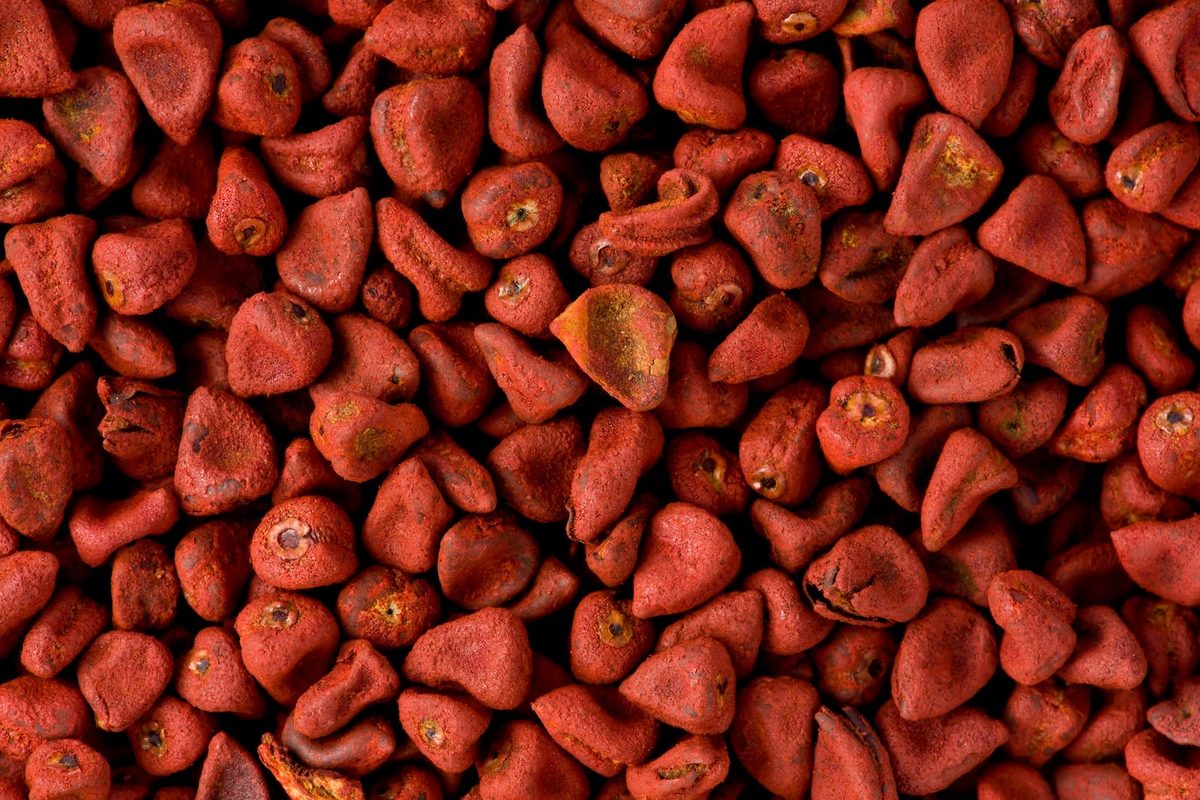
Annatto seeds (achiote) are the seeds of Bixa orellana, and cooks use them mainly for color: the brick-red coating on the seed turns oil golden, marinades red and rice yellow-orange.1 The seeds themselves are very hard, so nearly every technique comes down to one question: how do you get the color off the seed and into the food? There are three answers. Infuse the seeds in fat and strain them out, grind them into a paste or powder, or buy them already ground or blended.
For the plant, its pigments and how annatto is regulated, see the annatto seeds profile.
At a glance
| Goal | Technique | Source |
|---|---|---|
| Color a sauté, rice or sofrito | Annatto oil: heat the seeds in oil, strain them out | ATK; Norman Van Aken23 |
| Color and season meat or fish | Achiote paste (recado): ground seeds with spices, garlic and citrus | Katzer; Milliken and Feniger14 |
| Color soups and stews | Ground seeds stirred in | Katzer, on Philippine cooking1 |
| All-purpose Puerto Rican seasoning | Sazón: ground achiote with cumin, garlic and salt | ATK5 |
| Skip the grinding | Buy achiote powder or paste | Bramen6 |
What annatto does in a dish
Color. The red comes mainly from bixin, which is soluble in vegetable oil, and its water-soluble counterpart norbixin.7 That is why both fat and water can pull color out of the seed. The Caribbean method is to fry the seeds in animal or vegetable fat and cook with the colored fat,1 while PROSEA describes extracting the dye by soaking seeds in water.8
Flavor. Sources describe annatto’s flavor differently:
| Source | What it says |
|---|---|
| Gernot Katzer, Spice Pages | Dried seeds have a weak, perfumed smell that does not carry into the food1 |
| America’s Test Kitchen | Achiote oil tints food and adds subtle flavor2 |
| Lisa Bramen, Smithsonian | A whole seed, chewed, tasted mild and claylike to her6 |
What they share is that flavor is minor. Annatto is often called “poor man’s saffron,” and The Spice House frames it as an inexpensive way to get a golden color that does not reproduce saffron’s flavor.9 Treat it as a color first; see saffron substitutes if saffron is what a recipe actually needs.
Making annatto oil
This is the most useful annatto technique, and it avoids grinding altogether. Two named recipes:
| Recipe | Seeds | Oil | Method | Keeping |
|---|---|---|---|---|
| America’s Test Kitchen | 1/4 cup | 1 cup vegetable oil | Heat together over medium heat until tiny bubbles rise from the seeds, 3 to 5 minutes; strain and cool about 20 minutes | Glass container, refrigerated, up to 1 month2 |
| Norman Van Aken (Food Network) | 1/2 cup | 2 cups olive oil | Toast the seeds dry until they just start to smoke, add the oil, take it off the heat when it begins to simmer, cool and strain | Airtight, cool and dark, “several months”3 |
Both work out to 1 part seeds to 4 parts oil by volume. A formula of half a cup of seeds to one cup of oil also circulates; that is twice as seed-heavy as either recipe, and no named source for it was found. The Spice House’s version is simpler still: once the oil turns bright yellow, the seeds are done and can be discarded.9
The two recipes disagree on storage, refrigerated for a month against several months in a cool cupboard, and neither explains its figure. We found no extension guidance specific to annatto oil. Following the shorter, refrigerated figure is our judgment, not a sourced rule.
Using it. ATK suggests the oil for a traditional sofrito, or in place of the oil in almost any sauté or stir-fry.2 In the Caribbean the colored fat is used to cook vegetables or meat,1 and in Vietnam annatto oil is used to improve the color of coconut-based curries.1 ATK also warns that the oil stains, so protect clothing and wipe spills promptly.2
Water or broth instead of oil. Because norbixin is water-soluble,7 steeping the seeds in hot water or stock also draws out color, and PROSEA records soaking in water as a way to extract the dye.8 We found no named recipe giving amounts for a home water infusion, so treat it as a method: steep a spoonful of seeds in hot liquid, strain once it is deeply colored, and use the liquid in the dish.
Grinding: the hard-seed problem
Whole annatto seeds are hard, and the sources agree that this is the main obstacle:
- Lisa Bramen, writing for Smithsonian, tried a mortar and pestle and was left with intact seeds and a red-orange stain in the bowl. In a mini food processor the seeds bounced around like pebbles, and after soaking them in hot water for two hours they were moistened but otherwise unchanged. Her advice is to buy pre-ground achiote.6
- Katzer notes that when annatto is used ground, the seeds are often soaked in hot water first to soften them.1 Bramen’s two-hour soak did not do that for her, so soaking alone may not be enough.
- Mary Sue Milliken and Susan Feniger’s achiote paste grinds the seeds dry with the other whole spices in a spice mill or coffee grinder to a powder-like consistency.4
In practice: a dedicated electric spice or coffee grinder is the tool a named recipe relies on; a mortar and pestle is hard going. Both oil recipes strain the whole seeds out,23 and Bramen’s soak suggests liquid alone does little to soften them.6 If you have no grinder, use annatto oil or buy achiote powder.
Pastes, blends and dishes
Achiote paste and recado (Yucatán, Mexico). Meat is often marinated in a spice mixture called recado, made with annatto; food prepared this way is called pibil.1 Mexican cooks also use a ready-made achiote paste of annatto seeds with preservatives such as acetic acid.1 Milliken and Feniger’s homemade version gives a sense of proportion:4
| Ingredient | Amount |
|---|---|
| Annatto seeds | 2 tablespoons |
| Cumin seeds | 1 teaspoon |
| Dried oregano | 1 teaspoon |
| Allspice berries | 6 |
| Sea salt | 1 teaspoon |
| Garlic | 4 cloves, pressed |
| Lime juice | 4 tablespoons |
It makes about half a cup, is kept in the refrigerator, and is meant for cochinita pibil or any grilled seafood.4 Bramen also points to cochinita pibil, the spiced pulled pork of the Yucatán, as the dish to make with pre-ground achiote.6
Sazón (Puerto Rico). America’s Test Kitchen’s homemade sazón uses 1 tablespoon of ground achiote with ground cumin, granulated garlic, salt and optional MSG, and makes about a quarter cup; ATK describes sazón as used across the board in Puerto Rican cooking.5 See sazón seasoning.
The Philippines. The seeds are often ground and added to soups and stews, and meat is often marinated with annatto-colored seasonings.1 Bramen mentions Filipino-style tamales made with rice; the Tagalog name for annatto is atsuete.6
A claim we could not confirm. Annatto is sometimes said to be the essential note in Mexican rice. None of the sources checked here say so, and the named recipes above use it in marinades, pastes, oils and seasoning blends.
What it goes with
Annatto works as part of a blend rather than on its own. The named recipes pair it with cumin, garlic, oregano, allspice and lime juice,45 and Yucatecan recado is a spice mixture built on annatto.1 Given how little flavor annatto contributes,1 the supporting spices do most of the seasoning. That last point is our reading of the sources, and it matches a common claim that annatto should not be the main seasoning in a blend.
How much to use
Only the recipe figures above are sourced:
- Oil: about 1 part seeds to 4 parts oil by volume (ATK; Van Aken).23
- Paste: 2 tablespoons of seeds for about half a cup of paste (Milliken and Feniger).4
- Seasoning blend: 1 tablespoon of ground achiote in about a quarter cup of sazón (ATK).5
For coloring a pot of rice or a stew with oil you have already made, there is no published figure; start with a tablespoon or two in place of the plain oil and add more until the color is where you want it. That is a method, not a measurement. A common claim says too much annatto makes food bitter; none of the sources checked here say so.
Storage
No regulator or standards body gives a shelf life for annatto seeds, and no source checked supports the claim that they keep their flavor for years. Keep seeds sealed, cool and dark, and judge them by color: bright brick-red seeds are the ones to use, and dull brown ones are past their best. That color check is kitchen judgment, not a standard. See annatto seeds for more. For the oil, see the storage figures in the table above.
Safety
Annatto stains. ATK warns about clothing and spills and stores its oil in glass,2 and Bramen’s grinding attempts left her mortar and food processor stained.6 Allergic reactions to annatto are documented: a 1991 case report described hives, swelling and severely low blood pressure within 20 minutes of eating a cereal colored with annatto.10 That is a single case report, not a measure of how common the allergy is.
Related
- Annatto seeds, the full profile
- Achiote powder
- Annatto seed substitutes
- Sazón seasoning
- Cooking with saffron and saffron substitutes
Footnotes
-
Gernot Katzer, “Annatto (Bixa orellana L.)”, Gernot Katzer’s Spice Pages. gernot-katzers-spice-pages.com · Reference work ↩ ↩2 ↩3 ↩4 ↩5 ↩6 ↩7 ↩8 ↩9 ↩10 ↩11 ↩12 ↩13
-
“How to Make Your Own Achiote Oil in Minutes”, America’s Test Kitchen. americastestkitchen.com · Publication ↩ ↩2 ↩3 ↩4 ↩5 ↩6 ↩7 ↩8
-
Norman Van Aken, “Annatto Oil”, Food Network. foodnetwork.com · Publication ↩ ↩2 ↩3 ↩4
-
Mary Sue Milliken and Susan Feniger, “Achiote Paste”, Food Network. foodnetwork.com · Publication ↩ ↩2 ↩3 ↩4 ↩5 ↩6
-
David Pazmiño, “Homemade Sazón with Achiote, Coriander, and Cilantro”, America’s Test Kitchen. americastestkitchen.com · Publication ↩ ↩2 ↩3 ↩4
-
Lisa Bramen, “What the Heck Do I Do with Annatto?”, Smithsonian Magazine, 2011. smithsonianmag.com · Publication ↩ ↩2 ↩3 ↩4 ↩5 ↩6 ↩7
-
Rivera-Madrid et al., “Carotenoid Derivates in Achiote (Bixa orellana) Seeds”, Frontiers in Plant Science, 2016. frontiersin.org · Peer-reviewed ↩ ↩2
-
R. Rajendran, Bixa orellana, Plant Resources of South-East Asia (PROSEA). uses.plantnet-project.org · Reference work ↩ ↩2
-
“Annatto Seeds”, The Spice House (product page). thespicehouse.com · Merchant ↩ ↩2
-
“Anaphylaxis to annatto dye: a case report”, Annals of Allergy, 1991. pubmed.ncbi.nlm.nih.gov · Peer-reviewed ↩