Spice Substitutes · Substitutes
Annatto Seed Substitutes, Ranked by the Color Job Annatto Is Doing
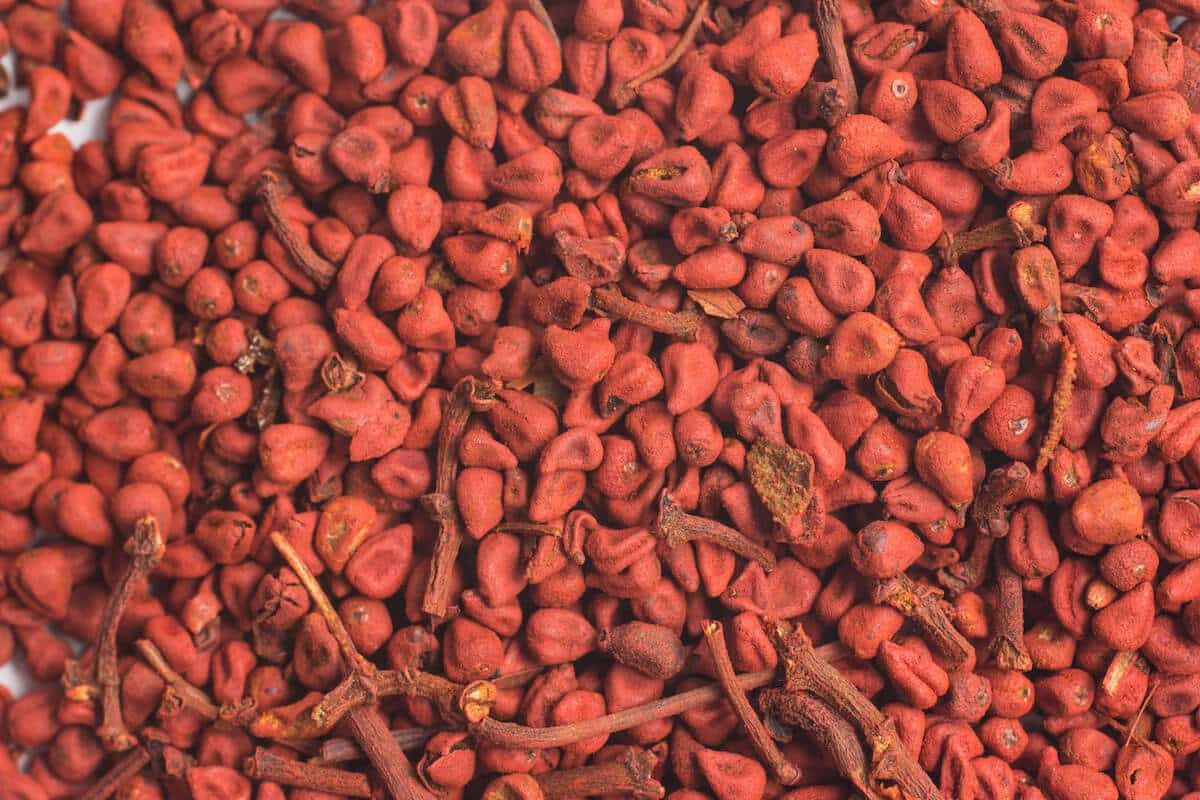
Annatto seeds come from Bixa orellana, a small tree native from Mexico to tropical South America.1 In most dishes their job is color, not flavor. Katzer notes that the dried seeds have a weak, perfumed smell and that their aroma is not carried into the food,2 and The Spice House describes the taste as nutty and mildly peppery.3 So a good substitute is mostly a matter of matching the color, and of getting that color into the right part of the dish.
Quick answer
| What annatto is doing | Best substitute | Starting amount, per 1 part annatto | Treatment |
|---|---|---|---|
| Any job, if you can get it | Achiote powder or achiote paste (the same seed) | Powder: about 1 part; paste: see below | Method |
| Red-orange color in oil, marinade or recado | Sweet paprika | 1 part, then adjust for color | Method |
| Golden color in rice or a stew | Turmeric | 1/4 part, then add for color | Method |
| Golden color, where cost is no object | Saffron | A small pinch of threads | Method |
| Yellow color with almost no flavor | Safflower | 1 part, then adjust for color | Method |
How the ratios on this page are labeled
Every ratio carries one of four labels.
- Computed: based on a measurable physical relationship, with the source named.
- Attributed: a named source publishes this ratio. We quote it as theirs.
- Disputed: named sources give different answers to the same swap. We show each one and do not average them.
- Method: we found no published ratio. We give a direction and a cautious starting point, and say so.
Every ratio on this page is Method. We found no credible source that publishes an amount for any annatto substitute. Because the job is color, the honest method is to add a little, look, and add more.
Why the form of the color matters
Annatto’s color comes from apocarotenoids, chiefly bixin, which can make up as much as 80 percent of the seed’s pigment.4 Bixin is oil-soluble, and its counterpart norbixin is water-soluble.4 That is why the traditional way to use the whole seeds is to fry them in fat: in the Caribbean the seeds are fried in animal or vegetable fat, and the colored fat is then used to cook vegetables or meat.2 The Spice House gives the same method for achiote oil: cook the seeds in hot oil until it turns bright yellow, then discard the seeds.3
How much pigment a seed holds varies widely; Katzer gives 2 to 5 percent of seed dry mass as common values.2 Two batches of annatto will not color a dish equally, which is one more reason to judge any substitute by eye.
If you can get the same seed in another form
Achiote powder or achiote paste
Achiote is the Mexican name for annatto, from Nahuatl.2 Ground annatto (achiote powder) is the same seed, and Katzer notes that cooks often soak whole seeds in hot water to soften them before grinding,2 which the powder spares you. In Mexico, much achiote is sold as a paste of annatto seeds with some preservatives, such as acetic acid.2 Yucatecan recado, the spice paste behind dishes called pibil, is made from annatto with other seasonings.2
Ratio (Method): We found no published conversion between whole annatto seeds and powder. Use about the same amount of powder as seeds, add it to warm oil or the marinade, and adjust by color. Paste is a blend, so its strength depends on the brand: start with a small spoonful, and remember it brings its own salt, acid and spices. Read the label.
If annatto is coloring oil, a marinade or recado red-orange
Sweet paprika
Paprika is the closest match for annatto’s red. Its color comes from carotenoids too, chiefly capsanthin and capsorubin, according to the FAO/WHO expert committee’s monograph on paprika extract.5 That shared pigment family is the best reason to reach for it. Where it falls short: paprika tastes of pepper, and hot paprika adds heat, so use a sweet (mild) one. Smoked paprika will add smoke.
In our kitchen judgment, paprika colors oil if it is stirred into warm, not hot, fat for a minute; it scorches and turns bitter quickly.
Ratio (Method): We found no published ratio. Start with the same amount of sweet paprika as the annatto called for, and adjust until the color looks right.
Paprika with a little turmeric
A mix of paprika and a small amount of turmeric pushes the color from red toward orange. This is a cook’s combination, not a tested one.
Ratio (Method): No published ratio was found. Start with 1 part paprika and a pinch of turmeric per part of annatto, and adjust by eye.
If annatto is turning rice or a stew golden
1. Turmeric
Turmeric’s yellow comes from curcumin.6 It is strong enough as a colorant that the US lists ground turmeric as a color additive in its own right.7 Where it falls short: it adds flavor that annatto does not. One reference describes turmeric’s taste as bitter and slightly acrid, yet sweet,8 and the color is yellow rather than annatto’s orange.
Ratio (Method): We found no published ratio. Start with about a quarter as much turmeric as annatto, and add more only if the color needs it. In our judgment, too much tastes bitter before the color looks wrong.
2. Saffron
Saffron is the dried stigma of the saffron crocus, and its coloring matter is crocin.9 It gives a golden color, which is the color annatto is often used to imitate: The Spice House calls annatto “a much cheaper substitute” for saffron’s golden coloring, adding that it does not replicate saffron’s flavor.3 Using saffron in place of annatto is that swap in reverse. Where it falls short: cost and flavor. Britannica calls it the most expensive spice in the world, and describes a strong aroma and a bitter taste.9 Saffron will change the dish’s flavor in a way annatto does not.
Ratio (Method): No published ratio was found. Start with a small pinch of threads steeped in a little warm water or broth, then add the liquid to the dish.
3. Safflower
Safflower florets bring color with almost no flavor. Katzer describes their taste as very weak and herbaceous and calls their value as a spice “nearly nil.”10 PROSEA describes safflower as a substitute for, and adulterant of, saffron as a food colorant, and names its yellow pigment, carthamidin, as water-soluble.11 Where it falls short: the color is yellow rather than red-orange, and Katzer calls it a poor imitation of saffron.10 Because its pigment is described as water-soluble, it suits rice or broth better than a coloring oil; that is our inference, not a tested result.
Ratio (Method): We found no published ratio. Start with the same volume of safflower as annatto, steeped in the cooking liquid, and adjust for color.
What isn’t known
- No credible source we found publishes a ratio for any annatto substitute. Every amount here is a starting point for adjusting by eye.
- No published conversion between whole annatto seeds, achiote powder and achiote paste was found.
- No source we read compares the coloring strength of annatto with paprika, turmeric, saffron or safflower.
- We found no source on whether turmeric, saffron or safflower color oil as annatto does.
Related
- Annatto seeds, achiote powder and cooking with annatto seeds
- Paprika and paprika substitutes
- Turmeric and turmeric substitutes
- Saffron, saffron substitutes and saffron vs. turmeric
- Safflower and safflower vs. saffron
- Sazón seasoning
Footnotes
-
Bixa orellana L., Plants of the World Online, Royal Botanic Gardens, Kew. powo.science.kew.org · Reference work ↩
-
Gernot Katzer, “Annatto (Bixa orellana L.)”, Gernot Katzer’s Spice Pages. gernot-katzers-spice-pages.com · Reference work ↩ ↩2 ↩3 ↩4 ↩5 ↩6 ↩7
-
“Annatto Seeds”, The Spice House. thespicehouse.com · Merchant ↩ ↩2 ↩3
-
Rivera-Madrid et al., “Carotenoid Derivates in Achiote (Bixa orellana) Seeds: Synthesis and Health Promoting Properties”, Frontiers in Plant Science, 2016. frontiersin.org · Peer-reviewed ↩ ↩2
-
Paprika extract, Chemical and Technical Assessment, 77th JECFA, FAO/WHO. fao.org · Regulator ↩
-
“Turmeric: Usefulness and Safety”, National Center for Complementary and Integrative Health, 2025. nccih.nih.gov · Regulator ↩
-
21 CFR 73.600, Turmeric, US Code of Federal Regulations. ecfr.gov · Regulator ↩
-
Prasad and Aggarwal, “Turmeric, the Golden Spice”, in Herbal Medicine: Biomolecular and Clinical Aspects, 2011. ncbi.nlm.nih.gov · Reference work ↩
-
“Saffron”, Encyclopaedia Britannica. britannica.com · Reference work ↩ ↩2
-
Gernot Katzer, “Safflower (Carthamus tinctorius L.)”, Gernot Katzer’s Spice Pages. gernot-katzers-spice-pages.com · Reference work ↩ ↩2
-
Oyen and Umali, Carthamus tinctorius, Plant Resources of South-East Asia (PROSEA). uses.plantnet-project.org · Reference work ↩