Cooking · Uses
Black Garlic Powder Uses: Rubs, Butter, Dips, Popcorn and Pasta
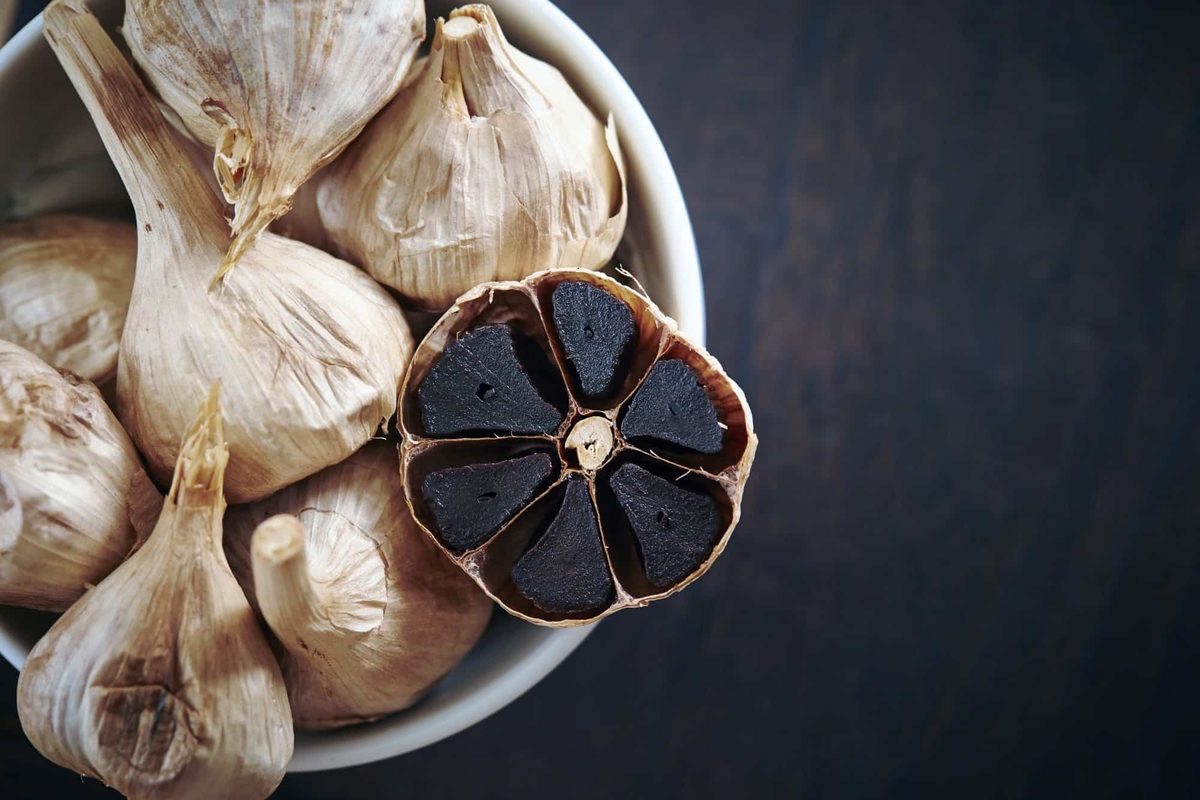
Black garlic powder is black garlic, dried and ground. Black garlic itself is whole garlic held for more than 10 days at 40 to 90°C and high humidity, with nothing added, until a Maillard reaction turns the cloves dark brown to black.1 Woodland Foods describes its powder as whole black garlic cloves, dried and pulverized,2 and both powders we checked list garlic plus silicon dioxide as an anti-caking agent.23
The thing to know before you cook with it: this is not a stronger garlic powder. It is a sweeter, milder one. Use it where you want garlic depth without garlic bite.
Quick guide
| Use | Why it fits | Basis |
|---|---|---|
| Dry rubs and seasoning mixes | Adds sweet, savory garlic depth to meat, fish and vegetables | Woodland Foods suggestion2 |
| Compound butter and garlic bread | Dark, mellow garlic flavor in a spread | Kitchen judgment; Woodland’s butter recipe uses whole cloves4 |
| Dips and spreads | Mixes into aioli or soft blue cheese | Woodland Foods suggestion2 |
| Popcorn and potato chips | Blended with salt as a seasoning | Woodland Foods suggestion2 |
| Roast potatoes | Tossed on before roasting | Woodland Foods suggestion2 |
| Vinaigrettes and pasta | Garlic flavor without raw sharpness | Kitchen judgment |
| Anywhere you need garlic’s bite | Not a good fit; use regular garlic powder | See below15 |
How it differs from regular garlic powder
Aging changes garlic in ways that carry through to the powder. The 2017 Molecules review of black garlic reports more total and reducing sugars than in fresh garlic, less allicin, and a sweet and sour taste with no strong odor.1 The South China Morning Post says black garlic lacks the very strong flavor of normal garlic.5
The merchants describe the powder the same way. Woodland Foods calls it sweet, almost caramel-like, with hints of balsamic vinegar or tamarind, and more mellow and complex than raw or toasted garlic powder.2 Old Town Spice Shop uses nearly the same words: sweet and potent, with balsamic or tamarind notes.3
So a common claim that black garlic powder is a more aggressive form of garlic powder gets it backwards. In a dish built on sharp garlic flavor, such as a classic garlic bread or aioli, black garlic powder adds sweetness and color but not punch. Many cooks use both.
Black garlic is often described as rich in umami, and some recipes treat it as a stand-in for Parmesan. We found no measurement of glutamate or other umami compounds in black garlic, so treat that as a taste impression, not a fact.
Dry rubs and seasoning mixes
Woodland Foods suggests adding the powder to spice and seasoning mixes for meat, fish and vegetables.2 In a rub it sits well with the usual partners, onion powder, paprika, black pepper and brown sugar; those pairings are kitchen judgment. We found no test of how the powder holds up over high, direct heat, so keep an eye on it on the grill.
Starting point (Method): no published ratio exists. Swap it in for about half the garlic powder in a rub you already like, taste the raw mix, and adjust.
When the rub goes on meat or poultry, cook to the federal safe minimum internal temperatures: 145°F with a 3-minute rest for beef, pork and lamb steaks, roasts and chops; 160°F for ground meat; 165°F for all poultry.6
Compound butter and garlic bread
Black garlic powder stirred into soft butter gives a dark, mellow garlic butter for bread, steak, grilled chicken or vegetables.
Starting point (Method): about 1 teaspoon of powder per ¼ cup (4 tablespoons) of softened butter, with salt to taste. That is a cautious kitchen starting point, not a tested ratio. Grated Parmesan is a common addition.
For comparison (Attributed): Woodland Foods’ black garlic compound butter uses whole black garlic cloves, not powder: 1½ tablespoons of black garlic cloves to ⅔ cup unsalted butter, with 2 teaspoons minced chives, 1 teaspoon parsley and 1 teaspoon kosher salt, pureed together.4 It suggests the butter for warm bread, roasted or grilled meats and roasted vegetables, and says to keep it refrigerated or frozen and serve it at room temperature.4
For garlic bread, spread the butter on and toast as usual. Because the powder lacks raw garlic’s bite,5 some cooks mix it with regular garlic powder or fresh garlic to keep that edge.
Dips, spreads and dressings
Woodland Foods suggests mixing black garlic powder into aioli or softened mild blue cheese for a spread or dip.2 It also works in creamy dressings and vinaigrettes. Whisk it in well and give it a few minutes to hydrate; a dry powder can stay gritty in a cold dressing (kitchen judgment).
Popcorn and chips
Woodland Foods suggests mixing the powder with salt to season popcorn or potato chips.2 Fine salt and powder stick best to popcorn tossed in a little melted butter or oil while still warm; that is common practice rather than a sourced finding.
Starting point (Method): equal parts fine salt and black garlic powder, then adjust to taste.
Roast potatoes and vegetables
Woodland Foods suggests tossing the powder with potatoes before roasting.2 The same approach works for carrots, cauliflower and mushrooms (kitchen judgment).
Pasta
Toss hot pasta with olive oil or butter, black garlic powder, black pepper and Parmesan, or leave out the cheese for a vegan version. The powder brings sweet, savory garlic notes rather than heat. This is a kitchen suggestion, not a sourced recipe.
What the labels say, and what they don’t
Woodland Foods describes its black garlic as fermented at high temperatures.2 The Molecules review describes black garlic production as heat and humidity with no additional treatment or additives, attributes the color to a Maillard reaction, and describes no microbial step.1 Its own term is “aged black garlic.” The black garlic profile covers how it is made in more detail.
Storage
We found no shelf-life figure for black garlic powder from a regulator or standards body. Keep it sealed, dry and away from heat, and follow the package date. Both commercial powders we checked add silicon dioxide as an anti-caking agent.23 A homemade powder has none, so an airtight jar matters more (kitchen judgment).
What isn’t known
- No published ratio for swapping black garlic powder for regular garlic powder.
- No measurement of umami compounds in black garlic or its powder.
- No test of how quickly the powder scorches on high heat.
- No shelf-life figure for the powder.
Related
- Black garlic, the full profile
- Garlic powder, garlic powder substitutes and granulated garlic vs. garlic powder
- Garlic powder vs. garlic and fresh garlic substitutes
- Too much garlic powder? How to fix the dish
Footnotes
-
Ji Hyeon Ryu and Dawon Kang, “Physicochemical Properties, Biological Activity, Health Benefits, and General Limitations of Aged Black Garlic: A Review”, Molecules, 2017. mdpi.com · Peer-reviewed ↩ ↩2 ↩3 ↩4
-
Black Garlic Powder, product page, Woodland Foods. shop.woodlandfoods.com · Merchant ↩ ↩2 ↩3 ↩4 ↩5 ↩6 ↩7 ↩8 ↩9 ↩10 ↩11 ↩12 ↩13
-
Black Garlic Powder, product page, Old Town Spice Shop. oldtownspiceshop.com · Merchant ↩ ↩2 ↩3
-
Black Garlic Compound Butter, recipe, Woodland Foods, 2019. shop.woodlandfoods.com · Merchant ↩ ↩2 ↩3
-
“Black garlic”, South China Morning Post. scmp.com · Publication ↩ ↩2 ↩3
-
Cook to a Safe Minimum Internal Temperature, FoodSafety.gov. foodsafety.gov · Regulator ↩