Spices · Profile
Black Garlic: How It’s Made, What It Tastes Like and What the Research Shows
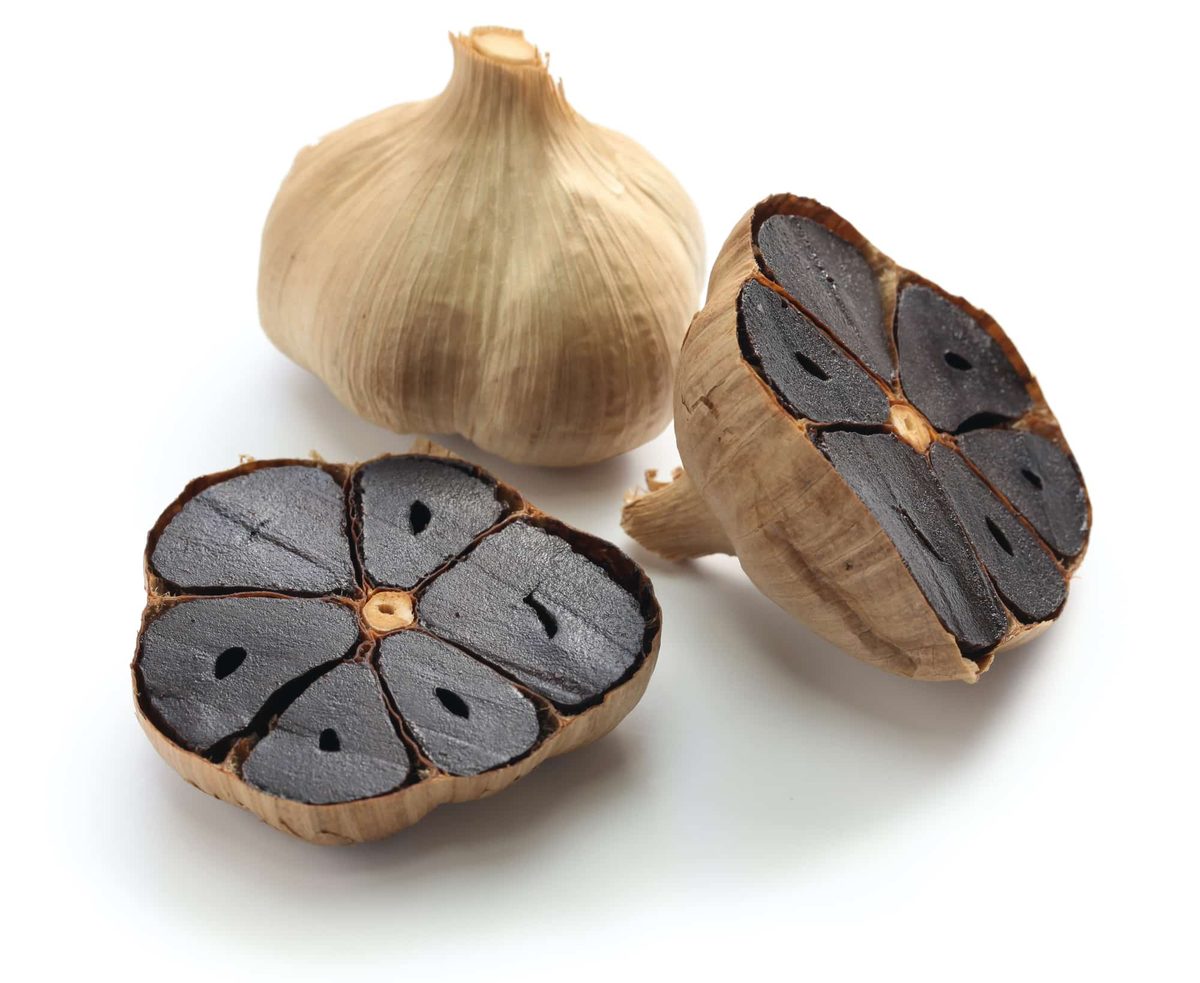
Black garlic is ordinary garlic, Allium sativum,1 held for days at warm temperatures and high humidity until the cloves turn black, soft and sweet. Nothing is added; the darkening comes from the Maillard reaction. The result tastes nothing like raw garlic: sweet, tangy and molasses-like, with almost none of garlic’s sharp bite.
At a glance
| What it is | Whole fresh garlic (Allium sativum) aged under controlled heat and humidity21 |
| Typical process | 40-90°C at 60-90% relative humidity, for more than 10 days2 |
| What happens | Maillard reaction: darkening, more sugars, less allicin2 |
| Additives | None2 |
| Flavor | Sweet and sour, with no strong odor; jelly-like texture2 |
| Notable compound | S-allyl cysteine, four to eight times higher than in fresh garlic2 |
| Forms sold | Whole bulbs, peeled cloves, paste, powder |
Measured values
1 figure, sourced| Measure | Value | Scope | Source |
|---|---|---|---|
| S-allyl cysteine (SAC) | about 9.8-11.4 mg per 100 g | black garlic, measurements cited in the 2017 Molecules review, depending on analytical methodSame measurements give fresh garlic about 2.2-2.3 mg per 100 g; review reports SAC four to eight times higher after aging | mdpi.com |
Each figure is quoted as its source states it, with the samples or standard it applies to. Where sources differ, both are shown; nothing is averaged. All measured values
How black garlic is made
A 2017 review in Molecules describes black garlic as fresh garlic processed in a temperature- and humidity-controlled room for more than 10 days, with no other treatment or additives.2 Production generally runs between 40 and 90°C at 60 to 90% relative humidity.2 One example schedule in the review steps the temperature down: two days at 90°C, four at 80°C, four at 60°C and one at 40°C.2 A Korean producer described in the South China Morning Post keeps the details secret but ages the garlic with hot air for 14½ days, dries it naturally for about 40 hours, then ages it again for 30 to 50 hours.3
Is it fermented?
Black garlic is often sold as “fermented,” but the process the review describes is heat and humidity alone, with no additional treatment or additives, and it attributes the dark brown color to a Maillard reaction set off by heating.2 It describes no microbial step. The review’s own term is “aged black garlic.”2
What changes in the clove
- Color. The white to pale yellow clove turns dark brown and eventually black.2
- Sugars. Total and reducing sugars are higher in black garlic than in fresh.2
- Allicin. Black garlic has less allicin than fresh garlic.2 In raw garlic, allicin forms within 10 to 60 seconds of crushing.4
- S-allyl cysteine (SAC). The review reports SAC four to eight times higher after aging. In the measurements it cites, fresh garlic held about 2.2-2.3 mg per 100 g and black garlic about 9.8-11.4 mg per 100 g, depending on the analytical method.2
Flavor and texture
The review describes black garlic as sweet and sour, with a jelly-like texture and no strong odor.2 The South China Morning Post calls the flavor creamy and molasses-like, somewhat sweet as well as savory and tangy, with a texture like soft, jelly-like fruit.3 It lacks the very strong flavor of normal garlic.3
Black garlic is often described as rich in umami; no measurement of glutamate or other umami compounds was found in the sources checked, so treat that as a taste impression.
Where it comes from
Garlic itself is ancient: ancient medical texts from Egypt, Greece, Rome, China and India mention it.5 Black garlic is a different matter. The Molecules review describes it only as recently introduced to Asian markets as a functional food.2 The South China Morning Post reports that Scott Kim began producing black garlic in South Korea in 2004, and that he did not invent the method.3
Beyond that, the history is murky. Claims that black garlic is a centuries-old Korean medicine, or traditional elsewhere in Asia, could not be traced to a source opened for this page.
How to use black garlic
Black garlic is used differently from fresh garlic, because it brings sweetness and depth rather than heat. These are kitchen judgments, not sourced findings:
- Mash into a paste with oil or butter and spread it on bread or stir it into sauces, dressings and mayonnaise.
- Slice thinly over pizza, salads, rice bowls or cheese plates.
- Whisk into pan sauces and glazes for meat or roasted vegetables, where its molasses note fits.
- Use the powder in rubs and seasoning blends. See black garlic powder uses.
It does not replace fresh garlic one for one in a dish that relies on garlic’s sharpness. For that job, see fresh garlic substitutes.
Health research
Most of the research on black garlic is laboratory and animal work. The Molecules review notes that its therapeutic effects have been shown in many types of cells and animal models, and that its components have not yet been fully analyzed.2 What the review reports:
| Finding | Kind of evidence |
|---|---|
| Stronger than fresh garlic in several antioxidant assays (DPPH, ABTS, hydroxyl radical scavenging, reducing power, SOD activity)2 | Laboratory assays |
| Weaker than fresh garlic in Fe2+-chelating activity; nitrite-scavenging results conflict between studies2 | Laboratory assays |
| Lower anti-inflammatory, anti-coagulation, immunomodulatory and anti-allergic effects than raw garlic2 | Mostly cell and animal studies |
| Reduced blood lipid measures after 12 weeks of supplementation in patients with mild hypercholesterolemia2 | One human trial cited in the review |
So black garlic is not simply “stronger” garlic: it scores higher on some antioxidant tests and lower on several other activities. This page makes no claim that black garlic prevents or treats any disease. For what NIH says about garlic in general, including supplements, see the garlic profile; NCCIH’s summary covers garlic, not black garlic specifically.6
Buying and storage
Good black garlic is uniformly dark, soft and moist; that is kitchen judgment rather than a standard. No regulator or standards body was found giving a shelf life; follow the package date and keep opened product sealed. For black garlic powder, check the ingredient list for anything besides garlic.
Related pages
Footnotes
-
Allium sativum L., Plants of the World Online, Royal Botanic Gardens, Kew. powo.science.kew.org · Reference work ↩ ↩2
-
Ji Hyeon Ryu and Dawon Kang, “Physicochemical Properties, Biological Activity, Health Benefits, and General Limitations of Aged Black Garlic: A Review”, Molecules, 2017. mdpi.com · Peer-reviewed ↩ ↩2 ↩3 ↩4 ↩5 ↩6 ↩7 ↩8 ↩9 ↩10 ↩11 ↩12 ↩13 ↩14 ↩15 ↩16 ↩17 ↩18 ↩19 ↩20 ↩21 ↩22
-
“Black garlic”, South China Morning Post. scmp.com · Publication ↩ ↩2 ↩3 ↩4
-
Garlic, Linus Pauling Institute Micronutrient Information Center, Oregon State University. lpi.oregonstate.edu · Reference work ↩
-
Rivlin, “Historical perspective on the use of garlic”, Journal of Nutrition, 2001. synapse.mskcc.org · Peer-reviewed ↩
-
Garlic: Usefulness and Safety, National Center for Complementary and Integrative Health. nccih.nih.gov · Regulator ↩