Spice Comparisons · Comparison
Granulated Garlic vs. Garlic Powder: Same Dried Garlic, Different Grind
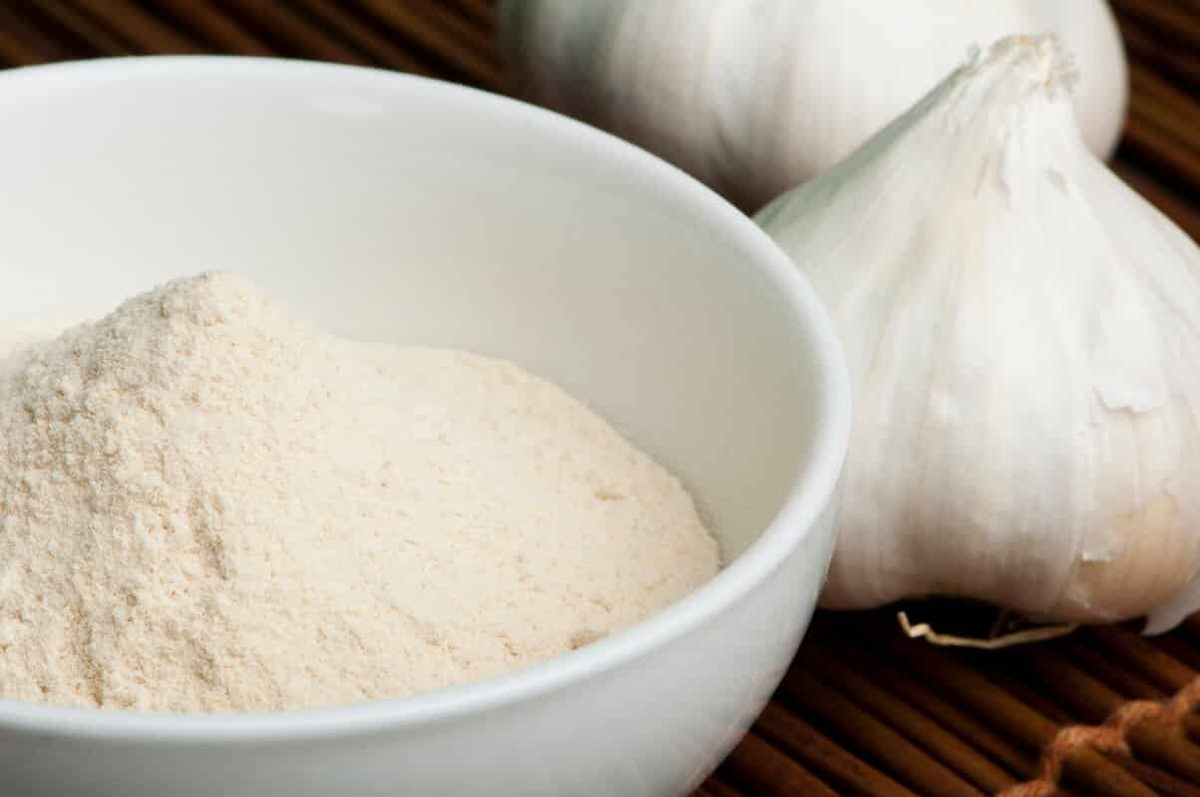
Granulated garlic and garlic powder are the same thing at different grinds. America’s Test Kitchen says both are made from garlic cloves that are dehydrated and then ground, with garlic powder having “a negligibly finer texture.”1 Other sources describe a bigger gap and say you need about half as much powder as granulated garlic,2 but nobody has published a measurement. In practice, the choice is about texture and how the garlic disperses, and the swap is close to even.
Side by side
| Granulated garlic | Garlic powder | |
|---|---|---|
| Made from | Garlic, Allium sativum,3 dehydrated and ground1 | Same1; cloves are usually sliced and dried at low temperature before milling4 |
| Texture | Coarser than common garlic powders (The Spice House, of its own product);5 “like fine sand” (The Takeout)2 | “Almost like soft dust” (The Takeout);2 “negligibly finer” than granulated (ATK)1 |
| One teaspoon weighs | No published figure found | 3.1 g (USDA)6 |
| Equal to one small clove | 1/4 tsp, for The Spice House’s own product5 | 1/8 tsp (NDSU, NMSU)78 |
| Flavor chemistry | Alliin and alliinase, which make allicin once wet9 | Same9 |
| In liquids | No source tested | Blends into sauces quickly (The Takeout)2 |
| Storage | Airtight container (UC ANR, for dried garlic)10 | Same10 |
| Price | No dated, sourced comparison found | No dated, sourced comparison found |
The per-clove row mixes sources: The Spice House’s figure is for its own granulated garlic, and the extension figures are for powder in general. Read it as a direction, not a conversion. For powder on its own, see garlic powder.
The difference is grind size, and how much it matters is disputed
Both products are dried garlic. The sources agree that granulated is the coarser of the two;152 they disagree on how much that matters.
- ATK calls powder’s finer texture “negligible.”1
- The Takeout’s Creshonda A. Smith describes the difference as fine dust versus fine sand, writes that perceived potency is directly related to how finely the garlic is ground, and says the coarser granules take longer to release their flavor.2 That is the writer’s assessment; the article cites no test.
Neither source measured particle size, weight per spoonful or flavor release, and we found no source that did. A commonly repeated explanation says coarse granules trap more air, so a spoonful holds less garlic. That is plausible, but no one has published the weights to show it.
What both share is the chemistry. Dried garlic holds alliin and the enzyme alliinase, which make allicin, the main flavor compound, once the garlic is wet.9 ATK found that garlic powder straight from the jar has not developed its full flavor and recommends stirring it into an equal amount of water first.9 Powder sautéed in butter before it met any moisture had almost no garlic flavor at all.11 We found no equivalent test on granulated garlic. Our judgment is to treat it the same way, since it is the same dried garlic, but that is untested.
Can one stand in for the other?
Yes. The question is only how much.
Ratio (Disputed):
| Source | What it says |
|---|---|
| The Takeout (Smith, 2025)2 | Use about half as much garlic powder as granulated garlic |
| America’s Test Kitchen1 | Powder’s texture is “negligibly finer”; gives no conversion |
| The Spice House, its granulated garlic5 | 1/4 tsp equals one small clove |
| NDSU and NMSU Extension, garlic powder78 | 1/8 tsp equals one small clove |
The last two rows come from different sources and products, so they hint at the same direction as The Takeout without confirming it. Clove equivalents for powder also disagree among themselves: McCormick gives both 1/4 and 1/8 teaspoon per clove on the same product page.12 See garlic powder vs. garlic for that table.
Our starting point (Method):
- Granulated in place of powder: start with the same amount, taste after it has had time to hydrate, and add up to double.
- Powder in place of granulated: start with about half, then taste and add up to the same amount.
Those ranges are ours, set between the sources above. They are not measurements.
Which to use where
No source has tested these uses; the following are cooks’ judgments.
- Spice rubs and blends: either works. Many cooks prefer granulated garlic in coarse barbecue rubs; that is a preference, not a tested result.
- Shakers and toppings: in our judgment granulated garlic pours more freely from a shaker.
- Sauces, dressings, dips and butters: powder disperses quickly, as The Takeout notes.2 For either form, hydrating it in a little water first helps.9
- Marinade injectors: powder is less likely to clog a fine needle.
- Hot oil or a dry pan: neither. Ground spices don’t fare well under intense heat and can turn bitter,13 and powder that met heat before moisture lost most of its flavor in ATK’s test.11 Add dried garlic with liquid or after other aromatics.
Nutrition
At seasoning amounts neither adds meaningful nutrition. USDA analyzes garlic powder (per 100 g: 9.0 g fiber, 1.65 mg vitamin B6, 5.65 mg iron);6 a teaspoon weighs 3.1 g, so it supplies about 0.05 mg of B6 and 0.18 mg of iron by our arithmetic. We found no USDA record for granulated garlic. Whether the two differ nutritionally has not been measured.
What isn’t known
- No published measurement of particle size, bulk density or weight per teaspoon for granulated garlic, so there is no Computed conversion between the two.
- No test of whether the coarser grind releases flavor more slowly, or of hydrating granulated garlic.
- No source on how widely anticaking agents are used in plain granulated garlic or powder; check the label.
- We could not open an international standard for dried garlic, so no official grade or particle-size definitions are given here.
Related
- Garlic powder, garlic and garlic salt
- Garlic powder substitutes and fresh garlic substitutes
- Garlic powder vs. garlic and garlic powder vs. garlic salt
- Onion powder, how to dry garlic and too much garlic powder
Footnotes
-
Garlic Substitutes, America’s Test Kitchen. americastestkitchen.com · Publication ↩ ↩2 ↩3 ↩4 ↩5 ↩6 ↩7
-
Creshonda A. Smith, What’s The Actual Difference Between Garlic Powder And Granulated Garlic?, The Takeout, 2025. thetakeout.com · Publication ↩ ↩2 ↩3 ↩4 ↩5 ↩6 ↩7 ↩8
-
Allium sativum L., Plants of the World Online, Royal Botanic Gardens, Kew. powo.science.kew.org · Reference work ↩
-
Garlic, Linus Pauling Institute Micronutrient Information Center, Oregon State University. lpi.oregonstate.edu · Reference work ↩
-
Granulated Garlic product page, The Spice House. thespicehouse.com · Merchant ↩ ↩2 ↩3 ↩4
-
Spices, garlic powder (FDC ID 171325), USDA FoodData Central. fdc.nal.usda.gov · Regulator ↩ ↩2
-
Julie Garden-Robinson, Ingredient Substitutions (FN198), NDSU Extension, 2018. ksre.ksu.edu · Reference work ↩ ↩2
-
In a Pinch Ingredient Substitution (E-131), NMSU Cooperative Extension, 2016. pubs.nmsu.edu · Reference work ↩ ↩2
-
Carolyn Grillo, For Great Garlic Bread, Hydrate Your Garlic Powder First, America’s Test Kitchen, 2021. americastestkitchen.com · Publication ↩ ↩2 ↩3 ↩4 ↩5
-
Linda J. Harris, Garlic: Safe Methods to Store, Preserve, and Enjoy, UC Agriculture and Natural Resources, 2016. ccfruitandnuts.ucanr.edu · Reference work ↩ ↩2
-
Experiment: Bringing Out the Best in Garlic Powder, America’s Test Kitchen. americastestkitchen.com · Publication ↩ ↩2
-
McCormick Gourmet Organic Garlic Powder product page, McCormick. mccormick.com · Merchant ↩
-
Marco Rossi, How To Improvise Instant Pot Seasoning Without Burning Your Spices, Tasting Table, 2023. tastingtable.com · Publication ↩