Spice Comparisons · Comparison
Garlic Powder vs. Fresh Garlic: Flavor Chemistry, Clove Equivalents and When to Use Each
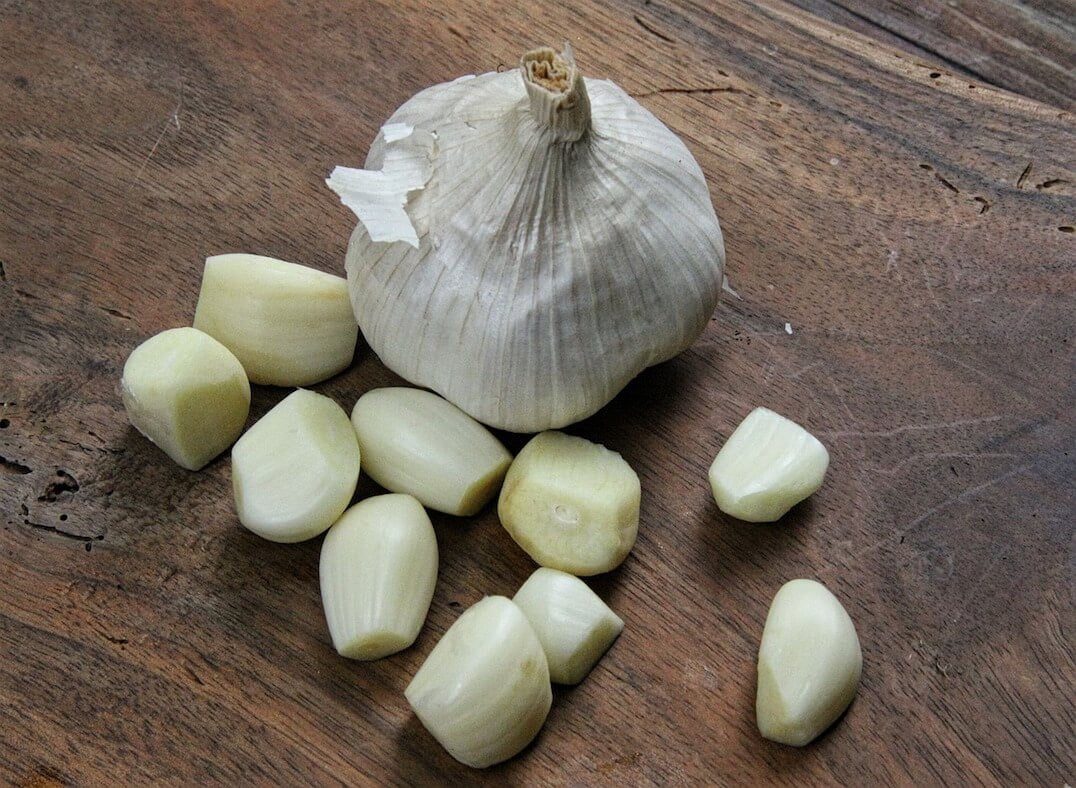
Fresh garlic and garlic powder come from the same plant, Allium sativum,1 and depend on the same reaction for their flavor: the enzyme alliinase turning a compound called alliin into allicin. The difference is when that reaction happens. In a fresh clove it starts the moment you cut it and is complete within seconds.2 In garlic powder the enzyme and alliin sit dormant until the powder gets wet.3 That timing explains most of what cooks notice: fresh garlic’s sharper bite, powder’s flatter taste straight from the jar, and why powder dropped into a hot, dry pan can lose nearly all its flavor.4
Side by side
| Fresh garlic | Garlic powder | |
|---|---|---|
| What it is | Cloves of the bulb of Allium sativum1 | Cloves usually sliced, dried at low temperature and ground2 |
| When the flavor forms | On cutting or crushing; complete within 10 to 60 seconds of crushing2 | Once the powder is wet; water activates alliin and alliinase to make allicin3 |
| Effect of heat | Heat inactivates alliinase,2 so heating whole cloves to 140°F or above takes away much of the raw bite5 | Powder heated in butter before it met moisture had almost no garlic flavor at all (ATK)4 |
| Water, per 100 g (USDA) | 58.6 g6 | 6.45 g7 |
| Weights (USDA) | 1 clove = 3 g6 | 1 teaspoon = 3.1 g7 |
| Equal to one clove | 1/8 to 1/4 teaspoon; sources disagree (see below) | |
| Storage | 3 to 5 months cool (60°F), dry and dark; not in the refrigerator, which stimulates sprouting (UC ANR)8 | Airtight container (UC ANR); no regulator or standards body gives a shelf life8 |
| Flavor (editorial) | Hot and sharp raw; sweet and mellow cooked gently; nutty when browned | Rounder and sweeter than raw garlic, without the browned notes |
| Food-safety point | Garlic in oil is a botulism risk (see below)8 | |
| Price | No dated, sourced comparison found | No dated, sourced comparison found |
For each form on its own, see garlic and garlic powder.
Why they taste different
How you cut fresh garlic changes it. America’s Test Kitchen ranks whole cloves as the mildest, then sliced, then minced, with paste the sharpest, and notes that minced garlic left sitting keeps developing stronger flavor.9 That fits the chemistry: more cell damage, more of the enzyme reaching alliin.2 Allicin itself is unstable and breaks down into a range of other sulfur compounds,2 which is part of why raw, resting and cooked garlic all taste different.
Powder needs water first. ATK found that garlic powder straight from the jar has not developed its full flavor, and recommends stirring it into an equal amount of water before using it.3 In its experiment, powder stirred dry into mashed potatoes tasted “harsh and garlicky but not particularly complex,” and powder sautéed in butter before it met any moisture had almost no garlic flavor at all, because the heat got to the enzyme first.4
Heat works on both, from different starting points. With fresh garlic, heat stops the enzyme, so cooking whole or sliced cloves gives a milder, sweeter result than raw.25 ATK’s tests found that blanching or microwaving cloves to 140°F or above tamed the bite, and toasting in a dry skillet worked least well.5 Minced garlic added to a hot pan too early can burn and turn acrid and bitter, so ATK adds it after onions or other vegetables have softened.10 Ground spices in general don’t fare well under intense heat,11 so the same caution applies to powder.
When fresh matters most. ATK compared dried garlic products with fresh minced garlic in a Caesar salad, its croutons, and garlic bread. Its verdict: “When garlic is a predominant flavor in a recipe, nothing comes close to fresh,” though where garlic is a background flavor any dried garlic product except garlic salt will do in a pinch.12 Of the dried forms, its tasters liked garlic powder best.12
How much powder replaces a clove
Published equivalents disagree, sometimes on the same page:
| Source | Garlic powder | Fresh garlic |
|---|---|---|
| NDSU Extension, FN19813 | 1/8 tsp | 1 small clove |
| NMSU Extension, E-13114 | 1/8 tsp | 1 small clove |
| McCormick organic garlic powder page, product details15 | 1/4 tsp | 1 clove |
| McCormick organic garlic powder page, image tip15 | 1/8 tsp | 1 clove |
These are round-number kitchen rules, not measurements, and they don’t agree on clove size. Three more sources fall on the same two figures: UC Agriculture and Natural Resources gives 1/8 teaspoon for a medium clove,8 McCormick’s spice conversion chart gives 1/8 teaspoon per clove,16 and ATK gives 1/4 teaspoon per clove.12 None of them measured flavor strength.
Our starting point (Method): 1/8 teaspoon of powder per clove, hydrated, then taste and add more. Going the other way, use one small clove for every 1/8 teaspoon of powder a recipe calls for. A clove weighs about 3 g by USDA’s figure;6 1/8 teaspoon of powder weighs about 0.4 g by our arithmetic from USDA’s 3.1 g per teaspoon.7 Powder is dried garlic, so the weights aren’t meant to match, but the gap shows how concentrated it is.
Can one stand in for the other?
| Swap | Starting amount | Treatment | Works best for |
|---|---|---|---|
| Powder for fresh | 1/8 tsp per clove | Disputed (table above) | Soups, sauces, braises and rubs where garlic is in the background12 |
| Fresh for powder | 1 small clove per 1/8 tsp | Disputed (table above) | Wet dishes; grated to a paste for butters and dips |
| Dried minced garlic for fresh | 1/4 tsp per small clove (NDSU); 1/4 tsp per medium clove (UC ANR) | Attributed138 | Starting a sauté, where powder would scorch |
- In a rub, blend or seasoned flour, powder does a job fresh garlic can’t: it stays dry and spreads evenly. That is kitchen judgment.
- In garlic bread, dressings and compound butter, fresh garlic grated to a paste works, and so does powder hydrated first.3 ATK’s crouton and garlic bread tests are where dried garlic fell furthest behind.12
- Starting a sauté, add fresh garlic after the onions soften,10 or use dried minced garlic. Keep powder out of a hot, dry pan.4
More swaps are on garlic powder substitutes and fresh garlic substitutes.
Nutrition: what drying changes
At cooking amounts, neither form adds meaningful nutrition. USDA’s records show what drying does to the composition, with one caution: these are two separate analyses of different samples, not the same garlic measured before and after drying.
| Per 100 g (USDA) | Garlic, raw6 | Garlic powder7 |
|---|---|---|
| Water | 58.6 g | 6.45 g |
| Energy | 149 kcal | 331 kcal |
| Fiber | 2.1 g | 9.0 g |
| Vitamin C | 31.2 mg | 1.2 mg |
| Vitamin B6 | 1.24 mg | 1.65 mg |
| Potassium | 401 mg | 1,190 mg |
| Sodium | 17 mg | 60 mg |
Most of the differences come from water: take it out and everything else is concentrated. Vitamin C is the exception. By our arithmetic, raw garlic carries about 75 mg of vitamin C per 100 g of dry matter, and the powder about 1.3 mg, so almost none of it shows up in the powder record. Other nutrients don’t line up as neatly, which is what you would expect from two different samples. A clove (3 g) of raw garlic supplies under 1 mg of vitamin C,6 so in practice the loss doesn’t matter much.
On allicin, the Linus Pauling Institute notes that most garlic powder tablets tested produce little allicin.2 That finding concerns supplement tablets, not kitchen powder, and we found no measurement of allicin yield from culinary garlic powder.
Health claims
Garlic’s health research mostly uses supplements, often garlic powder in tablets, rather than food. The NIH’s National Center for Complementary and Integrative Health summarizes it cautiously: supplements may reduce total and LDL cholesterol a little in people with high cholesterol, limited evidence suggests they may reduce blood pressure in people with hypertension, and eating garlic does not seem to reduce the risk of stomach cancer.17 Nothing reviewed here shows that fresh garlic in food is healthier than garlic powder in food, or that either treats or prevents disease. NCCIH also notes that garlic supplements may increase the risk of bleeding.17
Safety: garlic in oil
Fresh garlic carries the one real food-safety hazard in everyday garlic use. UC Agriculture and Natural Resources warns that garlic in oil provides an ideal environment for Clostridium botulinum, the bacterium that causes botulism, and the same hazard applies to roasted garlic stored in oil.8 Its rules: do not store garlic in oil at room temperature; refrigerate it for no more than 4 days, or freeze it.8 Commercial garlic-in-oil products are made under strict guidelines that home kitchens can’t reproduce.8
What isn’t known
- No source measures the flavor strength of garlic powder against fresh garlic. Every clove equivalent is a rule of thumb.
- No measurement of allicin formed by culinary garlic powder versus fresh garlic was found.
- USDA’s raw and powder records are separate samples, so the nutrient table is not a before-and-after measurement of drying.
- No regulator or standards body gives a shelf life for garlic powder.
Related
- Garlic and garlic powder
- Garlic powder substitutes and fresh garlic substitutes
- Garlic powder vs. garlic salt and granulated garlic vs. garlic powder
- Garlic vs. ginger and onion powder vs. onion
- Too much garlic, too much garlic powder and how to dry garlic
Footnotes
-
Allium sativum L., Plants of the World Online, Royal Botanic Gardens, Kew. powo.science.kew.org · Reference work ↩ ↩2
-
Garlic, Linus Pauling Institute Micronutrient Information Center, Oregon State University. lpi.oregonstate.edu · Reference work ↩ ↩2 ↩3 ↩4 ↩5 ↩6 ↩7 ↩8
-
Carolyn Grillo, For Great Garlic Bread, Hydrate Your Garlic Powder First, America’s Test Kitchen, 2021. americastestkitchen.com · Publication ↩ ↩2 ↩3 ↩4
-
Experiment: Bringing Out the Best in Garlic Powder, America’s Test Kitchen. americastestkitchen.com · Publication ↩ ↩2 ↩3 ↩4
-
Taking the Bite out of Garlic, America’s Test Kitchen. americastestkitchen.com · Publication ↩ ↩2 ↩3
-
Garlic, raw (FDC ID 169230), USDA FoodData Central. fdc.nal.usda.gov · Regulator ↩ ↩2 ↩3 ↩4 ↩5
-
Spices, garlic powder (FDC ID 171325), USDA FoodData Central. fdc.nal.usda.gov · Regulator ↩ ↩2 ↩3 ↩4
-
Linda J. Harris, Garlic: Safe Methods to Store, Preserve, and Enjoy, UC Agriculture and Natural Resources, 2016. ccfruitandnuts.ucanr.edu · Reference work ↩ ↩2 ↩3 ↩4 ↩5 ↩6 ↩7 ↩8
-
Carolyn Grillo, The Strength of Garlic’s Flavor Depends on How You Cut It, America’s Test Kitchen, 2022. americastestkitchen.com · Publication ↩
-
Liz Bomze, Why You Should Wait to Add Garlic, America’s Test Kitchen, 2023. americastestkitchen.com · Publication ↩ ↩2
-
Marco Rossi, How To Improvise Instant Pot Seasoning Without Burning Your Spices, Tasting Table, 2023. tastingtable.com · Publication ↩
-
Garlic Substitutes, America’s Test Kitchen. americastestkitchen.com · Publication ↩ ↩2 ↩3 ↩4 ↩5
-
Julie Garden-Robinson, Ingredient Substitutions (FN198), NDSU Extension, 2018. ksre.ksu.edu · Reference work ↩ ↩2
-
In a Pinch Ingredient Substitution (E-131), NMSU Cooperative Extension, 2016. pubs.nmsu.edu · Reference work ↩
-
McCormick Gourmet Organic Garlic Powder product page, McCormick. mccormick.com · Merchant ↩ ↩2
-
How to Grind Your Own Spices, Plus Spice Conversions, McCormick, 2025. mccormick.com · Merchant ↩
-
Garlic: Usefulness and Safety, National Center for Complementary and Integrative Health, 2025. nccih.nih.gov · Regulator ↩ ↩2