Cooking · Fix
Too Much Garlic Powder? How to Fix It, Fastest Fix First
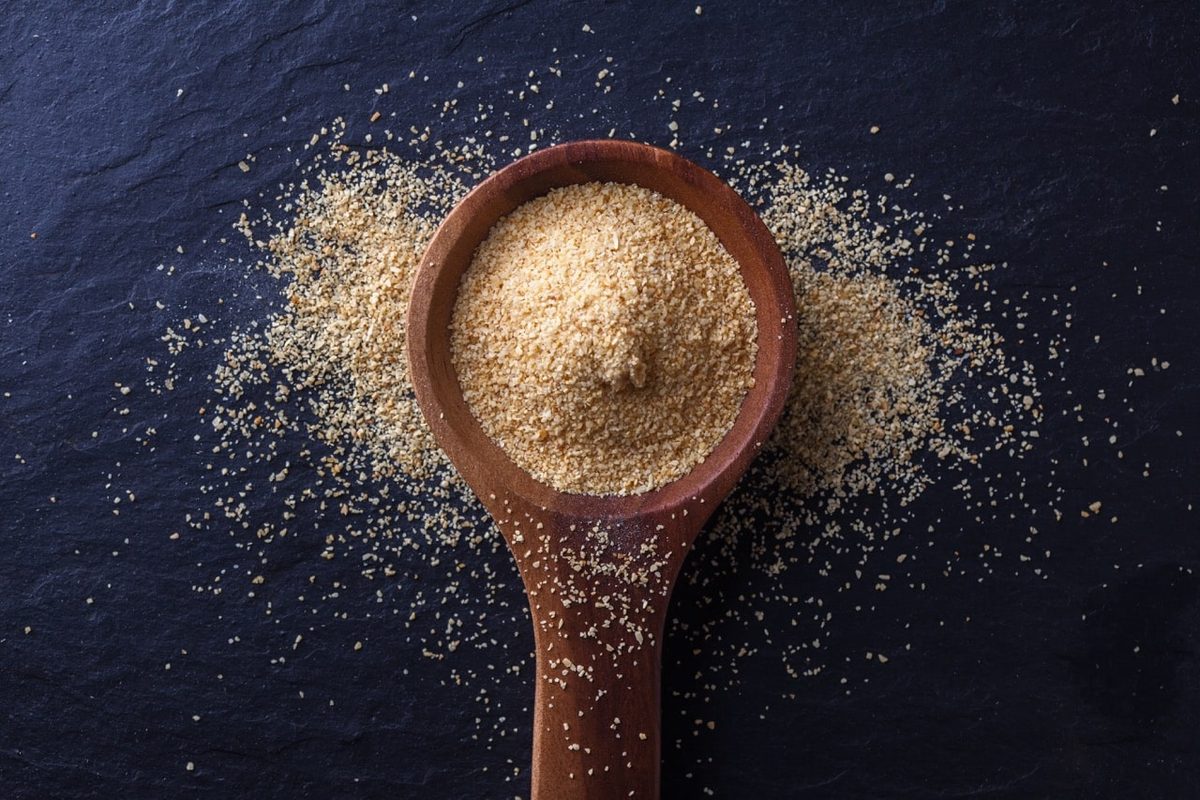
Too much garlic powder usually means one of three problems: the garlic tastes raw and harsh, the powder scorched and the dish tastes bitter, or there is simply too much garlic for everything else in the pot. The fix depends on which one you have, so taste first and match the problem below. Within each section the fastest fix comes first.
Quick answer
| What’s wrong | Fastest fix | If that’s not enough |
|---|---|---|
| Too much garlic, overall | Add more of everything else, or make a garlic-free second batch and combine | Balance with acid, sweetness, fresh herbs or something creamy |
| Sharp, raw garlic bite (dips, dressings, rubs) | Dilute with more of the base | Brighten with lemon or vinegar; add fresh herbs |
| Bitter or acrid (powder scorched in the pan) | Move the food to a clean pan without scraping the bottom | A little sweetness or salt; start the fat over if it still tastes burnt |
| Caked on the outside of meat or vegetables | Scrape or wipe off the excess, then re-season lightly | Don’t rinse raw meat or poultry under the tap |
Sheer volume: too much garlic for the dish
Dilute. This is the one fix that actually lowers the amount of garlic in each bite rather than disguising it. Add more liquid (water, stock, tomatoes) to a soup or sauce, or more of the main ingredients to a stew, braise or casserole. If you can’t add to the dish without changing it, Tasting Table suggests cooking a second batch with no garlic and combining the two.1 Two equal batches leave you with half the concentration, and more food. Freeze the extra.
Balance with acid. A squeeze of lemon or lime, or a splash of vinegar, won’t remove garlic, but a bright, sour note gives your palate something else to register. Tasting Table’s guide recommends a fresh squeeze of lemon at the end, along with vinegar.1 Use lime in Mexican or Southeast Asian dishes where it already belongs. No source we found explains a chemical reason acid would weaken garlic flavor, so treat this as a balancing technique, not a neutralizer.
Add sweetness, carefully. The same guide suggests a little honey or sugar to soften garlic’s sharp, sometimes bitter edge.1 Use it in dishes that already carry some sweetness: barbecue sauce, glazes, sweet-and-sour or General Tso’s-style sauces, tomato sauce.
Layer in fresh herbs or other aromatics. Parsley, basil, cilantro, chives or scallions stirred in at the end add a fresh note that competes with the garlic.1 Choose whatever fits the dish.
Add something creamy. Sour cream, yogurt, cream or cheese in a dairy-friendly dish, or coconut milk in a Thai or other dish where dairy would be out of place. Treat this as kitchen judgment: it adds volume and a rich, mild flavor that softens the overall impression. We could not find a source showing that dairy or fat chemically binds garlic’s flavor compounds, so we won’t claim it does.
Harsh, raw garlic bite
In our judgment, this shows up most in things that never get cooked after the powder goes in: dips, dressings, compound butter, popcorn seasoning, a dry rub tasted before cooking.
Some background helps here. Garlic powder is made from garlic dried at low temperature so that its flavor-making enzyme, alliinase, survives.2 The enzyme sits dormant in the dry powder and becomes active again once the powder meets water, producing allicin, the main compound behind garlic’s flavor.34 In America’s Test Kitchen’s experiment, garlic powder stirred straight into mashed potatoes tasted “harsh and garlicky but not particularly complex.”3
Dilute first. Double the base of the dip or dressing (more sour cream, mayonnaise, yogurt, oil and vinegar) and adjust the other seasonings to match.
Brighten it. Lemon juice, vinegar and fresh herbs help a raw-tasting dip the same way they help a cooked dish.1
What heat can and can’t do. Heat inactivates alliinase.2 ATK found that garlic powder sautéed in butter before it met any moisture ended up with almost no garlic flavor, because the heat destroyed the enzyme before it could make allicin.3 That is useful for prevention (see below), but it does not tell you what happens if you heat a dip that already has hydrated garlic powder in it. We found no test of that, so we can’t promise that warming a dish will tame raw garlic that is already there.
Bitter or acrid: the powder scorched
Ground spices go from fragrant to burnt quickly in a hot, dry pan, and burnt spices turn bitter.5 Typical ways it happens: garlic powder sprinkled into hot oil, or a heavily seasoned rub on a ripping-hot pan. Fresh garlic does the same: ATK warns that minced garlic added to the pan too early can burn and turn acrid and bitter.6
Get the food out of the burnt pan. Transfer soup, sauce or sautéed food to a clean pan, leaving the scorched layer behind. Don’t scrape the bottom, which only adds more burnt flavor.7 Then taste: the dish may be fine.
Blunt what bitterness is left. In controlled taste tests, sweet tastes and sodium salts both suppressed bitterness, with sugar the strongest suppressor of other tastes; citric acid was the weakest and did not significantly suppress the others.8 Those are laboratory results with pure taste solutions, not a test on food, but they point the same way as kitchen practice: a pinch of sugar or honey, or a little more salt if the dish can take it, is more likely to help bitterness than a squeeze of lemon.87
If it’s still acrid, start that step over. If the oil or butter you bloomed the powder in tastes burnt and the dish hasn’t gone far yet, discard it and redo that step. In our judgment that beats trying to mask a strong burnt taste.
Caked on the surface
When the powder sits on the outside of a roast, chicken pieces or roasted vegetables, dilution won’t reach it.
Scrape or wipe off the excess with a knife or paper towel, then re-season lightly. Vegetables can also be tossed with a fresh batch of unseasoned vegetables.
Don’t rinse raw meat or poultry. Rinsing excess seasoning off a roast under the tap is sometimes suggested, but the USDA does not recommend washing raw poultry, beef, pork, lamb or veal before cooking, because splashing spreads bacteria around the kitchen, and its research found rinsing raises the risk of cross-contamination.9 Scrape it instead.
Fixes that don’t hold up
A potato in the pot. The idea that a raw potato absorbs excess flavor comes from the oversalted-soup trick. Even for salt the evidence is thin: a Tasting Table writer who uses it calls the potato “more of an aid than a final answer” and says it won’t remove all the salt.10 We found no test of a potato against garlic. What a potato does do is add bland bulk, so if you like potato in the dish, leave it in and count it as dilution.
Onion powder to “cancel out” garlic. Onion and garlic are close relatives in the genus Allium.1112 In our judgment, that kinship is exactly why adding onion powder won’t reduce a garlic overdose: it piles on more pungent allium flavor. It is sometimes said that onion powder has about the same flavor concentration as garlic powder, so you can add an equal amount; we found no source that supports this. If you want a rounder allium flavor, add a little and taste, but don’t count on it as a fix.
Preventing it next time
Know how much powder replaces a clove, and know that the answer varies. Published equivalents disagree, sometimes on the same page:
| Source | Garlic powder | Fresh garlic |
|---|---|---|
| NDSU Extension, FN19813 | 1/8 tsp | 1 small clove |
| NMSU Extension, E-13114 | 1/8 tsp | 1 small clove |
| McCormick organic garlic powder page, product details15 | 1/4 tsp | 1 clove |
| McCormick organic garlic powder page, image tip15 | 1/8 tsp | 1 clove |
These are round-number kitchen rules, not measurements, and they don’t agree on clove size: two specify a small clove. None of these sources measured the flavor of powder against fresh garlic. The safest reading: start at 1/8 teaspoon per clove a recipe calls for, taste, and add more if you want it. It’s easy to add powder and hard to take it out. More on the differences in garlic powder vs. fresh garlic and granulated garlic vs. garlic powder. No source we found gives a measured volume conversion between granulated and powdered garlic.
Hydrate the powder first, then taste. Dry garlic powder hasn’t developed its full flavor yet.4 If you season a quick dish with dry powder and taste right away, it can seem weak, which tempts you to add more before the powder has had a chance to take up moisture from the food. ATK’s fix is to stir the powder into an equal amount of water before using it.4 Do that, wait a moment, and you’ll be tasting something closer to the final flavor.
Keep it out of a hot, dry pan. Ground spices scorch fast.5 Add garlic powder to a sauce or with liquid rather than into smoking oil, and keep heavy garlic rubs for moderate heat.
Shake into your hand, not over the pot. This is common kitchen practice: measuring away from the dish means a loose lid or a clogged shaker hole that suddenly clears spills onto the counter, not into dinner.
Related
Footnotes
-
Simple Ways To Tone Down The Pungency Of Garlic, Harmony Colangelo, Tasting Table, 2023. tastingtable.com · Publication ↩ ↩2 ↩3 ↩4 ↩5
-
Garlic, Linus Pauling Institute Micronutrient Information Center, Oregon State University. lpi.oregonstate.edu · Reference work ↩ ↩2
-
Experiment: Bringing Out the Best in Garlic Powder, America’s Test Kitchen. americastestkitchen.com · Publication ↩ ↩2 ↩3
-
For Great Garlic Bread, Hydrate Your Garlic Powder First, Carolyn Grillo, America’s Test Kitchen, 2021. americastestkitchen.com · Publication ↩ ↩2 ↩3
-
How To Improvise Instant Pot Seasoning Without Burning Your Spices, Marco Rossi, Tasting Table, 2023. tastingtable.com · Publication ↩ ↩2
-
Why You Should Wait to Add Garlic, Liz Bomze, America’s Test Kitchen, 2023. americastestkitchen.com · Publication ↩
-
What To Do With Burnt Soup, Karen Greco, Tasting Table, 2022. tastingtable.com · Publication ↩ ↩2
-
Green BG et al., Taste Mixture Interactions: Suppression, Additivity, and the Predominance of Sweetness, Physiology & Behavior, 2010. pmc.ncbi.nlm.nih.gov · Peer-reviewed ↩ ↩2
-
Washing Food: Does it Promote Food Safety?, USDA Food Safety and Inspection Service. fsis.usda.gov · Regulator ↩
-
How To Fix An Oversalted Soup, Alison Spiegel, Tasting Table, 2016. tastingtable.com · Publication ↩
-
Allium sativum L., Plants of the World Online, Royal Botanic Gardens, Kew. powo.science.kew.org · Reference work ↩
-
Allium cepa L., Plants of the World Online, Royal Botanic Gardens, Kew. powo.science.kew.org · Reference work ↩
-
Ingredient Substitutions (FN198), Julie Garden-Robinson, NDSU Extension, 2018. ksre.ksu.edu · Reference work ↩
-
In a Pinch Ingredient Substitution (E-131), NMSU Cooperative Extension, 2016. pubs.nmsu.edu · Reference work ↩
-
McCormick Gourmet Organic Garlic Powder product page, McCormick. mccormick.com · Merchant ↩ ↩2